
보고 싶어요
보고 싶어요
What you'll learn
- Say I miss you with 보고 싶어요, 보고 싶습니다 or 보고 싶어, depending on the listener.
- Understand why Korean says "I want to see you".
- Tell 보고 싶어요 apart from 그리워요.
- Pronounce 싶어요 as [시퍼요].
Before you start: you only need to read Hangul. For the next step in feelings, see I love you in Korean. Time: about 10 minutes. Audio plays only when you press a button.
How Do You Say I Miss You in Korean?
The standard way to say I miss you in Korean is 보고 싶어요. It is built from 보다 (boda, to see), the ending -고 싶다 (-go sipda, to want to) and the polite -어요. So the literal meaning is "I want to see (you)".
| Situation | Best form | Romanization | Why |
|---|---|---|---|
| Texting a friend or colleague you know | 보고 싶어요 | bogo sipeoyo | Polite, warm |
| Talking to a partner | 보고 싶어 | bogo sipeo | Casual |
| A formal letter or speech | 보고 싶습니다 | bogo sipseumnida | Formal |
| Meeting again after time apart | 보고 싶었어요 | bogo sipeosseoyo | Past: I missed you |
| Longing for a faraway person or time | 그리워요 | geuriwoyo | Deep longing |
Korean often drops "I" and "you". So 보고 싶어요 alone is a full sentence, and the listener understands who you mean. The next section sorts the forms by level.
What Are the Formal, Polite and Casual Ways to Say I Miss You?
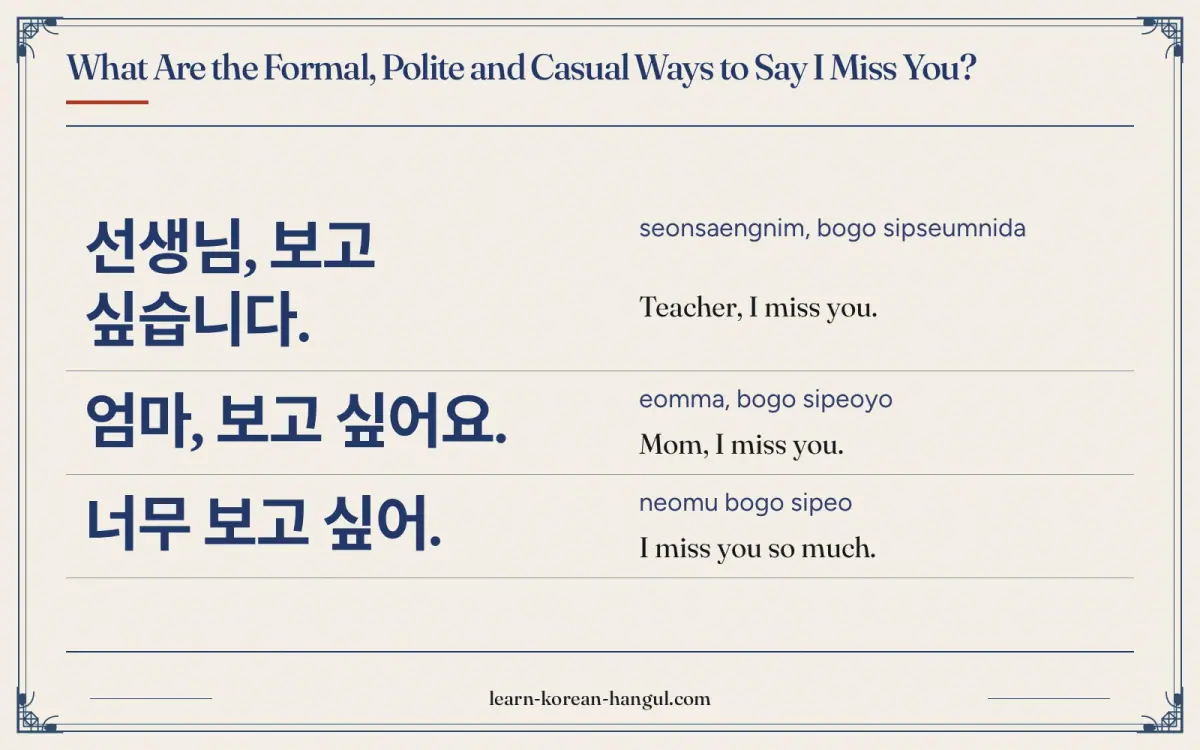
The forms follow the Korean speech levels, explained in the guide to Korean speech levels. Here we move from formal to casual.
Formal: 보고 싶습니다 (bogo sipseumnida)
Formal · 합쇼체보고 싶습니다 uses the formal -습니다 ending. It fits a letter to a teacher, a speech, or a message to an older relative who expects formal language. It is pronounced [보고 십씀니다].
선생님, 보고 싶습니다.
seonsaengnim, bogo sipseumnida
Teacher, I miss you.
Polite: 보고 싶어요 (bogo sipeoyo)
Polite · 해요체보고 싶어요 is the everyday default. It suits parents, colleagues, friends and partners, in speech and in messages.
엄마, 보고 싶어요.
eomma, bogo sipeoyo
Mom, I miss you.
Casual: 보고 싶어 (bogo sipeo)
Casual · 반말보고 싶어 drops the polite ending. Use it with a partner, a close friend or a younger person. Add 너무 or 많이 for emphasis: 너무 보고 싶어.
너무 보고 싶어.
neomu bogo sipeo
I miss you so much.
Past: 보고 싶었어요 (bogo sipeosseoyo)
Polite · 해요체보고 싶었어요 is the past form. Say it when you meet again, or when you look back on a time apart: "I missed you".
정말 보고 싶었어요.
jeongmal bogo sipeosseoyo
I really missed you.
Longing: 그리워요 (geuriwoyo)
Polite · 해요체그리워요 comes from 그립다, "to long for". It is deeper than 보고 싶어요 and often refers to a person, a place or a time you cannot return to easily. 고향이 그리워요 means "I miss my hometown".
The Pattern behind It: -고 싶다
The ending -고 싶다 (-go sipda) means "want to". Put it after a verb stem and you get a wish: 먹고 싶어요 (I want to eat), 가고 싶어요 (I want to go), 자고 싶어요 (I want to sleep). With 보다 (to see), it gives 보고 싶어요, "I want to see (you)". Once you know this pattern, you can build dozens of sentences, and you can see why the phrase for missing someone is so common. These forms look simple on paper, but their sound changes surprise learners.
How Do You Pronounce 보고 싶어요?
보고 싶어요 is pronounced [보고 시퍼요], bo-go si-peo-yo, in five syllables. The ㅍ at the bottom of 싶 moves to the next syllable, so you hear peo, not eo.
- 보 (bo): "boh".
- 고 (go): "goh".
- 싶 (sip): spelled with ㅍ, but the ㅍ moves on in speech.
- 어 (eo): joins the ㅍ to sound like "puh".
- 요 (yo): "yo".
Sound Changes to Listen For
These changes follow the National Institute of Korean Language standard pronunciation rules (표준 발음법):
- A final consonant moves to a vowel. 싶어요 is [시퍼요] and 싶었어요 is [시퍼써요] (Article 13).
- ㅍ becomes ㅂ at the end of a syllable. 보고 싶습니다 is [보고 십씀니다], because ㅍ is said as ㅂ before a consonant (Article 9), the following ㅅ becomes tense ㅆ (Article 23), and ㅂ before ㄴ turns into ㅁ (Article 18). See Korean tensification.
- Tensing after a stop. 죽겠어요 in 보고 싶어 죽겠어요 (I miss you like crazy) is [죽께써요]: ㄱ after a final ㄱ becomes tense ㄲ (Article 23).
With the sound in your ear, the next question is when to use it.
When Should You Use 보고 싶어요, and When Should You Not?
Use 보고 싶어요 for people and pets you want to see. For missing a place, a past time or a chance, Korean usually picks other verbs.
Situations Where It Fits
- A long-distance call. 많이 보고 싶어요.
- A message to a friend overseas. 친구들이 보고 싶어요.
- A child to a parent. 엄마, 보고 싶어요.
Situations to Avoid
- A missed chance. Say 아쉬워요 (what a pity), as in 콘서트를 못 가서 아쉬워요 (it is a pity I could not go to the concert).
- Missing a hometown. 고향이 그리워요 or 고향에 가고 싶어요 sounds more natural.
- Someone you barely know. 보고 싶었어요 can sound too intimate; say 반가워요 (good to see you).
Two short conversations show how it sounds.
What Does I Miss You Sound Like in a Real Conversation?
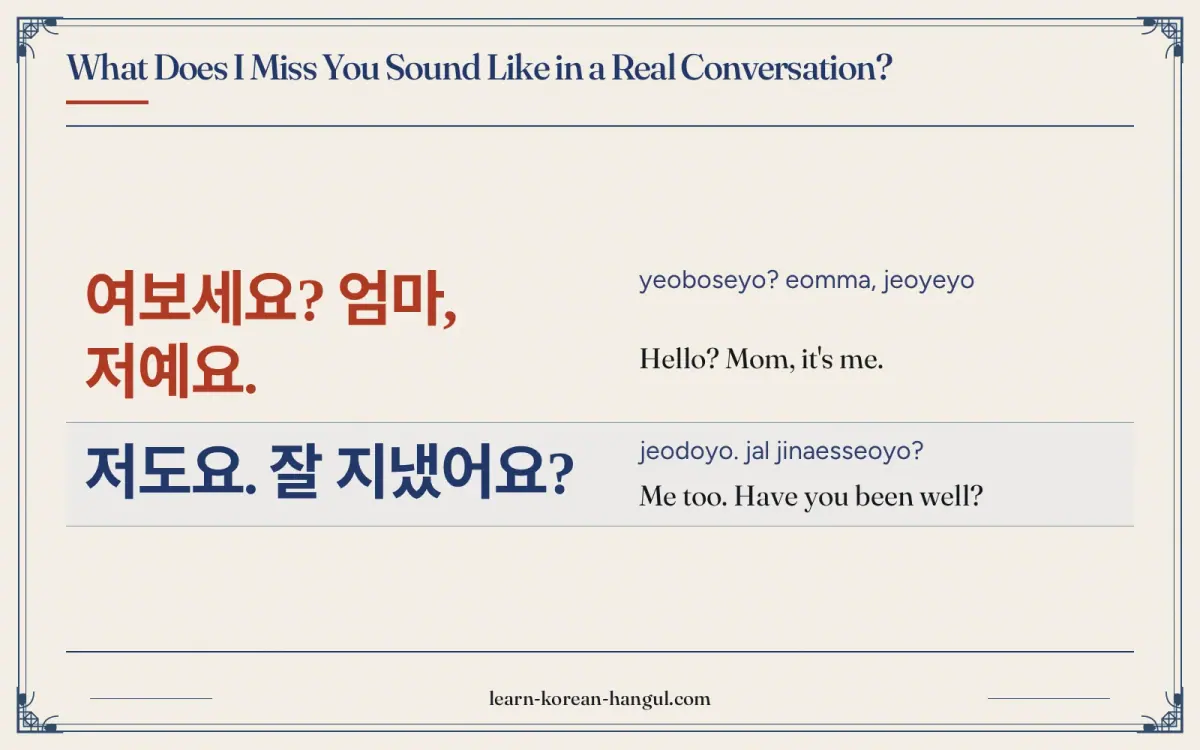
In real life, the phrase often comes with a reason or a plan to meet. Listen for the soft ending.
A Video Call Home
Jisu
여보세요? 엄마, 저예요.
yeoboseyo? eomma, jeoyeyo
Hello? Mom, it's me.
Mother
어, 우리 딸! 밥은 먹었어?
eo, uri ttal! babeun meogeosseo?
Oh, my daughter! Have you eaten?
Jisu
네, 먹었어요. 엄마, 보고 싶어요.
ne, meogeosseoyo. eomma, bogo sipeoyo
Yes, I have. Mom, I miss you.
Mother
엄마도 보고 싶어. 곧 보자.
eommado bogo sipeo. got boja
I miss you too. See you soon.
What to notice: the mother answers with 도 (too) and the casual form, while the daughter stays polite.
At the Airport
Yuna
오랜만이에요! 보고 싶었어요.
oraenmanieyo! bogo sipeosseoyo
It's been a while! I missed you.
Hyun
저도요. 잘 지냈어요?
jeodoyo. jal jinaesseoyo?
Me too. Have you been well?
What to notice: the past tense appears because they have just met again.
What Should You Know about the Culture behind I Miss You?
Koreans use 보고 싶어요 widely, not only for romance. A parent, a friend, a teacher or an old classmate can all hear it. In songs and dramas, 보고 싶다 is a common title, which is why learners meet it early.
- Missing is shown by food and visits. People say 밥 한번 먹어요 (let's eat together) when they miss someone.
- Distance. Students abroad and families apart use the phrase often in calls and messages.
- Short texts. A bare 보고 싶어 with no other words is a common, tender text.
In text messages, people often add ㅠㅠ after the phrase, as in 보고 싶어 ㅠㅠ. The letters look like two crying eyes, and they make the message sound sweet and a little sad. Songs and cute posts also use the short 보고파 (bogopa), from the poetic ending -고프다. You can recognise it, but keep 보고 싶어요 for your own speech.
Another idiom is 네 생각이 나 (ne saenggagi na), literally "a thought of you comes up", used in casual speech when a person comes to mind; 네 is usually said [니] here. It is softer than 보고 싶어요.
An expert tip: you rarely need to repeat the whole phrase when someone says it to you. A short 저도요 (me too) or 저도 보고 싶었어요 is the normal, warm answer.
What Mistakes Do Learners Make with I Miss You in Korean?
Most mistakes come from the English habit of using "miss" for everything.
| Mistake | Why it is a problem | Fix |
|---|---|---|
| 놓쳤어요 for missing a person | Means "I failed to catch it" | Say 보고 싶어요 |
| 고향이 보고 싶어요 for homesickness | Sounds like you only want to look at it | Say 고향이 그리워요 |
| Saying 싶어요 as [십어요] | Not the standard sound | Say [시퍼요] |
| 보고 싶습니다 in a soft text | Stiff | Say 보고 싶어요 |
| 보고 싶었어요 while still apart | Wrong tense | Say 보고 싶어요 |
Learners often assume Korean has one verb for miss. Actually, English "miss" covers several jobs, and Korean splits them: 보고 싶다 (want to see), 그립다 (long for), 놓치다 (fail to catch a bus or a chance) and 빠지다 (miss a class or a meeting).
Is It the Same as Miss You, Miss U or Missing You?
Yes. The short answers below cover the other searches folded into this page.
- I miss you formal in Korean: 보고 싶습니다.
- I miss you casual in Korean: 보고 싶어.
- I miss u in Korean: 보고 싶어 (the English "u" has no Korean twin).
- Miss you in Korean: 보고 싶어요, with or without 많이.
- Missing you in Korean: 보고 싶어요 already covers the present feeling; Korean needs no separate -ing form here.
Now say them aloud.
Practice: Say It Aloud
Play the slow clip of 보고 싶어요 three times, then say [시퍼요] without the final ㅍ. Choose a phrase. Answers follow.
- A daughter calls her mother.
- A student writes to a teacher.
- You see your friend after a year.
- You miss your hometown.
Answers
- 엄마, 보고 싶어요.
- 선생님, 보고 싶습니다.
- 보고 싶었어요.
- 고향이 그리워요.
The phrase flashcards drill these lines with audio.
Related Phrases to Learn Next
Missing leads to meeting and to love.
- I love you in Korean: 사랑해요 for deeper feelings.
- I like you in Korean: 좋아해요 for early feelings.
- See you soon in Korean: 곧 봐요 for what comes next.
This guide belongs to the Korean love phrases collection. What this page does not cover: poetry, song lyrics and long letters. Remember that Korean says "I want to see you", pick a level, and you can say i miss you in Korean with warmth.
Frequently Asked Questions
How do you say I miss you in Korean?
Say 보고 싶어요 (bogo sipeoyo) in a polite setting and 보고 싶어 (bogo sipeo) to a close friend or partner. In a formal setting, say 보고 싶습니다. Korean has no single verb for miss, so the phrase literally means I want to see you. Add 많이 or 너무 to make it stronger.
How do you say I missed you in Korean?
Say 보고 싶었어요 (bogo sipeosseoyo) in polite speech or 보고 싶었어 in casual speech. The past tense -었- shows that the missing has happened and that you are now with the person or looking back. If you are still apart, use the present: 보고 싶어요. Pronounce it [보고 시퍼써요].
What is the difference between 보고 싶어요 and 그리워요?
보고 싶어요 means I want to see you, and it is the common phrase for a person you can meet. 그리워요 means I long for someone or something, often far away in distance or time, such as a hometown or a childhood friend. Use 보고 싶어요 for daily messages and 그리워요 for deeper nostalgia.
Is 보고 싶어요 only for romantic partners?
No. You can say it to family, friends, a teacher or a child. The tone and level mark the closeness. 엄마, 보고 싶어요 is natural for a daughter, and 친구들이 보고 싶어요 is natural for friends. Only the context decides if it is romantic, so there is no hidden meaning in the phrase itself.
Can I use 보고 싶어요 for things, like missing a bus?
Not for a bus. 보고 싶어요 is for people and pets, or for something you literally want to see. For a hometown, say 그리워요 or 가고 싶어요 (I want to go). For food, say 먹고 싶어요 (I want to eat), and for a bus you did not catch, say 놓쳤어요, because Korean has no single verb for miss.
What is the most common mistake with I miss you in Korean?
Learners say 놓쳤어요 or 그리워해요 for every miss, or they pronounce 싶어요 as [십어요]. Use 보고 싶어요 with people, and say [시퍼요]. The final ㅍ moves to the next syllable and keeps its sound. Another slip is using the formal 보고 싶습니다 in a soft message, which can feel stiff.