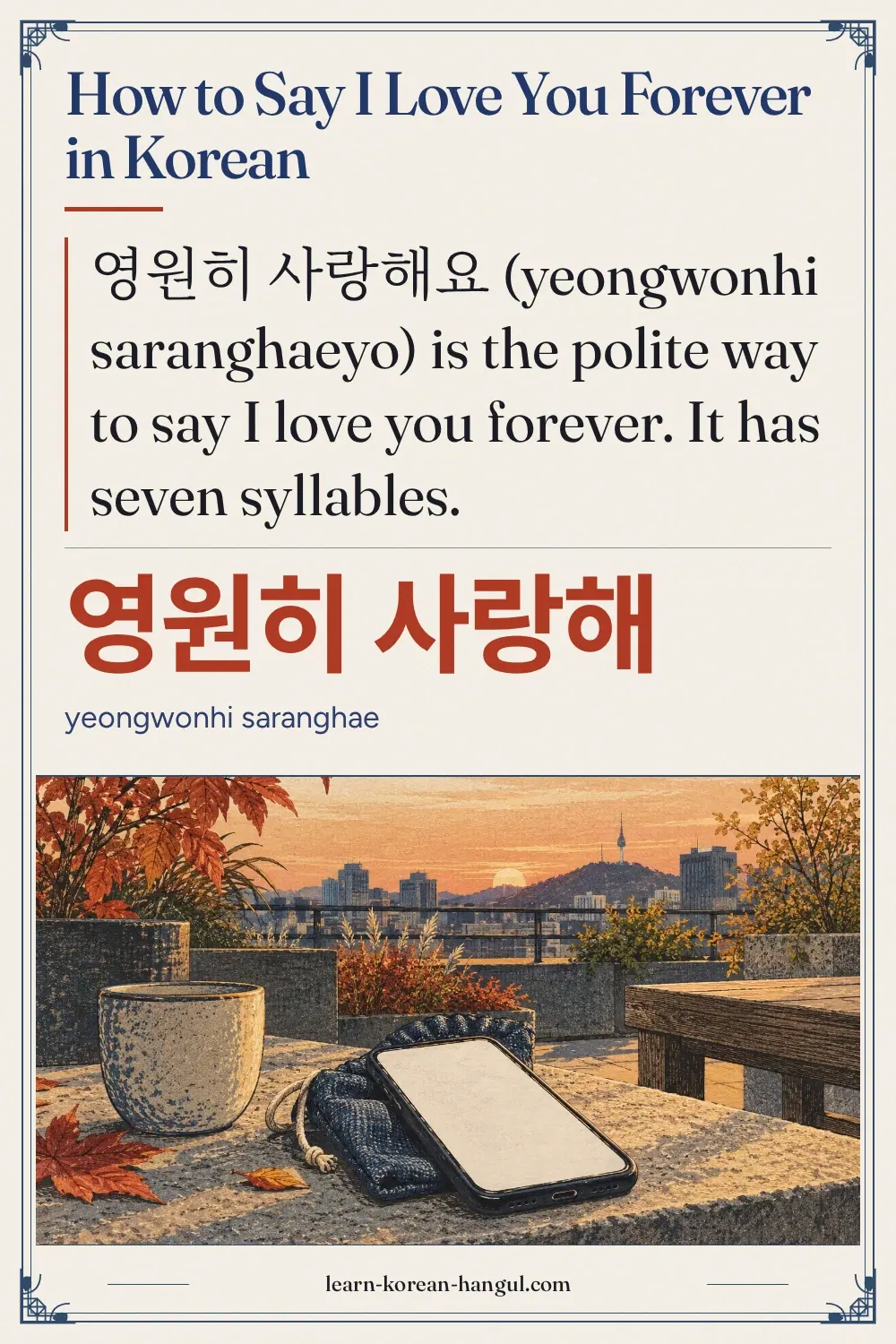
영원히 사랑해요
영원히 사랑해요
What you'll learn
- Say I love you forever with 영원히 사랑해요, 사랑합니다 or 사랑해.
- Turn a statement into a promise with 사랑할게요.
- Choose between 영원히, 평생, 항상 and 언제까지나.
- Hear the sound changes in 사랑합니다 and 사랑할게요.
Before you start: you should know the basic sentence I love you in Korean. Time: about 10 minutes. Audio plays only when you press a button.
Key facts
- 영원히 사랑해요 (yeongwonhi saranghaeyo) is the polite way to say I love you forever.
- 영원히 (yeongwonhi) is the adverb for "forever" and goes before the verb.
- 사랑할게요 (pronounced [사랑할께요]) makes a promise: "I will love you".
- 평생 (lifetime) and 항상 (always) are common alternatives.
How Do You Say I Love You Forever in Korean?
The standard way to say I love you forever in Korean is 영원히 사랑해요. It has two parts: the adverb 영원히 (yeongwonhi, forever) and the polite verb 사랑해요 (saranghaeyo, I love you). 사랑해요 comes from 사랑하다 (saranghada, to love). Korean drops "I" and "you", so the speaker and the listener come from the situation.
| Situation | Best form | Romanization | Why |
|---|---|---|---|
| Telling a partner or a parent politely | 영원히 사랑해요 | yeongwonhi saranghaeyo | Polite, warm |
| Telling a partner casually | 영원히 사랑해 | yeongwonhi saranghae | Casual |
| A formal speech or letter | 영원히 사랑합니다 | yeongwonhi saranghamnida | Formal |
| Making a promise | 영원히 사랑할게요 | yeongwonhi saranghalgeyo | Promise |
| Saying for life | 평생 사랑할게요 | pyeongsaeng saranghalgeyo | Lifetime |
| A steady feeling | 항상 사랑해요 | hangsang saranghaeyo | Always |
Each form fits a different moment, from a card to a vow. The next section sorts the forms by level.
What Are the Formal, Polite and Casual Ways to Say I Love You Forever?
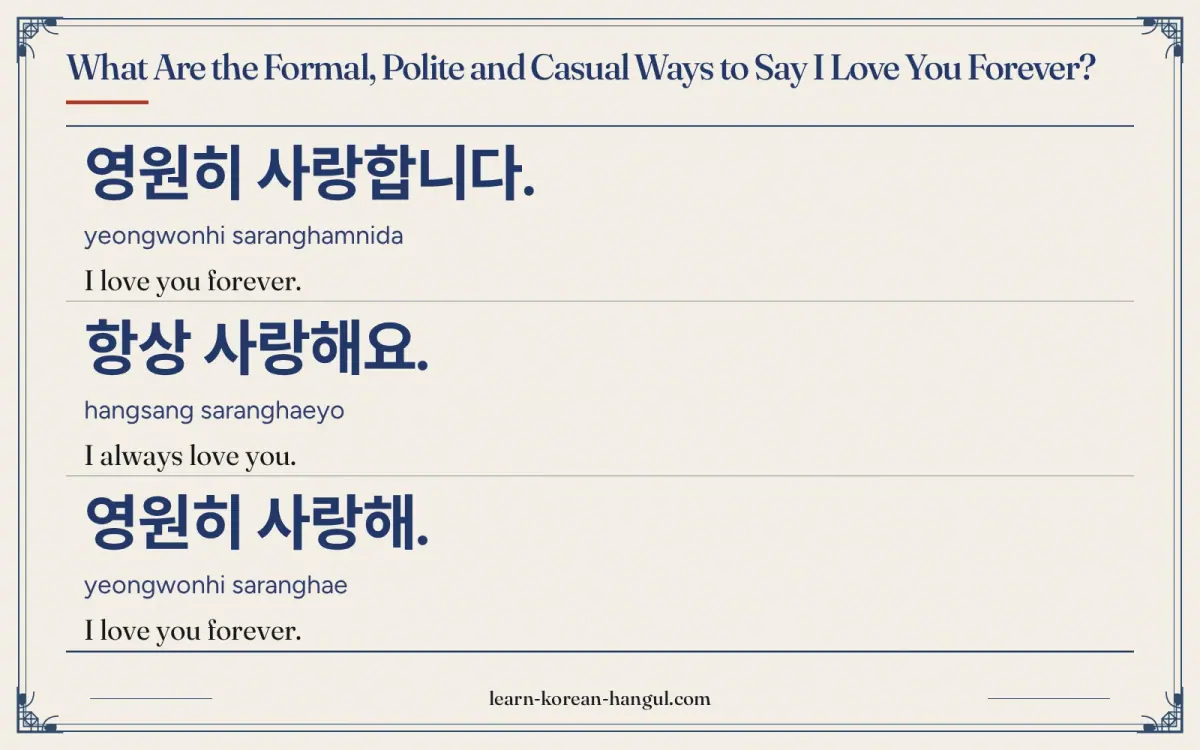
The forms follow the Korean speech levels, explained in the guide to Korean speech levels. Here we move from formal to casual.
Formal: 영원히 사랑합니다 (yeongwonhi saranghamnida)
Formal · 합쇼체영원히 사랑합니다 uses the formal -ㅂ니다 ending. It fits a wedding speech, a letter to a parent or a public message. It is pronounced [영원히 사랑함니다], because ㅂ before ㄴ turns into ㅁ.
영원히 사랑합니다.
yeongwonhi saranghamnida
I love you forever.
Polite: 영원히 사랑해요 (yeongwonhi saranghaeyo)
Polite · 해요체영원히 사랑해요 is the everyday default. It suits a partner you address politely, a parent, a grandparent or a message to someone you respect.
항상 사랑해요.
hangsang saranghaeyo
I always love you.
Casual: 영원히 사랑해 (yeongwonhi saranghae)
Casual · 반말영원히 사랑해 drops the polite 요. Use it with a partner, a child or a close friend. You can add a name before it: 지수야, 영원히 사랑해.
영원히 사랑해.
yeongwonhi saranghae
I love you forever.
A Promise: 영원히 사랑할게요 (yeongwonhi saranghalgeyo)
Polite · 해요체The ending -(으)ㄹ게요 makes a promise or a decision by the speaker. 영원히 사랑할게요 means "I will love you forever", and it is pronounced [영원히 사랑할께요], with a tense ㄲ after ㄹ. It is a common line in vows.
영원히 사랑할게요.
yeongwonhi saranghalgeyo
I will love you forever.
A Lifetime: 평생 사랑할게요 (pyeongsaeng saranghalgeyo)
Polite · 해요체평생 (pyeongsaeng) means "all one's life". 평생 사랑할게요 is pronounced [평생 사랑할께요] and sounds natural in a spoken vow. Some people choose 평생 over 영원히 because it is grounded in real life.
평생 사랑할게요.
pyeongsaeng saranghalgeyo
I will love you for life.
As Long as Time Lasts: 언제까지나 (eonjekkajina)
Polite · 해요체언제까지나 means "for as long as it lasts", "always". 언제까지나 사랑할 거예요 is a soft way to say "I will always love you", and it is pronounced [언제까지나 사랑할꺼예요]. It sounds gentle and a little literary.
A Noun Phrase: 영원한 사랑 (yeongwonhan sarang)
Polite · 해요체영원한 사랑 means "forever love" or "eternal love". 영원한 is the modifier form of 영원하다 (to be eternal), and it describes the noun 사랑. You will see it in song titles and cards.
The Pattern behind It: Statement or Promise
A present form like 사랑해요 states a feeling: "I love you". A -(으)ㄹ게요 form like 사랑할게요 makes a promise: "I will love you". Korean learners often mix them up, but the rule is simple: use -해요 for the feeling now and -할게요 for what you promise to do. Every action verb works the same way, so 도와줄게요 means "I will help you" and 기다릴게요 means "I will wait".
How Do You Pronounce 영원히 사랑해요?
영원히 사랑해요 is pronounced [영원히 사랑해요], yeong-won-hi sa-rang-hae-yo, in seven syllables. The ㅎ in 히 and 해 is soft, so it may sound almost silent in fast speech.
- 영 (yeong): the vowel ㅕ starts with a "y", and the final ㅇ is "ng".
- 원 (won): the vowel ㅝ is "wo", with ㅓ unrounded and a final ㄴ.
- 히 (hi): a light "hi".
- 사 (sa): "sa".
- 랑 (rang): the final ㅇ is "ng".
- 해 (hae): the ㅎ sits between two voiced sounds, so it is breathy and soft.
- 요 (yo): "yo".
Sounds to Listen For
These notes follow the National Institute of Korean Language standard pronunciation rules (표준 발음법):
- Soft ㅎ. In 영원히 and 사랑해요, the ㅎ follows a nasal or a vowel, so it can fade in fast speech. Keep it light, not silent.
- Formal ending. 사랑합니다 is [사랑함니다]: ㅂ becomes ㅁ before ㄴ (Article 18).
- Tense after -ㄹ. In 사랑할게요 the ㄱ after ㄹ becomes tense, so you say [사랑할께요] (Article 27). The same happens in 사랑할 거예요, said [사랑할꺼예요]. See Korean tensification.
Practise 영원히 slowly three times. Then say 사랑해요 in one breath. When you put them together, keep the stress even: yeong-won-hi, sa-rang-hae-yo.
When Should You Use 영원히 사랑해요, and When Should You Not?
Use 영원히 사랑해요 for deep, serious feelings. It is a strong phrase, and many people keep it for special moments such as vows, anniversaries and cards.
Situations Where It Fits
- A wedding or a proposal. 영원히 사랑할게요.
- An anniversary card. 영원히 사랑해.
- A message to a parent or child. 엄마, 영원히 사랑해요.
Situations to Avoid
- A new relationship. Saying "forever" early can feel too heavy. Try 좋아해요 first. See I like you in Korean.
- A friend you are not close to. A friend may feel awkward. Say 고마워요 (thank you) instead.
- A formal speech to a stranger. Choose 감사합니다 and keep love language for people you know.
Two short conversations show how the phrase sounds.
What Does I Love You Forever Sound Like in a Real Conversation?
In real life, the phrase often appears as an answer to another loving sentence. Listen for the warm, falling tone.
A Wedding Vow
Groom
영원히 사랑할게요.
yeongwonhi saranghalgeyo
I will love you forever.
Bride
저도요. 평생 함께해요.
jeodoyo. pyeongsaeng hamkkehaeyo
Me too. Let's be together for life.
What to notice: the bride answers with 저도요 (me too) and 평생 함께해요 (let's be together for life), which uses 평생 instead of 영원히. The sentence-ending 해요 can also mean "let's", in a gentle way.
A Birthday Card to Mom
Daughter
엄마, 생일 축하해요.
eomma, saengil chukahaeyo
Mom, happy birthday.
Mom
고마워.
gomawo
Thank you.
Daughter
영원히 사랑해요.
yeongwonhi saranghaeyo
I love you forever.
Mom
엄마도 영원히 사랑해.
eommado yeongwonhi saranghae
I love you forever too.
What to notice: the daughter stays polite with 요, while the mother speaks casually. Both use 영원히 사랑해(요), and the phrase is not only romantic.
What Should You Know about the Culture behind I Love You Forever?
Korean couples often celebrate milestones by counting days, such as the 100th day together (백일, baegil), and cards for these days often include 영원히 사랑해. The phrase also appears in songs, dramas and wedding vows.
- Family love. Children say 사랑해요 to parents, especially on special days, and 영원히 adds weight.
- Cards and messages. A written card or message is a common place for 영원히 사랑해.
- Lifetime language. In spoken vows, 평생 is common, because it feels concrete.
An expert tip: 사랑해요 is a heavy word in daily Korean, and friends tend to use 좋아해요 or 고마워요 for lighter feelings. Save 영원히 사랑해요 for moments when the feeling is truly big, and it will land well.
What Mistakes Do Learners Make with I Love You Forever in Korean?
Most mistakes come from the adverb and from the verb form.
| Mistake | Why it is a problem | Fix |
|---|---|---|
| 영원 사랑해요 | 영원 is a noun, not an adverb | Say 영원히 |
| 영원이 사랑해요 | Misspelling: the adverb ends in 히 | Write 영원히 |
| 사랑하요 | The contraction is missing | Say 사랑해요 |
| 영원히 사랑합니다 to a partner | Stiff | Say 영원히 사랑해 |
| 영원히 사랑해요 to a new date | Too heavy too soon | Say 좋아해요 |
Learners often assume that "forever" must be 영원히. Actually, Koreans choose between 영원히, 평생, 항상 and 언제까지나, and in everyday speech 평생 or 항상 often sounds more natural.
Is It the Same as Love You Forever, Forever Love or Always Love You?
Mostly. The short answers below cover the other searches folded into this page.
- Love you forever in Korean: 영원히 사랑해, a casual message with no subject.
- Forever love in Korean: 영원한 사랑 as a noun phrase.
- Always love you in Korean: 항상 사랑해요, or the promise 언제까지나 사랑할 거예요.
- I love you so much: for a different degree, see I love you so much in Korean.
Now say them aloud.
Practice: Say It Aloud
Play the slow clip of 영원히 사랑해요 three times, then say it with a steady tempo. Choose a phrase. Answers follow.
- You text your partner casually.
- You write a card to your mother with respect.
- You promise in a wedding vow.
- You say that you always love someone.
Answers
- 영원히 사랑해.
- 영원히 사랑해요.
- 영원히 사랑할게요.
- 항상 사랑해요.
The phrase flashcards drill these lines with audio.
Related Phrases to Learn Next
Love for ever leads to the plain phrase, a bigger one and a question.
- I love you in Korean: 사랑해요 for the basic sentence.
- I love you so much in Korean: 너무 사랑해요 for a stronger feeling.
- Will you marry me in Korean: 나랑 결혼해 줄래요? for the next step.
This guide belongs to the Korean love phrases collection. What this page does not cover: love poetry, song lyrics and wedding speeches. Remember that 영원히 goes before the verb, choose a level, and you can say i love you forever in Korean with warmth.
Frequently Asked Questions
How do you say I love you forever in Korean?
Say 영원히 사랑해요 (yeongwonhi saranghaeyo) in a polite setting and 영원히 사랑해 (yeongwonhi saranghae) to a partner. In a formal setting, say 영원히 사랑합니다. The adverb 영원히 (forever) comes before 사랑해요 (I love you). For a promise, say 영원히 사랑할게요, which means "I will love you forever".
How do you say love you forever in Korean?
Drop the subject and say 영원히 사랑해, as a casual message to a partner or a close friend. Korean leaves out "I" and "you" when they are clear. In writing, add the name of the person: 지수야, 영원히 사랑해. For a more formal message, say 영원히 사랑합니다.
How do you say forever love in Korean?
As a noun phrase, say 영원한 사랑 (yeongwonhan sarang), which means "eternal love" or "forever love". It appears in song titles, poems and wedding cards. As a sentence, you would say 영원히 사랑해요. The adjective 영원한 (eternal) comes before the noun 사랑 (love).
How do you say always love you in Korean?
Say 항상 사랑해요 (hangsang saranghaeyo), which means "I always love you". 항상 describes a habit or a constant feeling, while 영원히 describes something without an end. For "I will always love you", say 언제까지나 사랑할 거예요 (eonjekkajina saranghal geoyeyo), which is a gentle, warm promise.
What is the difference between 영원히 and 평생?
영원히 (yeongwonhi) means forever, with no end at all, even beyond life. 평생 (pyeongsaeng) means a lifetime, for as long as you live. In spoken vows, 평생 often sounds more natural, as in 평생 사랑할게요. 영원히 appears more in songs, cards and dramas, where the feeling is bigger.
What is the most common mistake with I love you forever in Korean?
Learners say 영원 사랑해요 or 영원이 사랑해요, which mix the noun 영원 with the adverb 영원히. Use 영원히 before the verb. A second slip is writing 사랑하요, because 하여요 shortens to 해요. A third is using this strong phrase with someone you have just met.