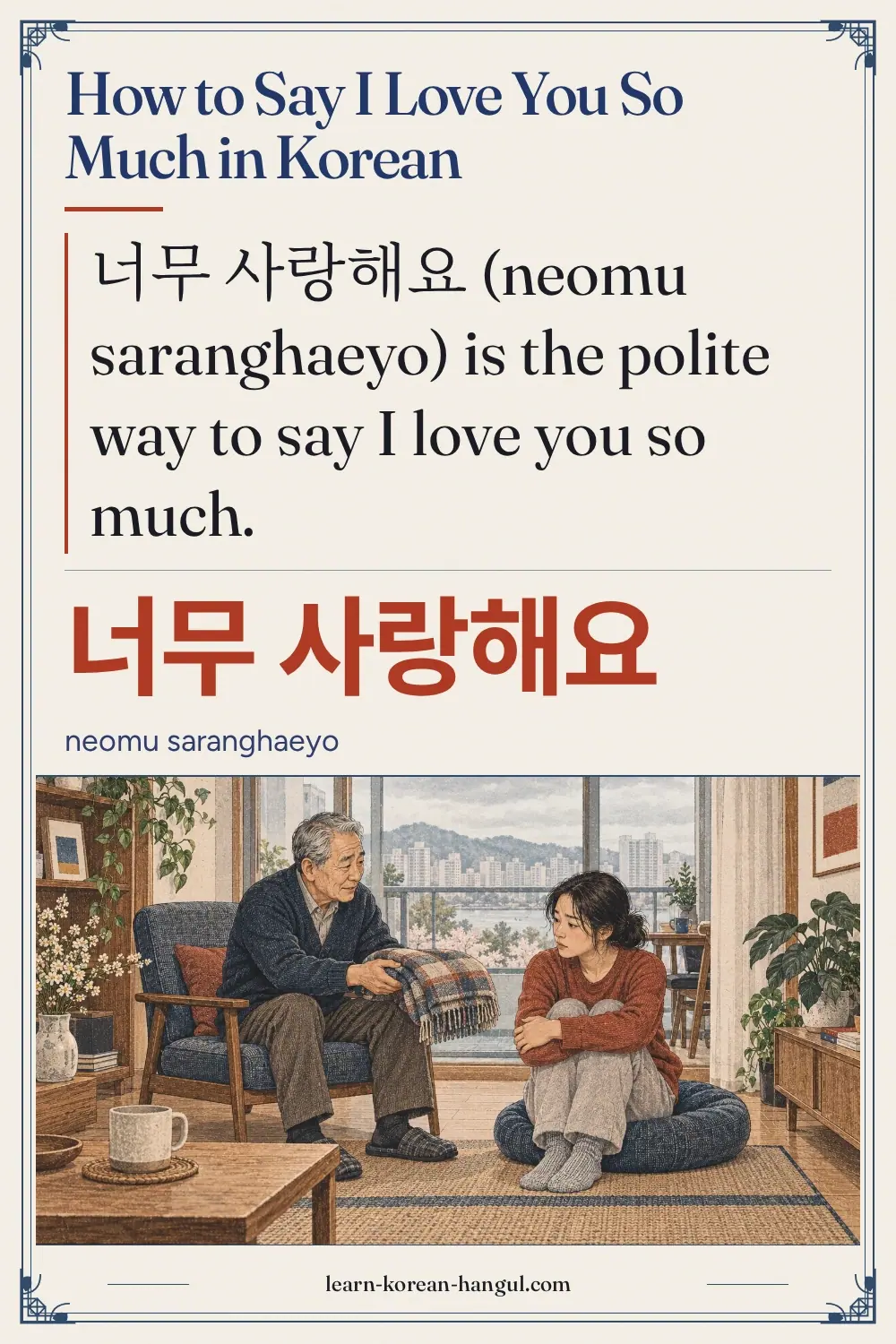
너무 사랑해요
너무 사랑해요
What you'll learn
- Say I love you so much with 너무, 정말, 많이 or 제일 in front of 사랑해요.
- Choose a formal, polite or casual form for the listener.
- Pronounce 사랑합니다 as [사랑함니다].
- Know when this strong phrase is right.
Before you start: first learn the plain I love you in Korean, because this page adds one word to it. Time: about 10 minutes. Audio plays only when you press a button.
How Do You Say I Love You so Much in Korean?
The standard way to say I love you so much in Korean is 너무 사랑해요. The verb 사랑하다 (saranghada) means "to love", and 너무 (neomu) is an adverb that adds "so much" in front of it.
| Situation | Best form | Romanization | Why |
|---|---|---|---|
| Telling a partner in a message | 너무 사랑해요 | neomu saranghaeyo | Polite, warm |
| Telling a spouse at home | 너무 사랑해 | neomu saranghae | Casual |
| A wedding speech | 너무 사랑합니다 | neomu saranghamnida | Formal |
| A soft, steady feeling | 많이 사랑해요 | mani saranghaeyo | A lot |
| The most in the world | 세상에서 제일 사랑해요 | sesangeseo jeil saranghaeyo | Superlative |
Korean often drops "I" and "you", so the sentence is complete without them. The next section shows how the level changes the form.
What Are the Formal, Polite and Casual Ways to Say I Love You so Much?
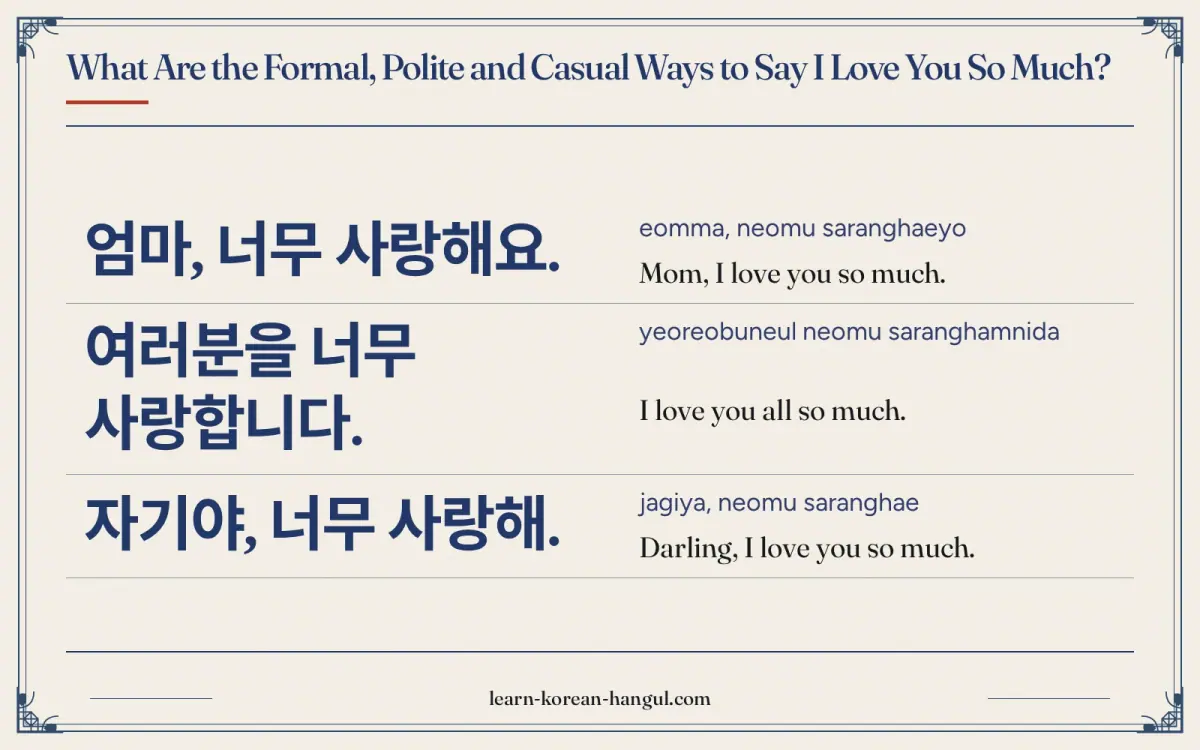
The forms follow the Korean speech levels, explained in the guide to Korean speech levels. The strength word stays the same; the ending changes.
Polite: 너무 사랑해요 (neomu saranghaeyo)
Polite · 해요체This is the default for most situations: texts, messages, anniversaries and partners who still speak politely. It also works for parents.
엄마, 너무 사랑해요.
eomma, neomu saranghaeyo
Mom, I love you so much.
Formal: 너무 사랑합니다 (neomu saranghamnida)
Formal · 합쇼체너무 사랑합니다 is formal and solemn. You hear it in wedding vows, in speeches and in letters to grandparents. It is pronounced [너무 사랑함니다].
여러분을 너무 사랑합니다.
yeoreobuneul neomu saranghamnida
I love you all so much.
Casual: 너무 사랑해 (neomu saranghae)
Casual · 반말너무 사랑해 drops the polite ending. It fits couples, close friends and children. Add 진짜 (really) for more intensity: 진짜 너무 사랑해.
자기야, 너무 사랑해.
jagiya, neomu saranghae
Darling, I love you so much.
Polite: 많이 사랑해요 (mani saranghaeyo)
Polite · 해요체많이 means "a lot", and it feels calm and caring. Parents say it to children, and friends say it kindly. 정말 사랑해요 (I truly love you) sounds sincere, and 세상에서 제일 사랑해요 means "I love you most in the world".
세상에서 제일 사랑해요.
sesangeseo jeil saranghaeyo
I love you most in the world.
Written forms are simple. The sound of the formal form needs a short note.
How Do You Pronounce 너무 사랑해요?
너무 사랑해요 is pronounced [너무 사랑해요], neo-mu sa-rang-hae-yo, in six syllables. It sounds just like it is written.
- 너 (neo): "nuh".
- 무 (mu): "moo".
- 사 (sa): "sah".
- 랑 (rang): a light r, "ah", and ng.
- 해 (hae): a clear h and "eh".
- 요 (yo): "yo".
Sound Changes to Listen For
Two points matter, and the first follows the National Institute of Korean Language standard pronunciation rules (표준 발음법, Article 18):
- ㅂ before ㄴ becomes ㅁ. 사랑합니다 is pronounced [사랑함니다]. This is nasalization, explained in Korean nasalization.
- ㅎ after ㅇ is soft. In 사랑해요 the ㅎ comes between voiced sounds, so it is light in fast speech; careful speech keeps a faint h: sa-rang-hae-yo.
Next, how to pick the right intensity word.
When Should You Use 너무 사랑해요, and When Should You Not?
Use it with a partner, a spouse, family or very close friends, when your feeling is clear. Do not use it with colleagues, with a new date or in a casual compliment.
Situations Where It Fits
- An anniversary message. 오늘도 너무 사랑해요.
- A parent to a child. 많이 사랑해.
- A wedding speech. 너무 사랑합니다.
Situations to Avoid
- A first date. 좋아해요 is better. See I like you in Korean.
- A friendly thank you. Say 너무 고마워요, not 사랑해요.
- Online strangers. The phrase may feel too strong or insincere.
Two short conversations show the difference in tone.
What Does I Love You so Much Sound Like in a Real Conversation?
Listen to how the intensity word comes first, then the ending carries the level.
A Night Call
Minho
오늘도 수고했어.
oneuldo sugohaesseo
You worked hard today too.
Hana
고마워. 너무 사랑해.
gomawo. neomu saranghae
Thanks. I love you so much.
Minho
나도 사랑해. 잘 자.
nado saranghae. jal ja
I love you too. Sleep well.
What to notice: the casual 사랑해 is calm, and 나도 (me too) makes the reply short.
A Card for Mom
Daughter
엄마, 생일 축하해요. 너무 사랑해요.
eomma, saengil chukahaeyo. neomu saranghaeyo
Mom, happy birthday. I love you so much.
Mother
어머, 고마워. 엄마도 많이 사랑해.
eomeo, gomawo. eommado mani saranghae
Oh, thank you. I love you a lot too.
What to notice: the daughter uses the polite form, while the mother answers in casual speech, as parents do.
What Should You Know about the Culture behind I Love You so Much?
Many Koreans were raised in families where love was shown through care, such as food and gifts, instead of words. Younger generations say 사랑해요 more openly, in messages and on special days. Love is also shown through small acts: 밥은 먹었어? (have you eaten?) is often a love word.
- Word choice. The word 너무 was once treated as only negative, meaning "too much". The National Institute of Korean Language's dictionary now accepts it as "very" as well (revised in 2015), so 너무 사랑해요 is correct.
- Cute language. Couples and children use 하늘만큼 땅만큼 사랑해 (I love you as much as the sky and the earth).
- Messages. A short written 사랑해요 can feel easier than saying it aloud.
An expert tip: adults who find 사랑해요 too heavy often say 너무 고마워요 (thank you so much) or 항상 응원해요 (I always support you). These phrases can carry the same love with less weight.
What Mistakes Do Learners Make with I Love You so Much in Korean?
Most mistakes come from the wrong level or the wrong person.
| Mistake | Why it is a problem | Fix |
|---|---|---|
| 너무 사랑해 to an older person | Too casual | Say 너무 사랑해요 |
| Saying it to a new acquaintance | Feels too strong | Say 좋아해요 |
| [사랑합니다] with a clear b | Not the standard sound | Say [사랑함니다] |
| Adding 당신을 for "you" | Sounds like a song lyric | Drop it, or use a name: 지민 씨, 너무 사랑해요 |
| Using 매우 in speech | Sounds stiff | Say 너무 or 정말 |
Learners often assume 너무 always means "too much". Actually, the old negative meaning has faded, and 너무 is now a normal way to say "so much" in speech.
Is It the Same as Very Much or a Lot?
Close. The short answers below cover the other searches folded into this page.
- I love you very much in Korean: 정말 사랑해요, or the formal 진심으로 사랑합니다.
- Love you so much in Korean: 너무 사랑해, with the casual ending.
- I love you a lot in Korean: 많이 사랑해요.
Now say them aloud.
Practice: Say It Aloud
Play the slow clip of 너무 사랑해요 three times, then say each ending. Choose a phrase. Answers follow.
- You message your partner on your anniversary.
- A father tells his young daughter.
- A groom speaks at the wedding.
- You want a calm "I love you a lot".
Answers
- 너무 사랑해요.
- 많이 사랑해 or 너무 사랑해.
- 너무 사랑합니다.
- 많이 사랑해요.
The phrase flashcards drill these lines with audio.
Related Phrases to Learn Next
Deepen the feeling and answer back.
- I love you too in Korean: 나도 사랑해 as the reply.
- I love you forever in Korean: 영원히 사랑해 for promises.
- I miss you in Korean: 보고 싶어요 when you are apart.
This guide belongs to the Korean love phrases collection. What this page does not cover: love letters, proposals and the whole vocabulary of affection. Pick a level, add one strength word, and you can say i love you so much in Korean with confidence.
Frequently Asked Questions
How do you say I love you so much in Korean?
Say 너무 사랑해요 (neomu saranghaeyo) in a polite setting and 너무 사랑해 (neomu saranghae) to a partner or close friend. In a formal speech or letter, say 너무 사랑합니다. If you want to address the person, put the name first, as in 지민 씨, 너무 사랑해요 (Jimin, I love you so much).
How do you say I love you very much in Korean?
Say 정말 사랑해요 (jeongmal saranghaeyo). 정말 means really and sounds sincere. For a letter or a speech, 진심으로 사랑합니다 (I love you with all my heart) sounds formal and moving. The dictionary word 매우 (very) sounds stiff with 사랑하다, so in speech use 너무, 정말 or the softer 많이.
How do you say I love you a lot in Korean?
Say 많이 사랑해요 (mani saranghaeyo), which means I love you a lot. 많이 describes the amount of love, so it feels gentle and steady. 너무 sounds more intense and emotional. Parents often say 많이 사랑해 to children, and couples use both. For a poetic version, say 하늘만큼 땅만큼 사랑해.
Is 너무 only for bad things in Korean?
Not any more. Older rules used 너무 only for something too much, as in 너무 매워요 (too spicy). Today, speakers also use it for very, as in 너무 예뻐요 (so pretty). The National Institute of Korean Language updated its dictionary entry to accept this use, so 너무 사랑해요 is correct. Many people still prefer 정말 in writing.
Can I say 너무 사랑해요 to my parents?
Yes. Many Koreans now say it to parents, especially in messages, though some families keep it unspoken and show care by actions. Match the level you already use at home. 엄마, 너무 사랑해 is common with a mother you speak casually to, and 너무 사랑해요 suits polite speech. Parents' Day (8 May) is a natural moment.
What is the most common mistake with I love you so much in Korean?
Learners say 너무 사랑해요 for a person they just met. In Korea, 사랑해요 is a deep word, and it is not used lightly. Another mistake is to write 사랑합니다 and say it as [사랑합니다], with a clear b sound. The standard sound is [사랑함니다], with an m.