곧 봐요
곧 봐요
What you'll learn
- Choose between 곧 (soon), 또 (again) and 나중에 (later).
- Switch between respectful, polite and casual forms.
- Pronounce 곧 with a closed final ㄷ.
- Know when see you soon is a plan and when it is only a kind wish.
Before you start: knowing see you later in Korean helps, because it covers the open-ended farewell that 곧 is not. Time: about 10 minutes. Audio plays only when you press a button.
How Do You Say See You Soon in Korean?
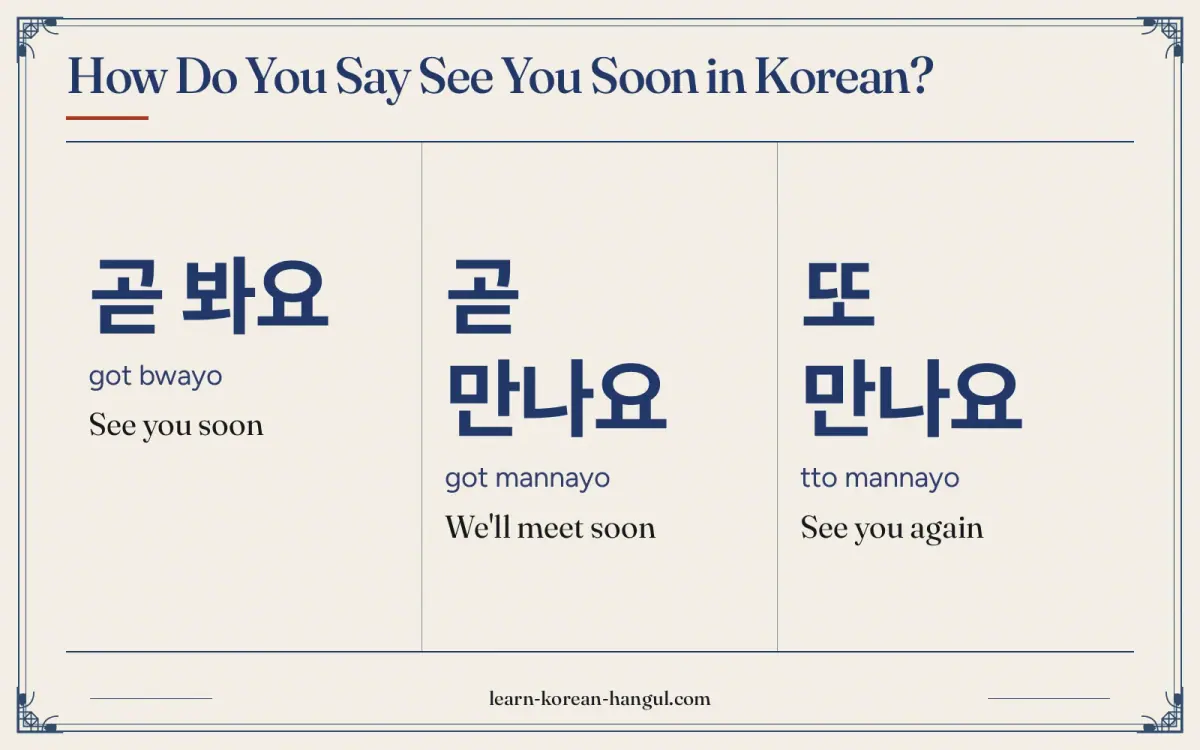
The standard way to say see you soon in Korean is 곧 봐요, which literally means "we will see each other soon". 곧 is the time word "soon", and 봐요 is the polite form of 보다, "to see".
| Intent | Korean | Romanization | Meaning |
|---|---|---|---|
| Meeting is near | 곧 봐요 | got bwayo | See you soon |
| A plan to meet | 곧 만나요 | got mannayo | We'll meet soon |
| Warm wish | 또 만나요 | tto mannayo | See you again |
| Respectful | 곧 뵙겠습니다 | got boepgetseumnida | I will see you soon |
곧 appears in many everyday sentences, such as 곧 도착해요 (I will arrive soon) and 곧 시작해요 (it starts soon). That makes it a time word first and a farewell word second. Each form is explained below.
What Are the Formal, Polite and Casual Ways to Say See You Soon?
Korean changes the sentence ending to match the listener, a system called speech levels. The guide to Korean speech levels explains them in depth, and this page uses three: formal (합쇼체), polite (해요체) and casual (해체).
Respectful: 곧 뵙겠습니다 (got boepgetseumnida)
Formal · 합쇼체곧 뵙겠습니다 means "I will see you soon" and is for a senior, a client or a teacher. 뵙다 is the humble verb for "to see" someone senior, so the verb changes, not just the ending. It is common at the end of emails and calls with a meeting already arranged.
곧 뵙겠습니다.
got boepgetseumnida
See you soon.
Polite: 곧 만나요 (got mannayo)
Polite · 해요체곧 만나요 uses 만나다, "to meet", and sounds like a real plan: you are about to meet. It fits a friend on the way to a cafe or a colleague arriving at a venue.
곧 만나요.
got mannayo
We'll meet soon.
Polite: 또 만나요 (tto mannayo)
Polite · 해요체또 만나요 means "let's meet again". 또 does not tell you when, so it works as a warm wish after a pleasant time together, such as a dinner, a trip or a class.
또 만나요.
tto mannayo
See you again.
Casual: 곧 봐 (got bwa)
Casual · 반말With friends, drop the -요: 곧 봐 means "see ya soon". Use it among classmates, siblings and close colleagues of your age. Never use it with a teacher, a boss or an older stranger.
곧 봐.
got bwa
See you soon.
The polite 곧 봐요 from the heading is the safe choice in most situations. The word 곧 also appears outside farewells, which helps you remember its meaning.
열차가 곧 도착합니다.
yeolchaga got dochakamnida
The train is arriving soon.
Next, the sounds that make 곧 봐요 natural.
How Do You Pronounce 곧 봐요?
곧 봐요 has three syllables and is said [곧뽜요] in connected speech: the closed final ㄷ of 곧 makes the next ㅂ tense. The word 곧 has no vowel after the ㄷ, so the tongue stops against the ridge behind the teeth and no air is released. Say it in three beats.
- 곧 (got): "go" plus a silent stop of the tongue, like the end of English "got" without the puff of air.
- 봐 (bwa): a quick "bwah", where ㅗ slides into ㅏ. After 곧 the b is tight and tense, close to [뽜].
- 요 (yo): "yo".
Sound Changes to Listen For
Three pronunciation points matter here.
- Unreleased final ㄷ. At the end of a syllable the letter ㄷ is pronounced as a closed t sound, and so are final ㅅ, ㅆ, ㅈ, ㅊ and ㅌ. This is part of the National Institute of Korean Language Standard Pronunciation rules (표준 발음법).
- What the closed ㄷ does to the next word. Before ㅂ, ㄷ or ㄱ it makes that sound tense, so 곧 봐요 is [곧뽜요] and 곧 도착해요 is [곧또차캐요]. Before ㅁ or ㄴ it turns into ㄴ, so 곧 만나요 is [곤만나요]. Romanization still writes got bwayo and got mannayo.
- Liaison in 다음에. In 다음에 봐요 (see you next time), the ㅁ of 다음 moves onto the empty ㅇ of 에, so the word is said [다으메]. See Korean liaison.
Once the sound is clear, the next question is when see you soon is the right phrase.
When Should You Use 곧 봐요, and When Should You Not?
Use 곧 봐요 when the next meeting is near in time and you either have a plan or will see each other by chance. Use 또 만나요 when you want to show warmth, and 곧 뵙겠습니다 for someone senior.
Situations Where It Fits
- On the way to a meeting. 곧 도착해요, 곧 봐요.
- Ending a call before an event. 그럼 곧 봐요.
- After a good dinner. 오늘 즐거웠어요. 또 만나요.
- Emailing a client before a meeting. 곧 뵙겠습니다.
Situations to Avoid
- A vague future. If you do not know when, say 나중에 봐요.
- A permanent parting. Use 안녕히 가세요, as in goodbye in Korean.
- Seniors with 곧 봐. Use 곧 뵙겠습니다 or 곧 봐요.
Real exchanges show the different jobs of 곧 and 또.
What Does See You Soon Sound Like in a Real Conversation?
See you soon usually closes a short exchange about where someone is or about how the time went.
On the Way to a Meeting
Jia
지금 출발했어요.
jigeum chulbalhaesseoyo
I've just set off.
Minsu
알겠어요. 곧 봐요.
algesseoyo. got bwayo
Got it. See you soon.
What to notice: 곧 봐요 fits because the meeting is close in time. 지금 출발했어요 (I've just set off) gives the plan.
After a Dinner with Friends
Jia
오늘 즐거웠어요. 또 만나요.
oneul jeulgeowosseoyo. tto mannayo
I had fun today. Let's meet again.
Minsu
네, 곧 봐요.
ne, got bwayo
Yes, see you soon.
What to notice: Jia uses 또 만나요 as a warm wish, and Minsu answers with 곧 봐요 to show that he also wants to meet soon. The lead-up phrase 오늘 즐거웠어요 is a common closing remark. For a next-day plan, see see you tomorrow in Korean.
Friends Meeting at a Station
Minsu
곧 도착해.
got dochakae
I'll arrive soon.
Jia
응, 곧 봐.
eung, got bwa
Yeah, see you soon.
What to notice: friends drop every polite ending. 곧 도착해 uses the same 곧 as the farewell, which shows that it is a time word. These habits come from Korean farewell customs.
What Should You Know about the Culture behind See You Soon?
Korean farewells often express a wish to meet again, and the exact phrase tells you how real the plan is.
- 곧 means a near plan. If someone says 곧 봐요, they expect to see you within a short time, often the same day or week.
- 또 is a feeling, not a schedule. 또 만나요 and 또 봐요 show warmth after a good meeting. They do not have to lead to a date.
- Follow up with details. A real plan usually comes with 연락할게요 (I will contact you) or a day and time.
- Say it with a smile and a nod. Many Koreans pair the farewell with a small bow when leaving an elder.
An expert insight: learners often use 곧 for any future farewell, because soon sounds friendly. Korean listeners hear it as a promise, so keep 곧 for meetings that really are near. The mistakes below show the other common slips.
What Mistakes Do Learners Make with See You Soon in Korean?
Most errors come from the time word or from the ending.
| Mistake | Why it is a problem | Fix |
|---|---|---|
| 곧 봐요 for a meeting next month | 곧 implies a near time | Say 나중에 봐요 or 다음에 봐요 |
| 곧 봐 to a teacher | Casual speech is rude | Say 곧 봐요 or 곧 뵙겠습니다 |
| 또 만나요 as a firm plan | It is a wish, not a date | Add a day or 연락할게요 |
| Saying "go-d" with a released d | The closed final sound is missing | Say [곧] with a stopped tongue |
| 곧 봐요 as a permanent goodbye | Sounds like you will meet shortly | Say 안녕히 가세요 |
Learners often assume 곧 and 또 are interchangeable because both seem friendly. Actually, 곧 is about time ("soon"), and 또 is about repetition ("again"), so they answer different questions.
Is It the Same as See You Again or until Next Time?
Not exactly. Each English variant points to one form on this page. The short answers below cover the other searches folded into this page.
- See you again in Korean: 또 만나요 or 또 봐요.
- See you soon formal in Korean: 곧 뵙겠습니다 or 곧 뵐게요.
- Until next time in Korean: 다음에 또 만나요 (see you again next time) or 다음에 봐요.
- Take care and see you soon: add take care in Korean before the farewell.
The pattern holds across all of them: choose the time word, then the ending. Now practise.
Practice: Say It Aloud
Play the slow clip of 곧 봐요 three times, then say 또 만나요. Choose a phrase for each situation. Answers follow.
- You are five minutes from a friend's cafe and call her.
- You leave a pleasant dinner with a coworker.
- You end a call with a client before tomorrow's meeting.
- You tell a friend your age you will arrive soon.
Answers
- 곧 도착해요. 곧 봐요. (or 곧 도착해 to a close friend)
- 오늘 즐거웠어요. 또 만나요.
- 곧 뵙겠습니다.
- 곧 도착해. 곧 봐.
The phrase flashcards drill these with audio.
Related Phrases to Learn Next
See you soon leads into other farewells, so these are the natural next phrases.
- See you later in Korean: 나중에 봐요 and 이따 봐요.
- See you tomorrow in Korean: 내일 봐요 and 내일 뵙겠습니다.
- Goodbye in Korean: 안녕히 가세요 and 안녕히 계세요.
This guide belongs to the Korean greetings collection. What this page does not cover: the full honorific system and written farewells such as email closings, which have their own lessons. Use 곧 for a real plan, 또 for warmth and 뵙겠습니다 for seniors, and you can say see you soon in Korean at any farewell.
Frequently Asked Questions
What is the difference between 곧 봐요 and 곧 만나요?
봐요 means see and 만나요 means meet. 곧 봐요 is the lighter farewell, while 곧 만나요 sounds like a real plan to meet. Use 곧 봐요 when leaving someone you will see shortly, and 곧 만나요 when you are about to arrange or begin a meeting. Both are polite.
How do I say see you again in Korean?
Say 또 만나요 (tto mannayo) or 또 봐요 (tto bwayo) in polite speech. 또 means again. These show warmth after a good time together, such as a dinner or a trip. With friends, say 또 만나 or 또 봐. Add a time word if you plan a date.
Can I use 곧 for a vague future?
No. 곧 means soon in time, usually within minutes, hours or a few days, and it implies a real plan. For a vague future, use 나중에 (later) or 다음에 (next time). Saying 곧 봐요 and then not meeting for a month may confuse the listener.
What does 곧 도착합니다 mean?
곧 도착합니다 means arriving soon. You hear it in transport announcements and in messages such as 곧 도착해요 (I will arrive soon). It shows that 곧 is a time word for something about to happen, not only a farewell. Use it when you are close to a place and want to reassure the other person.
How do I say see you soon in formal Korean?
Say 곧 뵙겠습니다 (got boepgetseumnida) or 곧 뵐게요 (got boelgeyo) to a senior, a client or a teacher. 뵙다 is the humble verb for seeing a senior person, so the verb changes as well as the ending. Friends and equals hear the ordinary 곧 봐요.