다시 전화할게요
다시 전화할게요
What you'll learn
- Say 다시 전화할게요 aloud as [다시 전화할께요], with the tense ending.
- Choose between 다시 전화할게요, 나중에 전화드릴게요, 다시 전화드리겠습니다 and 다시 걸게.
- Promise a call-back to a friend, a colleague and a client.
- Avoid using 전화해요 when you mean a promise.
Before you start: you need to read Hangul; romanization is shown as an aid and can be hidden. Time: about 9 minutes. Audio plays only when you press a button.
How Do You Say I'll Call You Back in Korean?
The direct answer is 다시 전화할게요. 다시 means "again", 전화 (jeonhwa) means "phone call" and comes from Chinese-based vocabulary, and 하다 turns it into the verb "to phone". The ending -ㄹ게요 says "I will, for you". Korean has other call-back phrases, and the table shows how they differ.
| Form | Romanization | Meaning | Use it for |
|---|---|---|---|
| 다시 전화할게요 | dasi jeonhwahalgeyo | I'll call back | Colleagues and acquaintances |
| 나중에 전화드릴게요 | najunge jeonhwadeurilgeyo | I'll call you later | Elders, customers, clients |
| 다시 전화드리겠습니다 | dasi jeonhwadeurigetseumnida | I will call you again | Formal business calls |
| 이따가 전화할게요 | ittaga jeonhwahalgeyo | I'll call you in a bit | Same-day call-backs |
| 다시 걸게 | dasi geolge | I'll call again | Friends and family |
All five promise a call, and they differ in respect and timing. The next section shows each in a sentence.
What Are the Polite, Humble, Formal and Casual Ways to Say I'll Call You Back?
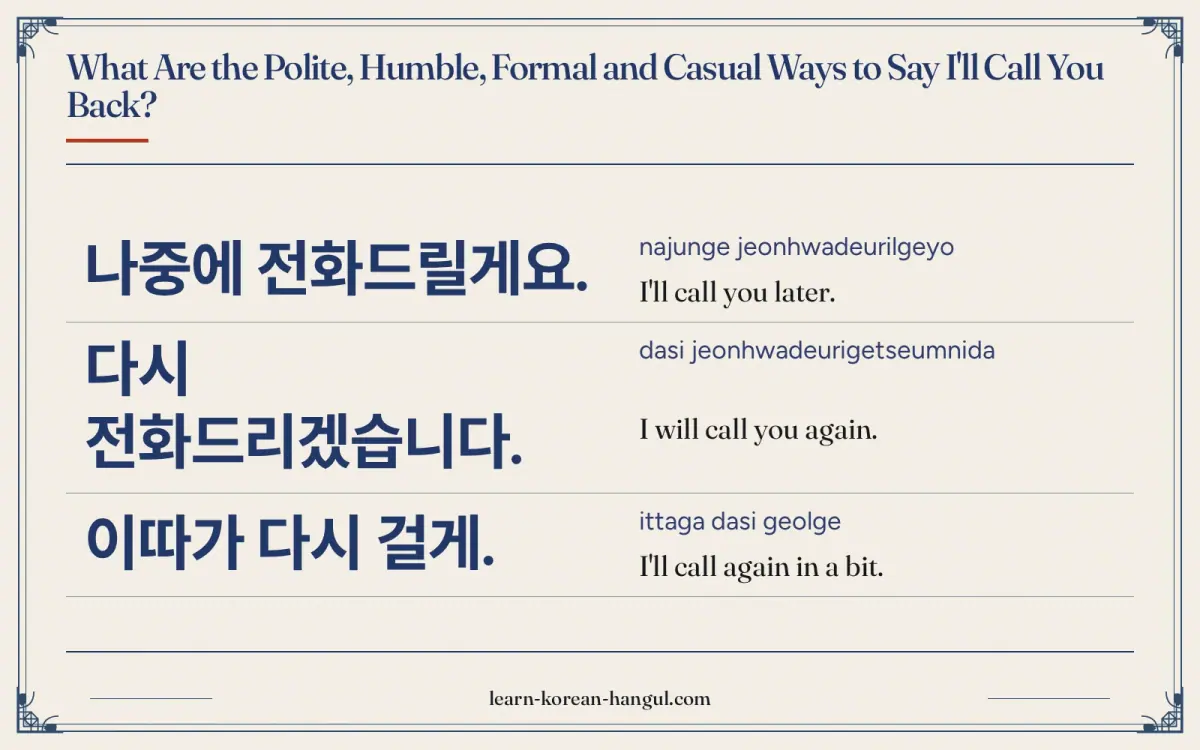
The forms follow the Korean speech levels explained in the guide to Korean speech levels. Because you are the one giving a call, Korean also lets you lower yourself with a humble verb.
Polite: 다시 전화할게요 (dasi jeonhwahalgeyo)
Polite · 해요체This is the standard form. Use it when you cannot talk now. A short reason first, such as 바빠요 (I'm busy), makes the call-back sound sincere.
지금은 바빠요. 다시 전화할게요.
jigeumeun bappayo. dasi jeonhwahalgeyo
I'm busy now. I'll call you back.
Polite and Humble: 나중에 전화드릴게요 (najunge jeonhwadeurilgeyo)
Polite · 해요체드리다 is the humble form of 주다 (to give), used when your action benefits a respected person. 전화드리다 means "to phone someone respectfully". 나중에 means "later", with no exact time promised.
나중에 전화드릴게요.
najunge jeonhwadeurilgeyo
I'll call you later.
Formal: 다시 전화드리겠습니다 (dasi jeonhwadeurigetseumnida)
Formal · 합쇼체On a business call, add the formal ending -겠습니다 to the humble verb. It sounds like customer service and is the safest form for clients you do not know.
다시 전화드리겠습니다.
dasi jeonhwadeurigetseumnida
I will call you again.
Casual: 다시 걸게 (dasi geolge)
Casual · 반말With friends, use the verb 걸다 (to place a call, literally "to hang"). 전화를 걸다 means "to make a call". 이따가 (in a bit) adds a rough time.
이따가 다시 걸게.
ittaga dasi geolge
I'll call again in a bit.
After a Missed Call: 전화 못 받았어요
Polite · 해요체If you are the one calling back, explain the missed call first. 받다 means "to receive" and also "to answer a phone". 못 means "cannot", so 못 받았어요 is "I couldn't answer".
전화 못 받았어요.
jeonhwa mot badasseoyo
I couldn't answer the phone.
The forms differ in respect, not meaning, and their endings share a sound change.
How Do You Pronounce 다시 전화할게요?
다시 전화할게요 is pronounced [다시 전화할께요], dasi jeonhwahalgeyo in Revised Romanization, the official system for writing Korean in Latin letters.
- 다시 (dasi): "da-shee", with a light s.
- 전화 (jeonhwa): "juhn-hwa"; in fast speech the h is very soft.
- 할 (hal): a light h, then "al".
- 께요 (kkeyo): written 게요, but said with a tense, firm k.
Sound Changes to Listen For
- Tensification after ㄹ. After the ㄹ of -ㄹ게요, the ㄱ becomes tense. So 할게요 is [할께요], and 드릴게요 is [드릴께요]. Revised Romanization does not show tensing caused by a neighbouring sound, so it writes geyo. See the lesson on Korean tensification.
- Soft h in 전화. The ㅎ between voiced sounds is weak in fast speech, so 전화 can sound like [저놔]. Say it carefully when you practise.
- Humble verb. 전화드릴게요 follows the same tense ending, so it is [전화드릴께요].
Sounding right helps, and so does knowing when to promise the call, which comes next.
When Should You Use 다시 전화할게요, and When Should You Not?
Use 다시 전화할게요 when you cannot talk now and you intend to call again. A promise to call is a real commitment in Korea, so make it only if you can keep it.
Situations Where It Fits
- You are in a meeting or on a train. Say it briefly and hang up.
- The line is bad. Promise to try again.
- A missed call. Return the call and say you will call again if they are busy.
Situations to Avoid
- As a way to end a call you do not want. Koreans expect the call-back to happen.
- With a client in casual speech. Use 나중에 전화드릴게요 or 다시 전화드리겠습니다.
- When you mean "call me". That is 전화해 주세요; see call me in Korean.
Real calls are short, so here are three.
What Does I'll Call You Back Sound Like in a Real Conversation?
A call-back promise comes at the start or the end of a short call. Listen to the reason and then the promise.
A Busy Friend
Caller
지금 통화할 수 있어요?
jigeum tonghwahal su isseoyo
Can you talk now?
You
지금은 바빠요. 다시 전화할게요.
jigeumeun bappayo. dasi jeonhwahalgeyo
I'm busy now. I'll call you back.
What to notice: the caller's question rises, because it is a yes/no question, and 바빠요 is the polite form of 바쁘다 (to be busy).
A Client Calls during a Meeting
Client
지금 통화 괜찮으세요?
jigeum tonghwa gwaenchaneuseyo
Is it all right to talk now?
You
죄송합니다. 지금 회의 중이에요. 나중에 전화드릴게요.
joesonghamnida. jigeum hoeui jungieyo. najunge jeonhwadeurilgeyo
I'm sorry. I'm in a meeting now. I'll call you later.
What to notice: 괜찮으세요 is said [괜차느세요], and the speaker uses the humble 전화드릴게요 for a client.
Friends, One Eating
You
나 지금 밥 먹어. 이따가 다시 걸게.
na jigeum bap meogeo. ittaga dasi geolge
I'm eating now. I'll call again in a bit.
Friend
응, 알겠어.
eung, algesseo
Okay, got it.
What to notice: 알겠어 is the casual "got it", and the friends skip the polite ending. Real calls also depend on phone habits in Korea.
What Should You Know about the Culture behind Phone Call-Backs?
Phone etiquette in Korea values promptness. A promised call-back is expected soon, and a missed call is usually returned.
- Return missed calls. If you see a missed call from someone you know, calling back is polite, even for a short chat.
- Text first. People often send a message first, such as "지금 통화 가능해요?" to check whether it is a good time.
- KakaoTalk calls. Many people use the free voice and video calls inside the KakaoTalk messaging app, so "I'll call you back" may mean a KakaoTalk call.
- Work calls. At work, 나중에 전화드릴게요 is common when you cannot talk, and you are expected to follow up the same day.
An expert insight: learners often say "call you later" with a time that is too vague. Actually, Koreans prefer a rough time, such as 이따가 (in a bit) or 오후에 (in the afternoon), so the listener knows when to expect the call. The mistakes below show other traps.
What Mistakes Do Learners Make with I'll Call You Back in Korean?
Most mistakes come from the verb form or from mixing up who calls whom.
| Mistake | Why it is a problem | Fix |
|---|---|---|
| 전화해요 as a promise | States "I call", with no commitment | Say 전화할게요 |
| 전화해 주세요 for "I'll call you" | Means "please call me" | Say 전화할게요 |
| 전화할게요 to a client | Plain verb is not humble enough | Say 전화드릴게요 |
| Saying jeon-hwa-hal-ge-yo with a plain g | Misses the tense ending | Say [전화할께요] |
| 전화를 받을게요 | Means "I'll answer the call" | Use 전화할게요 for calling out |
Learners often assume that 다시 전화할게요 is polite enough for every listener. Actually, it is a polite but plain form, and a client or an elder expects the humble 드리다.
Other Ways People Search for I'll Call You Back in Korean
People search for this idea in a few shapes. The short answers below cover each one.
- Call back in Korean: 다시 전화하다 (to phone again), as in 다시 전화할게요.
- Call you later in Korean: 나중에 전화할게요, or 이따가 전화할게요 for later today.
- I'll call you later in Korean: 나중에 전화드릴게요 for respect, or 나중에 전화할게 for friends.
- Romanized: dasi jeonhwahalgeyo, following the Revised Romanization of Korean; romanization is an aid, not the real spelling.
Reading the forms is one thing; saying them on cue is another, so practise now.
Practice: Say It Aloud
Play the slow clip of 다시 전화할게요 and repeat it three times, with a firm [께요]. Then say 나중에 전화드릴게요 as you would to a client. Choose a phrase for each situation, and check the answers below.
- A friend calls while you are at the dentist.
- A customer calls when you are in a meeting.
- A colleague calls while you are in a taxi.
Answers
- 이따가 다시 걸게.
- 나중에 전화드릴게요, or 다시 전화드리겠습니다.
- 다시 전화할게요.
Drill these lines with the phrase flashcards, which include audio for each form.
Related Phrases to Learn Next
Call-backs sit among a small set of phone phrases.
- Call me in Korean: the other side of the call.
- Bye on the phone in Korean: how to end a call.
- I'm busy in Korean: the reason you give for calling back.
This guide belongs to the Korean phone phrases collection. What this page does not cover: voicemail messages and business call scripts. Give a reason, promise the call with -ㄹ게요, and choose 드리다 for people you respect, and you will say I'll call you back in Korean naturally.
Frequently Asked Questions
How do you say I'll call you back in Korean?
Say 다시 전화할게요 (dasi jeonhwahalgeyo). 다시 means "again", 전화 means "phone call", and -ㄹ게요 promises that you will do it. To an elder, a customer or a client, say 나중에 전화드릴게요, "I'll call you later", with the humble verb 드리다. With friends, say 다시 걸게.
How do you pronounce 다시 전화할게요?
It sounds like [다시 전화할께요]. The ending -ㄹ게요 always has a tense ㄱ, so 게 is said [께], even though it is written with a plain ㄱ. The word 전화 is often said fast, so the h is soft, [저놔]. Revised Romanization shows the spelling-based form, dasi jeonhwahalgeyo.
What is the difference between 다시 전화할게요 and 나중에 전화드릴게요?
다시 전화할게요 means "I'll call again" and is polite. 나중에 전화드릴게요 means "I'll call you later" and is humble, because the verb 드리다 lowers the speaker for the listener's sake. Use the second with elders, customers, teachers and clients, and the first with colleagues, classmates and people about your own age.
Is 다시 전화할게요 formal or casual?
It is polite, in the everyday 해요 style. It is not formal, because it does not use the -ㅂ니다 ending, and it is not casual, because it keeps -요. For a formal business call, say 다시 전화드리겠습니다. For friends, say 다시 걸게. Polite is the best choice when you are not sure.
Can I use 다시 전화할게요 with friends, elders and strangers?
It works with strangers and colleagues. With an elder or a customer, use 나중에 전화드릴게요 or 다시 전화드리겠습니다, because the humble verb shows more respect. With friends, drop the -요 and say 다시 걸게. Choosing among the three is a matter of closeness and rank.
What is the most common mistake with I'll call you back in Korean?
The most common mistake is saying 전화해요, which just states "I call" and does not promise anything. The ending -ㄹ게요 marks a commitment to the listener. A second mistake is using 전화해 주세요 by accident; that means "please call me", so the roles are reversed. A third is saying -ㄹ게요 with a plain g.