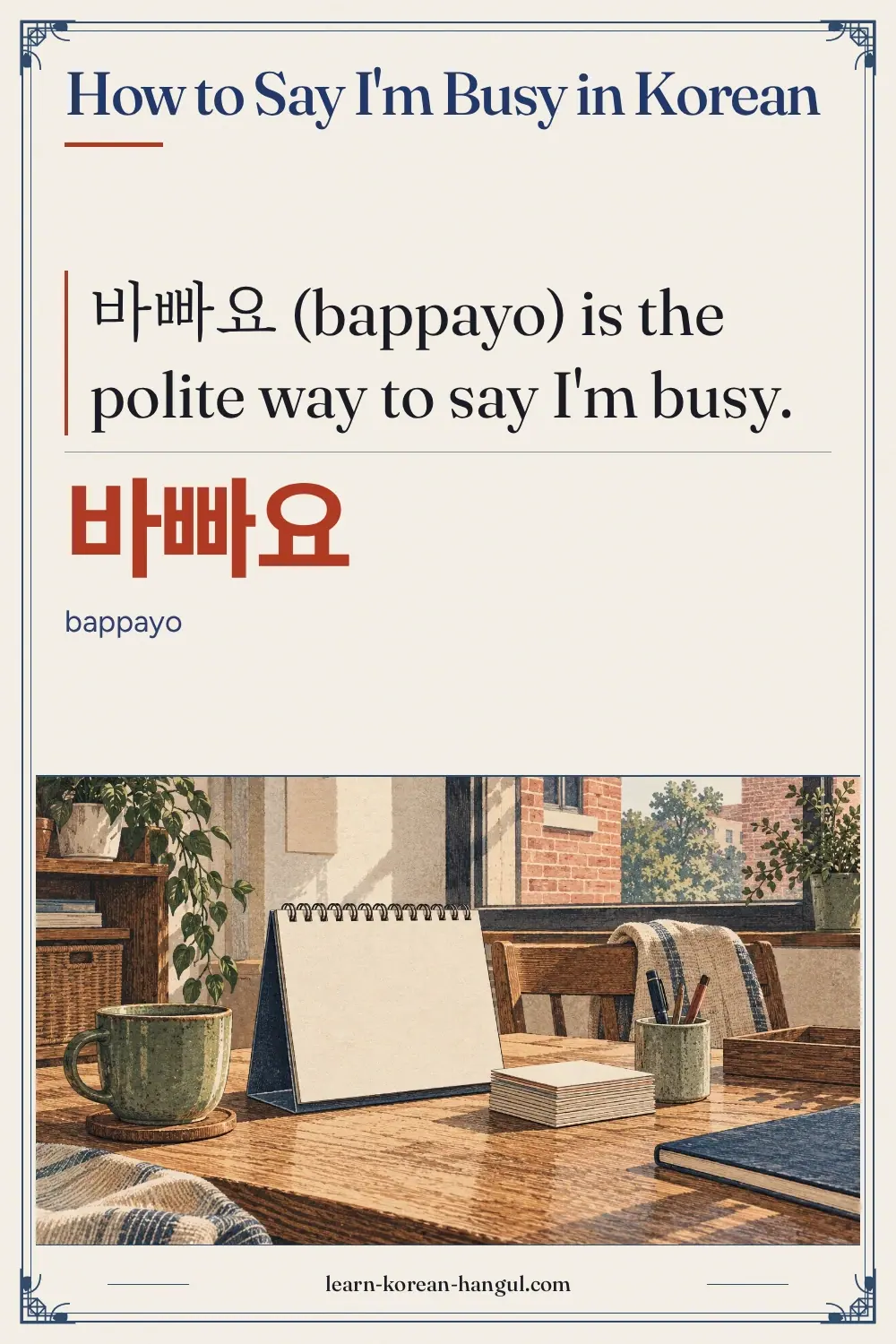
바빠요
바빠요
What you'll learn
- Say I'm busy with 바빠요, 바쁩니다 or 바빠, depending on the listener.
- Turn down an invitation politely with 바빠서요.
- See why 바쁘- becomes 바빠- and not 바쁘어요.
- Pronounce 바쁩니다 as [바쁨니다] and keep the tense ㅃ in 바빠요.
Before you start: you only need to read Hangul. If you want the opposite situation, learn are you free in Korean. Time: about 10 minutes. Audio plays only when you press a button.
How Do You Say I'm Busy in Korean?
The standard way to say I'm busy in Korean is 바빠요. Korean usually drops "I", so 바빠요 alone is a full sentence. You can add 저는 (jeoneun, as for me) when you want to contrast yourself with someone else, as in 저는 바빠요, 하지만 친구는 한가해요 (I'm busy, but my friend is free).
| Situation | Best form | Romanization | Why |
|---|---|---|---|
| Telling a colleague or a shop owner | 바빠요 | bappayo | Polite, natural |
| Texting a close friend | 바빠 | bappa | Casual |
| A report, a customer call or an announcement | 바쁩니다 | bappeumnida | Formal |
| Busy for a while | 요즘 바빠요 | yojeum bappayo | Busy lately |
| Declining softly | 지금 좀 바빠서요 | jigeum jom bappaseoyo | Gives a reason |
The next section sorts these forms by listener.
What Are the Formal, Polite and Casual Ways to Say I'm Busy?
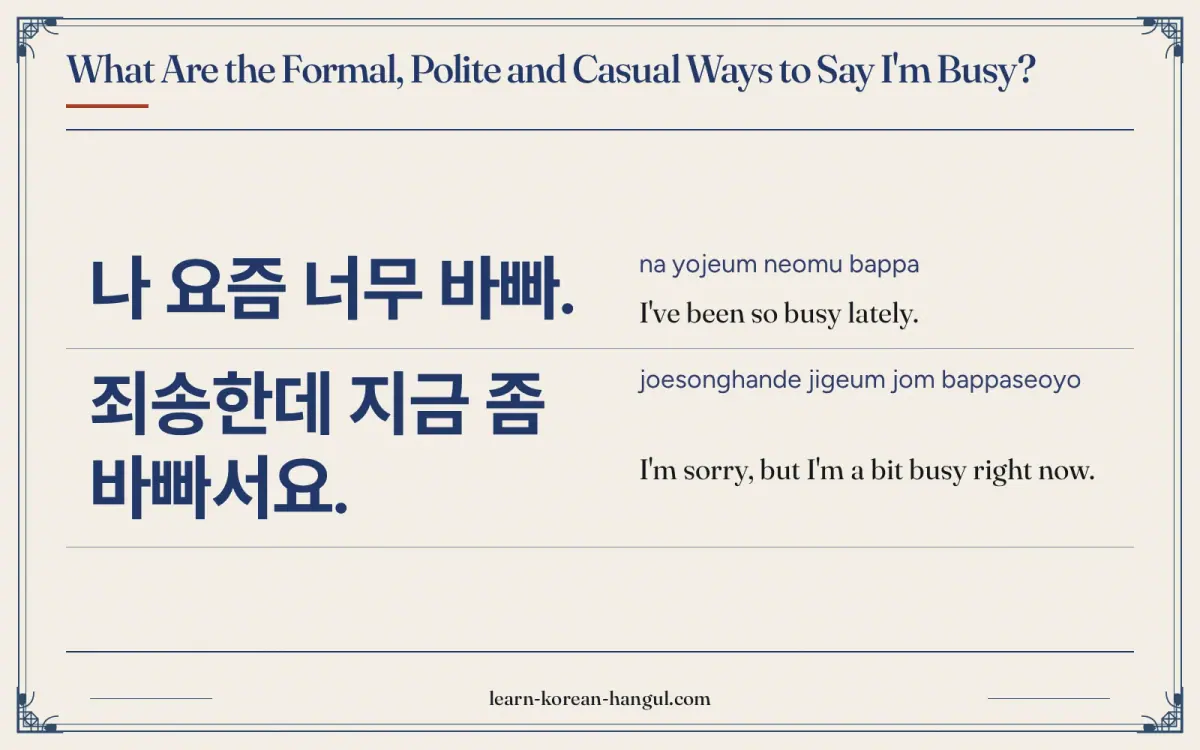
The forms follow the Korean speech levels, explained in the guide to Korean speech levels. The stem 바쁘- stays the same and the ending changes.
Polite: 바빠요 (bappayo)
Polite · 해요체바빠요 is the form to learn first. It suits coworkers, neighbours, shop staff and anyone you do not know well. It is also fine with friends, though they may shorten it.
오늘은 약속이 있어서 바빠요.
oneureun yaksogi isseoseo bappayo
I'm busy today because I have plans.
Casual: 바빠 (bappa)
Casual · 반말바빠 drops the polite ending. Use it with close friends, siblings and people younger than you. In a chat, many people write 바빠ㅠㅠ to add a sigh.
나 요즘 너무 바빠.
na yojeum neomu bappa
I've been so busy lately.
Formal: 바쁩니다 (bappeumnida)
Formal · 합쇼체바쁩니다 is the formal form. It appears in business replies, reports and announcements. In daily life you need it less, but it is easy to understand once you know the ending -ㅂ니다. It is pronounced [바쁨니다].
Softened: 지금 좀 바빠서요 (jigeum jom bappaseoyo)
Polite · 해요체바빠서요 ends with -아/어서요, which means "because". Korean often leaves the main clause unsaid, so the reason stands alone as the answer. The words 죄송한데 (joesonghande, I'm sorry, but) and 좀 (jom, a little) make it gentler. This is the line to use with a boss or an elder.
죄송한데 지금 좀 바빠서요.
joesonghande jigeum jom bappaseoyo
I'm sorry, but I'm a bit busy right now.
The forms look easy, but the stem hides a small grammar rule.
Why Does 바쁘다 Become 바빠요?
The stem 바쁘- ends in the vowel ㅡ (eu). Before the endings -아요 or -어요, Korean drops that ㅡ. Then the ending is 아 if the vowel in the syllable before is ㅏ or ㅗ, and 어 otherwise. Here the vowel before is ㅏ in 바, so the ending is 아: 바쁘 + 아요 → 바빠요. The past tense follows the same logic: 바빴어요 (bappasseoyo, I was busy).
- 바쁘다 → 바빠요 (busy)
- 아프다 → 아파요 (sick, painful)
- 예쁘다 → 예뻐요 (pretty)
- 기쁘다 → 기뻐요 (glad)
This is called ㅡ-dropping (으 탈락). School grammar counts it as regular, though many learner books teach it with the irregular verbs. The ㅡ comes back before consonant endings, so you get 바쁘지 않아요 (I'm not busy) and 바쁩니다. Now to the sounds.
How Do You Pronounce 바빠요?
바빠요 is pronounced [바빠요], ba-ppa-yo, in three syllables. The middle consonant ㅃ is a tense consonant. You press your lips together firmly and release without a puff of air. It is a stronger p than the one in ㅂ, and it is not the same as the aspirated ㅍ.
- 바 (ba): a soft b and "ah".
- 빠 (ppa): a tight, short p, "ppah".
- 요 (yo): "yo".
Revised Romanization writes the tense letter, so you see bappayo with a double p. Do not read it as ba-ba-yo: a plain ㅂ would give a different, softer sound. Listen to the clip and copy the short, tight closure.
Sound Changes to Listen For
These notes follow the National Institute of Korean Language standard pronunciation rules (표준 발음법):
- ㅂ before ㄴ becomes ㅁ. 바쁩니다 is [바쁨니다] (Article 18). RR shows this as bappeumnida. See Korean nasalization.
- The final ㅆ moves to the next vowel. 바빴어요 is [바빠써요], as if the ㅆ were the start of the next syllable.
- No change in 바빠요 itself. The ㅃ is written in the spelling, so you simply say it tense.
With the sound clear, here is when each form fits.
When Should You Use 바빠요, and When Should You Not?
Use 바빠요 to explain why you cannot do something, or to describe a hard week. Be careful with it as a bare refusal to someone older or senior.
Situations Where It Fits
- Declining plans with a friend. 오늘은 좀 바빠요. 내일 어때요? (I'm a bit busy today. How about tomorrow?)
- Explaining a delay at work. 이번 주에는 일이 많아서 바빠요. (I'm busy this week because I have a lot of work.)
- Small talk. 요즘 바빠요? (Have you been busy lately?)
Situations to Avoid
- A flat refusal to a boss or elder. A bare 바빠요 can feel curt. Say 죄송한데 지금 좀 바빠서요 instead.
- A first meeting. Say 만나서 반가워요 first. Mentioning how busy you are right away sounds distant.
- Writing to a customer. Use a formal reply with 바쁩니다 only if needed. Often 확인 후 연락드리겠습니다 (I will check and contact you) is better.
Two short conversations show how it sounds.
What Does I'm Busy Sound Like in a Real Conversation?
In real life, the line comes with an offer to meet another time. Notice what follows it.
Plans with a Friend
Minho
오늘 저녁에 시간 있어?
oneul jeonyeoge sigan isseo?
Do you have time this evening?
Seoyeon
미안, 나 오늘 너무 바빠. 내일은 어때?
mian, na oneul neomu bappa. naeireun eottae?
Sorry, I'm so busy today. How about tomorrow?
Minho
내일 좋아!
naeil joa!
Tomorrow works!
What to notice: the casual 바빠 comes with 미안 (sorry) and a counter-offer, 내일은 어때?.
When the Team Leader Asks
Team Leader
지민 씨, 이 서류 좀 봐 줄 수 있어요?
jimin ssi, i seoryu jom bwa jul su isseoyo?
Jimin, could you look at this document?
Jimin
죄송한데 지금 좀 바빠서요. 세 시 이후에 괜찮으세요?
joesonghande jigeum jom bappaseoyo. se si ihue gwaenchaneuseyo?
I'm sorry, I'm a bit busy right now. Would after three o'clock be okay?
Team Leader
네, 괜찮아요. 그때 봐요.
ne, gwaenchanayo. geuttae bwayo
Yes, that's fine. See you then.
What to notice: Jimin softens the refusal with 죄송한데 and 바빠서요, then offers a time, so the team leader can plan. She uses the honorific 괜찮으세요? for the senior, who answers in plain polite 괜찮아요.
What Should You Know about the Culture behind I'm Busy?
Busy is the standard polite excuse in Korea, and it is also a point of pride in many workplaces. A full schedule suggests that you are needed. Because of this, coworkers often greet each other with 바쁘시죠? (bappeusijyo, you must be busy), even when they have nothing particular to say. The honorific -시- shows respect for the person you are asking, so you never use it about yourself.
- Reasons matter. A bare refusal can feel cold. Adding 일이 있어서요 (I have something on) keeps the mood warm.
- Offer another time. 다음에 같이 해요 (let's do it together next time) closes the exchange kindly.
- Do not boast. Saying 저는 정말 바빠요 repeatedly can sound like a complaint. Pair it with a smile or a joke.
A related word is 정신없이 바빠요 (jeongsineopsi bappayo), "so busy I cannot think". Koreans use it for hectic days such as moving house or a deadline. It is friendly and a little humorous. The next section covers the mistakes learners make.
What Mistakes Do Learners Make with I'm Busy in Korean?
Most mistakes come from the ㅡ-dropping stem and from the register.
| Mistake | Why it is a problem | Fix |
|---|---|---|
| 바쁘어요 | The ㅡ must drop | Say 바빠요 |
| 바쁘요 | Missing the vowel ending | Say 바빠요 |
| [바쁘니다] for the formal form | The ㅂ turns into ㅁ | Say [바쁨니다] |
| 바빠 to a boss | Too casual | Say 바빠요 or 바빠서요 |
| 저는 바쁘세요 | The honorific is for others, not you | Say 저는 바빠요 |
| 바빠요 with no reason | Can sound curt to a senior | Add 죄송한데 ... 바빠서요 |
An expert tip: do not mix the honorific into a statement about yourself. You can ask 바쁘세요? (are you busy?) to an elder, but you answer 바빠요 about yourself.
How Do You Ask Someone If They Are Busy?
Turn the same words into a yes/no question by raising your voice at the end. To a friend, say 바빠? (bappa?). To a colleague or stranger, say 바빠요? (bappayo?). To an elder or a customer, use the honorific 바쁘세요? (bappeuseyo?). A softer way to ask is 지금 시간 괜찮으세요? (jigeum sigan gwaenchaneuseyo?), which means "is now a good time?".
| Listener | Question | Romanization |
|---|---|---|
| Close friend | 바빠? | bappa |
| Colleague | 바빠요? | bappayo |
| Elder or customer | 바쁘세요? | bappeuseyo |
The opposite is 한가해요 (hangahaeyo, I'm free) or 시간 있어요 (sigan isseoyo, I have time). Asking 요즘 어떻게 지내요? (how have you been?) is another gentle way to start.
Is It the Same as I Am Busy, Im Busy or Busy?
Yes. The short answers below cover the other searches folded into this page.
- I am busy in Korean: 바빠요 or the formal 바쁩니다.
- Im busy in Korean: the same sentence; the apostrophe makes no difference in English.
- Busy in Korean: 바쁜 (bappeun) before a noun, as in 바쁜 하루 (a busy day) and 바쁜 사람 (a busy person).
- I've been busy lately: 요즘 바빠요.
- I'm very busy: 너무 바빠요 or 정말 바빠요.
Now practise aloud.
Practice: Say It Aloud
Play the slow clip of 바빠요 three times and keep the ㅃ tight. Then choose a phrase. Answers follow.
- You tell a close friend you cannot meet today.
- You tell a coworker politely that you are busy.
- You answer a customer in formal speech.
- You must decline your boss softly.
Answers
- 나 오늘 바빠.
- 바빠요.
- 바쁩니다.
- 죄송한데 지금 좀 바빠서요.
The phrase flashcards drill these lines with audio.
Related Phrases to Learn Next
Busy leads to tiredness and to apologies.
- I'm tired in Korean: 피곤해요 when the busy week is over.
- Sorry in Korean: 죄송합니다 when you must say no.
- What are you doing in Korean: 뭐 해요? to ask about someone's plans.
This guide belongs to the Korean feelings phrases collection. What this page does not cover: scheduling a meeting, business email wording and the days of the week. Remember that the ㅡ drops, give a reason to a senior, and keep the ㅃ tense, and you can say i'm busy in Korean naturally.
Frequently Asked Questions
How do you say I'm busy in Korean?
Say 바빠요 (bappayo) in polite speech, 바빠 (bappa) to a close friend and 바쁩니다 (bappeumnida) in formal speech. The word comes from the adjective 바쁘다, to be busy. Korean usually drops 저는, so 바빠요 alone is a complete sentence.
How do I decline an invitation by saying I'm busy?
Use 바빠서요 with a short apology: 죄송한데 지금 좀 바빠서요 (joesonghande jigeum jom bappaseoyo). The ending -아/어서요 gives the reason without finishing the sentence, which sounds soft. Add 다음에 같이 해요 to offer another time. A bare 바빠요 to a boss or elder can feel too direct.
Why is it 바빠요 and not 바쁘어요?
The stem 바쁘- ends in ㅡ, and Korean drops that vowel before the -아/어 endings. The vowel in the syllable before is ㅏ, so the ending is 아. That gives 바쁘 + 아요 = 바빠요. The same pattern gives 아프다 → 아파요 and 기쁘다 → 기뻐요.
How do you pronounce 바쁩니다?
It is pronounced [바쁨니다]. The final ㅂ of 쁩 sits before ㄴ, so it becomes ㅁ (Article 18 of the standard pronunciation rules). Revised Romanization writes this as bappeumnida. The tense ㅃ stays tense in both 바쁩니다 and 바빠요.
What is the difference between 바빠요 and 바쁘세요?
바빠요 describes yourself. 바쁘세요 uses the honorific -(으)시- and is for asking or talking about someone you respect, as in 요즘 바쁘세요? You never use the honorific about yourself. Answer an elder who asks 바쁘세요? with 네, 좀 바빠요.
How do I say I've been busy lately in Korean?
Say 요즘 바빠요 (yojeum bappayo). 요즘 means these days. To stress it, say 요즘 너무 바빠요 or 요즘 정신없이 바빠요 for so busy you cannot think. With a friend, drop 요: 요즘 너무 바빠.