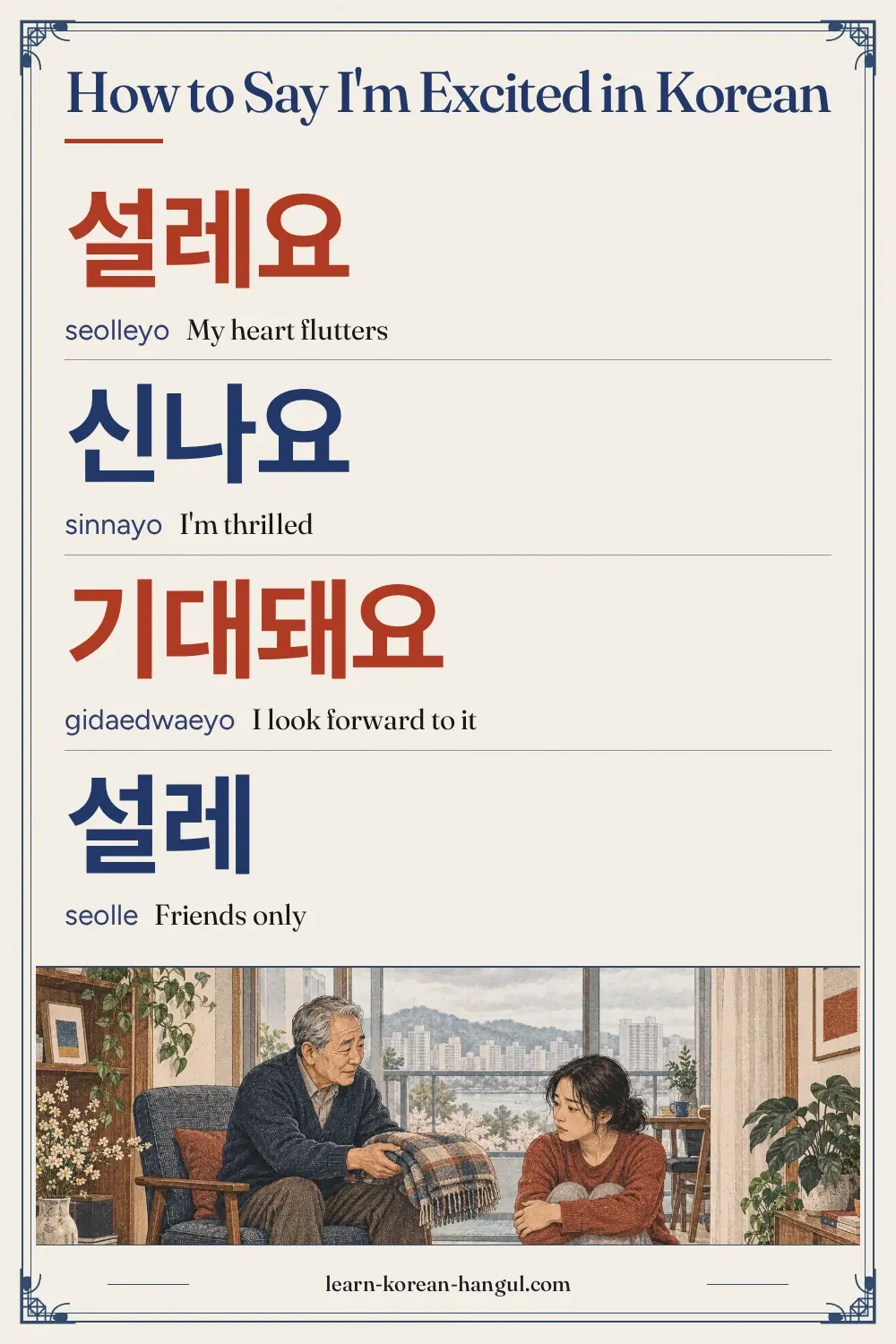
설레요
설레요
What you'll learn
- Say I'm excited with 설레요, 신나요 or 기대돼요, depending on the kind of excitement.
- Use the casual 설레 and the formal 설렙니다 with the right listener.
- See why 기대되다 becomes 기대돼요 and not 기대되요.
- Pronounce 설레요 with a long ㄹㄹ.
Before you start: you only need to read Hangul. When the good mood grows, learn I'm happy in Korean. Time: about 10 minutes. Audio plays only when you press a button.
How Do You Say I'm Excited in Korean?
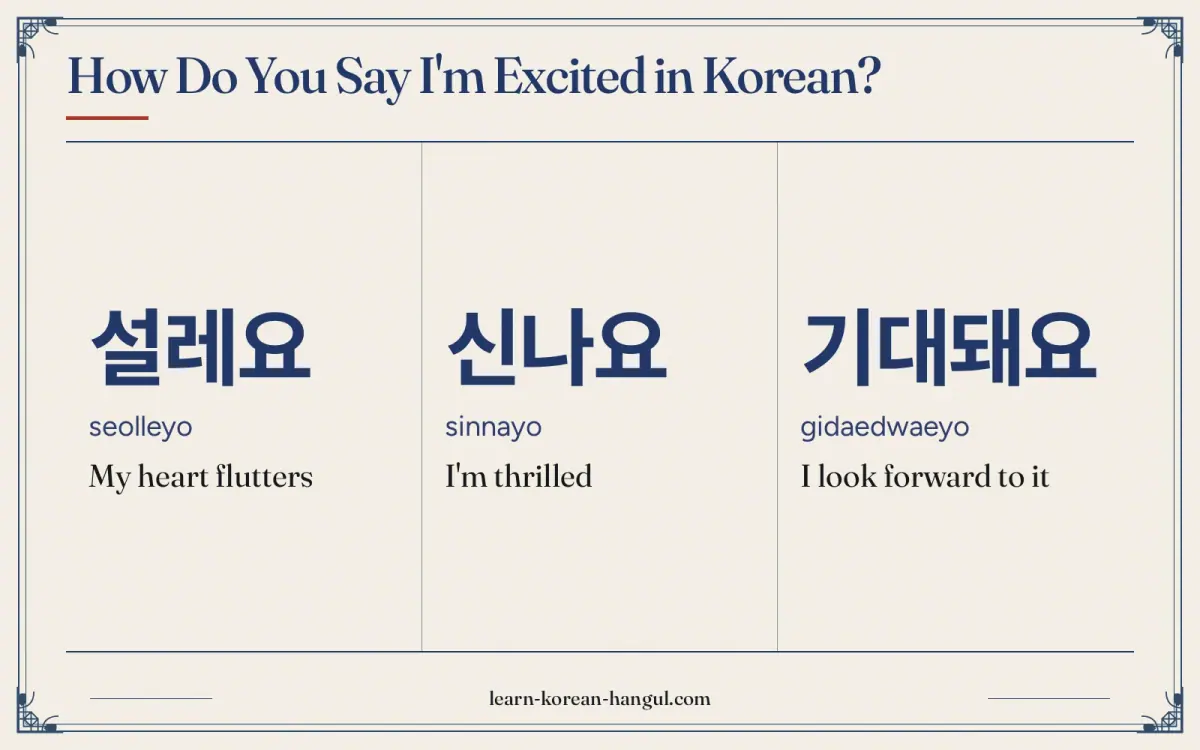
The standard way to say I'm excited in Korean is 설레요, when the excitement comes with fluttering nerves, as before a date, a trip or the first day of something new. Korean has no single word for every kind of excitement, so you pick by feeling. Korean usually drops "I", so each word alone is a full sentence.
| Kind of excitement | Best form | Romanization | Meaning |
|---|---|---|---|
| Fluttering, anticipation | 설레요 | seolleyo | My heart flutters |
| Fun, thrilled, pumped | 신나요 | sinnayo | I'm thrilled |
| Looking forward to something | 기대돼요 | gidaedwaeyo | I look forward to it |
| Casual, fluttering | 설레 | seolle | Friends only |
| Formal | 설렙니다 | seollemnida | Speeches, writing |
The next section sorts these by feeling and by listener.
What Are the Polite and Casual Ways to Say I'm Excited?
The forms follow the Korean speech levels, explained in the guide to Korean speech levels. Here the feeling picks the word and the ending picks the level.
Fluttering: 설레요 (seolleyo)
Polite · 해요체설레요 is the form to learn first. It suits coworkers, friends and family. The verb 설레다 describes a flutter in the chest, so it often goes with a trip, a meeting or a crush. The related noun is 설렘 (seollem, a flutter).
내일 여행을 가서 너무 설레요.
naeil yeohaengeul gaseo neomu seolleyo
I'm so excited because I'm going on a trip tomorrow.
Thrilled: 신나요 (sinnayo)
Polite · 해요체신나요 is about fun and energy, like at a concert, a party or a game. The verb is 신나다 (sinnada), and the casual form is 신나. People also say 신난다! (sinnanda) when they are happy in the moment.
콘서트 가는 날이라 신나요!
konseoteu ganeun narira sinnayo!
It's the day of the concert, so I'm thrilled!
Looking Forward: 기대돼요 (gidaedwaeyo)
Polite · 해요체기대돼요 means you are looking forward to something. It is calm and positive, and it suits both friends and work. It is a good choice when you are not sure if 설레요 is too romantic.
다음 주에 만나는 게 정말 기대돼요.
daeum ju-e mannaneun ge jeongmal gidaedwaeyo
I'm really looking forward to meeting next week.
Casual and Formal
Casual · 반말With close friends, drop 요: 설레, 신나, 기대돼. In formal speech, use 설렙니다, 신납니다 and 기대됩니다 (gidaedoemnida). The formal forms are pronounced [설렘니다], [신남니다] and [기대됨니다].
One of these words has a small spelling trap.
Why Does 기대되다 Become 기대돼요?
The verb 기대되다 ends in 되다. Before 어요, 되 + 어 contracts to 돼. So 기대되 + 어요 → 기대돼요. The same contraction happens in the past: 기대됐어요 (gidaedwaesseoyo, I was looking forward to it). Writing 기대되요 is a very common mistake.
- 되다 → 돼요 (becomes)
- 기대되다 → 기대돼요 (look forward to)
- 걱정되다 → 걱정돼요 (be worried)
- 궁금하다 → 궁금해요 (be curious; a 하다 word for comparison)
A quick test is to replace the word with 해요. If 해요 fits, use 돼요, as in 기대해요 and 기대돼요. In contrast, 설레다 and 신나다 have no such contraction: 설레 + 어요 → 설레요, and 신나 + 아요 → 신나요. The past form of 설레다 is 설렜어요 (seollesseoyo). Next, the sounds.
How Do You Pronounce 설레요?
설레요 is pronounced [설레요], seol-le-yo, in three syllables. The ㄹ at the end of 설 and the ㄹ at the start of 레 sit side by side, so you hear one long "l" sound: touch the tongue tip to the ridge behind your upper teeth and hold it a moment. The vowel ㅓ is unrounded, so keep your lips relaxed.
- 설 (seol): "suhl", with the tongue ending on the ridge.
- 레 (le): the long l continues, then "eh".
- 요 (yo): "yo".
Neither ㄹㄹ nor ㄴㄴ in 신나요 is tense. They are simply long. Revised Romanization shows the doubled letter, seolleyo and sinnayo. Most Seoul speakers say ㅐ and ㅔ the same, so 설레 sounds like 설래; the spelling with ㅔ is correct.
Sound Changes to Listen For
These notes follow the National Institute of Korean Language standard pronunciation rules (표준 발음법):
- ㅂ before ㄴ becomes ㅁ. 설렙니다 is [설렘니다] (Article 18). See Korean nasalization.
- The vowels ㅚ and ㅙ. The standard lists ㅚ among the 10 simple vowels and allows a diphthong pronunciation ([we]); most speakers use the diphthong. The ㅙ of 돼 is also [we] in everyday speech, so 기대되- and 기대돼- sound alike and only the spelling tells them apart.
- The final ㅆ moves forward. 설렜어요 is [설레써요] (Article 13).
With the sound clear, here is when each form fits.
When Should You Use 설레요, and When Should You Not?
Use 설레요 when the excitement is mixed with a little nerves or romance. Use 신나요 for pure fun and 기대돼요 for calm anticipation.
Situations Where It Fits
- Before a trip. 내일 출발이라 설레요. (I leave tomorrow, so I'm excited.)
- A first day. 첫 출근이라 설레요. (It's my first day at work, so I'm excited.)
- A date or a new friend. 오늘 만나는 게 설레요. (I'm excited to meet today.)
Situations to Avoid
- A noisy party. 설레요 sounds too soft. Say 신나요 instead.
- A work goal. 설레요 about a project can sound too personal. Say 기대돼요.
- With a boss. If you are unsure, pick 기대돼요, which is warm but safe.
Two short conversations show how it sounds.
What Does I'm Excited Sound Like in a Real Conversation?
In real life, the line is followed by a plan and a shared mood. Notice the answers.
The Night before a Picnic
Yuna
내일 소풍이야! 너무 설레!
naeil sopungiya! neomu seolle!
The picnic is tomorrow! I'm so excited!
Doyun
나도! 도시락 싸 갈게.
nado! dosirak ssa galge
Me too! I'll bring a lunch box.
Yuna
신난다!
sinnanda!
Yay!
What to notice: Yuna starts with the fluttering 설레 and ends with the playful 신난다. Doyun answers with a promise, 싸 갈게, which is pronounced [싸 갈께].
A Colleague's Trip
Colleague
이번 주말에 여행 가신다고 들었어요. 설레세요?
ibeon jumare yeohaeng gasindago deureosseoyo. seolleseyo?
I heard you are going on a trip this weekend. Are you excited?
Hana
네, 많이 설레요. 오랜만이라 기대돼요.
ne, mani seolleyo. oraenmanira gidaedwaeyo
Yes, very. It has been a while, so I'm looking forward to it.
What to notice: the colleague uses the honorific 설레세요 to ask, but Hana uses plain 설레요 about herself. She adds 기대돼요 to make the feeling sound relaxed.
What Should You Know about the Culture behind I'm Excited?
설레다 is the feeling you get with a crush, a first date or a new start, and it is often paired with the heartbeat word 두근두근 (dugeundugeun). Because of this, it appears often in love stories and in messages between close friends. Koreans also say 설레요 for non-romantic things, such as the night before a school trip or the first day of vacation, because the fluttering is the same.
- Romance. 너 때문에 설레 can sound like a confession, so be careful in who you say it to.
- Seasons. The first snow or the cherry blossom season often gives people 설렘.
- Fun. For a party or a game, 신나요 is the safer word.
You may also see the compound 기대 반 설렘 반 (gidae ban seollem ban), "half anticipation, half excitement". The next section covers the mistakes learners make.
What Mistakes Do Learners Make with I'm Excited in Korean?
Most mistakes come from picking the wrong word and from spelling.
| Mistake | Why it is a problem | Fix |
|---|---|---|
| 흥분해요 for happy excitement | It means worked up or agitated | Say 신나요 or 설레요 |
| 신나요 for a crush | Sounds too playful | Say 설레요 |
| 기대되요 | 되 + 어 contracts to 돼 | Say 기대돼요 |
| 설래요 | The word uses ㅔ | Say 설레요 |
| 설레임 | The standard noun is 설렘 | Say 설렘 |
| 설레 to an elder | Too casual | Say 설레요 |
The word 흥분하다 (heungbunhada) is the one to be careful with. It can mean "to be excited", but it also means "to be worked up", and a Korean listener may hear anger or arousal. Use it for sports commentary or science, not for your own happy mood.
How Do You Ask Someone If They Are Excited?
Raise your voice at the end for a yes/no question. To a friend, say 설레? (seolle?). To a colleague, say 설레요? (seolleyo?). To an elder, use the honorific 설레세요? (seolleseyo?), which adds -(으)시- for the listener. The honorific is for the other person, so never use it for yourself. A neutral option is 기대되세요? (gidaedoeseyo?), which asks if they are looking forward to it.
| Listener | Question | Romanization |
|---|---|---|
| Close friend | 설레? | seolle |
| Colleague | 설레요? | seolleyo |
| Elder or customer | 설레세요? | seolleseyo |
A good follow-up is 어디 가요? (eodi gayo?), which means "where are you going?". Wh-questions like this do not end with a sharp rise.
Is It the Same as I Am Excited, Excited or Looking Forward?
Close. The short answers below cover the other searches folded into this page.
- I am excited in Korean: 설레요, 신나요 or 기대돼요, depending on the feeling.
- Excited in Korean: 설레는 (seolleneun) before a noun, as in 설레는 마음 (an excited heart).
- Looking forward in Korean: 기대돼요, or 기대하고 있어요 (I am looking forward to it).
- I can't wait: 빨리 가고 싶어요 or 기다려져요 (gidaryeojyeoyo).
- I'm so excited: 너무 설레요.
Now practise aloud.
Practice: Say It Aloud
Play the slow clip of 설레요 three times and hold the ㄹㄹ. Then choose a phrase. Answers follow.
- You tell a close friend that your heart is fluttering about tomorrow.
- You tell a coworker politely that you look forward to the trip.
- You say you are thrilled at a concert.
- You ask a senior if they are excited.
Answers
- 나 설레.
- 기대돼요.
- 신나요.
- 설레세요?
The phrase flashcards drill these lines with audio.
Related Phrases to Learn Next
Excited leads to happy and to nervous.
- I'm happy in Korean: 행복해요 for happiness.
- I'm nervous in Korean: 떨려요 when excitement comes with nerves.
- I love you in Korean: 사랑해요 when the flutter becomes something more.
This guide belongs to the Korean feelings phrases collection. What this page does not cover: dating vocabulary, travel words and fandom slang. Remember that 설레요 is a flutter, 신나요 is fun, and 기대돼요 needs 돼, and you can say i'm excited in Korean naturally.
Frequently Asked Questions
How do you say I'm excited in Korean?
The word depends on the feeling. Say 설레요 (seolleyo) for fluttering anticipation, 신나요 (sinnayo) for fun, energetic excitement and 기대돼요 (gidaedwaeyo) for looking forward to something. All three are polite. With a close friend, use 설레, 신나 or 기대돼. For formal speech, use 설렙니다.
What is the difference between 설레요, 신나요 and 기대돼요?
설레요 is a fluttering mix of joy and nerves, like before a date or a trip. 신나요 is fun and energy, like at a concert or a party. 기대돼요 is calmer and means you look forward to something. If unsure with a boss or elder, 기대돼요 is the safest and warmest choice.
Why is it 기대돼요 and not 기대되요?
기대되다 ends in 되다, and 되 + 어요 contracts to 돼요. A useful test is to replace the word with 해요: if 기대해요 works, then 기대돼요 is right. 기대되요 is a common spelling mistake. The past form is 기대됐어요, and the formal form is 기대됩니다.
Can I use 흥분해요 to say I'm excited in Korean?
Usually not. 흥분하다 means to be worked up or agitated, and listeners may hear anger or arousal. For happy excitement, use 신나요, 설레요 or 기대돼요. 흥분 appears more in news and science, as in 흥분한 관중 (an excited crowd).
Is it 설렘 or 설레임?
The standard noun is 설렘 (seollem), formed from the verb stem 설레- plus -ㅁ. The form 설레임 is common in casual writing but is not standard. Use 설레는 마음 (an excited heart) for an adjective-like phrase, and 설렘 for the noun.
How do you pronounce 설레요?
It is pronounced [설레요], with a long ㄹㄹ between 설 and 레. Hold the tongue on the ridge behind your upper teeth for a moment. The ㅓ in 설 is unrounded. Revised Romanization writes seolleyo. The sound is not tense; it is only long.