행복해요
행복해요
What you'll learn
- Say I'm happy with 행복해요, 행복해 or 행복합니다, depending on the listener.
- Choose between 행복해요 (happy), 기뻐요 (glad) and 좋아요 (good).
- Pronounce 행복해요 as [행보캐요], with an aspirated ㅋ.
- Avoid 행복이에요 when you mean I am happy.
Before you start: you only need to read Hangul. When the mood turns the other way, learn I'm sad in Korean. Time: about 10 minutes. Audio plays only when you press a button.
Key facts
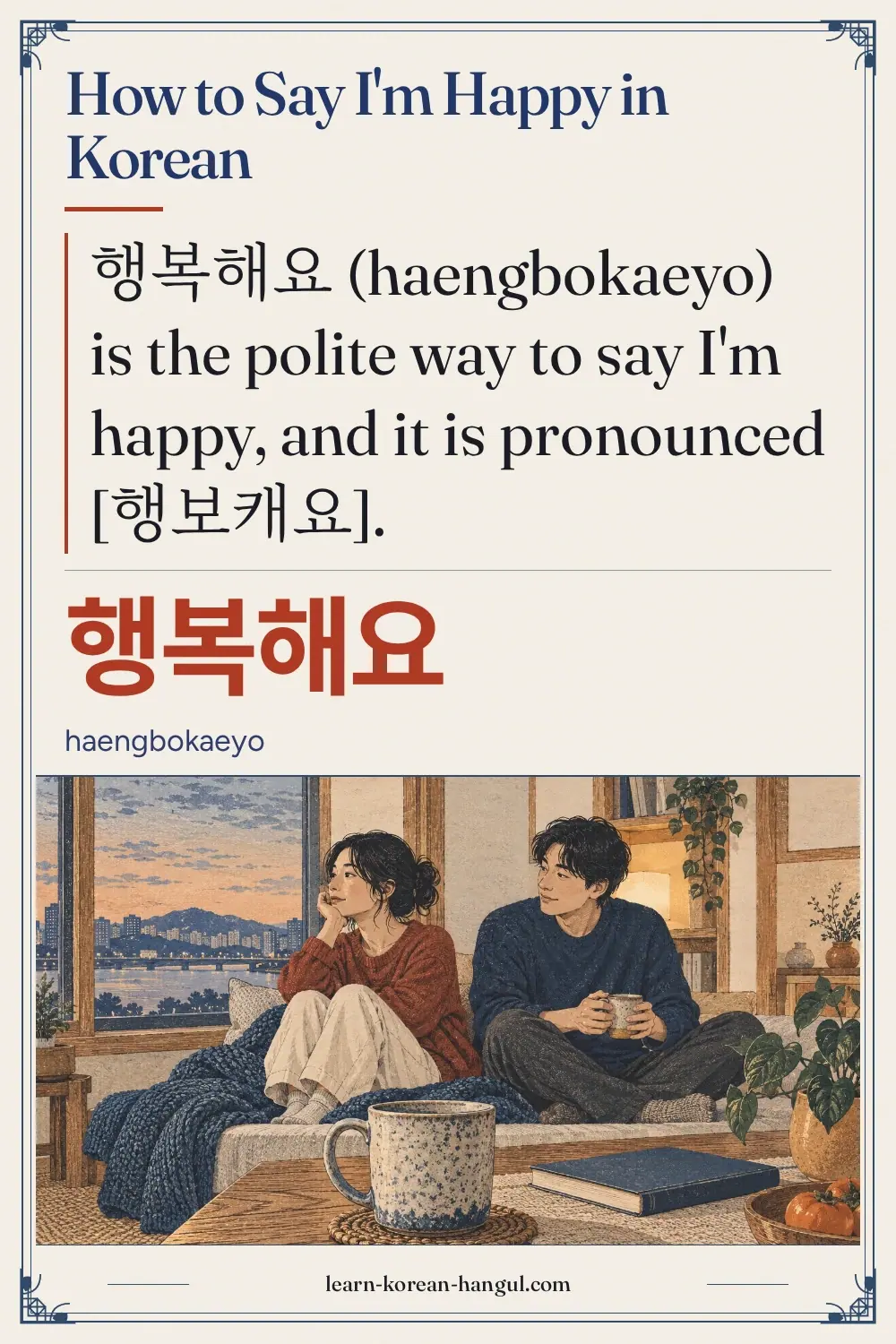
- 행복해요 (haengbokaeyo) is the polite way to say I'm happy, pronounced [행보캐요].
- 행복해 (haengbokae) is the casual form, and 행복합니다 (haengbokamnida) is the formal form.
- 기뻐요 (gippeoyo) is glad, for specific good news.
- 좋아요 (joayo) and 기분 좋아요 (gibun joayo) are light, everyday good moods.
- Revised Romanization shows the merged ㅋ sound in the verb forms (haengbokaeyo); the noun 행복 is simply haengbok.
How Do You Say I'm Happy in Korean?
The standard way to say I'm happy in Korean is 행복해요. The noun 행복 (haengbok) means happiness, and 하다 turns it into a verb-like adjective, so 행복하다 means to be happy. Korean usually drops "I", so 행복해요 alone is a full sentence. It has four syllables: haeng-bo-kae-yo.
| Situation | Best form | Romanization | Why |
|---|---|---|---|
| Telling a family member or colleague you are content | 행복해요 | haengbokaeyo | Polite, heartfelt |
| Telling a close friend | 행복해 | haengbokae | Casual |
| Glad about specific news | 기뻐요 | gippeoyo | A reaction to an event |
| A light good mood | 좋아요 / 기분 좋아요 | joayo / gibun joayo | Everyday, relaxed |
| A formal speech | 행복합니다 | haengbokamnida | Formal |
The next section sorts the forms by the person you are talking to.
What Are the Polite and Casual Ways to Say I'm Happy?
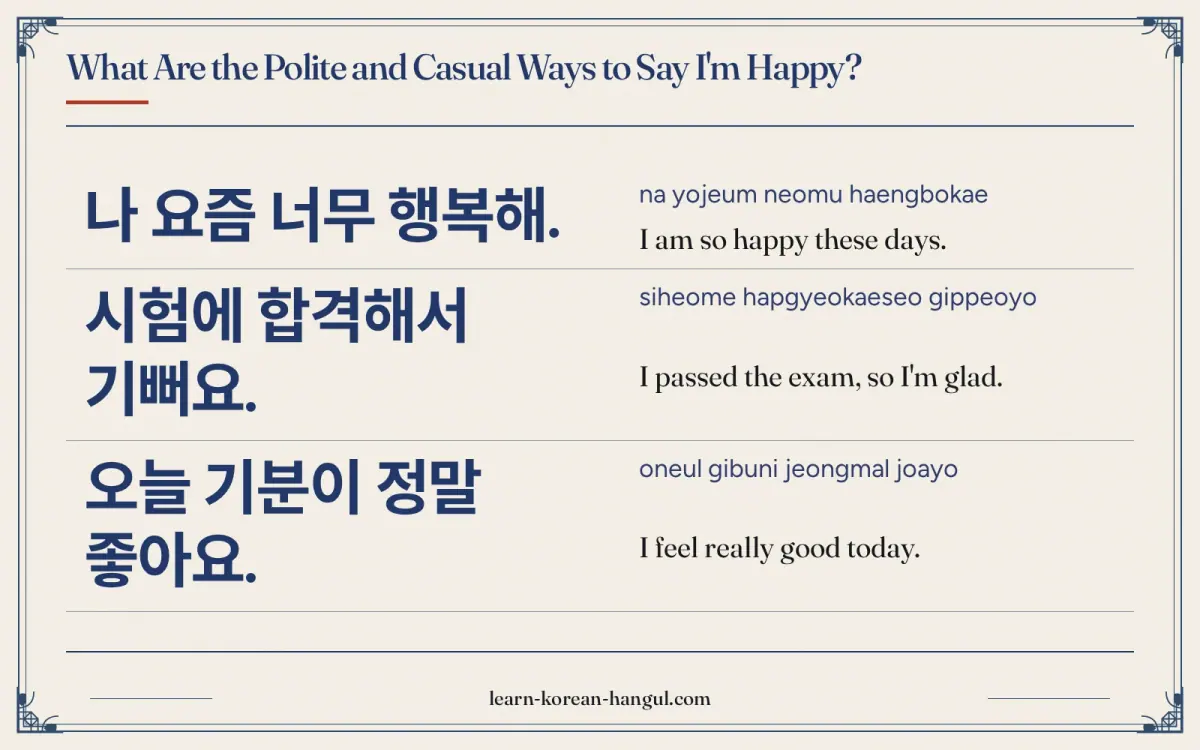
The forms follow the Korean speech levels, explained in the guide to Korean speech levels. The stem stays close to the same, and the ending changes the level.
Polite: 행복해요 (haengbokaeyo)
Polite · 해요체행복해요 is the form to learn first. It suits family, close colleagues and friends. It is a strong, heartfelt word, so it fits a warm moment more than a passing mood.
가족과 함께 있어서 행복해요.
gajokgwa hamkke isseoseo haengbokaeyo
I am happy because I am with my family.
Casual: 행복해 (haengbokae)
Casual · 반말행복해 drops the polite 요. Use it with close friends, siblings and partners. It is pronounced [행보캐].
나 요즘 너무 행복해.
na yojeum neomu haengbokae
I am so happy these days.
Polite: 기뻐요 (gippeoyo)
Polite · 해요체기뻐요 means "I'm glad" or "I'm delighted". It reacts to something that just happened: good news, a gift or a reunion. Use 행복해요 for a lasting state and 기뻐요 for a moment. The stem 기쁘- drops its ㅡ before 어요, so 기쁘 + 어요 becomes 기뻐요.
시험에 합격해서 기뻐요.
siheome hapgyeokaeseo gippeoyo
I passed the exam, so I'm glad.
Polite: 좋아요 (joayo)
Polite · 해요체좋아요 means "it's good" or "I like it". For a mood, add 기분 (gibun, mood): 기분 좋아요 means "I feel good". It is light, safe and very common. Notice that 좋아요 can also say "OK" or "I like it", so the situation shows the meaning.
오늘 기분이 정말 좋아요.
oneul gibuni jeongmal joayo
I feel really good today.
Formal: 행복합니다 (haengbokamnida)
Formal · 합쇼체행복합니다 is the formal form. It appears in speeches, wedding messages and written greetings. It is pronounced [행보캄니다]: the ㄱ and ㅎ merge into ㅋ, and the ㅂ turns into ㅁ before ㄴ. The sound rule behind this comes next.
How Do You Pronounce 행복해요?
행복해요 is written with a ㄱ at the end of 복 and an ㅎ at the start of 해, but it is pronounced [행보캐요]. The two sounds merge into one aspirated ㅋ, which is the sound of the Korean letter ㅋ in 캐. So the word has four syllables: haeng-bo-kae-yo.
- 행 (haeng): a soft h, then "eh" and an "ng" at the end.
- 보 (bo): "boh".
- 캐 (kae): a ㅋ with a puff of air, then "eh".
- 요 (yo): "yo".
Sound Changes to Listen For
These changes follow the National Institute of Korean Language standard pronunciation rules (표준 발음법):
- ㄱ + ㅎ becomes ㅋ. 행복해요 is [행보캐요] (Article 12). Revised Romanization shows this in verb forms, so the romanization is haengbokaeyo. The noun 행복 stays haengbok. See Korean aspiration before ㅎ for more words like this.
- ㅂ before ㄴ becomes ㅁ. 행복합니다 is [행보캄니다] (Article 18).
- Tense ㅃ in 기뻐요. The spelling ㅃ is already tense, so [기뻐요] has no extra change. RR writes it as pp: gippeoyo.
With the sound clear, here is when to use each form.
When Should You Use 행복해요, and When Should You Not?
Use 행복해요 for a lasting, warm feeling about people, family or life. For small, passing moods, 좋아요 is lighter and more common.
Situations Where It Fits
- A family dinner. 다 같이 있어서 행복해요. (I'm happy that we're all together.)
- A wedding or an anniversary. 오늘 정말 행복해요. (I'm really happy today.)
- Telling a friend about life. 요즘 나 행복해. (I'm happy these days.)
Situations to Avoid
- A small event. If you only got a good coffee, say 좋아요 rather than 행복해요.
- A formal first meeting. Strong feelings can sound too personal, so choose 기분이 좋아요 or 반가워요 (nice to see you).
- News that just arrived. Choose 기뻐요 to react to a specific event.
- Noun mistakes. 행복이에요 means "it is happiness". Say 행복해요 for "I am happy".
Two short conversations show how it sounds.
What Does I'm Happy Sound Like in a Real Conversation?
In real life, the line is followed by a reason. Notice the answers.
Friends Catching Up
Jiho
요즘 어때?
yojeum eottae?
How have you been?
Suyeon
나 요즘 정말 행복해.
na yojeum jeongmal haengbokae
I'm really happy these days.
Jiho
왜? 좋은 일 있어?
wae? joeun il isseo?
Why? Did something good happen?
Suyeon
응, 나 합격했어!
eung, na hapgyeokaesseo
Yes, I passed!
What to notice: the casual 행복해 comes with a reason, and the friend asks a wh-question, 왜?, to hear the story.
Colleagues in the Office
Colleague
과장님, 오늘 기분이 좋으세요?
gwajangnim, oneul gibuni joeuseyo?
Manager, are you in a good mood today?
Manager
네, 프로젝트가 잘 끝나서 기뻐요.
ne, peurojekteuga jal kkeunnaseo gippeoyo
Yes, I'm glad the project finished well.
Colleague
축하해요!
chukahaeyo
Congratulations!
What to notice: the manager uses 기뻐요 for a specific event, the project ending. The colleague uses the honorific 좋으세요 for the manager.
How Do You Ask Someone Whether They Are Happy?
To a friend, say 행복해? (haengbokae?) with a rising voice. To a colleague or stranger, say 행복해요? (haengbokaeyo?). To an elder, use the honorific 행복하세요? (haengbokaseyo?), which adds the respectful -시- to the stem. The honorific shows respect for the person you ask, so never use it for yourself. Spoken, 행복하세요 is [행보카세요].
| Listener | Question | Romanization |
|---|---|---|
| Close friend | 행복해? | haengbokae |
| Colleague | 행복해요? | haengbokaeyo |
| Elder or customer | 행복하세요? | haengbokaseyo |
The same form also works as a wish, 행복하세요 ("be happy"), which you might write on a card. The context and the tone show whether it is a question or a wish.
What Should You Know about the Culture behind I'm Happy?
Many Koreans find 행복해요 a strong, heartfelt word, so in daily talk people more often say 좋아요 or 기분 좋아요 than announce happiness. Saying it plainly can sound emotional, and that is why you hear it mostly at family occasions, in songs, on cards and with close friends.
- Cards and wishes. 행복하세요 or 행복하게 지내세요 (be happy) is a warm closing on a note.
- Understatement. A modest 나쁘지 않아요 (it's not bad) can mean "I'm quite happy".
- Sharing the news. When you say 기뻐요, expect a reply of 축하해요, which is written chukahaeyo in RR.
These are general habits rather than rules, and individuals differ.
What Mistakes Do Learners Make with I'm Happy in Korean?
Most mistakes come from the sound rule and from mixing up three words that English translates as "happy".
| Mistake | Why it is a problem | Fix |
|---|---|---|
| 행복이에요 | It means "it is happiness" | Say 행복해요 |
| 기뻐요 for general life | It sounds like news just arrived | Say 행복해요 |
| [행복해요] in speech | The real sound has an aspirated ㅋ | Say [행보캐요] |
| 행복해 to an elder | Too casual | Say 행복해요 |
| 행복하세요 for yourself | The honorific is for others | Say 행복해요 |
Learners also forget the tense. For a feeling that is over, use the past 행복했어요 (haengbokaesseoyo): 어릴 때 행복했어요, I was happy when I was young.
Is It the Same as Happy, I Am Happy, Im Happy or I'm Glad?
Mostly. The short answers below cover the other searches folded into this page.
- Happy in Korean: 행복해요 for a deeper happiness. Before a noun, use 행복한 (haengbokan), as in 행복한 가족 (a happy family).
- I am happy in Korean: 행복해요 or the formal 행복합니다.
- Im happy in Korean: the same sentence; the missing apostrophe makes no difference in English.
- I'm glad in Korean: 기뻐요 for news, and 반가워요 (bangawoyo) for being glad to meet someone.
Now practise aloud.
Practice: Say It Aloud
Play the slow clip of 행복해요 three times and make the ㅋ clear. Then choose a phrase. Answers follow.
- You tell a close friend you are happy.
- You are glad about good news from your manager.
- You ask your grandmother whether she is happy.
- Which word fits a light mood after a good coffee?
Answers
- 행복해.
- 기뻐요.
- 행복하세요?
- 기분 좋아요.
The phrase flashcards drill these lines with audio.
Related Phrases to Learn Next
Happiness connects to excitement, the opposite feeling and to love.
- I'm excited in Korean: 신나요 and 설레요 for excitement.
- I'm sad in Korean: 슬퍼요 for the opposite mood.
- I'm fine in Korean: 괜찮아요 for a calm answer.
- I love you in Korean: 사랑해요 for deep affection.
This guide belongs to the Korean feelings phrases collection. What this page does not cover: the full vocabulary of emotions and writing wishes on cards. Remember the [행보캐요] sound, pick a level and choose between 행복해요, 기뻐요 and 좋아요, and you can say i'm happy in Korean naturally.
Frequently Asked Questions
How do you say i'm happy in Korean?
Say 행복해요 (haengbokaeyo) in polite speech, 행복해 (haengbokae) to a close friend and 행복합니다 (haengbokamnida) in formal speech. For being glad about particular news, say 기뻐요 (gippeoyo). For a light, everyday good mood, say 기분 좋아요 (gibun joayo).
How do you pronounce 행복해요?
행복해요 is written 행복해요 but pronounced [행보캐요]. The final ㄱ of 복 meets the ㅎ of 해, and together they make an aspirated ㅋ. So you hear haeng-bo-kae-yo, four syllables. Make the ㅋ clear, with a puff of air.
What is the difference between 행복해요 and 기뻐요?
행복해요 describes a deep, ongoing happiness, such as with your family or your life. 기뻐요 means glad, and it reacts to a specific event, such as good news or a gift. If you say 기뻐요 about your whole life, it can sound like you just heard good news.
Is 행복해요 formal or casual?
It is polite, which sits in the middle. Formal speech uses 행복합니다, pronounced [행보캄니다], which you hear in speeches. Casual speech uses 행복해. 행복해요 is safe in most conversations, but it is a heartfelt word, so in daily talk people often choose 좋아요 or 기분 좋아요.
Can I use 행복해요 with friends, elders and strangers?
Yes. 행복해요 is polite enough for elders and strangers, and friends will understand it too. It sounds quite emotional, so it fits warm moments best. To ask an elder whether they are happy, use the honorific question 행복하세요? (haengbokaseyo?).
What is the most common mistake with i'm happy in Korean?
Learners say 행복이에요, which means happiness is, instead of 행복해요. Another slip is using 기뻐요 for general life satisfaction, which sounds like news. Learners also write the spoken sound as [행복해요]; remember that the real sound is [행보캐요], with the ㅋ.