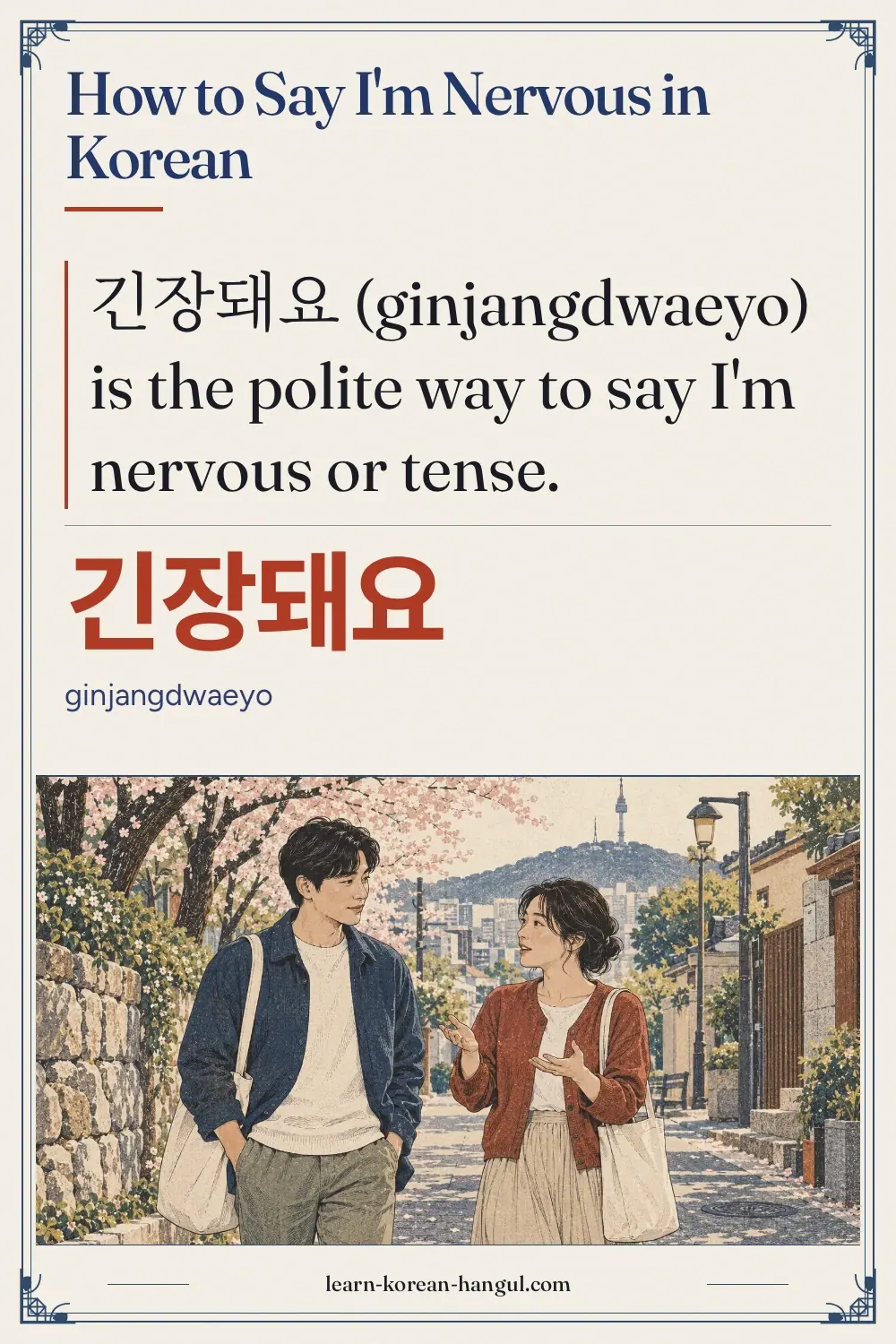
긴장돼요
긴장돼요
What you'll learn
- Say I'm nervous with 긴장돼요 and 떨려요, and tell them apart.
- Say I got nervous with 긴장했어요.
- Spell 돼요 correctly and avoid 되요.
- Pronounce 떨려요 with its held ㄹ.
Before you start: you only need to read Hangul. Once you can say you are nervous, learn how to wish someone luck with good luck in Korean. Time: about 10 minutes. Audio plays only when you press a button.
How Do You Say I'm Nervous in Korean?
The standard way to say I'm nervous in Korean is 긴장돼요. The noun 긴장 (ginjang) means tension, and 되다 (doeda) means to become. So 긴장돼요 means "tension is arising in me". Korean usually drops "I", so 긴장돼요 alone is a full sentence.
| Situation | Best form | Romanization | Why |
|---|---|---|---|
| Before an exam, interview or talk | 긴장돼요 | ginjangdwaeyo | Polite, tense |
| Hands or heart reacting | 떨려요 | tteollyeoyo | Shaking, fluttering |
| Describing a moment that passed | 긴장했어요 | ginjanghaesseoyo | Got nervous |
| Telling a close friend | 긴장돼 | ginjangdwae | Casual |
| A formal statement | 긴장됩니다 | ginjangdoemnida | Formal |
The next section sorts these forms by situation.
What Are the Polite Ways to Say I'm Nervous?
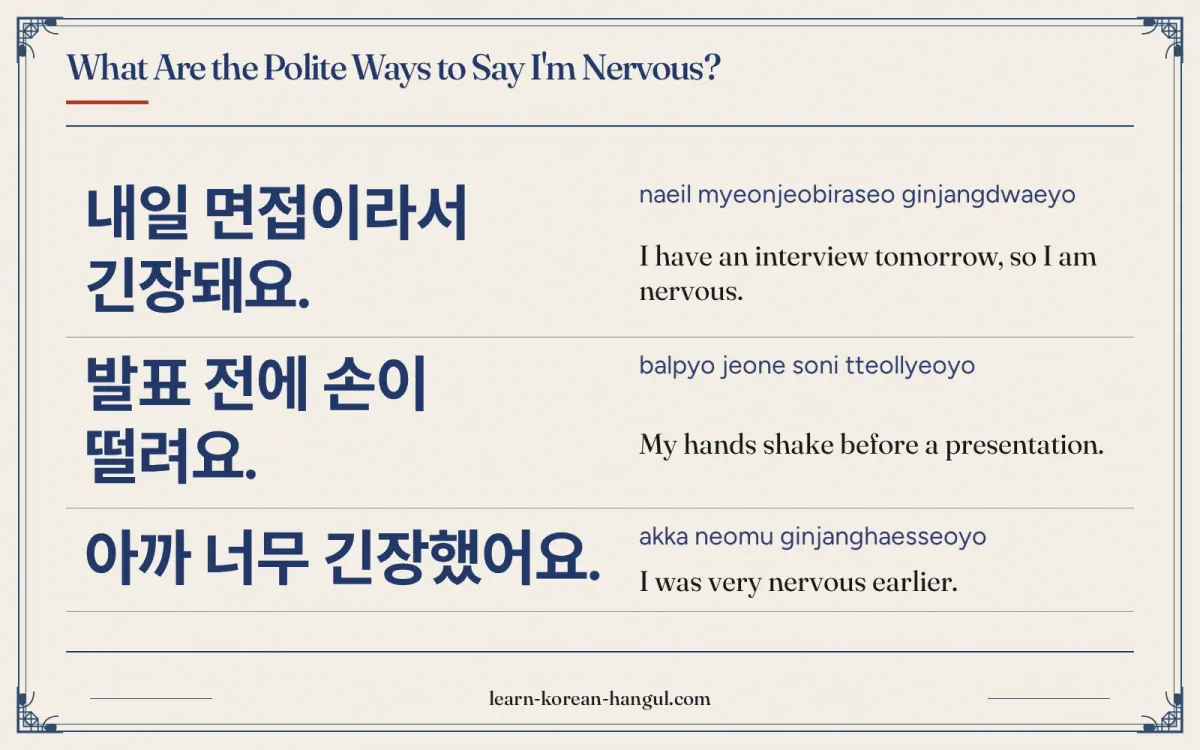
The forms below are all polite, and each one fits a different kind of nerves. The whole system of levels is in the guide to Korean speech levels.
Polite: 긴장돼요 (ginjangdwaeyo)
Polite · 해요체긴장돼요 is the form to learn first. It suits colleagues, teachers and strangers, and it is the safest choice when the feeling is about performance or pressure.
내일 면접이라서 긴장돼요.
naeil myeonjeobiraseo ginjangdwaeyo
I have an interview tomorrow, so I am nervous.
Polite: 떨려요 (tteollyeoyo)
Polite · 해요체떨려요 comes from the verb 떨리다 (tteollida), "to tremble". It names the body's reaction, so it fits trembling hands, a pounding heart or the flutter before a date. It can be an excited feeling too, which makes it warmer than 긴장돼요.
발표 전에 손이 떨려요.
balpyo jeone soni tteollyeoyo
My hands shake before a presentation.
Polite, past: 긴장했어요 (ginjanghaesseoyo)
Polite · 해요체긴장했어요 uses the verb 긴장하다 (ginjanghada) in the past. It means "I got nervous" or "I was nervous", and you use it after the event or while telling a story.
아까 너무 긴장했어요.
akka neomu ginjanghaesseoyo
I was very nervous earlier.
Casual and Formal
Casual · 반말With close friends, drop the 요 and say 긴장돼 or 떨려. Use these with friends, siblings and people younger than you.
Formal · 합쇼체The formal form is 긴장됩니다. It is rare in daily talk and appears in announcements. It is pronounced [긴장됨니다].
나 오늘 소개팅이야. 너무 떨려.
na oneul sogaetingiya. neomu tteollyeo
I have a blind date today. I am so nervous.
Behind these forms sits a spelling rule that causes many errors.
Why Is It 돼요 and Not 되요?
The verb 되다 (doeda) means "to become". Its stem is 되-, and the polite ending is -어요. When 되 and 어 meet, they contract into 돼. So 되어요 becomes 돼요, and 긴장되어요 becomes 긴장돼요.
The two letters 돼 and 되 sound almost the same for most speakers, so spelling is the hard part. A simple test:
- Try the word 해 or 하 in the same place. If 해요 fits, write 돼요.
- If 하 fits, write 되.
- 긴장하다 → 긴장해요, so the matching word is 긴장돼요.
- 하면 → 되면, so "if it becomes" is 되면.
Another helpful pair: 긴장되다 describes a feeling that arises in you, and 긴장하다 describes you becoming tense. Both exist, and 긴장돼요 sounds like a feeling while 긴장해요 sounds like an action, so many speakers prefer 긴장돼요 for the present feeling.
How Do You Pronounce 긴장돼요?
긴장돼요 is pronounced [긴장돼요], gin-jang-dwae-yo, in four syllables. It sounds as it is written.
- 긴 (gin): a soft g and a short "in".
- 장 (jang): "jahng" ending in ng.
- 돼 (dwae): a quick d, then a glide into "eh". It sounds like "dweh".
- 요 (yo): a short "yo".
Sound Changes to Listen For
These changes follow the National Institute of Korean Language standard pronunciation rules (표준 발음법):
- Double ㄹ. 떨려요 has two ㄹ sounds in a row, ㄹ at the end of 떨 and ㄹ at the start of 려, and they are pronounced as one long l. The ㄸ at the start is a tense sound that is already written, which is why romanization shows tt. See Korean tensification.
- ㅂ before ㄴ becomes ㅁ. 긴장됩니다 is [긴장됨니다] (Article 18). See Korean nasalization.
- Linking. 면접이라서 is [면저비라서], because the final ㅂ moves onto the next vowel (Article 13).
- Tense after -ㄹ. In 잘할 수, the ㅅ becomes tense: [잘할쑤] (Article 27).
With the sound clear, here is when each form fits.
When Should You Use 긴장돼요, and When Should You Not?
Use 긴장돼요 before something that matters. Use 떨려요 when your body shows it.
Situations Where It Fits
- Before an exam. 내일 시험이라서 긴장돼요 (I have a test tomorrow, so I'm nervous).
- Before a job interview. 면접 전에 긴장돼요.
- Before a date or a stage. 데이트 전에 떨려요 (I'm fluttering before a date).
Situations to Avoid
- When you mean worry. If you are anxious about a problem rather than a moment, say 걱정돼요 (geokjeongdwaeyo). See I'm worried in Korean.
- When you mean fear. For something frightening, see I'm scared in Korean.
- In a job interview itself. Saying 긴장돼요 to an interviewer is understandable, but many people prefer 조금 긴장했지만 열심히 하겠습니다 (I'm a little nervous, but I'll do my best).
Two short conversations show how it sounds.
What Does I'm Nervous Sound Like in a Real Conversation?
In real life the line is followed by encouragement. Notice the answers.
The Night before an Exam
Seoyeon
내일이 수능이야. 너무 떨려.
naeiri suneungiya. neomu tteollyeo
The exam is tomorrow. I'm so nervous.
Taeho
괜찮아, 잘할 수 있어. 파이팅!
gwaenchana, jalhal su isseo. paiting!
It's okay, you can do well. Fighting!
Seoyeon
고마워.
gomawo
Thanks.
What to notice: 떨려 is the casual form, and the friend answers a worry with 잘할 수 있어, which is encouragement, not alarm. Here 잘할 수 is pronounced [잘할쑤].
Before a Presentation
Colleague
오늘 발표죠? 긴장돼요?
oneul balpyojyo? ginjangdwaeyo?
Today's your presentation, right? Are you nervous?
Jimin
네, 조금 긴장돼요.
ne, jogeum ginjangdwaeyo
Yes, a little nervous.
Colleague
잘할 수 있어요. 파이팅!
jalhal su isseoyo. paiting!
You can do it. Fighting!
What to notice: the polite 긴장돼요 comes with 조금 (a little), which keeps the tone modest. The question 긴장돼요? is a yes/no question, so it rises at the end.
What Should You Know about the Culture behind I'm Nervous?
Exams carry great weight in Korea. Many students use 떨려요 on the day of the national college entrance exam, called 수능 (suneung), and the whole country tends to notice. Family, teachers and juniors send encouragement, and well-wishers reply 잘할 수 있어요 or 파이팅. Saying you are nervous invites encouragement, not worry.
A well-known custom is to give a student sticky treats such as 찹쌀떡 (chapssaltteok, sticky rice cake) or 엿 (yeot, taffy). The idea is that the sweet "sticks" to a good result. Whether or not a friend does this, a kind message such as 시험 잘 봐 (siheom jal bwa, do well on the exam) is welcome.
Before a talk, people calm themselves with 심호흡 (simhoheup, a deep breath) and a phrase like 긴장 풀어요 (ginjang pureoyo, relax). Telling someone 너무 긴장하지 마세요 (neomu ginjanghaji maseyo, don't be too nervous) is also common.
An expert tip: 떨려요 can also mean shivering from cold, as in 추워서 떨려요. The word is about the body shaking, so check the cause before you translate.
What Mistakes Do Learners Make with I'm Nervous in Korean?
Most mistakes come from the spelling of 돼 and from mixing nerves with worry.
| Wrong | Why it is a problem | Correct |
|---|---|---|
| 긴장되요 | The ending 되어요 contracts to 돼요 | 긴장돼요 |
| 긴장 돼요 (with a space) | 긴장되다 is one word | 긴장돼요 |
| 걱정돼요 for nervous | Means "I'm worried" | 긴장돼요 |
| 긴장 있어요 | Not a natural pattern | 긴장돼요 |
| 긴장돼 to a boss | Too casual | 긴장돼요 |
Another trap is the honorific. The ending -시- shows respect for the person you talk about, so 긴장되세요? asks an older person "are you nervous?", and you never use it about yourself.
How Do You Ask Someone If They Are Nervous?
Turn the words into a question with a rise, because this is a yes/no question. To a friend, say 긴장돼? (ginjangdwae?) or 떨려? (tteollyeo?). To a colleague, say 긴장돼요? (ginjangdwaeyo?). To an elder, use the honorific 긴장되세요? (ginjangdoeseyo?).
To ask what is making someone nervous, use a question word: 뭐가 제일 떨려요? (mwoga jeil tteollyeoyo?). The stress goes on 뭐, and the pitch falls or rises and falls, not a sharp rise. A sharp rise would turn 뭐 into "something".
Is It the Same as I Am Nervous, Nervous or Anxious?
Mostly yes. The short answers below cover the other searches folded into this page.
- I am nervous in Korean: 긴장돼요 or 떨려요.
- Nervous in Korean: before a noun, the adjective-like form is 긴장한, as in 긴장한 얼굴 (a nervous face).
- Anxious in Korean: 불안해요 (buranhaeyo) is a deeper, longer anxiety, and 걱정돼요 is worry. For a moment of nerves, 긴장돼요 is the right choice.
Related Phrases to Learn Next
- To wish someone luck, learn good luck in Korean.
- To encourage a nervous friend, say you can do it in Korean.
- To calm someone down, use don't worry in Korean.
- To tell the difference with worry, see I'm worried in Korean.
Every phrase in this group lives in the Korean feelings phrases collection.
Practice: Say It Aloud
Play the slow clip of 긴장돼요 three times and keep the glide in 돼. Then choose a phrase. Answers follow.
- You are with a close friend before an exam.
- You tell a coworker politely before a presentation.
- You tell a friend your hands are shaking.
- You are telling a story about how nervous you were.
Answers
- 나 긴장돼.
- 긴장돼요.
- 손이 떨려.
- 너무 긴장했어요.
Drill these with the phrase flashcards. Saying i'm nervous in Korean is easier when you remember the spelling 돼요 and keep it apart from worry.
Frequently Asked Questions
How do you say I'm nervous in Korean?
Say 긴장돼요 (ginjangdwaeyo) in polite speech and 긴장돼 (ginjangdwae) to a close friend. For nerves that show in your body, say 떨려요 (tteollyeoyo), which means I'm shaking or my heart is fluttering. To say you got nervous earlier, use 긴장했어요 (ginjanghaesseoyo).
How do you pronounce 긴장돼요?
긴장돼요 has four syllables, gin-jang-dwae-yo, and is pronounced [긴장돼요]. The syllable 돼 starts with a quick d and then glides to the vowel, like dwe. The sibling word 떨려요 has a tense ㄸ, which is already written, and a held double ㄹ.
What is the difference between 긴장돼요 and 떨려요?
긴장돼요 describes feeling tense and under pressure, such as before an exam, an interview or a presentation. 떨려요 stresses trembling or fluttering nerves, and it can be excited as well as scared, so it fits a date or a stage. Both are polite.
Can I use 긴장돼요 with friends, elders and strangers?
Yes. With friends use 긴장돼 or 떨려, and with elders or strangers use 긴장돼요 or 떨려요. To ask an older person, use the honorific 긴장되세요? (ginjangdoeseyo?), and do not use that honorific about yourself.
Why is it 긴장돼요 and not 긴장되요?
돼요 is the contraction of 되어요, so it is the correct spelling. 되요 is a common spelling mistake because 돼 and 되 sound almost the same. A test helps: replace the word with 하 or 해. If 해요 fits, write 돼요, and if 하 fits, write 되.
What is the most common mistake with I'm nervous in Korean?
Learners write 긴장되요 instead of 긴장돼요, or say 걱정돼요, which means I'm worried, not nervous. They also say 긴장 있어요, which is not natural. The right pattern is 긴장돼요 or 긴장했어요.