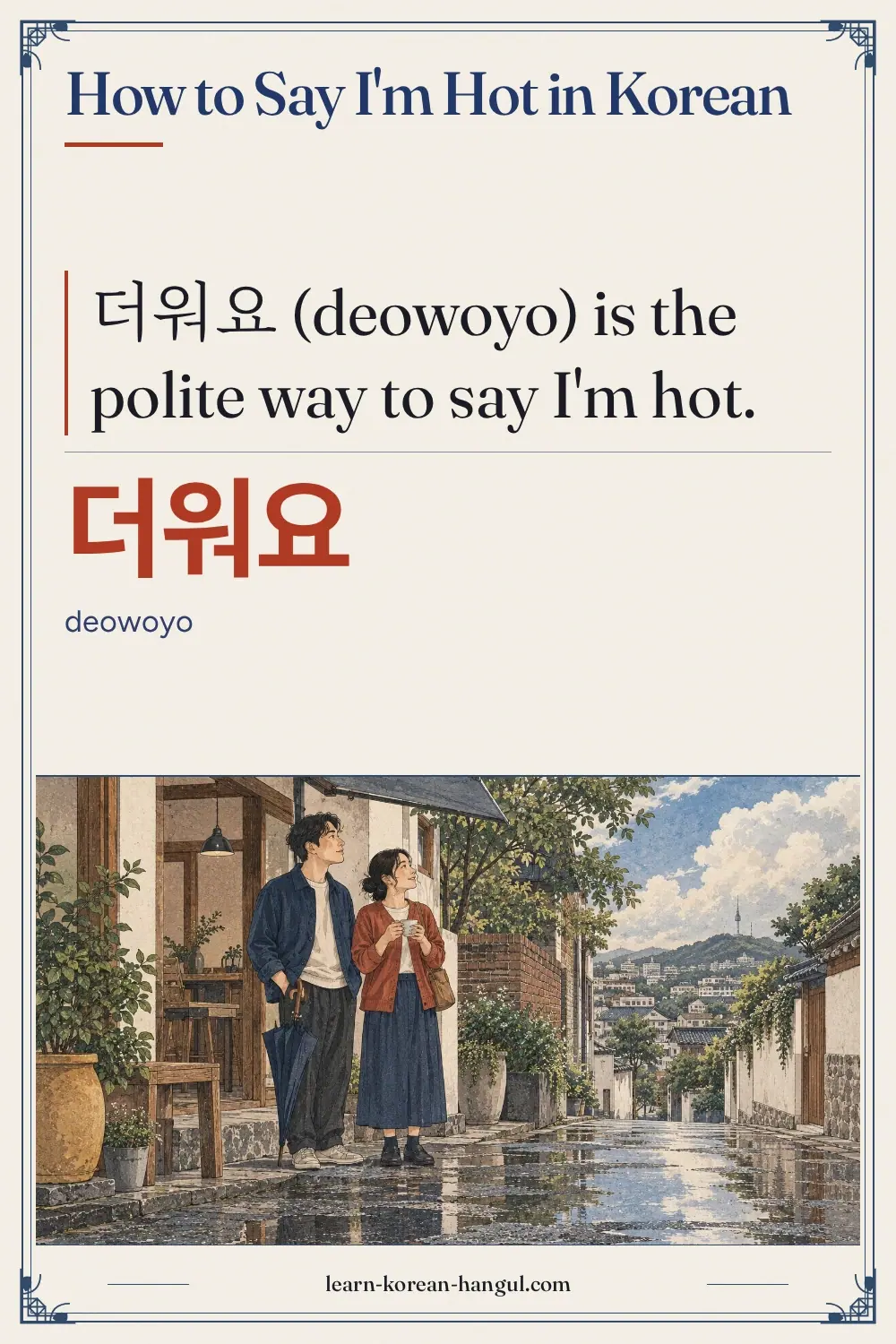
더워요
더워요
What you'll learn
- Say I'm hot with 더워요, 더워 or 너무 더워요, depending on the listener.
- Ask an elder politely whether they feel hot with 더우세요?
- Understand why 덥다 becomes 더워요 and not 덥어요.
- Tell weather heat (더워요) apart from hot food (뜨거워요) and spicy food (매워요).
Before you start: you only need to read Hangul. When you are cooling down, learn I'm cold in Korean for the opposite feeling. Time: about 10 minutes. Audio plays only when you press a button.
Key facts
- 더워 (deowo) is the casual form, and 너무 더워요 (neomu deowoyo) means it's so hot.
- 덥다 is a ㅂ irregular adjective, so the polite form is 더워요, never 덥어요.
- Hot food, drinks and objects take 뜨거워요 (tteugeowoyo), not 더워요.
How Do You Say I'm Hot in Korean?
The standard way to say I'm hot in Korean is 더워요. It describes how the temperature feels to you: the weather, a crowded subway car, a stuffy room or your own body after a walk. Korean usually drops "I", so 더워요 alone is a full sentence. It has three syllables: deo-wo-yo.
| Situation | Best form | Romanization | Why |
|---|---|---|---|
| Telling a colleague the office is warm | 더워요 | deowoyo | Polite, natural |
| Telling a close friend | 더워 | deowo | Casual |
| Very hot weather | 너무 더워요 | neomu deowoyo | So hot |
| Asking your grandmother | 더우세요? | deouseyo | Honorific question |
| Saying you are sweating | 땀이 나요 | ttami nayo | Describes the body |
The next section sorts the forms by the person you are talking to.
What Are the Polite and Casual Ways to Say I'm Hot?
The forms follow the Korean speech levels, explained in the guide to Korean speech levels. The stem 더우- stays close to the same, and the ending changes the level.
Polite: 더워요 (deowoyo)
Polite · 해요체더워요 is the form to learn first. It suits colleagues, shop staff, neighbours and older people. It is polite without sounding stiff, so you can say it in a taxi or at a family dinner.
방이 너무 더워요. 창문을 열면 시원해요.
bang-i neomu deowoyo. changmuneul yeolmyeon siwonhaeyo
The room is so hot. If we open the window, it is cool.
Casual: 더워 (deowo)
Casual · 반말더워 drops the polite 요. Use it with close friends, siblings and children. A drawn-out 더워~ is a common summer complaint among friends, usually followed by a plan to cool down.
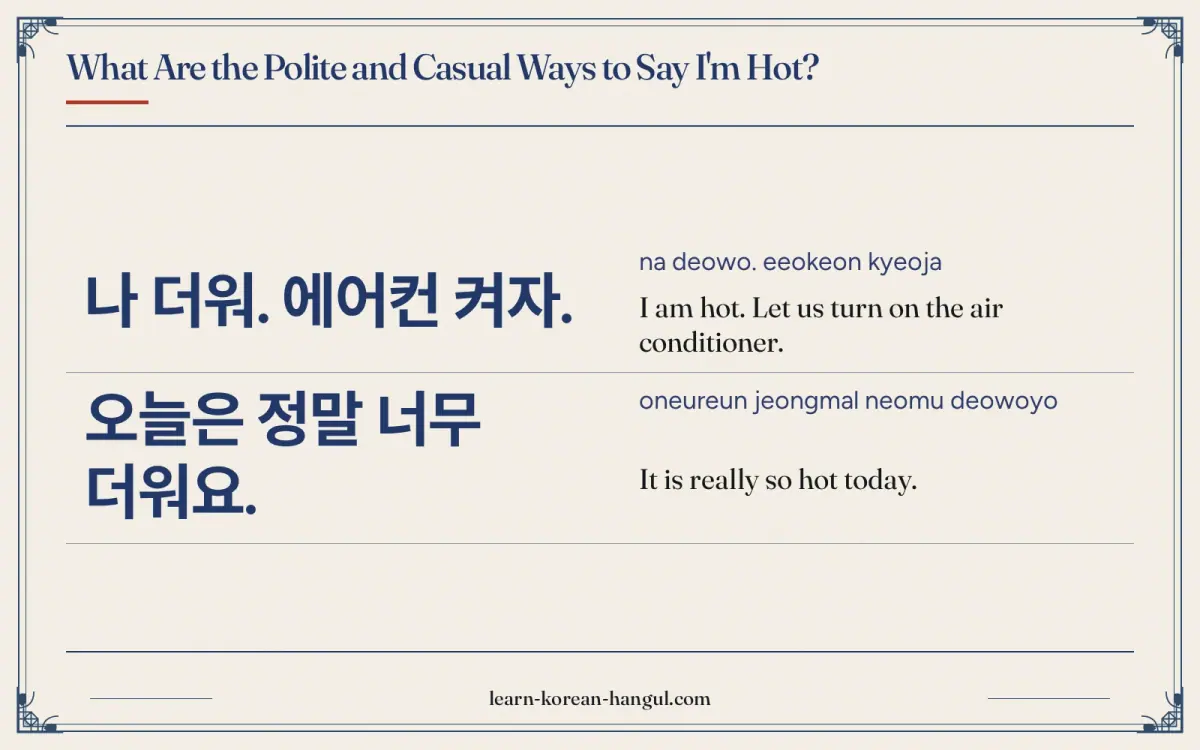
나 더워. 에어컨 켜자.
na deowo. eeokeon kyeoja
I am hot. Let us turn on the air conditioner.
Polite: 너무 더워요 (neomu deowoyo)
Polite · 해요체너무 means "very" or "too" and is the everyday way to add strength. 너무 더워요 says the heat is more than comfortable. Another everyday word is 진짜 (jinjja, really): 진짜 더워요. Neither word changes the politeness level; the ending 요 does that.
오늘은 정말 너무 더워요.
oneureun jeongmal neomu deowoyo
It is really so hot today.
Formal: 덥습니다 (deopseumnida)
Formal · 합쇼체덥습니다 is the formal form. You hear it in weather reports and announcements, and you will rarely need it in conversation. It is pronounced [덥씀니다]: the 습 is tense after the ㅂ, and the ㅂ of 습 then turns into ㅁ before ㄴ. The grammar behind 더워요 is next.
Why Does 덥다 Become 더워요?
덥다 is a ㅂ irregular adjective. When the stem ends in ㅂ and the next ending starts with a vowel, the ㅂ becomes 우 (u) and joins the ending. So 덥 + 어요 turns into 더워요, and the written form 덥어요 is wrong. The same change gives the forms below.
- 덥다 → 더워요 (hot)
- 춥다 → 추워요 (cold)
- 뜨겁다 → 뜨거워요 (hot to the touch)
- 어렵다 → 어려워요 (difficult)
Before a consonant, the ㅂ stays, so the formal form is 덥습니다 and the plain negative is 덥지 않아요 (deopji anayo). Before the honorific -(으)세요, the ㅂ also becomes 우: 더우세요 (deouseyo). Next, the pronunciation.
How Do You Pronounce 더워요?
더워요 is pronounced [더워요] and has three syllables: deo-wo-yo. It sounds just like it is written.
- 더 (deo): the vowel ㅓ is unrounded, so keep your lips relaxed, not round like "oh".
- 워 (wo): start with a quick w, then the same open ㅓ sound.
- 요 (yo): "yo".
Sound Changes to Listen For
The one change to know is on the dictionary form. It follows the National Institute of Korean Language standard pronunciation rules (표준 발음법, Article 23).
- Tense ㄷ after ㅂ. 덥다 is [덥따]: after the final ㅂ, the next ㄷ becomes tense ㄸ. RR shows the plain spelling deopda, because it does not show tensing caused by a neighbouring sound. See Korean tensification.
- No change in 더워요. Once the ㅂ has become 우, there is no final consonant left, so nothing else changes.
With the sound clear, here is when to use each form.
When Should You Use 더워요, and When Should You Not?
Use 더워요 when the temperature around you, or your own body temperature, is uncomfortable. It also works as a gentle hint that you want a fan, a window or the air conditioner.
Situations Where It Fits
- A summer commute. 지하철이 너무 더워요. (The subway is so hot.)
- A restaurant on a warm night. 여기 좀 더워요. (It is a bit hot here.)
- Exercise or a hike. 걸으니까 더워요. (I'm hot because I'm walking.)
Situations to Avoid
- Hot food or drink. Use 뜨거워요 (tteugeowoyo): 국이 뜨거워요, the soup is hot.
- Spicy food. Use 매워요 (maewoyo): 김치찌개가 매워요, the kimchi stew is spicy.
- Complaining to a host. In someone's home, a polite question such as 에어컨을 켜도 될까요? (may I turn on the air conditioner?) works better than a flat 더워요.
- Looks. The English slang "hot" for an attractive person does not exist in 더워요. People say 잘생겼어요 (jalsaenggyeosseoyo, handsome) or 예뻐요 (yeppeoyo, pretty) for looks.
Two short conversations show how it sounds.
What Does I'm Hot Sound Like in a Real Conversation?
In real life, the line is followed by a plan to cool down. Notice the answers.
Friends on a Summer Afternoon
Minsu
나 너무 더워. 아이스크림 먹으러 갈래?
na neomu deowo. aiseukeurim meogeureo gallae?
I'm so hot. Do you want to go and eat ice cream?
Yuna
좋아! 나도 더워.
joa! nado deowo
Great! I'm hot too.
What to notice: the casual 더워 comes with a suggestion, and the reply 나도 더워 means "me too".
A Warm Office
Colleague
과장님, 사무실이 좀 더워요.
gwajangnim, samusiri jom deowoyo
Manager, the office is a bit hot.
Manager
그래요? 에어컨을 켜세요.
geuraeyo? eeokeoneul kyeoseyo
Is it? Please turn on the air conditioner.
Colleague
네, 감사합니다.
ne, gamsahamnida
Yes, thank you.
What to notice: the colleague uses the polite 더워요 and adds 좀 (a bit) to soften the complaint, and the manager answers with the honorific 켜세요.
How Do You Ask Someone Whether They Are Hot?
To a friend, say 더워? (deowo?) with a rising voice. To a colleague or stranger, say 더워요? (deowoyo?). To an elder, use the honorific 더우세요? (deouseyo?), which adds the respectful -시- to the stem. The honorific shows respect for the person you ask, so never use it for yourself.
| Listener | Question | Romanization |
|---|---|---|
| Close friend | 더워? | deowo |
| Colleague | 더워요? | deowoyo |
| Elder or customer | 더우세요? | deouseyo |
What Should You Know about the Culture behind I'm Hot?
Korean summers are hot and humid, especially after the rainy season (장마, jangma) ends. Weather is a standard topic of small talk, and 오늘 진짜 더워요 is a perfectly normal way to start a conversation with a neighbour or a colleague.
There is also a food tradition. On three days in the hottest part of summer, called 복날 (bongnal, pronounced [봉날]), many Koreans eat hot 삼계탕 (samgyetang, ginseng chicken soup). The idea is 이열치열 (iyeolchiyeol), fighting heat with heat. It sounds odd at first, and it explains why 뜨거워요 and 더워요 often appear in the same meal.
- Air conditioning. Many cafes, shops and subway cars are cool in summer, so people carry a thin jacket.
- Fans and handheld fans. A small handheld fan is a common summer item, and offering to share one is friendly.
- Cold drinks. 아이스 아메리카노 (iced Americano) is a standard answer to 더워요.
These are general habits rather than rules, and individual families differ.
What Mistakes Do Learners Make with I'm Hot in Korean?
Most mistakes come from the ㅂ irregular and from mixing up heat words.
| Mistake | Why it is a problem | Fix |
|---|---|---|
| 덥어요 | The ㅂ must change to 우 | Say 더워요 |
| 뜨거워요 for the weather | 뜨거워요 is for objects, food and water | Say 더워요 |
| 더워요 for spicy food | Spice is 매워요 | Say 매워요 |
| 더워 to an elder | Too casual | Say 더워요 or ask 더우세요? |
| 더우세요 for yourself | The honorific is for others | Say 더워요 |
Learners also forget the tense. For something that was hot earlier, such as yesterday, use the past 더웠어요 (deowosseoyo): 어제 정말 더웠어요, it was really hot yesterday. You can add a place or a subject too, as in 날씨가 더워요 (nalssiga deowoyo, the weather is hot).
Is It the Same as Hot, It's Hot or I'm Sweating?
Mostly. The short answers below cover the other searches folded into this page.
- Hot in Korean: 더워요 for temperature, 뜨거워요 for the touch and 매워요 for spice. Before a noun, use 더운 (deoun), as in 더운 날씨 (hot weather).
- It's hot in Korean: 날씨가 더워요 (the weather is hot), or just 더워요 if the context is clear.
- I'm sweating in Korean: 땀이 나요 (ttami nayo, sweat comes out). It is pronounced [따미 나요]. Add 많이 for a lot: 땀이 많이 나요.
Now practise aloud.
Practice: Say It Aloud
Play the slow clip of 더워요 three times and keep the ㅓ relaxed. Then choose a phrase. Answers follow.
- You are with a close friend on a hot day.
- You tell a colleague politely.
- You want to ask your grandmother.
- Your soup is too hot to eat. Which word do you use?
Answers
- 더워.
- 더워요.
- 더우세요?
- 뜨거워요.
The phrase flashcards drill these lines with audio.
Related Phrases to Learn Next
Heat leads to the opposite feeling and to drinks.
- I'm cold in Korean: 추워요 when the temperature drops.
- I'm thirsty in Korean: 목말라요 when you need a drink.
- Korean speech levels: the full picture of formal, polite and casual endings.
This guide belongs to the Korean feelings phrases collection. What this page does not cover: weather vocabulary, seasons and the full set of temperature adjectives. Remember that the ㅂ changes to 우, pick a level, and add 너무 for emphasis, and you can say i'm hot in Korean naturally.
Frequently Asked Questions
How do you say i'm hot in Korean?
Say 더워요 (deowoyo) in polite speech. It is the form to learn first, and it suits colleagues, shop staff and anyone you do not know well. With a close friend, say 더워 (deowo). For a stronger feeling, add 너무: 너무 더워요 (neomu deowoyo) means it's so hot.
How do you pronounce 더워요?
더워요 has three syllables, deo-wo-yo, and it sounds as it is written: [더워요]. Keep the ㅓ relaxed, with unrounded lips, and glide through 워 into 요. The dictionary form 덥다 is different: it is pronounced [덥따], with a tense ㄷ after the final ㅂ.
What is the difference between 더워요 and 더워?
Both mean I'm hot. 더워요 ends in the polite 요 and fits almost everyone. 더워 drops 요 and is casual speech for close friends, siblings and children. Using 더워 to a boss, a teacher or an older stranger would sound too familiar, so add 요 whenever you are unsure.
Is 더워요 formal or casual?
It is polite, which sits in the middle. Formal speech uses 덥습니다 (deopseumnida), which you hear in announcements, and casual speech uses 더워. In daily life 더워요 is safe in almost every situation, because it is warm without being stiff.
Can I use 더워요 with friends, elders and strangers?
Yes, with all three. 더워요 is polite enough for strangers and elders, and friends will understand it too, although they may prefer 더워. Remember that 더워요 is about your own feeling. To ask an elder whether they feel hot, use the honorific question 더우세요?
What is the most common mistake with i'm hot in Korean?
Learners say 뜨거워요 for the weather, but 뜨거워요 is for hot objects, food and water. The second slip is 덥어요, which forgets that 덥다 is a ㅂ irregular. The correct polite form is 더워요, and a hot day is 날씨가 더워요 or simply 더워요.