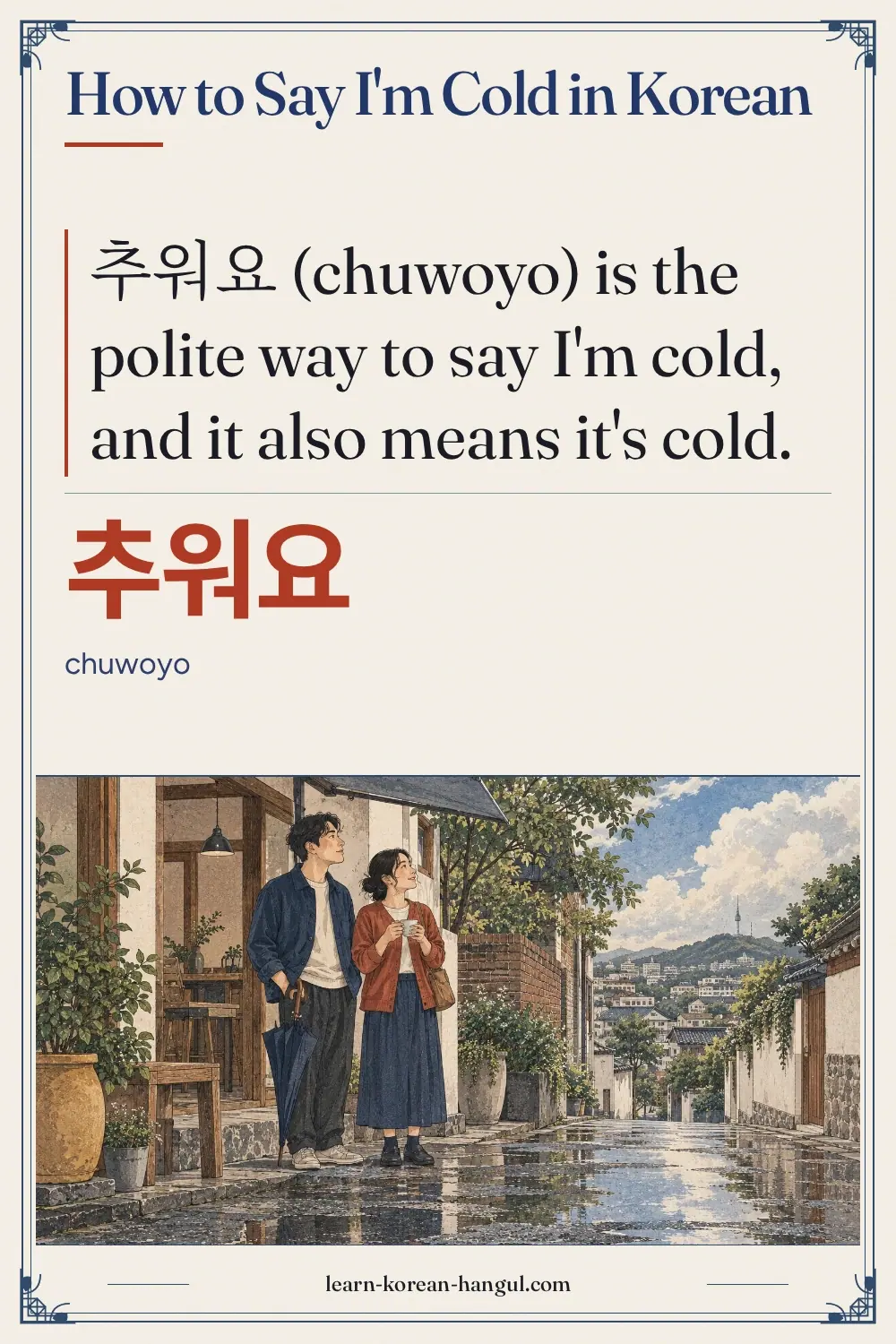
추워요
추워요
What you'll learn
- Say I'm cold with 추워요, 춥습니다 or 추워, depending on the listener.
- Tell cold weather apart from a cold object, with 춥다 and 차갑다.
- See why 춥- becomes 추워- and not 춥어요.
- Pronounce 춥습니다 as [춥씀니다].
Before you start: you only need to read Hangul. When the summer comes, learn I'm hot in Korean. Time: about 10 minutes. Audio plays only when you press a button.
How Do You Say I'm Cold in Korean?
The standard way to say I'm cold in Korean is 추워요. Korean does not need a dummy "it" or "I", so the same short word covers "I'm cold" and "it's cold". Context tells the listener which one you mean. Say 오늘 추워요 for "it's cold today" and 저 추워요 for "I'm cold".
| Situation | Best form | Romanization | Why |
|---|---|---|---|
| Telling a colleague or a stranger | 추워요 | chuwoyo | Polite, natural |
| Telling a close friend | 추워 | chuwo | Casual |
| A weather report or a formal talk | 춥습니다 | chupseumnida | Formal |
| Very cold | 너무 추워요 | neomu chuwoyo | So cold |
| Freezing | 얼어 죽겠어요 | eoreo jukgesseoyo | Exaggeration |
The next section sorts these by listener.
What Are the Formal, Polite and Casual Ways to Say I'm Cold?
The forms follow the Korean speech levels, explained in the guide to Korean speech levels. Here the meaning stays the same and the ending changes.
Polite: 추워요 (chuwoyo)
Polite · 해요체추워요 is the form to learn first. It suits family, coworkers and strangers. You can say it to a taxi driver to ask for the heater or to a friend who is walking beside you.
오늘 바람이 불어서 너무 추워요.
oneul barami bureoseo neomu chuwoyo
It's so cold today because the wind is blowing.
Casual: 추워 (chuwo)
Casual · 반말추워 drops the polite ending. Use it with close friends, siblings and children. A whining 추워~ is a cute way to ask for a jacket.
나 너무 추워, 문 좀 닫아 줘.
na neomu chuwo, mun jom dada jwo
I'm so cold, please close the door.
Formal: 춥습니다 (chupseumnida)
Formal · 합쇼체춥습니다 is the formal form. It appears in weather reports and speeches, as in 내일은 아침 기온이 낮아 춥습니다 (tomorrow it is cold because the morning temperature is low). In daily life you will not need it often. It is pronounced [춥씀니다].
Strong: 얼어 죽겠어요 (eoreo jukgesseoyo)
Polite · 해요체얼어 죽겠어요 literally means "I will freeze to death". It is a playful exaggeration for "I'm freezing". The pattern -아/어 죽겠어요 is common for strong feelings, so you will also hear 더워 죽겠어요 for very hot. It is pronounced [어러 죽께써요].
밖에서 한 시간 기다렸더니 얼어 죽겠어요.
bakkeseo han sigan gidaryeotdeoni eoreo jukgesseoyo
I waited outside for an hour, so I'm freezing.
The forms look regular, but 춥다 hides a small grammar rule.
Why Does 춥다 Become 추워요?
춥다 is a ㅂ-irregular adjective. Its stem is 춥-. Before a vowel ending, the final ㅂ turns into 우 and then joins the ending: 춥 + 어요 → 추우 + 어요 → 추워요. The past tense is 추웠어요 (chuwosseoyo), and "because I'm cold" is 추워서 (chuwoseo).
- 춥다 → 추워요 (cold)
- 덥다 → 더워요 (hot)
- 쉽다 → 쉬워요 (easy)
- 어렵다 → 어려워요 (difficult)
The ㅂ stays before a consonant, so you get 춥지 않아요 (it's not cold) and 춥고 (cold and ...). A small number of ㅂ-ending words are regular, such as 입다 (입어요, to wear) and 좁다 (좁아요, narrow). You learn those as exceptions. Next, the pronunciation.
How Do You Pronounce 추워요?
추워요 is pronounced [추워요], chu-wo-yo, in three syllables. The vowel in the middle, ㅝ, is a quick glide: say "oo" and slide straight into "wuh". The ㅓ in it is unrounded. The lips start rounded for the glide and then relax.
- 추 (chu): an aspirated ch with a puff of air, then "oo".
- 워 (wo): "wuh" with a short glide.
- 요 (yo): "yo".
Sound Changes to Listen For
These notes follow the National Institute of Korean Language standard pronunciation rules (표준 발음법):
- Tense after ㅂ. In 춥습니다 the ㅅ after the final ㅂ becomes tense, and the ㅂ before ㄴ in 니다 becomes ㅁ, giving [춥씀니다] (Articles 23 and 18). Revised Romanization shows the nasal change but not the tensing, so you see chupseumnida. See Korean tensification and Korean nasalization.
- The final ㅆ moves forward. 추웠어요 is [추워써요].
- No change in 추워요 itself. Say it as spelled.
With the sound clear, here is when each form fits.
When Should You Use 추워요, and When Should You Not?
Use 추워요 when you feel cold or want to comment on the weather. With someone senior, do not pair it with a blunt command; turn the request into a polite question.
Situations Where It Fits
- Walking outside in winter. 오늘 진짜 추워요. (It's really cold today.)
- Indoors, hinting politely. 여기 좀 추워요. (It's a bit cold in here.)
- Small talk. 날씨가 많이 추워졌어요. (The weather has become much colder.)
Situations to Avoid
- Ordering a senior to fix it. 추워요, 에어컨 꺼요 is too blunt. Ask 에어컨 좀 꺼 주실 수 있어요? (could you turn off the air conditioning?).
- Talking about a cold drink. Use 차가워요 or 시원해요 instead; see the mistakes table.
- A formal announcement. Use 춥습니다.
Two short conversations show how it sounds.
What Does I'm Cold Sound Like in a Real Conversation?
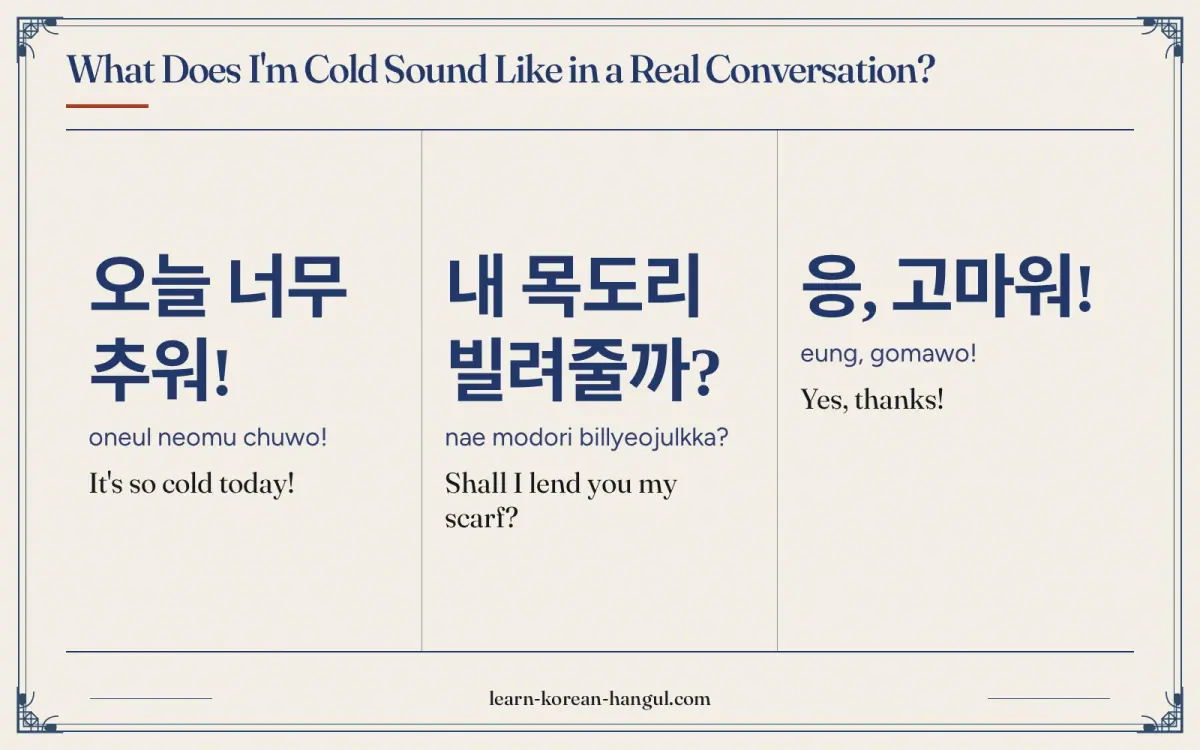
In real life, the line is followed by an offer or a request. Notice the answers.
At the Bus Stop
Jiwon
오늘 너무 추워!
oneul neomu chuwo!
It's so cold today!
Hyunwoo
내 목도리 빌려줄까?
nae modori billyeojulkka?
Shall I lend you my scarf?
Jiwon
응, 고마워!
eung, gomawo!
Yes, thanks!
What to notice: the casual 추워 gets a kind offer, and the answer 응 is casual too.
In a Café
Customer
저기요, 좀 추워요. 에어컨 좀 꺼 주실 수 있어요?
jeogiyo, jom chuwoyo. eeokeon jom kkeo jusil su isseoyo?
Excuse me, it's a bit cold. Could you turn off the air conditioning?
Staff
네, 바로 끌게요.
ne, baro kkeulgeyo
Yes, I'll turn it off right away.
Customer
감사합니다.
gamsahamnida
Thank you.
What to notice: the customer states the feeling first, then makes a polite request with the honorific 주실. The staff member answers with a promise ending, 끌게요.
What Should You Know about the Culture behind I'm Cold?
Korean winters can be sharply cold, so talking about the cold is a normal way to start a conversation. Many homes use floor heating called 온돌 (ondol), and people often sit on the warm floor in winter. A common greeting in cold weather is 오늘 많이 춥죠? (it's very cold today, isn't it?), and the polite reply is 네, 정말 춥네요.
- Offering warmth. Hearing 추워요 often leads to an offer of a coat, a scarf or a hot drink.
- Seasonal talk. People mention the cold to open a chat with neighbours and colleagues.
- Caring words. 감기 조심하세요 (gamgi josimhaseyo, take care not to catch a cold) is a kind reply.
You may also hear 추위를 타요 (chuwireul tayo), which means "I feel the cold easily". It describes a person, not the weather. The next section covers the mistakes learners make.
What Mistakes Do Learners Make with I'm Cold in Korean?
Most mistakes come from the ㅂ-irregular stem and from words that look similar.
| Mistake | Why it is a problem | Fix |
|---|---|---|
| 춥어요 | The ㅂ must change | Say 추워요 |
| 추어요 | The ㅂ turns into 우, and 우 + 어 must join as 워 | Say 추워요 |
| 차가워요 for the weather | 차갑다 is cold to the touch | Say 추워요 |
| [춥스니다] for the formal form | The ㅅ is tense and the ㅂ is nasal | Say [춥씀니다] |
| 추워 to an elder | Too casual | Say 추워요 |
The pair 춥다 and 차갑다 matters most. 춥다 describes the air, the weather and how your body feels. 차갑다 describes things you touch: water, a drink, a handle or a hand. So you say 오늘 추워요 for the day, 물이 차가워요 for the water and 손이 차가워요 for cold hands.
How Do You Ask Someone If They Are Cold?
Raise your voice at the end for a yes/no question. To a friend, say 추워? (chuwo?). To a colleague or stranger, say 추워요? (chuwoyo?). To an elder, use the honorific 추우세요? (chuuseyo?), which adds -(으)시- to the stem. The honorific shows respect for the person you ask, so never use it for yourself.
| Listener | Question | Romanization |
|---|---|---|
| Close friend | 추워? | chuwo |
| Colleague | 추워요? | chuwoyo |
| Elder or customer | 추우세요? | chuuseyo |
A helpful follow-up is 담요 드릴까요? (damnyo deurilkkayo, shall I give you a blanket?). The answer can be 괜찮아요, 안 추워요 (I'm fine, I'm not cold).
Is It the Same as I'm Freezing, It's Cold or Cold?
Mostly yes. The short answers below cover the other searches folded into this page.
- I'm freezing in Korean: 얼어 죽겠어요 or 너무 추워요.
- It's cold in Korean: 추워요 or 날씨가 추워요. There is no separate "it".
- Cold in Korean: 추운 (chuun) before a noun, as in 추운 날씨 (cold weather). For a cold object, use 차가운. The full word guide for cold in Korean explains the difference.
- It's not cold: 안 추워요 or 춥지 않아요.
- It's getting colder: 추워지고 있어요.
Now practise aloud.
Practice: Say It Aloud
Play the slow clip of 추워요 three times and keep the glide smooth. Then choose a phrase. Answers follow.
- You are with a friend and shivering.
- You tell a coworker politely.
- You read out a weather report in formal speech.
- You ask your grandmother if she is cold.
Answers
- 추워.
- 추워요.
- 춥습니다.
- 추우세요?
The phrase flashcards drill these lines with audio.
Related Phrases to Learn Next
Cold leads to its opposite and to tiredness.
- I'm hot in Korean: 더워요 for summer.
- I'm tired in Korean: 피곤해요 after a long day outside.
- How's the weather in Korean: 오늘 날씨 어때요? to start a chat.
This guide belongs to the Korean feelings phrases collection. What this page does not cover: the seasons, clothing words and temperature numbers. Remember that the ㅂ turns into 우, choose 춥다 for the air and 차갑다 for things you touch, and you can say i'm cold in Korean naturally.
Frequently Asked Questions
How do you say I'm cold in Korean?
Say 추워요 (chuwoyo) in polite speech, 추워 (chuwo) to a close friend and 춥습니다 (chupseumnida) in formal speech. The word comes from the adjective 춥다. Korean has no dummy "it", so 추워요 covers both "I'm cold" and "it's cold", and context decides which one you mean.
How do you say I'm freezing in Korean?
Say 너무 추워요 for "I'm so cold" and 얼어 죽겠어요 (eoreo jukgesseoyo) for "I'm freezing". The second form means "I will freeze to death" and is a playful exaggeration, not a dark remark. It is pronounced [어러 죽께써요]. Use it with friends, family and in light talk with colleagues.
Why is it 추워요 and not 춥어요?
춥다 is a ㅂ-irregular adjective. Before a vowel ending, its final ㅂ turns into 우, and 우 + 어 joins to 워. So 춥 + 어요 becomes 추워요. The ㅂ stays before consonants, as in 춥지 않아요. Hot and easy follow the same pattern: 더워요 and 쉬워요.
What is the difference between 춥다 and 차갑다?
춥다 describes cold air, weather and the way your body feels, as in 오늘 추워요. 차갑다 describes cold things you touch, such as water, ice or a hand, as in 물이 차가워요. Using 차가워요 for the weather sounds odd to Korean listeners, so keep 춥다 for the day and 차갑다 for objects.
How do I ask someone if they are cold in Korean?
To a friend, say 추워?. To a colleague, say 추워요?. To an elder or a customer, say 추우세요?, which uses the honorific -(으)시- to show respect for the listener. Raise your voice a little at the end. You can add 담요 드릴까요? (shall I give you a blanket?) to be helpful.
How do you pronounce 춥습니다?
It is pronounced [춥씀니다]. The ㅅ after ㅂ becomes tense (Article 23), and the ㅂ in 습 turns into ㅁ before the ㄴ of 니다 (Article 18). Revised Romanization writes chupseumnida, showing the nasal change but not the tensing.