목말라요
목말라요
What you'll learn
- Say I'm thirsty with 목말라요, 목말라 or 목마릅니다, depending on the listener.
- Follow it with a polite request for water.
- Understand why 마르다 becomes 말라요.
- Pronounce 목말라요 as [몽말라요].
Before you start: you only need to read Hangul. For the matching hunger phrase, see I'm hungry in Korean. Time: about 10 minutes. Audio plays only when you press a button.
How Do You Say I'm Thirsty in Korean?
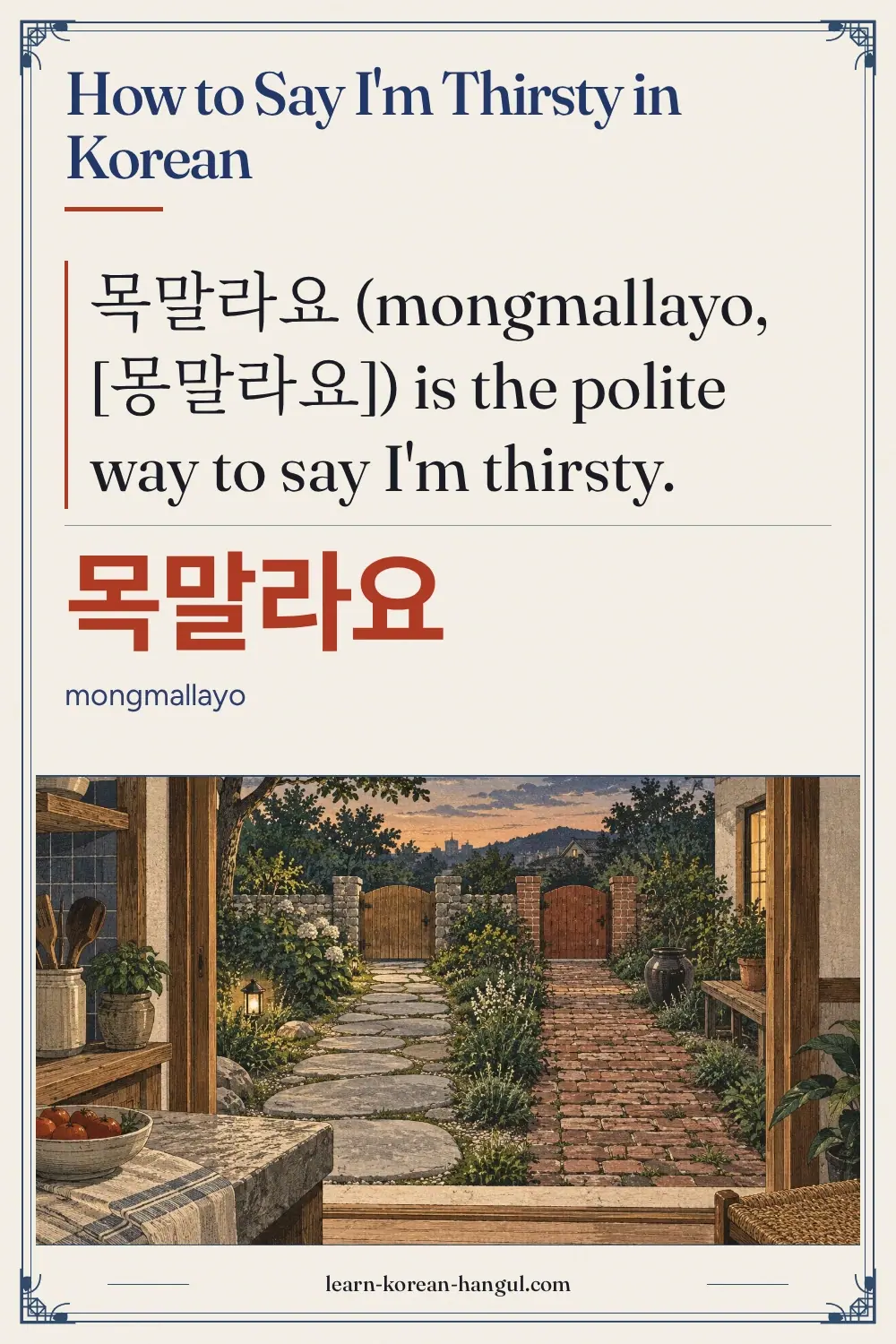
The standard way to say I'm thirsty in Korean is 목말라요. The word 목 (mok) means throat or neck, and 마르다 (mareuda) means to dry out. So the literal meaning is "my throat is dry". Korean usually drops "I", so 목말라요 alone is a full sentence.
| Situation | Best form | Romanization | Why |
|---|---|---|---|
| Telling a colleague or a waiter | 목말라요 | mongmallayo | Polite, natural |
| Telling a close friend | 목말라 | mongmalla | Casual |
| Explaining the cause, with a subject | 목이 말라요 | mogi mallayo | The throat is dry |
| A formal statement | 목마릅니다 | mongmareumnida | Formal |
| Asking for water next | 물 좀 주세요 | mul jom juseyo | Polite request |
The next section sorts these forms by listener.
What Are the Polite, Formal and Casual Ways to Say I'm Thirsty?
The stem stays the same and the ending changes with the speech level. The whole system is in the guide to Korean speech levels.
Polite: 목말라요 (mongmallayo)
Polite · 해요체목말라요 is the form to learn first. It suits family, colleagues, waiters and strangers. The past tense is 목말랐어요 (mongmallasseoyo), "I was thirsty".
운동하고 나서 너무 목말라요.
undonghago naseo neomu mongmallayo
After exercising I am so thirsty.
Polite with a Subject: 목이 말라요 (mogi mallayo)
Polite · 해요체목이 말라요 means exactly the same, but the particle 이 marks 목 (throat) as the subject. It is a little fuller and is useful when you want to add a word before it, as in 목이 너무 말라요. It is pronounced [모기 말라요], with the final ㄱ linking to the next syllable.
Casual: 목말라 (mongmalla)
Casual · 반말목말라 drops the polite ending. Use it with close friends, siblings and children. It often comes with a request.
나 목말라. 물 좀 줘.
na mongmalla. mul jom jwo
I am thirsty. Give me some water.
Formal: 목마릅니다 (mongmareumnida)
Formal · 합쇼체목마릅니다 is the formal form. In daily life you will rarely need it, but you may hear it in a broadcast or a speech. It is pronounced [몽마름니다]. The stem keeps its 르, because the formal ending begins with a consonant.
Asking for Water: 물 좀 주세요 (mul jom juseyo)
Polite · 해요체After 목말라요, a natural next line is 물 좀 주세요, "please give me some water". The small word 좀 softens the request. The full phrase is on its own page, water please in Korean.
목말라서 물을 두 잔 마셨어요.
mongmallaseo mureul du jan masyeosseoyo
I was thirsty, so I drank two glasses of water.
Behind these forms sits one grammar rule.
Why Does 마르다 Become 말라요?
마르다 is a 르 irregular verb. When 아 or 어 follows, the 르 splits: the ㄹ moves back to the previous syllable and a second ㄹ starts the ending. So 마르 + 아요 becomes 말라요. The ending is 아 because the vowel before 르 is ㅏ, as in 마. If that vowel were anything else, the ending would be 어, as in 부르다 → 불러요 (to call).
- 마르다 → 말라요 (dry, thirsty)
- 모르다 → 몰라요 (not know)
- 다르다 → 달라요 (different)
- 빠르다 → 빨라요 (fast)
Before a consonant ending, nothing changes, which gives the formal 목마릅니다. Before the modifier ending -(으)ㄴ it is 목마른, as in 목마른 사람 (a thirsty person).
How Do You Pronounce 목말라요?
목말라요 is pronounced [몽말라요], mong-mal-la-yo, in four syllables. The spelling and the sound differ at the first border.
- 목 (mok): the final ㄱ is a closed stop that you do not release.
- 말 (mal): a clear ㅁ followed by "al".
- 라 (la): the ㄹ of 말 and the ㄹ of 라 meet and make a held ㄹ, so you hear one long l.
- 요 (yo): a short "yo".
Sound Changes to Listen For
These changes follow the National Institute of Korean Language standard pronunciation rules (표준 발음법):
- ㄱ before ㅁ becomes ㅇ. 목말라요 is [몽말라요] (Article 18). The same thing happens in 목마릅니다, which is [몽마름니다]. See Korean nasalization.
- ㅂ before ㄴ becomes ㅁ. In 목마릅니다, the ㅂ of 릅 turns into ㅁ before the ㄴ of 니다 (Article 18).
- Linking. In 목이, the final ㄱ moves to the next syllable and the phrase 목이 말라요 sounds like [모기 말라요] (Article 13).
The long ㄹ in 말라 is easy to shorten by mistake, so listen to the slow clip.
When Should You Use 목말라요, and When Should You Not?
Use 목말라요 when you want a drink or want someone to notice you are dry. Do not use it as a hint at a formal visit.
Situations Where It Fits
- After sports or a hike. 산에 올라가서 목말라요 (I climbed the mountain, so I'm thirsty).
- At a restaurant. 목말라요, 물 좀 주세요.
- With a friend on a hot day. 나 목말라. 뭐 마실래? (I'm thirsty. What shall we drink?)
Situations to Avoid
- A formal dinner at someone's home. Wait until the host offers a drink, then accept politely.
- A phone call or a meeting. Ask for water at a break.
- A sore throat. Do not say 목말라요 when you mean your throat hurts. Say 목이 아파요.
Two short conversations show how it sounds.
What Does I'm Thirsty Sound Like in a Real Conversation?
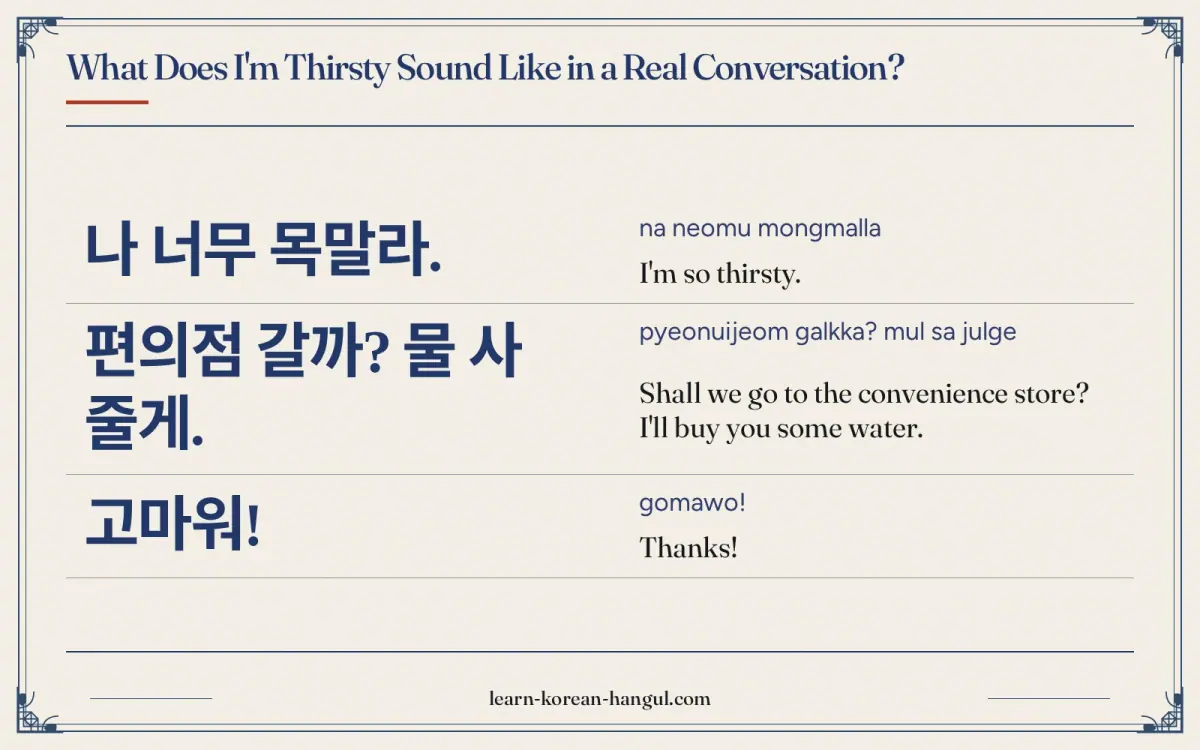
In real life the line is followed by a plan. Notice the answers.
A Walk with a Friend
Minji
나 너무 목말라.
na neomu mongmalla
I'm so thirsty.
Junho
편의점 갈까? 물 사 줄게.
pyeonuijeom galkka? mul sa julge
Shall we go to the convenience store? I'll buy you some water.
Minji
고마워!
gomawo!
Thanks!
What to notice: 줄게 ([줄께]) is the casual way to promise something, and the friend answers a complaint with an offer.
At a Restaurant
Customer
저 목말라요. 시원한 물 좀 주세요.
jeo mongmallayo. siwonhan mul jom juseyo
I'm thirsty. Some cold water, please.
Staff
네, 바로 갖다 드릴게요.
ne, baro gatda deurilgeyo
Yes, I'll bring it right away.
Customer
감사합니다.
gamsahamnida
Thank you.
What to notice: the customer pairs the feeling with a clear request, and the staff member uses a polite promise ending, -ㄹ게요, pronounced [드릴께요].
What Should You Know about the Culture behind I'm Thirsty?
In most Korean restaurants, water is free, and you often serve yourself from a dispenser or a cooler. Signs that say 물은 셀프 (mureun selpeu, water is self-service) are common. So if you are thirsty, the first thing to do may be to look around for the dispenser, not to ask. In a restaurant where staff bring water, asking with 물 좀 주세요 is normal.
Many homes keep barley tea, called 보리차 (boricha), in the fridge as the everyday drink. It is mild and served cold in summer and warm in winter. A host who says 뭐 좀 마실래요? (mwo jom masillaeyo?) is asking what you would like to drink, and a polite answer is 물 주세요 or 보리차 주세요.
An expert tip: for extreme thirst Koreans say 목이 타요 (mogi tayo), "my throat is burning", which is stronger than 목말라요. It is an everyday exaggeration after sport, spicy food or a hot day.
What Mistakes Do Learners Make with I'm Thirsty in Korean?
Most mistakes come from the 르 irregular stem and from similar-sounding body words.
| Wrong | Why it is a problem | Correct |
|---|---|---|
| 목마르어요 | The 르 must split | 목말라요 |
| 목말르어요 | Mixes two patterns | 목말라요 |
| 목이 아파요 for thirsty | Means "my throat hurts" | 목말라요 |
| Saying mok-malla-yo with a hard ㄱ | The ㄱ turns into ㅇ before ㅁ | [몽말라요] |
| 목말라 to an elder | Too casual | 목말라요 |
The word 갈증 (galjeung, [갈쯩]) also means thirst, but it sounds clinical or written. Use it in a medical or news context, and 목말라요 in speech.
How Do You Ask Someone If They Are Thirsty?
Turn the same words into a question. To a friend, say 목말라? (mongmalla?). To a colleague, say 목말라요? (mongmallayo?) with a gentle rise, because this is a yes/no question. To an older person, say 목마르시죠? (mongmareusijyo?), which adds the honorific -시- and the softening ending -죠.
If you are the host, offer a drink with 물 드릴까요? (mul deurilkkayo?), "shall I give you some water?". To ask what someone wants, use a question word: 뭐 마실래요? (mwo masillaeyo?). The stress falls on 뭐, and the pitch falls or rises and falls, not a sharp rise. A sharp rise would turn 뭐 into "something", and the question would mean "do you want something to drink?".
Is It the Same as I Am Thirsty, Thirsty or Im Thirsty?
Yes. The short answers below cover the other searches folded into this page.
- I am thirsty in Korean: 목말라요 or the formal 목마릅니다.
- Im thirsty in Korean: the same sentence; the apostrophe makes no difference in English.
- Thirsty in Korean: before a noun, the adjective is 목마른, as in 목마른 사람 (a thirsty person).
Related Phrases to Learn Next
- To ask for a drink, learn water please in Korean.
- For the matching hunger phrase, learn I'm hungry in Korean.
- After a long day, say I'm tired in Korean.
- For weather feelings, compare I'm cold in Korean.
Every phrase in this group lives in the Korean feelings phrases collection.
Practice: Say It Aloud
Play the slow clip of 목말라요 three times and let the ㄱ turn into ㅇ. Then choose a phrase. Answers follow.
- You are with a close friend after running.
- You tell a waiter politely.
- You make a formal statement.
- How do you say "my throat hurts"?
Answers
- 나 목말라.
- 목말라요. 물 좀 주세요.
- 목마릅니다.
- 목이 아파요.
Drill these with the phrase flashcards. Saying i'm thirsty in Korean feels natural once you know that the throat is the thing that is dry.
Frequently Asked Questions
How do you say I'm thirsty in Korean?
Say 목말라요 (mongmallayo) in polite speech, 목말라 (mongmalla) to a close friend and 목마릅니다 (mongmareumnida) in formal speech. The phrase literally means that the throat is dry. You can also say 목이 말라요 (mogi mallayo), which spells out the subject 목이 and means the same thing.
How do you pronounce 목말라요?
목말라요 is written with four syllables and pronounced [몽말라요], mong-mal-la-yo. The final ㄱ of 목 turns into ㅇ before the ㅁ of 말, and the doubled ㄹ in 말라 is held a little longer, like a single long l. Say it as one smooth phrase.
What is the difference between 목말라요 and 목말라?
They mean the same thing. 목말라요 has the polite ending 요 and suits colleagues, older friends and strangers. 목말라 drops 요 and is for close friends, family and people younger than you.
Is 목말라요 formal or casual?
목말라요 is polite, the everyday middle level. The formal level is 목마릅니다 and the casual level is 목말라. The polite form is the safest choice with almost anyone.
Can I use 목말라요 with friends, elders and strangers?
Yes. With friends use 목말라, and with elders or strangers use 목말라요. To ask an older person whether they are thirsty, use the honorific question 목마르시죠? (mongmareusijyo?). Do not use the honorific -시- about yourself.
What is the most common mistake with I'm thirsty in Korean?
Learners write 목마르어요 or 목말르어요 by applying a regular pattern, but 마르다 is a 르 irregular verb and becomes 말라요. Another slip is saying 목이 아파요, which means my throat hurts, not I'm thirsty.