How Do You Say I'm Learning Korean in Korean?
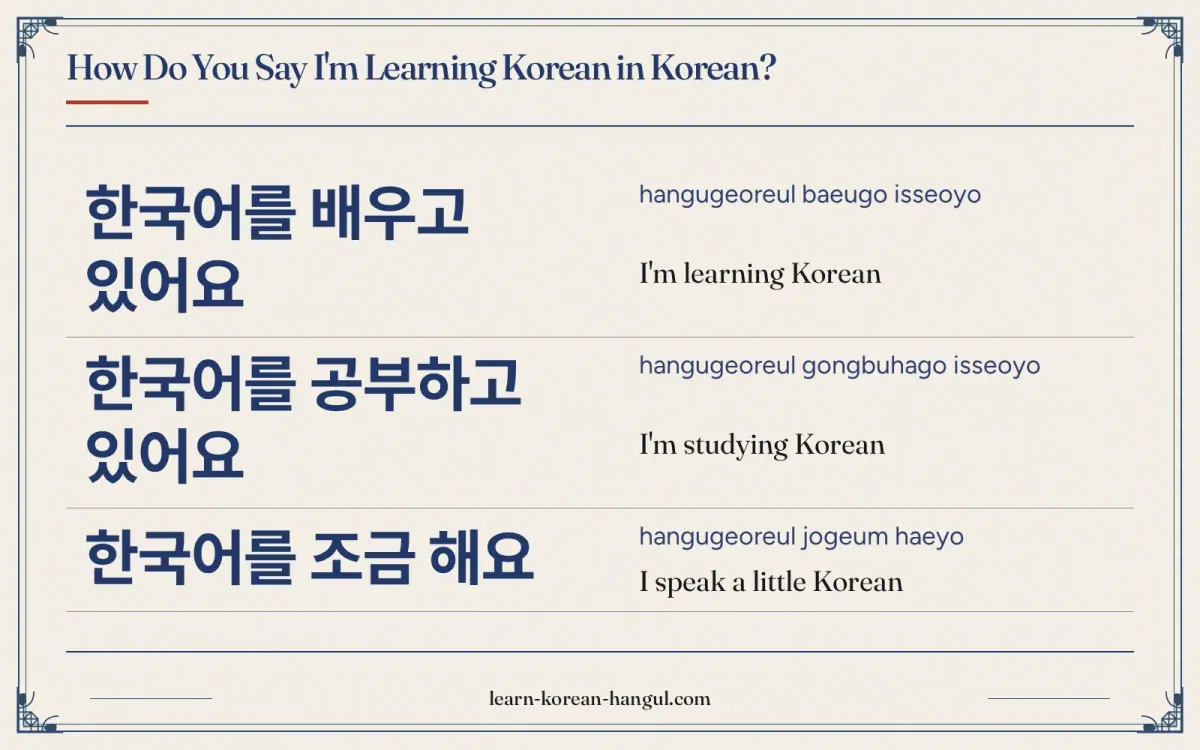
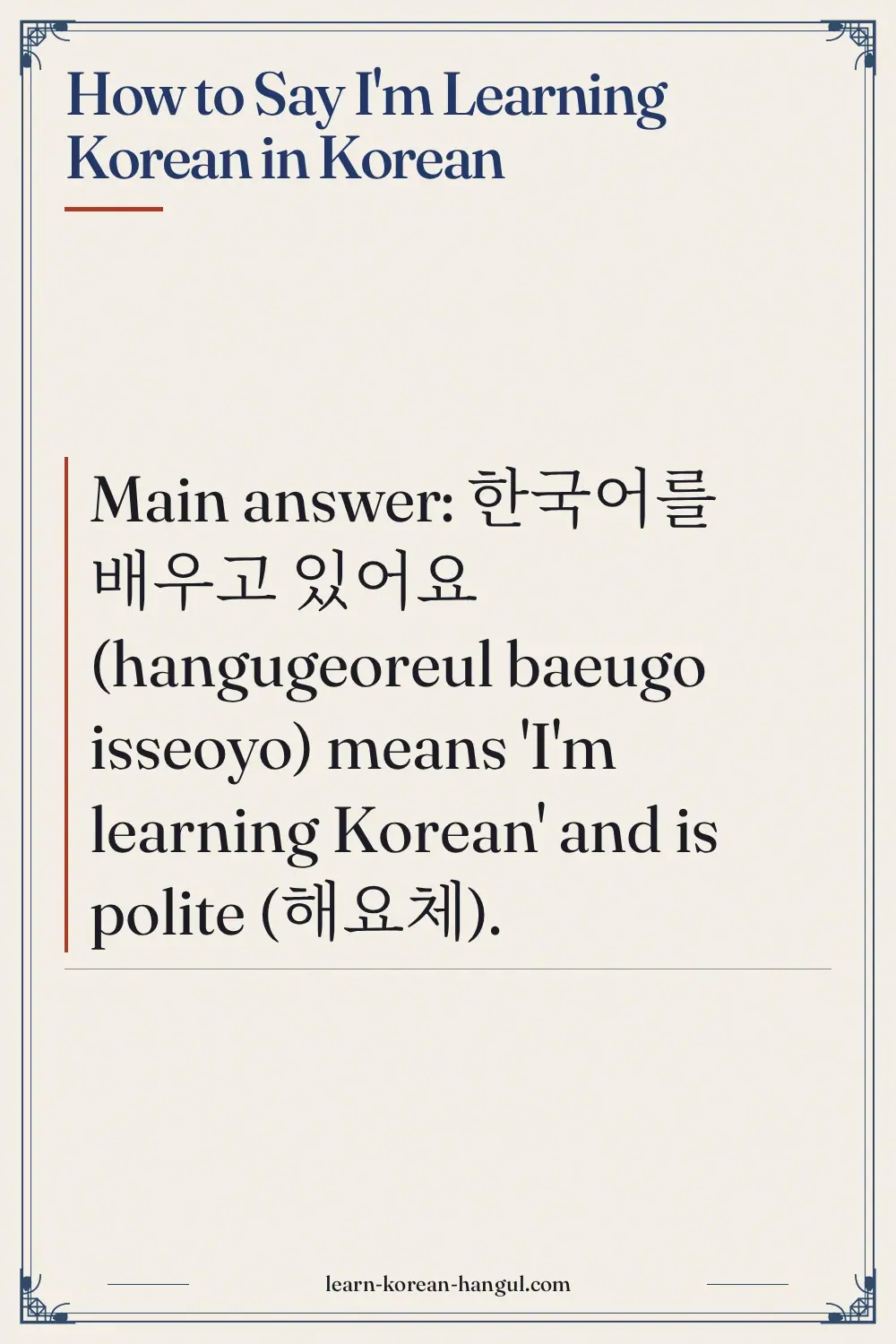
The standard polite way to say I'm learning Korean in Korean is 한국어를 배우고 있어요 (hangugeoreul baeugo isseoyo). The sentence has four parts: 한국어 (hangugeo, "the Korean language"), the object particle 를 (reul), 배우고 (baeugo, "learning") and 있어요 (isseoyo, "am doing"). The pattern -고 있다 means an action that is in progress.
Six forms cover most situations.
| Korean | Revised Romanization | Meaning | Register |
|---|---|---|---|
| 한국어를 배우고 있어요 | hangugeoreul baeugo isseoyo | I'm learning Korean | polite (해요체) |
| 한국어를 공부하고 있어요 | hangugeoreul gongbuhago isseoyo | I'm studying Korean | polite (해요체) |
| 한국어를 조금 해요 | hangugeoreul jogeum haeyo | I speak a little Korean | polite (해요체) |
| 한국어 공부 중이에요 | hangugeo gongbu jungieyo | I'm in the middle of studying Korean | polite (해요체) |
| 한국어를 배우고 있습니다 | hangugeoreul baeugo itseumnida | I'm learning Korean | formal (합쇼체) |
| 한국어를 배우고 있어 | hangugeoreul baeugo isseo | I'm learning Korean | casual (반말) |
Revised Romanization (the South Korean government standard of 2000) is a reading aid only. The Hangul is the real spelling. The next section sorts the forms by listener.
How Do You Say I'm Learning Korean Politely, Formally or Casually?
Four forms are polite, one is formal and one is casual. Korean speech levels explain the endings: 요 is polite, ㅂ니다 is formal, and a bare ending is casual. The differences between the polite forms lie in meaning, not in respect.
Polite: 한국어를 배우고 있어요 (hangugeoreul baeugo isseoyo)
한국어를 배우고 있어요 means "I'm learning Korean." The verb 배우다 (baeuda) means "to learn" from a teacher, a book or an experience. It is the best default for a traveller or a beginner who wants to explain why their Korean is simple.
Example: 저는 미국에서 왔어요. 한국어를 배우고 있어요. (jeoneun migugeseo wasseoyo. hangugeoreul baeugo isseoyo.) "I'm from the United States. I'm learning Korean."
Polite: 한국어를 공부하고 있어요 (hangugeoreul gongbuhago isseoyo)
한국어를 공부하고 있어요 means "I'm studying Korean." The verb 공부하다 (gongbuhada) means "to study," so the sentence stresses effort and schoolwork. Use it when you attend a class or follow a textbook.
Example: 요즘 한국어를 공부하고 있어요. (yojeum hangugeoreul gongbuhago isseoyo.) "These days I'm studying Korean."
Polite: 한국어를 조금 해요 (hangugeoreul jogeum haeyo)
한국어를 조금 해요 means "I speak a little Korean." The adverb 조금 (jogeum) means "a little," and 해요 comes from 하다, "to do." This sentence describes your current ability, not your studying. It is the modest answer when someone asks if you speak Korean.
Example: 한국어를 조금 해요. 천천히 말해 주세요. (hangugeoreul jogeum haeyo. cheoncheonhi malhae juseyo.) "I speak a little Korean. Please speak slowly."
Polite: 한국어 공부 중이에요 (hangugeo gongbu jungieyo)
한국어 공부 중이에요 means "I'm in the middle of studying Korean." The noun 중 (jung) means "in the middle of," so the sentence fits a moment: you are studying right now or at this stage of life.
Example: 지금 한국어 공부 중이에요. (jigeum hangugeo gongbu jungieyo.) "I'm studying Korean right now."
Formal: 한국어를 배우고 있습니다 (hangugeoreul baeugo itseumnida)
한국어를 배우고 있습니다 means "I'm learning Korean" in the formal style. Use it in a speech, an interview or a first meeting with a professor. Add 잘 부탁드립니다 (jal butakdeurimnida, "please look after me") to close politely.
Example: 한국어를 배우고 있습니다. 잘 부탁드립니다. (hangugeoreul baeugo itseumnida. jal butakdeurimnida.) "I'm learning Korean. Please look after me."
Casual: 한국어를 배우고 있어 (hangugeoreul baeugo isseo)
한국어를 배우고 있어 means "I'm learning Korean" and drops the polite 요, so it fits a close friend, a sibling or someone younger. Never use it with a teacher, an elder or a stranger.
Example: 나 요즘 한국어 배우고 있어. (na yojeum hangugeo baeugo isseo.) "I'm learning Korean these days."
Choosing a Form by Listener
The table gives one clear choice per listener.
| Listener | Best choice | Why |
|---|---|---|
| Shop owner, stranger, host family | 한국어를 배우고 있어요 | polite and clear |
| Teacher, classmate | 한국어를 공부하고 있어요 | stresses study |
| Someone who speaks fast to you | 한국어를 조금 해요 | sets expectations |
| Interview, speech | 한국어를 배우고 있습니다 | formal |
| Close friend | 한국어를 배우고 있어 | casual |
Once the form is chosen, the next step is how it sounds.
How Do You Pronounce 한국어를 배우고 있어요?
한국어를 배우고 있어요 is pronounced [한구거를 배우고 이써요], roughly "han-gu-geo-reul bae-u-go i-sseo-yo," with ten syllables in three word groups. Play the slow clip, then the normal clip, and repeat each one aloud.
| Word | Spelled | Spoken | Revised Romanization |
|---|---|---|---|
| 한국어를 | 한-국-어-를 | [한구거를] | hangugeoreul |
| 배우고 | 배-우-고 | [배우고] | baeugo |
| 있어요 | 있-어-요 | [이써요] | isseoyo |
What Sound Changes Happen in 한국어를 배우고 있어요?
Three sound details matter. They follow the Standard Pronunciation Rules (표준 발음법) of the National Institute of Korean Language (국립국어원).
- 한국어를 becomes [한구거를]. The final ㄱ of 국 moves to the next syllable because 어 begins with a silent ㅇ, so you hear "gu-geo."
- 있어요 becomes [이써요]. The double ㅆ is already tense, and it moves to the next syllable with the vowel.
- 있습니다 becomes [읻씀니다]. The final ㅆ sounds like [ㄷ] before a consonant, the ㅅ that follows turns tense, and the ㅂ sounds like ㅁ before ㄴ.
Linking is the pattern that makes spoken Korean sound smooth, and the pages on Korean tensification cover the tense sound in depth. With the sounds clear, the next question is when to use the phrase.
When Should You Use 한국어를 배우고 있어요, and When Should You Not?
Say it early in the conversation, because Koreans usually respond warmly and speak more slowly once they know you are a learner. The sentence also explains why your Korean is simple, so it works as a polite request for patience.
Situations Where 한국어를 배우고 있어요 Fits
- A self-introduction. Say your name, your country and then this sentence.
- A shop, cafe or taxi. Say it before you ask for help, so the staff adjust.
- Meeting a language partner. It starts a natural talk about how long and why.
Situations to Avoid with 한국어를 배우고 있어요
- Using a bare 한국어를 배워요 for "right now." The simple form is natural with 요즘 ("these days"), but on its own it can sound like a general statement. Add -고 있어요 to make the current activity clear.
- Using the casual form with an elder. Add 요.
- Using it as a reply to "Are you Korean?" First answer the question, then add that you are learning.
The dialogues below show the sentence in use.
What Does I'm Learning Korean Sound Like in a Real Conversation?
Read each dialogue, play the clip, and say one role aloud.
Dialogue 1: A compliment at a cafe
- A: 한국어를 잘하시네요! (hangugeoreul jalhasineyo!) "You speak Korean well!"
- B: 아니에요, 아직 부족해요. 한국어를 배우고 있어요. (anieyo, ajik bujokaeyo. hangugeoreul baeugo isseoyo.) "Not at all, I'm still lacking. I'm learning Korean."
- A: 열심히 하시네요. (yeolsimhi hasineyo.) "You work hard."
한국어를 잘하시네요! 아니에요, 아직 부족해요. 한국어를 배우고 있어요. 열심히 하시네요.
Dialogue 2: A language exchange
- A: 한국어를 얼마나 배웠어요? (hangugeoreul eolmana baewosseoyo?) "How long have you studied Korean?"
- B: 1년째 배우고 있어요. (illyeonjjae baeugo isseoyo.) "I've been learning it for a year."
- A: 와, 대단해요! (wa, daedanhaeyo!) "Wow, that's impressive!"
- B: 아직 어려워요. (ajik eoryeowoyo.) "It's still hard."
한국어를 얼마나 배웠어요? 1년째 배우고 있어요. 와, 대단해요! 아직 어려워요.
Dialogue 3: Two friends
- A: 너 요즘 뭐 해? (neo yojeum mwo hae?) "What have you been doing lately?"
- B: 나 한국어 공부하고 있어. (na hangugeo gongbuhago isseo.) "I've been studying Korean."
- A: 어때? 재미있어? (eottae? jaemiisseo?) "How is it? Fun?"
- B: 응, 재미있어. (eung, jaemiisseo.) "Yes, it's fun."
너 요즘 뭐 해? 나 한국어 공부하고 있어. 어때? 재미있어? 응, 재미있어.
In Dialogue 1, the compliment and the modest reply form a pattern that the next section explains.
What Should You Know about the Culture behind I'm Learning Korean?
Foreign learners often hear 한국어 잘하시네요 (hangugeo jalhasineyo, "you speak Korean well") as a compliment, and the polite reply is 아니에요, 아직 부족해요 (anieyo, ajik bujokaeyo, "no, I still lack skill"). The modest answer is a social habit: people play down their own skill and let the other person praise it. You can also accept the praise with 감사합니다 (gamsahamnida, "thank you"), which is natural for a learner.
Koreans often add 열심히 하세요 (yeolsimhi haseyo, "do your best") when they hear that you are learning. The phrase is encouragement, not a test. With the custom clear, the common mistakes are easy to spot.
What Mistakes Do Learners Make with I'm Learning Korean in Korean?
The most common mistake is using the simple present, 배워요, for something happening now. Five mistakes appear again and again:
- Saying 한국어를 배워요 for "I'm learning right now." The form is correct and common with 요즘, but on its own it can sound like a habit. Fix: add -고 있어요.
- Mixing up 배우다 and 공부하다. 배우다 is "learn" and 공부하다 is "study." Fix: use 배우고 있어요 for learning and 공부하고 있어요 for effort.
- Dropping 요 with elders. 배우고 있어 is casual. Fix: add 요.
- Reading 한국어 as han-guk-eo. The ㄱ links forward. Fix: say han-gu-geo.
- Answering a compliment with "yes, I speak well." Fix: reply 아니에요, 아직 부족해요.
These slips come from carrying English habits into Korean. A few related searches ask the same thing in other words, so they are answered next.
Is It the Same as I Study Korean or I Speak a Little Korean?
Not exactly, because each English sentence maps to a different Korean one. Five searches lead to this page, so each gets a short answer.
- I am learning Korean and I'm studying Korean: 한국어를 배우고 있어요 and 한국어를 공부하고 있어요.
- I learn Korean and I study Korean: the simple 배워요 or 공부해요 states a habit.
- I speak a little Korean: 한국어를 조금 해요.
- How long you have studied: 한국어를 1년째 배우고 있어요 (hangugeoreul illyeonjjae baeugo isseoyo), "I've been learning Korean for a year."
After the answers, the next pages continue the conversation.
Related Phrases to Learn Next
Three phrases help you keep the conversation going:
- Can you speak English in Korean: the question you may need after your own sentence.
- I don't understand in Korean: what to say when the reply is too fast.
- Introduce yourself in Korean: the full set of lines for a first meeting.
Practice: Say It Aloud
Spend five minutes on this routine.
- Play the slow clip of 한국어를 배우고 있어요 and repeat it three times.
- Say 한국어를 with the link: [한구거를], not "han-guk-eo-reul."
- Say 한국어를 배우고 있어요 and then 한국어를 조금 해요, and decide which fits your level.
- Hide the Romanization with the toggle and read the six forms from Hangul only.
- Drill the cluster with the phrase flashcards.
When the sentence comes out smoothly, you can say I'm learning Korean in Korean to a shop owner, a teacher or a friend.
Frequently Asked Questions
The answers below add details about how to say I'm learning Korean in Korean beyond the sections above.
How do you say I'm learning Korean in Korean?
The standard polite sentence is 한국어를 배우고 있어요 (hangugeoreul baeugo isseoyo). To stress effort, say 한국어를 공부하고 있어요. For a modest answer about ability, say 한국어를 조금 해요. In formal speech, end with 있습니다. With close friends, use 있어 without the 요.
How do you pronounce 한국어를 배우고 있어요?
Say it as [한구거를 배우고 이써요]. The final ㄱ of 국 links to the vowel of 어, and the double ㅆ of 있 moves to the next syllable. The Revised Romanization is hangugeoreul baeugo isseoyo. Play the slow clip first, then repeat at normal speed until the three word groups flow together.
What is the difference between 한국어를 배우고 있어요 and 한국어를 공부하고 있어요?
배우다 means to learn, from a teacher, a book or an experience. 공부하다 means to study, which stresses effort and schoolwork. Both are polite when they end in 요. Use 배우고 있어요 as the everyday default and 공부하고 있어요 when you attend a class or follow a textbook.
Can I use 한국어를 배우고 있어요 with friends, elders and strangers?
Yes. 한국어를 배우고 있어요 works with elders, teachers, strangers and most friends. With a close friend, 한국어를 배우고 있어 is natural. In a speech or an interview, 한국어를 배우고 있습니다 sounds better. Avoid the casual form with anyone older or a person you have just met.
What is the most common mistake with I'm learning Korean in Korean?
Learners say 한국어를 배워요 for something happening now. The sentence is correct, but without a time word such as 요즘 it can read like a general fact or habit. Add -고 있어요 for an action in progress: 한국어를 배우고 있어요. A second frequent slip is mixing up 배우다 (learn) and 공부하다 (study).
How do I answer when someone says I speak Korean well?
Reply 아니에요, 아직 부족해요 (anieyo, ajik bujokaeyo), which means "no, I still lack skill." The modest answer is a social habit in Korea. You can also say 감사합니다 and add 열심히 공부하고 있어요 ("I am studying hard"). Both replies are polite and welcome.