How Do You Say Can You Speak English in Korean?
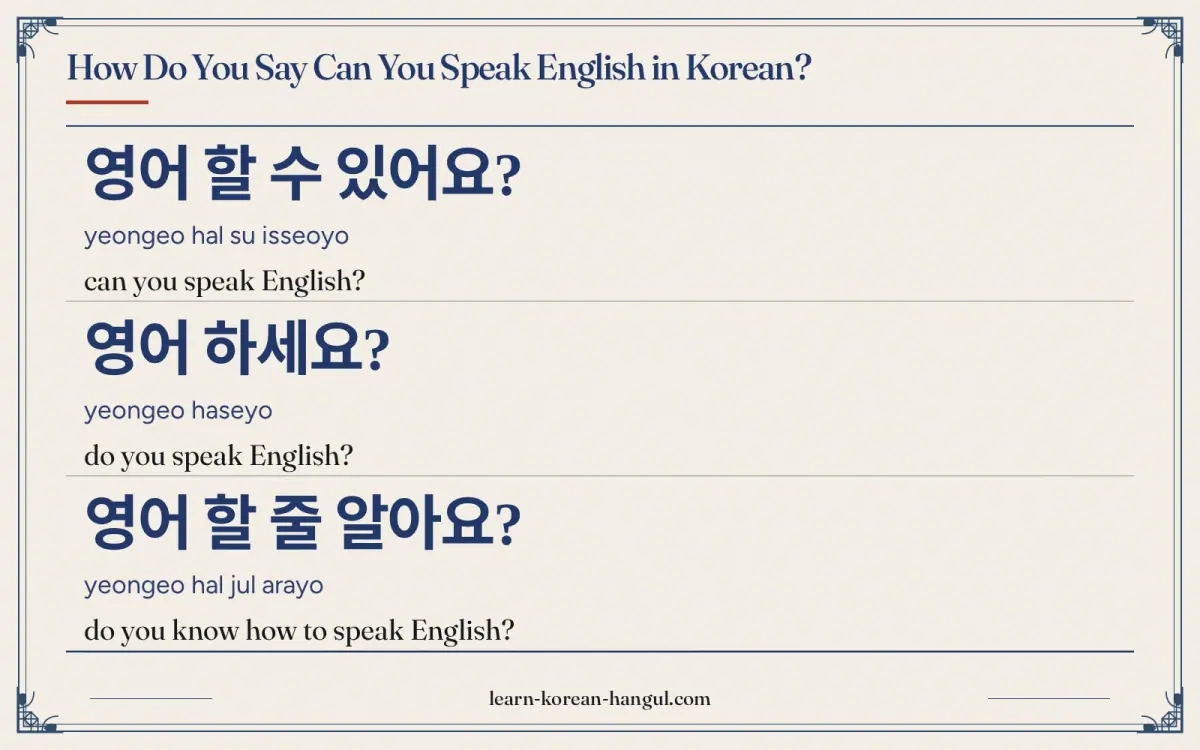
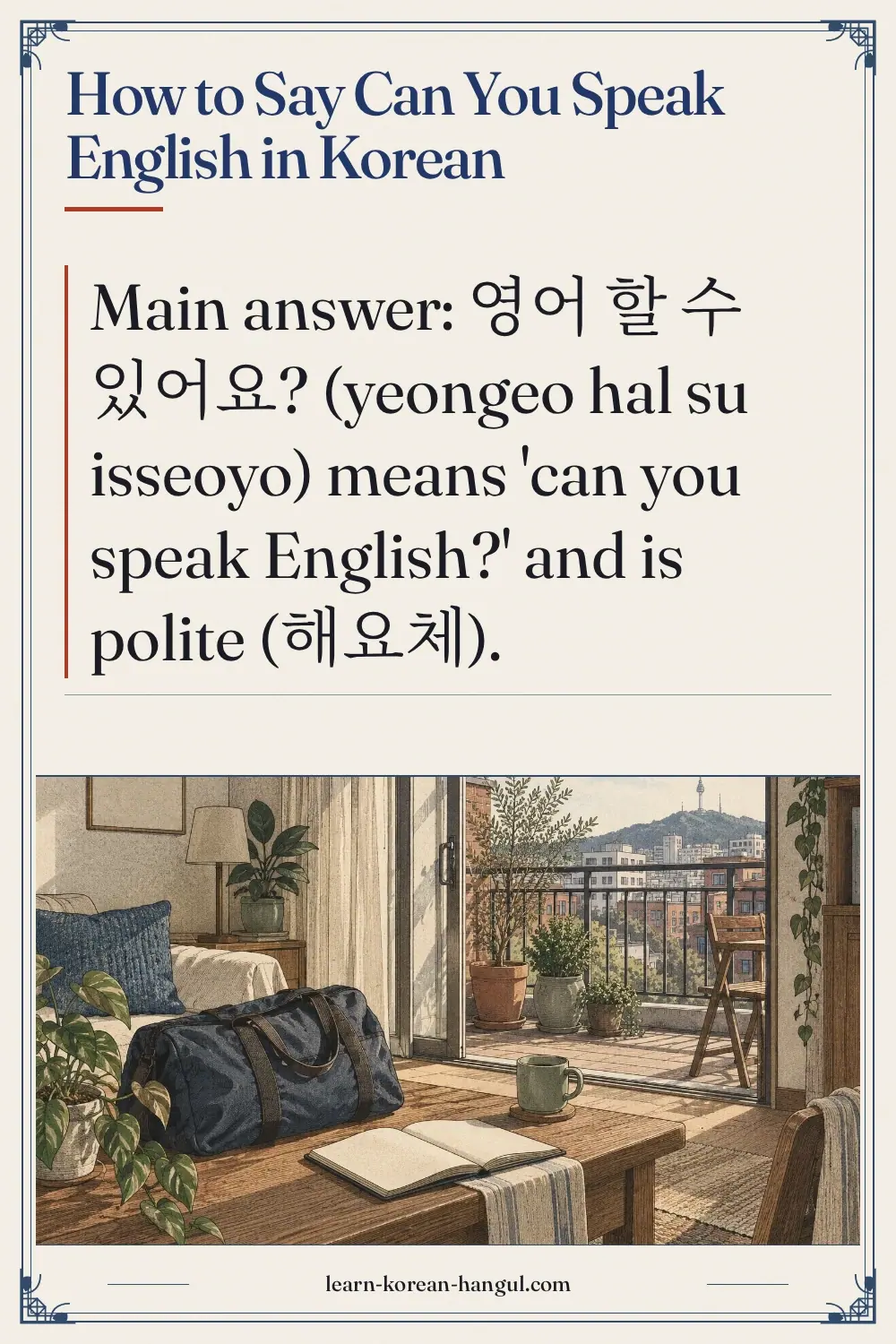
The standard polite way to say can you speak English in Korean is 영어 할 수 있어요? (yeongeo hal su isseoyo). The phrase has three parts: 영어 (yeongeo, "English"), 할 수 있어요 (hal su isseoyo, "can do," from the pattern -(으)ㄹ 수 있다, "to be able to") and a rising voice at the end that turns the statement into a question. The question mark in writing matches that rise in speech.
Five forms cover most situations.
| Korean | Revised Romanization | Meaning | Register |
|---|---|---|---|
| 영어 할 수 있어요? | yeongeo hal su isseoyo | can you speak English? | polite (해요체) |
| 영어 하세요? | yeongeo haseyo | do you speak English? | polite, respectful |
| 영어 할 줄 알아요? | yeongeo hal jul arayo | do you know how to speak English? | polite |
| 영어 해요? | yeongeo haeyo | speak English? | polite, informal tone |
| 영어 하십니까? | yeongeo hasimnikka | do you speak English? | formal (합쇼체) |
Revised Romanization (the South Korean government standard of 2000) is a reading aid only. The Hangul is the real spelling. The next section sorts the forms by listener.
What Are the Polite Ways to Say Can You Speak English?
All four everyday forms are polite (해요체), and the Korean speech levels explain why. They differ in tone and in the idea they ask about: ability, habit or knowledge. You will rarely need a casual form, because this question is usually asked of strangers.
Polite: 영어 할 수 있어요? (yeongeo hal su isseoyo)
영어 할 수 있어요? means "can you speak English?" and asks whether the person is able to do it. It is the clearest and most complete form, and it suits hotel staff, shop clerks and officials.
Example: 죄송한데요, 영어 할 수 있어요? (joesonghandeyo, yeongeo hal su isseoyo?) "Excuse me, can you speak English?"
Polite: 영어 하세요? (yeongeo haseyo)
영어 하세요? means "do you speak English?" The verb 하세요 uses the honorific marker -(으)시-, which raises the listener. It is short and respectful, and it fits an older person or a person in a role, such as a doctor or a tour guide.
Example: 저기요, 영어 하세요? (jeogiyo, yeongeo haseyo?) "Excuse me, do you speak English?"
Polite: 영어 할 줄 알아요? (yeongeo hal jul arayo)
영어 할 줄 알아요? means "do you know how to speak English?" The pattern -(으)ㄹ 줄 알다 asks about a learned skill. The question can sound like a test of the person's knowledge, so use it when you want to ask about skill, not just about whether English is possible right now.
Example: 영어 할 줄 알아요? 길을 몰라요. (yeongeo hal jul arayo? gireul mollayo.) "Do you know how to speak English? I don't know the way."
Polite: 영어 해요? (yeongeo haeyo)
영어 해요? means "speak English?" and sounds light. The form drops the honorific, so it is polite but informal in tone. Use it with people close to your own age in a relaxed setting, such as a cafe worker your age.
Example: 영어 해요? 메뉴가 있어요? (yeongeo haeyo? menyuga isseoyo?) "Do you speak English? Is there a menu?"
Choosing a Form by Listener
The table gives one clear choice per listener.
| Listener | Best choice | Why |
|---|---|---|
| Hotel or shop staff | 영어 할 수 있어요? | clear and polite |
| Older stranger, doctor, guide | 영어 하세요? | respectful |
| Official, announcement | 영어 하십니까? | formal |
| Someone your age, relaxed setting | 영어 해요? | light and polite |
| Asking about skill | 영어 할 줄 알아요? | learned ability |
Once the form is chosen, the next step is how it sounds.
How Do You Pronounce 영어 할 수 있어요?
영어 할 수 있어요? is pronounced [영어 할쑤 이써요], roughly "yeong-eo hal ssu i-sseo-yo," with seven syllables in four word groups. Play the slow clip, then the normal clip, and repeat each one aloud.
| Word | Spelled | Spoken | Revised Romanization |
|---|---|---|---|
| 영어 | 영-어 | [영어] | yeongeo |
| 할 수 | 할 수 | [할쑤] | hal su |
| 있어요 | 있-어-요 | [이써요] | isseoyo |
What Sound Changes Happen in 영어 할 수 있어요?
Three sound details matter. They follow the Standard Pronunciation Rules (표준 발음법) of the National Institute of Korean Language (국립국어원).
- 영어 is read yeong-eo. The final ㅇ of 영 is a nasal "ng" and stays with its own syllable, so the vowel 어 begins a fresh syllable.
- 할 수 becomes [할쑤]. After the ending ㄹ of the "can" pattern -(으)ㄹ, the consonant ㅅ is tense. Article 27 of the rules describes this, and it is the sound that learners hear as "hal ssu." The same rule makes 할 줄 sound like [할쭐].
- 있어요 becomes [이써요]. The double ㅆ is already tense, and it moves to the next syllable.
The page on tensification explains the second change in more depth. With the sounds clear, the next question is how to use the phrase politely.
When Should You Use 영어 할 수 있어요?, and When Should You Not?
Use it politely to a clerk or hotel staff, and start with 죄송한데요 (joesonghandeyo, "excuse me, but...") to soften. Asking in Korean first shows effort and respect, and it gives the listener a moment to prepare. For a stranger on the street, use 저기요 (jeogiyo, "excuse me") to get attention first.
Situations Where 영어 할 수 있어요? Fits
- A hotel front desk. Greet first, then ask the question.
- A shop or restaurant. Ask before you order, so the staff can fetch a menu or a colleague.
- A street, station or tourist office. Use 저기요 and then 영어 하세요?.
Situations to Avoid with 영어 할 수 있어요?
- Asking in English first. Opening in English can make staff uneasy. Start in Korean, then switch if needed.
- Using the question as a greeting. Say 안녕하세요 first, then ask.
- Skipping a softener. A bare question can sound abrupt. Add 죄송한데요 or 실례합니다.
The most polite order is a greeting, a softener, and then the question. The dialogues below show the order in use.
What Does Can You Speak English Sound Like in a Real Conversation?
Read each dialogue, play the clip, and say one role aloud.
Dialogue 1: At a hotel desk
- A: 죄송한데요, 영어 할 수 있어요? (joesonghandeyo, yeongeo hal su isseoyo?) "Excuse me, can you speak English?"
- B: 네, 조금요. (ne, jogeumyo.) "Yes, a little."
- A: 감사합니다. (gamsahamnida.) "Thank you."
죄송한데요, 영어 할 수 있어요? 네, 조금요. 감사합니다.
Dialogue 2: On the street
- A: 저기요, 영어 하세요? (jeogiyo, yeongeo haseyo?) "Excuse me, do you speak English?"
- B: 아니요, 영어를 잘 못해요. (aniyo, yeongeoreul jal motaeyo.) "No, I can't speak English well."
- B: 하지만 도와줄게요. (hajiman dowajulgeyo.) "But I'll help you."
저기요, 영어 하세요? 아니요, 영어를 잘 못해요. 하지만 도와줄게요.
In Dialogue 1, the answer 조금요 (jogeumyo, "a little") is a common modest reply. In Dialogue 2, the helper declines the question but offers to help, which is a kind way to end a refusal. The guide to excuse me in Korean covers 저기요 and its relatives. A cultural idea sits behind these replies.
What Should You Know about the Culture behind Can You Speak English?
Many Koreans can read English but feel shy about speaking, so asking gently helps them feel at ease. English is taught in school for years, and many people read it well, but speaking in front of a stranger can feel risky. A polite opener, a smile and a slow voice reduce the pressure, and a short answer such as 조금요 usually means "I can help a little."
Modesty also shapes the reply. A person who answers 조금요 may speak far more than "a little," because Korean etiquette favours humble answers about one's own skill. If you want to make the exchange easier, ask short yes-or-no questions and use gestures, a translation app or a written note. Because the culture favours modest replies, learners often misjudge the answer, which leads to the mistakes below.
What Mistakes Do Learners Make with Can You Speak English in Korean?
The most common mistake is asking in English first, which can make staff uneasy. Five mistakes appear again and again:
- Starting in English. Fix: open with 안녕하세요 or 죄송한데요, then ask in Korean.
- Dropping the 요. 영어 할 수 있어 is casual and rude to a stranger. Fix: end with 요.
- Using 영어 하세요? about yourself. The honorific -(으)시- raises the other person only. Fix: say 저는 영어를 해요 ("I speak English") for yourself.
- Missing the tense sound. Saying "hal su" with a soft s sounds foreign. Fix: say [할쑤].
- Taking 조금요 as a refusal. The reply is polite, and the person can often help. Fix: continue slowly.
These mistakes come from carrying English habits into Korean. A few related searches ask the same thing in other words, so they are answered next.
Short Answers on Do You Speak English and English Please
Four searches lead to this page, so each gets a short answer.
- Do you speak English in Korean: The best match is 영어 하세요?, which uses "do" instead of "can."
- Speak English in Korean: To say "I speak English," use 저는 영어를 해요 (jeoneun yeongeoreul haeyo).
- English please in Korean: Say 영어로 해 주세요 (yeongeoro hae juseyo), which means "please do it in English."
- Do you speak English formal in Korean: The formal form is 영어 하십니까? (yeongeo hasimnikka), used in announcements and formal service. For daily use, 영어 하세요? is enough.
After the answers, the next pages continue the conversation.
Related Phrases to Learn Next
Three phrases help you keep the conversation going:
- I'm learning Korean: the answer to the question "why do you speak Korean?"
- I don't understand in Korean: what to say when the reply is too fast.
- Excuse me in Korean: the softener that opens the question.
The complete list sits in the introduce yourself in Korean cluster.
Practice: Say It Aloud
Spend five minutes on this routine.
- Play the slow clip of 영어 할 수 있어요? and repeat it three times, with a rising voice at the end.
- Say it again with the tense sound: [할쑤], not "hal su."
- Say 죄송한데요, 영어 할 수 있어요? as one smooth sentence, then 저기요, 영어 하세요?.
- Hide the Romanization with the toggle and read the five forms from Hangul only.
- Drill the cluster with the phrase flashcards.
When the question comes out with a gentle rise, you can ask can you speak English in Korean in a way that puts the listener at ease.
Frequently Asked Questions
The answers below add details about how to say can you speak English in Korean beyond the sections above.
What is the difference between 영어 할 수 있어요? and 영어 하세요?
영어 할 수 있어요? asks whether the person is able to speak English, so it focuses on ability. 영어 하세요? asks whether they speak it, with the honorific -(으)시- that raises the listener. Both are polite, and the second sounds a little shorter and more respectful.
Is 영어 할 수 있어요? formal or casual?
영어 할 수 있어요? is polite, in the 해요체 style, between formal and casual. The formal version is 영어 하십니까? (yeongeo hasimnikka), used in announcements and formal service. A casual version, 영어 할 수 있어?, is only for close friends and younger people.
Can I use 영어 할 수 있어요? with friends, elders and strangers?
Yes. 영어 할 수 있어요? works with strangers, clerks and most people your age. For an older person, 영어 하세요? shows more respect. With close friends, a casual version without 요 is fine, but you will rarely need it, since this question is usually asked of strangers.
How do I answer when someone asks if I speak Korean?
Say 조금 해요 (jogeum haeyo, "I speak a little") or 한국어를 배우고 있어요 (hangugeoreul baeugo isseoyo, "I am learning Korean"). Add 천천히 말해 주세요 (cheoncheonhi malhae juseyo, "please speak slowly") if you need the other person to slow down, because spoken Korean can feel fast at first.
How do I ask someone to speak English instead of Korean?
Say 영어로 해 주세요 (yeongeoro hae juseyo), which means "please do it in English." Soften it with 죄송한데요 at the start, and smile, because a request to switch languages can feel awkward. The particle 로 marks the language, so 영어로 means "in English" and 한국어로 means "in Korean." Use 천천히 (cheoncheonhi, "slowly") to ask for a slower pace.
What is the most common mistake with can you speak English in Korean?
Learners ask in English first, which can make staff uneasy. Start with 안녕하세요 or 죄송한데요 and then ask in Korean. A second frequent mistake is dropping the 요 and saying 영어 할 수 있어, which sounds rude to a stranger.