먼저 가보겠습니다
먼저 가보겠습니다
What you'll learn
- Say I'm leaving first with 먼저 가보겠습니다, 먼저 갈게요 or 퇴근하겠습니다.
- Understand 먼저 (before you), -겠습니다 (formal intention) and -(으)ㄹ게요 (I will, for you).
- Hear and give the usual replies, 수고하셨습니다 and 조심히 들어가세요.
- Pronounce 가보겠습니다 as [가보겓씀니다].
Before you start: you only need to read Hangul. For the reply you will hear most often, see Good work today in Korean. Time: about 10 minutes. Audio plays only when you press a button.
Key facts
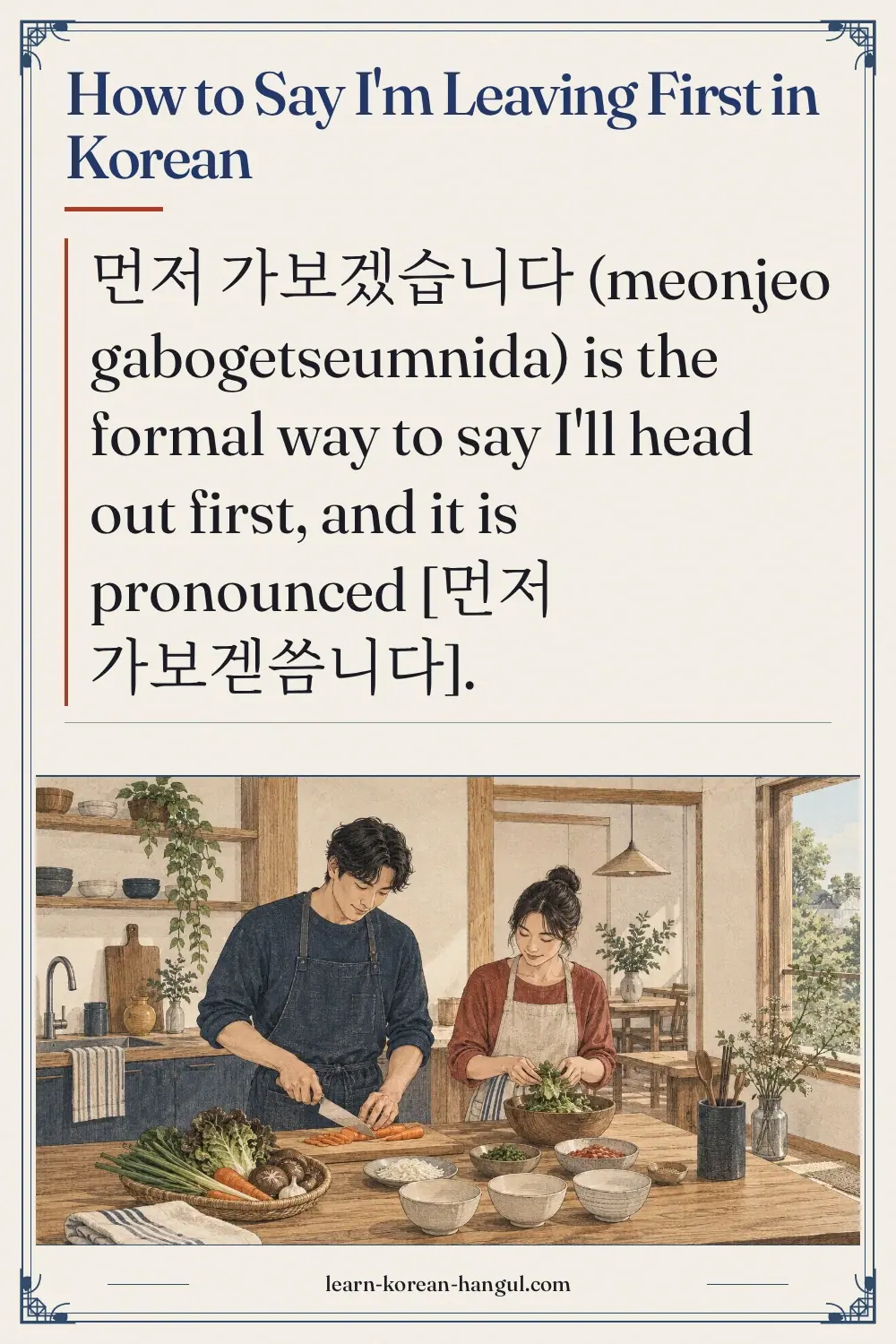
- 먼저 가보겠습니다 (meonjeo gabogetseumnida) is the formal way to say I'll head out first, pronounced [먼저 가보겓씀니다].
- 먼저 means before you, and it carries the "ahead of you" meaning.
- The usual reply is 수고하셨습니다 (sugohasyeotseumnida), thank you for your work.
- 가겠습니다 without 먼저 does not tell people that you leave before them.
How Do You Say I'm Leaving First in Korean?
The standard way to say I'm leaving first in Korean at work is 먼저 가보겠습니다. It has two parts. 먼저 (meonjeo) means "first" or "before you". 가보겠습니다 (gabogetseumnida) means "I will go", with a polite, humble tone from the formal ending -겠습니다. It has eight syllables: meon-jeo ga-bo-get-seum-ni-da.
| Situation | Best form | Romanization | Why |
|---|---|---|---|
| Leaving before your boss or a client | 먼저 가보겠습니다 | meonjeo gabogetseumnida | Formal, humble |
| Leaving before colleagues of your level | 먼저 갈게요 | meonjeo galgeyo | Polite, relaxed |
| Finishing work and heading home | 먼저 퇴근하겠습니다 | meonjeo toegeunhagetseumnida | Formal, work |
| Telling a close friend | 먼저 갈게 | meonjeo galge | Casual |
| Replying as the one who stays | 수고하셨습니다 | sugohasyeotseumnida | Thank you for your work |
The next section sorts the forms by the person you are talking to.
What Are the Formal and Polite Ways to Say I'm Leaving First?
The forms follow the Korean speech levels, explained in the guide to Korean speech levels. At work, the formal style is common, and the polite style is used with peers.
Formal: 먼저 가보겠습니다 (meonjeo gabogetseumnida)
Formal · 합쇼체먼저 가보겠습니다 is the form to learn first for work. It suits a boss, a client and a formal meeting. The word 가보다 softens the verb, and the ending -겠습니다 is formal and humble. Say it at the door while you look at the person you are addressing, and add a short nod.
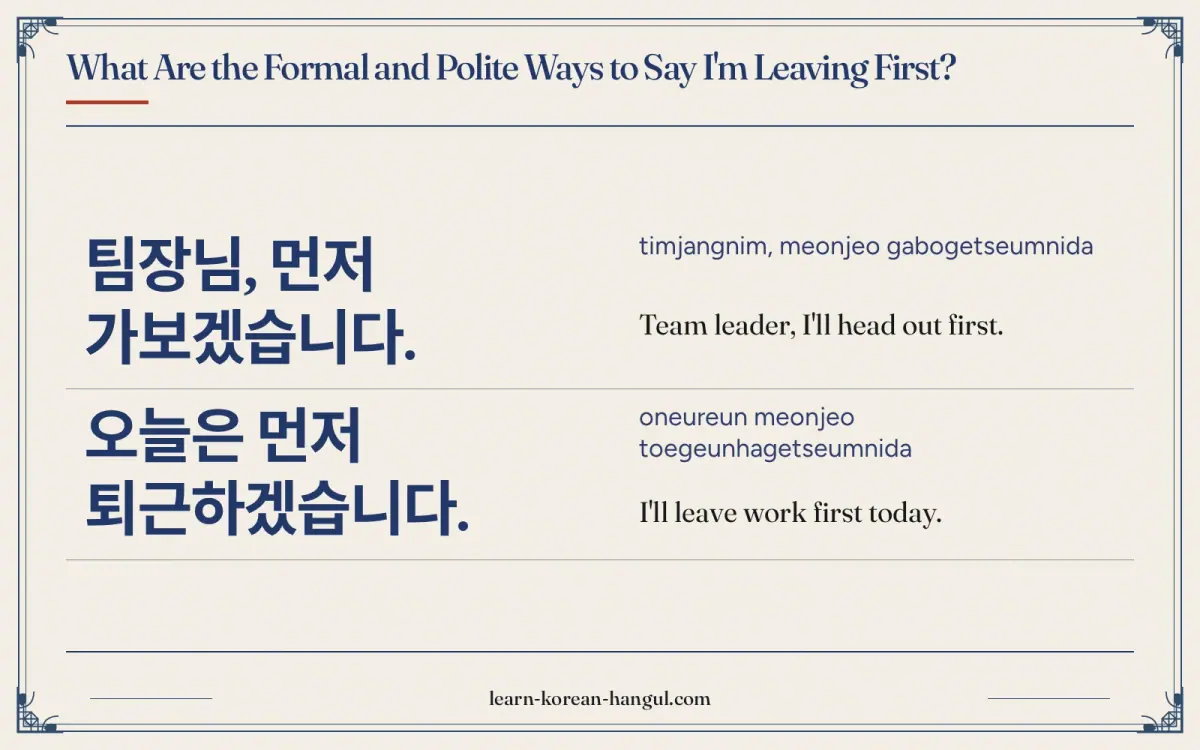
팀장님, 먼저 가보겠습니다.
timjangnim, meonjeo gabogetseumnida
Team leader, I'll head out first.
Polite: 먼저 갈게요 (meonjeo galgeyo)
Polite · 해요체먼저 갈게요 is polite and relaxed. It uses -(으)ㄹ게요, which tells the listener what you will do. It suits colleagues of the same rank, friends you respect and people at a dinner or party. It is pronounced [먼저 갈께요].
저 약속이 있어서 먼저 갈게요.
jeo yaksogi isseoseo meonjeo galgeyo
I have an appointment, so I'm going ahead.
Formal: 먼저 퇴근하겠습니다 (meonjeo toegeunhagetseumnida)
Formal · 합쇼체퇴근 (toegeun) means "leaving work", and 퇴근하다 is the verb. 먼저 퇴근하겠습니다 says "I will leave work first". It is clear and often used at the end of a working day. In RR, the first syllable is written toe, and many speakers say it like twe.
오늘은 먼저 퇴근하겠습니다.
oneureun meonjeo toegeunhagetseumnida
I'll leave work first today.
Casual: 먼저 갈게 (meonjeo galge)
Casual · 반말먼저 갈게 drops the polite 요. Use it with close friends and juniors. It is pronounced [먼저 갈께]. The grammar behind these phrases comes next.
Why Do We Say 먼저 가보겠습니다?
The phrase is built from small pieces.
- 먼저 (meonjeo) is an adverb meaning "first" or "before". It shows that you leave ahead of the listener.
- 가보다 (gaboda) combines 가다 (go) and 보다 (try). The pattern -아/어 보다 means "to try doing", and here it softens the statement: "I'll go and see", which sounds modest.
- -겠- marks your intention or plan. -습니다 is the formal sentence ending. Together, -겠습니다 means "I will", in a formal, humble tone.
- -(으)ㄹ게요 in 갈게요 tells the listener your decision, with a promise-like tone toward them. Use it only for your own action.
Compare the four levels: 먼저 가보겠습니다 (formal), 먼저 가겠습니다 (formal, plainer), 먼저 갈게요 (polite) and 먼저 갈게 (casual). Without 먼저, 가겠습니다 only means "I will go". With 먼저, it means "I will go before you". Next, the pronunciation.
How Do You Pronounce 먼저 가보겠습니다?
먼저 가보겠습니다 is pronounced [먼저 가보겓씀니다] and has eight syllables: meon-jeo ga-bo-get-seum-ni-da. The first half sounds as written, and the changes are in the last three syllables.
- 먼저 (meonjeo): the ㅓ is unrounded, so relax your lips, and do not round them like "oh".
- 가보 (gabo): "gah-boh", with no change.
- 겠 (get): the final ㅆ is pronounced as a stop, like ㄷ [겓].
- 습 (sseum): the ㅅ is tense, so say it with a firm "ss".
- 니다 (nida): the ㅂ of 습 turns into ㅁ, so you hear [씀니다].
Sound Changes to Listen For
These changes follow the National Institute of Korean Language standard pronunciation rules (표준 발음법):
- ㅆ becomes ㄷ before ㅅ. In 겠습니다, the final ㅆ is pronounced as ㄷ (Article 9), and the next ㅅ becomes tense (Article 23). The result is [겓씀]. See Korean tensification.
- ㅂ before ㄴ becomes ㅁ. 습니다 is [씀니다] (Article 18).
- Tense ㄱ after ㄹ. 갈게요 is [갈께요] (Article 27 and its note on -(으)ㄹ endings). RR writes the plain galgeyo.
- 퇴근 is [퇴근]. In everyday speech 퇴 is often said like 퉤, and RR writes toe.
With the sound clear, here is when to use each form.
When Should You Use 먼저 가보겠습니다, and When Should You Not?
Use 먼저 가보겠습니다 when you leave a meeting, a team dinner or the office before others, especially when someone senior is still there. It is a courtesy, not a request for permission.
Situations Where It Fits
- Leaving before the boss. 팀장님, 먼저 가보겠습니다. (Team leader, I'll head out first.)
- Leaving a team dinner early. 내일 일찍 출근해서 먼저 가보겠습니다. (I start early tomorrow, so I'll go first.)
- A hospital or family visit. 저는 먼저 갈게요. (I'll go first.)
Situations to Avoid
- Leaving silently. Sneaking out without a word can look careless in many Korean workplaces.
- Only a goodbye. 안녕히 계세요 is a plain goodbye. It does not say that you leave ahead of others, so add 먼저 to the sentence.
- Too casual. 먼저 갈게 to a boss is too casual. Use 먼저 가보겠습니다.
Two short conversations show how it sounds.
What Does I'm Leaving First Sound Like in a Real Conversation?
In real life, the line is followed by a reply of thanks and a goodbye. Notice the answers.
Leaving before the Team Leader
Employee
팀장님, 먼저 가보겠습니다.
timjangnim, meonjeo gabogetseumnida
Team leader, I'll head out first.
Team Leader
네, 수고하셨습니다.
ne, sugohasyeotseumnida
Yes, thank you for your work.
Employee
내일 뵙겠습니다.
naeil boepgetseumnida
I'll see you tomorrow.
What to notice: the formal 가보겠습니다 is answered with 수고하셨습니다, and the employee closes with the humble 뵙겠습니다 (I will see you).
Leaving a Team Dinner
Colleague
저 약속이 있어서 먼저 갈게요.
jeo yaksogi isseoseo meonjeo galgeyo
I have an appointment, so I'm going ahead.
Coworker
네, 조심히 들어가세요.
ne, josimhi deureogaseyo
Yes, go home safely.
Colleague
내일 봐요.
naeil bwayo
See you tomorrow.
What to notice: the polite 갈게요 is answered with the honorific 들어가세요, and the friendly 내일 봐요 closes the exchange.
How Do You Reply When Someone Else Leaves First?
When a colleague says they are leaving first, the person who stays usually replies 수고하셨습니다 (sugohasyeotseumnida, thank you for your work) or the shorter 수고하셨어요 (sugohasyeosseoyo). You can also say 조심히 들어가세요 (josimhi deureogaseyo, go home safely) or 내일 봐요 (naeil bwayo, see you tomorrow). To a senior who leaves, 안녕히 가세요 (annyeonghi gaseyo) is the safe choice: many etiquette guides advise against saying 수고하셨습니다 to someone above you, even though you will hear it often in offices.
| Who leaves | Reply | Romanization |
|---|---|---|
| A boss or senior | 안녕히 가세요 | annyeonghi gaseyo |
| A peer or junior | 수고하셨습니다 / 수고하셨어요 | sugohasyeotseumnida / sugohasyeosseoyo |
| A close friend | 잘 가 | jal ga |
See See you tomorrow in Korean for more ways to say goodbye.
What Should You Know about the Culture behind Leaving First?
Korean offices have often valued staying until the boss leaves, so announcing your exit softens leaving first. The announcement shows respect, and it keeps the group informed. Working hours and customs differ between companies and have been changing, so treat this as a common pattern rather than a rule.
- 칼퇴 (kaltoe) is slang for 칼퇴근, leaving work exactly on time, as sharp as a knife.
- 회식 (hoesik) means a team dinner, and leaving one early is a delicate moment where 먼저 matters.
- Politeness over speed. A calm nod and the right phrase matter more than the exact words.
The page for leaving work in Korean covers the vocabulary around the end of the working day. The page for business Korean phrases groups other office phrases.
What Mistakes Do Learners Make with I'm Leaving First in Korean?
Most mistakes come from leaving out 먼저 and from choosing the wrong level.
| Mistake | Why it is a problem | Fix |
|---|---|---|
| Leaving silently | It can look careless | Say 먼저 가보겠습니다 |
| 가겠습니다 without 먼저 | It does not say you leave ahead of others | Add 먼저 |
| 안녕히 계세요 only | It is a goodbye, not an announcement | Add 먼저 가보겠습니다 |
| 먼저 갈게 to a boss | Too casual | Say 먼저 가보겠습니다 |
| [가보겠습니다] as written | The real sound is [가보겓씀니다] | Practise the tense ㅆ |
Learners also forget the tense. For something done earlier, use the past 먼저 갔어요 (meonjeo gasseoyo): 팀장님은 먼저 갔어요, the team leader left first.
Is It the Same as Leaving Work, Go Home First or I'm Going Home?
Mostly. The short answers below cover the other searches folded into this page.
- Leaving work in Korean: 퇴근하겠습니다 (I'll leave work) or 퇴근해요 (toegeunhaeyo, I'm leaving work).
- Go home first in Korean: 먼저 집에 갈게요 (meonjeo jibe galgeyo), pronounced [먼저 지베 갈께요].
- I'm going home in Korean: 집에 가요 (jibe gayo, I'm going home) or 집에 갈게요, with 집에 pronounced [지베].
Now practise aloud.
Practice: Say It Aloud
Play the slow clip of 먼저 가보겠습니다 three times and make the 씀 firm. Then choose a phrase. Answers follow.
- You are leaving before your team leader.
- You are leaving a lunch with colleagues of your own level.
- You want to tell a close friend you are going ahead.
- A colleague says 먼저 가보겠습니다 as you stay at your desk. What do you reply?
Answers
- 팀장님, 먼저 가보겠습니다.
- 먼저 갈게요.
- 먼저 갈게.
- 수고하셨습니다.
The phrase flashcards drill these lines with audio.
Related Phrases to Learn Next
Leaving first connects to thanking people for their work and to goodbyes.
- Good work today in Korean: 수고하셨습니다 in full.
- See you tomorrow in Korean: 내일 봐요 and other goodbyes.
- Korean speech levels: formal, polite and casual endings.
This guide belongs to the business Korean phrases collection. What this page does not cover: overtime, resignations and meeting etiquette. Remember the word 먼저, pick a level, and say the sound [가보겓씀니다] clearly, and you can say i'm leaving first in Korean naturally.
Frequently Asked Questions
How do you say i'm leaving first in Korean?
Say 먼저 가보겠습니다 (meonjeo gabogetseumnida) to a boss or in a formal workplace, and 먼저 갈게요 (meonjeo galgeyo) to colleagues of the same level. With a close friend, say 먼저 갈게. To say you are leaving work, say 먼저 퇴근하겠습니다 (meonjeo toegeunhagetseumnida).
How do you pronounce 먼저 가보겠습니다?
It has eight syllables, meon-jeo ga-bo-get-seum-ni-da, and is pronounced [먼저 가보겓씀니다]. The final ㅆ in 겠 becomes ㄷ, the next ㅅ is tense, and the ㅂ in 습 turns into ㅁ before ㄴ. Keep the ㅓ in 먼저 unrounded, with relaxed lips, and say it smoothly.
What is the difference between 먼저 가보겠습니다 and 먼저 갈게요?
먼저 가보겠습니다 is formal and humble, so it suits a boss, a client or a formal meeting. 먼저 갈게요 is polite but relaxed, so it suits colleagues of the same level and friends you respect. Both say I'm leaving ahead of you, and both include 먼저.
Is 먼저 가보겠습니다 formal or casual?
It is formal. Formal speech uses -겠습니다 in announcements, meetings and workplaces. Polite speech uses 먼저 갈게요, and casual speech uses 먼저 갈게. If you are unsure at work, choose 먼저 가보겠습니다, because being too polite does less harm than being too casual.
Can I use 먼저 가보겠습니다 with friends, elders and strangers?
With elders and bosses, yes. With strangers, you seldom need it. With friends, it would sound stiff or humorous, so say 먼저 갈게. At a family gathering with grandparents, 먼저 가보겠습니다 shows respect, though 먼저 갈게요 is also acceptable if you are close.
What is the most common mistake with i'm leaving first in Korean?
Learners leave silently or only say 안녕히 계세요, which is a goodbye but does not say that you leave ahead of others. Another mistake is 가겠습니다 without 먼저. Without 먼저, the sentence means I will go, but not that you are leaving before everyone else.