How Do You Say Good Work Today in Korean?
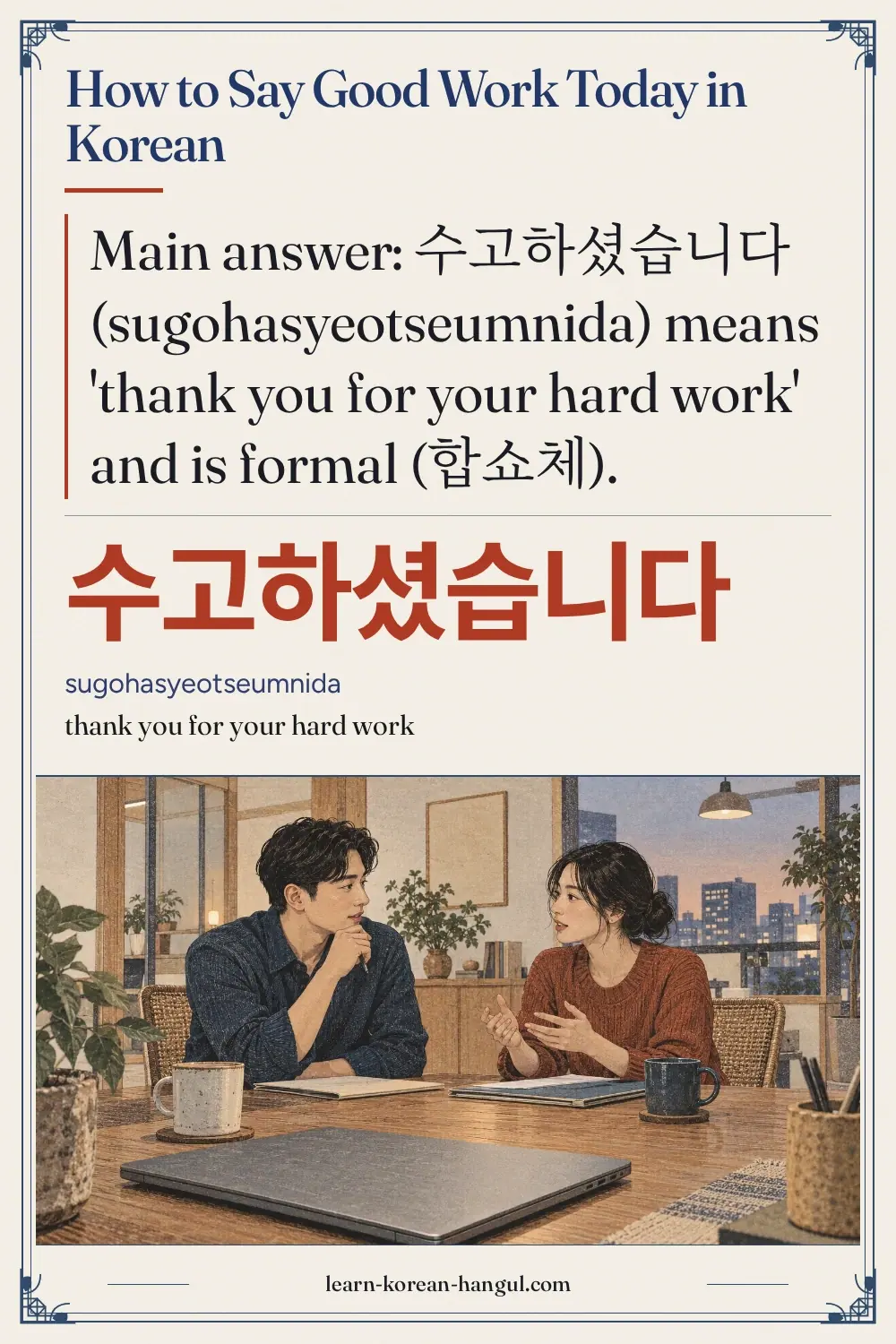
The standard formal way to say good work today in Korean is 수고하셨습니다 (sugohasyeotseumnida). The phrase has four parts: 수고 (sugo, "effort, trouble"), 하 (ha, from 하다, "to do"), 셨 (syeot, the honorific -시- joined with the past tense) and 습니다 (seumnida, the formal ending). Together they say "you made an effort," with respect and in the past tense.
The honorific -시- shows respect for the person you thank, and the past tense says the work is done. Because both are built in, the phrase cannot be used about yourself.
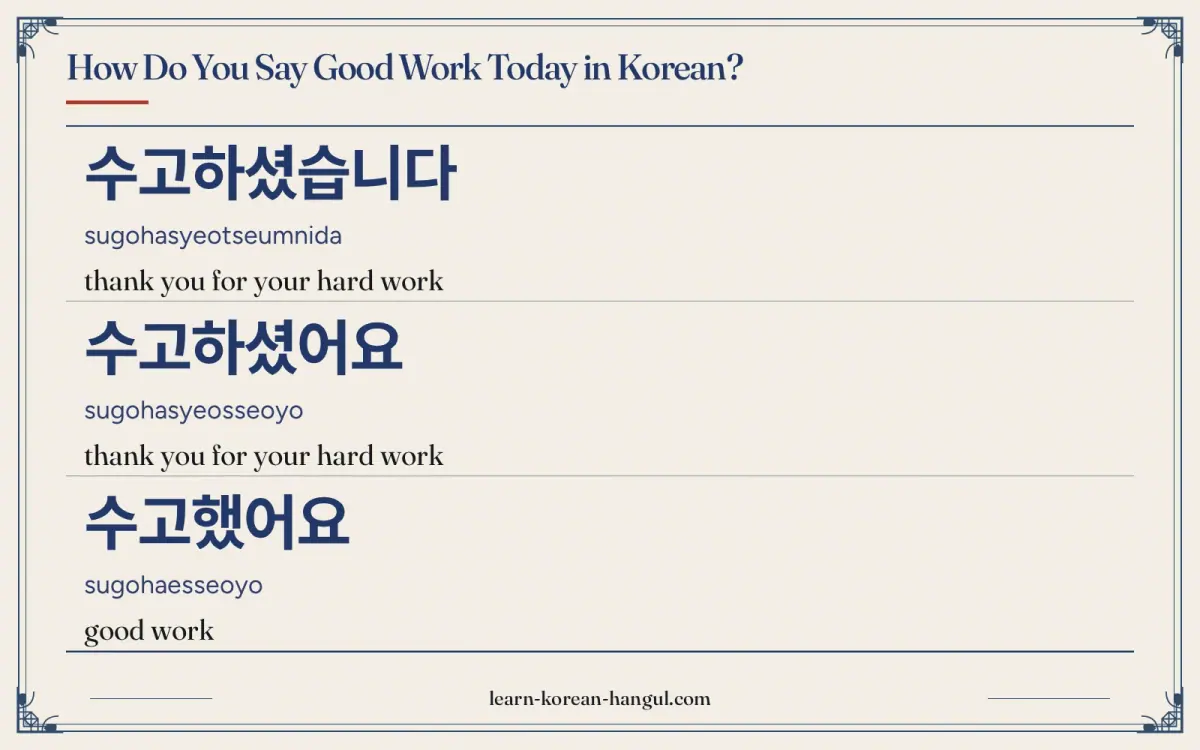
Four forms cover most situations.
| Korean | Revised Romanization | Meaning | Register |
|---|---|---|---|
| 수고하셨습니다 | sugohasyeotseumnida | thank you for your hard work | formal (합쇼체) |
| 수고하셨어요 | sugohasyeosseoyo | thank you for your hard work | polite (해요체), honorific |
| 수고했어요 | sugohaesseoyo | good work | polite, to a peer or junior |
| 수고했어 | sugohaesseo | good work | casual (해체) |
Revised Romanization (the South Korean government standard of 2000) is a reading aid only. The Hangul is the real spelling. The next section shows who each form fits.
What Are the Formal, Polite and Casual Ways to Say Good Work Today?
Korean changes the sentence ending to match the listener, and the Korean speech levels explain how. At work, the choice also depends on rank. The honorific -시- goes to seniors, and the plain forms go to peers and juniors.
Formal: 수고하셨습니다 (sugohasyeotseumnida)
수고하셨습니다 is the form to learn first, because workplaces use the formal style by default. It suits a manager, a client, a senior colleague and a speaker at a meeting. Say it with a small bow at the end of the day.
Example: 오늘도 수고하셨습니다. 내일 뵙겠습니다. (oneuldo sugohasyeotseumnida. naeil boepgetseumnida.) "Thank you for today's hard work. I'll see you tomorrow."
Polite Honorific: 수고하셨어요 (sugohasyeosseoyo)
수고하셨어요 keeps the honorific but uses the softer polite ending. It suits a senior colleague you know well, a teacher, a neighbour or a client in a friendly setting. The tone is warmer than the formal form.
Example: 오늘 정말 수고하셨어요. 푹 쉬세요. (oneul jeongmal sugohasyeosseoyo. puk swiseyo.) "You worked really hard today. Rest well."
Polite, without the Honorific: 수고했어요 (sugohaesseoyo)
수고했어요 drops -시-, so it fits a peer, a younger colleague or a team member you lead. A manager can say it to staff, and a friend can say it to a friend in polite company. Do not use it upward.
Casual: 수고했어 (sugohaesseo)
수고했어 drops the 요 and is casual (해체). Close friends, classmates and family hear it. It carries a friendly "well done" and often comes with a thank you.
Example: 오늘 수고했어. 고마워. (oneul sugohaesseo. gomawo.) "Good work today. Thanks."
Choosing a Form by Listener
The table gives one clear choice per situation.
| Situation | Best choice | Why |
|---|---|---|
| Manager, client, meeting | 수고하셨습니다 | formal and respectful |
| Senior colleague you know well | 수고하셨어요 | honorific and warm |
| Peer or junior colleague | 수고했어요 | polite, no honorific |
| Friend, classmate, family | 수고했어 | casual |
Once the choice is clear, the next step is to hear the words.
How Do You Pronounce 수고하셨습니다?
수고하셨습니다 is pronounced [수고하셛씀니다], roughly "su-go-ha-syeot-sseum-ni-da," with seven syllables in one word group. Play the slow clip, then the normal clip, and repeat each one aloud.
| Word | Spelled | Spoken | Revised Romanization |
|---|---|---|---|
| 수고하셨습니다 | 수-고-하-셨-습-니-다 | [수고하셛씀니다] | sugohasyeotseumnida |
| 수고하셨어요 | 수-고-하-셨-어-요 | [수고하셔써요] | sugohasyeosseoyo |
| 수고했어요 | 수-고-했-어-요 | [수고해써요] | sugohaesseoyo |
What Sound Changes Happen in the Good-Work Phrases?
The formal phrase has three changes in a row. First, the ㅆ at the end of 셨 cannot be released before a consonant, so it closes the syllable as a ㄷ-type stop: [셛]. Second, the ㅅ of 습 that follows a stop turns tense, so it sounds like "ss": [씀]. Third, the ㅂ of 습 meets the ㄴ of 니 and becomes ㅁ, so the ending is [씀니다]. This last change is nasalization, and the page on nasalization shows more cases. The Standard Pronunciation Rules (표준 발음법) of the National Institute of Korean Language (국립국어원) describe each step.
Revised Romanization shows the stop and the nasal, so it writes sugohasyeotseumnida. It does not show the tensing that comes from the neighbouring sound.
In the polite 수고하셨어요, the ㅆ moves forward to join the next vowel, so it sounds like [수고하셔써요]. The ㅓ in 셔 and 써 is unrounded: spread the lips and open the mouth without rounding them. For intonation, the phrase falls gently, as a statement of thanks. With the sounds clear, the next question is when to say it.
When Should You Use 수고하셨습니다, and When Should You Not?
Use 수고하셨습니다 when a piece of work has just ended: the end of a shift, a meeting, a project or a favour. It also works as a greeting for people who just finished something, like a speaker leaving the stage.
Situations Where 수고하셨습니다 Fits
- The end of the workday. Say it to colleagues as people leave.
- After a meeting or presentation. Say it to the presenter.
- After a team event or a shared task. Say it to the whole group.
Situations to Avoid
- To someone who is still working. Say 수고하세요 (sugohaseyo, "keep up the good work") as you leave. It wishes the person well for the work ahead.
- About yourself. The honorific -시- is for others, so do not say it about your own work.
- A casual form to a boss. 수고했어 is too familiar upward. Use 수고하셨습니다.
If unsure, choose the formal form and listen to what colleagues say. The dialogues below show how real endings sound.
What Does Good Work Today Sound Like in a Real Conversation?
Read each dialogue, play the clip, and say one role aloud.
Dialogue 1: At the end of the workday
- A: 부장님, 오늘도 수고하셨습니다. (bujangnim, oneuldo sugohasyeotseumnida.) "Director, thank you for today's hard work."
- B: 네, 수고했어요. 내일 봐요. (ne, sugohaesseoyo. naeil bwayo.) "Yes, good work. See you tomorrow."
부장님, 오늘도 수고하셨습니다. 네, 수고했어요. 내일 봐요.
Dialogue 2: Two friends after a group project
- A: 오늘 수고했어. (oneul sugohaesseo.) "Good work today."
- B: 너도 수고했어. 치킨 먹으러 가자. (neodo sugohaesseo. chikin meogeureo gaja.) "You too. Let's go eat chicken."
오늘 수고했어. 너도 수고했어. 치킨 먹으러 가자.
In Dialogue 1, the junior uses the honorific and the formal ending, and the senior answers with the polite 수고했어요, which has no honorific. This is the usual pattern at work. The guide to see you tomorrow in Korean covers the closing line. In Dialogue 2, both friends use the casual form and the second adds an invitation. The phrase also reflects workplace culture.
What Should You Know about the Culture behind Good Work Today?
수고하셨습니다 works as both thanks and a farewell in Korean offices. Colleagues say it to each other as they leave, and a manager may say it to the whole team. The phrase recognises effort, not only results, which fits the high value that workplaces place on effort and perseverance.
Rank adds a subtle layer. Some speakers feel that praising a senior's 수고 sounds as if a junior is judging the senior's work, so a few people prefer 고생하셨습니다 (gosaenghasyeotseumnida, "you went through hard times") or a plain 감사합니다 (gamsahamnida, "thank you") toward a very senior person. Others use 수고하셨습니다 upward without a second thought. The safest choice is to follow your colleagues. If you leave before your team, the guide to I'm leaving first in Korean gives the right line.
These shades explain several typical mistakes.
What Mistakes Do Learners Make with Good Work Today in Korean?
The most common mistake is mixing up two similar phrases. Five mistakes appear again and again:
- Saying 수고하세요 for finished work. It means "keep working well." Fix: say 수고하셨습니다.
- Spelling 셨 as 셧. The past tense needs the doubled ㅆ. Fix: 수고하셨습니다.
- Dropping the tense sounds. Saying [수고하셨습니다] with a soft ㅅ. Fix: [수고하셛씀니다].
- Using 수고했어요 for a boss. Fix: add -시- and say 수고하셨어요.
- Using the honorific for yourself. Fix: -시- is for others only.
All five come from translating "good work" without its direction. A few related searches ask the same thing in other words, so they are answered next.
Short Answers on Thank You for Your Hard Work, Well Done and Great Work
Five searches lead to this page, so each gets a short answer.
- Thank you for your hard work in Korean: Say 수고하셨습니다 or, for a very senior person, 고생하셨습니다.
- Thanks for your hard work in Korean: Say 수고해 줘서 고마워요 (sugohae jwoseo gomawoyo) to a peer or junior.
- Great work and well done in Korean: For a specific result, say 잘했어요 (jalhaesseoyo), as in good job in Korean. 수고했어요 praises the effort.
- You worked hard in Korean: Say 고생했어요 (gosaenghaesseoyo) to a peer or junior and 고생하셨습니다 to a senior.
The page on thank you in Korean covers the plain thanks.
Related Phrases to Learn Next
Three pages follow the same layout and pair well with this one:
- I'll do my best in Korean: the promise for the next day.
- See you tomorrow in Korean: the usual closing line.
- Nice to work with you in Korean: the greeting for a new teammate.
The complete list sits in the business Korean phrases cluster.
Practice: Say It Aloud
Spend five minutes on this routine.
- Play the slow clip of 수고하셨습니다 and repeat it three times, stopping on [셛] before [씀].
- Say 수고하셨습니다, then 수고하셨어요, and notice the softer ending.
- Say 수고했어요 and 수고했어, and name the listener for each.
- Hide the Romanization with the toggle and read the four forms from Hangul only.
- Drill the cluster with the phrase flashcards.
When the three changes in the ending run together smoothly, you can say good work today in Korean and sound at home in an office.
Frequently Asked Questions
The answers below add details about how to say good work today in Korean beyond the sections above.
What does 수고하셨습니다 mean?
수고하셨습니다 means "thank you for your hard work" or "good work today." The noun 수고 means effort or trouble, 하다 means "to do," and -시- and -았/었- add respect and past tense. People say it when a task or a working day ends, as thanks and recognition.
What is the difference between 수고하셨습니다 and 수고하세요?
수고하셨습니다 is past tense and says "you worked hard" about work that is finished. 수고하세요 is a request form that wishes someone well while they keep working, as when you leave a shop or an office. Use the first at the end of the work, and the second as you walk away.
Can I say 수고하셨습니다 to my boss?
Yes, in most workplaces, because the honorific -시- and the formal ending show respect. Some speakers feel that praising a boss's 수고 sounds as if a junior is judging a senior's work, so they prefer 고생하셨습니다 or 감사합니다 for a boss. If unsure, listen to what your colleagues say to the manager.
Is 수고했어요 polite?
Yes, 수고했어요 is polite (해요체), but it has no honorific -시-. It is the right choice for a peer or a junior, such as a younger colleague. For a boss or an older person, add -시- and say 수고하셨어요 or 수고하셨습니다 instead.
Why is 수고하셨습니다 pronounced [수고하셛씀니다]?
The ㅆ at the end of 셨 closes the syllable as a ㄷ-type stop, and the ㅅ of 습 turns tense after it. Then the ㅂ of 습 meets the ㄴ of 니 and becomes ㅁ. Revised Romanization writes sugohasyeotseumnida, which shows the stop and the nasal.
What is the most common mistake with good work today in Korean?
Learners often say 수고하세요 when they mean thanks for finished work. That phrase wishes someone well while they continue working. For finished work, use 수고하셨습니다 or 수고하셨어요. Another slip is spelling 셨 as 셧, which is a different syllable.