내일 봐요
내일 봐요
What you'll learn
- Choose between 봐요, 봬요, 뵙겠습니다 and 봐 for different listeners.
- Spell 봬요 correctly and explain why it is not 뵈요.
- Separate 내일 봐요 (a farewell) from 내일 만나요 (a plan).
- Use the phrases people say when leaving the office or class.
Before you start: knowing see you later in Korean helps, because it uses the same verb 봐요 with a different time word. Time: about 10 minutes. Audio plays only when you press a button.
Key facts
- 내일 봐 is the casual form, and 내일 뵙겠습니다 is the formal form for seniors.
- 내일 봬요 is the polite form for a senior, and the spelling 봬 comes from 뵈다 plus -어요.
How Do You Say See You Tomorrow in Korean?
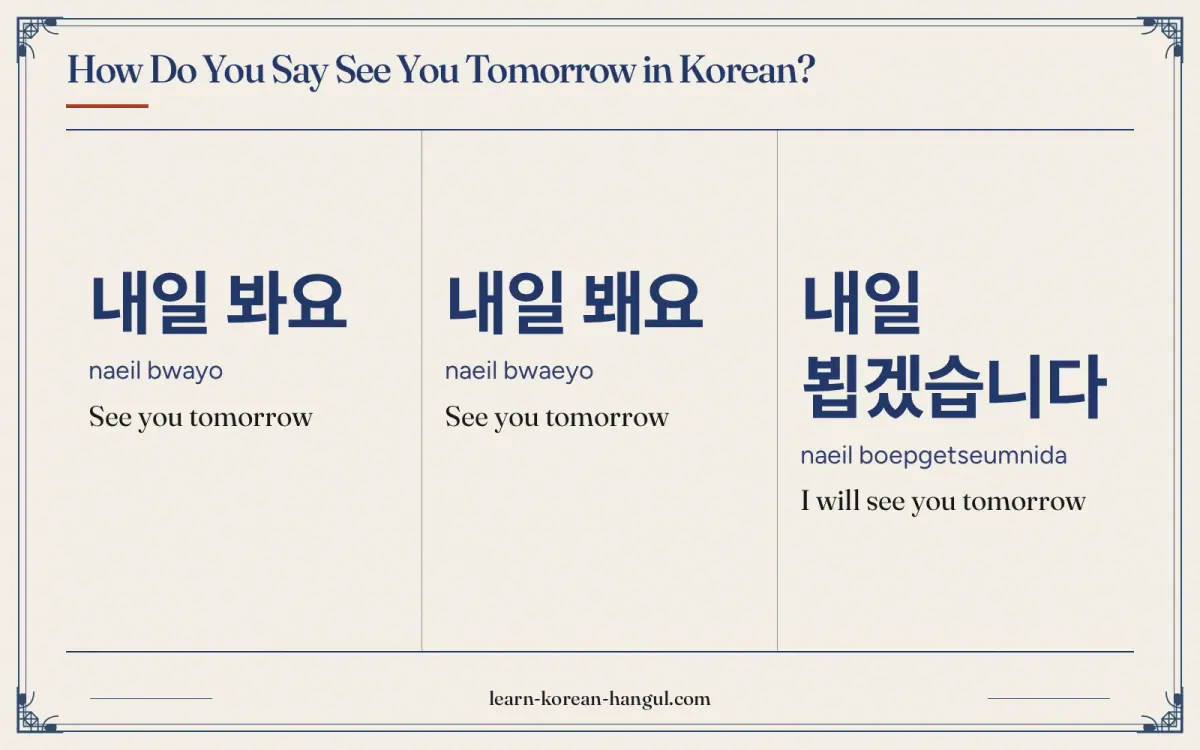
The standard way to say see you tomorrow in Korean is 내일 봐요, which literally means "we will see each other tomorrow". It is polite, short and suitable for almost any adult you meet regularly.
| Listener | Korean | Romanization | Meaning |
|---|---|---|---|
| Coworker, classmate | 내일 봐요 | naeil bwayo | See you tomorrow |
| Senior (polite) | 내일 봬요 | naeil bwaeyo | See you tomorrow |
| Senior (formal) | 내일 뵙겠습니다 | naeil boepgetseumnida | I will see you tomorrow |
| Friend | 내일 봐 | naeil bwa | See you tomorrow |
| Making a plan | 내일 만나요 | naeil mannayo | Let's meet tomorrow |
The time word 내일 can be swapped for another, which gives 주말에 봐요 (see you at the weekend) or 다음 주에 봐요 (see you next week). For later the same day, Koreans say 이따 봐요. The sections below explain each form.
What Are the Formal, Polite and Casual Ways to Say See You Tomorrow?
Korean changes the sentence ending, and sometimes the verb, to match the listener. This system is called speech levels, and the guide to Korean speech levels covers it in depth. This page uses three levels: formal (합쇼체), polite (해요체) and casual (해체).
Formal: 내일 뵙겠습니다 (naeil boepgetseumnida)
Formal · 합쇼체내일 뵙겠습니다 means "I will see you tomorrow" and is for a boss, a client, a professor or the head of a department. 뵙다 is the humble verb for seeing a senior person. Because the verb changes, it is more respectful than simply changing the ending of 보다.
먼저 가보겠습니다. 내일 뵙겠습니다.
meonjeo gabogetseumnida. naeil boepgetseumnida
I'll leave first. See you tomorrow.
Polite to Seniors: 내일 봬요 (naeil bwaeyo)
Polite · 해요체내일 봬요 is the polite form for a senior you know well, such as a teacher or an older coworker. The spelling follows a rule: the base verb is 뵈다, and 뵈 plus the ending -어요 contracts to 봬요, the same pattern that turns 되 plus -어요 into 돼요. The form 뵈요 is a common mistake.
내일 봬요.
naeil bwaeyo
See you tomorrow.
Polite: 내일 봐요 (naeil bwayo)
Polite · 해요체내일 봐요 is the default for coworkers, classmates, neighbours and anyone of similar rank. You can add a place to make it specific, such as 학교에서 (at school).
내일 학교에서 봐요.
naeil hakgyoeseo bwayo
See you at school tomorrow.
Casual: 내일 봐 (naeil bwa)
Casual · 반말With friends, drop the -요: 내일 봐 means "see ya tomorrow". Friends often shorten 내일 to 낼 in speech and messages, giving 낼 봐. Never use these with a teacher, a boss or an older stranger.
내일 봐.
naeil bwa
See you tomorrow.
Making a Plan: 내일 만나요 (naeil mannayo)
Polite · 해요체내일 만나요 uses the verb 만나다, "to meet". It is a polite proposal or confirmation of a meeting, not a farewell. Use it when you are arranging a time, a place or an activity.
내일 만나요.
naeil mannayo
Let's meet tomorrow.
The polite 내일 봐요 is the safe choice in most situations. Next, the sounds.
How Do You Pronounce 내일 봐요?
내일 봐요 is pronounced [내일 봐요], in four syllables, with no sound changes in the spelling. The first two syllables are separate, so say them with a clear break. Say it in four beats.
- 내 (nae): like the vowel in "net" with a slight lift.
- 일 (il): "eel", short.
- 봐 (bwa): a quick "bwah", where ㅗ slides into ㅏ.
- 요 (yo): "yo".
Sound Changes to Listen For
Two points matter in this group of phrases.
- Keep 내 and 일 apart. The word is nae-il, with two syllables, not "nail". A short pause helps.
- Tense sounds in 뵙겠습니다. After the closing ㅂ in 뵙, the ㄱ of 겠 is tense, and the ㅅ of 습 becomes ㅆ and the ㅂ turns into ㅁ before ㄴ, so the word is [뵙껟씀니다]. These changes follow the National Institute of Korean Language Standard Pronunciation rules (표준 발음법). See ㅂ-to-ㅁ nasalization.
Once the sounds are clear, the next question is which form suits each moment.
When Should You Use 내일 봐요, and When Should You Not?
Use 내일 봐요 at the end of a day when you will see the person again tomorrow. Use 내일 만나요 only when you are making a plan, and use 내일 뵙겠습니다 for someone senior.
Situations Where It Fits
- Leaving the office. 먼저 가보겠습니다. 내일 봬요.
- Ending a class. 선생님, 내일 뵙겠습니다.
- Leaving friends in the evening. 낼 봐.
- Ending a phone call. 그럼 내일 봐요.
Situations to Avoid
- A meeting not tomorrow. Change the time word, such as 다음 주에 봐요.
- A goodbye to someone you will not see again. Use 안녕히 가세요, as in goodbye in Korean.
- Bedtime at home. Use 안녕히 주무세요, as in good night in Korean, and add 내일 봐요 if you will see each other in the morning.
Real exchanges show how rank changes the words.
What Does See You Tomorrow Sound Like in a Real Conversation?
See you tomorrow usually follows a remark about the end of the day, so it comes with a leaving phrase.
Leaving the Office
Minsu
먼저 가보겠습니다. 내일 뵙겠습니다.
meonjeo gabogetseumnida. naeil boepgetseumnida
I'll leave first. See you tomorrow.
Manager
네, 수고했어요. 내일 봐요.
ne, sugohaesseoyo. naeil bwayo
Yes, good work. See you tomorrow.
What to notice: the junior uses the humble 뵙겠습니다 and the senior answers with the plain polite 봐요. Rank decides who uses which verb.
Friends Planning Tomorrow
Jia
내일 몇 시에 만나?
naeil myeot sie manna?
What time shall we meet tomorrow?
Minsu
열 시에 만나. 내일 봐.
yeol sie manna. naeil bwa
Let's meet at ten. See you tomorrow.
What to notice: 만나 sets the plan, and 봐 closes the call. The pair 만나 and 봐 shows the difference between a plan and a farewell.
End of Class
Teacher
오늘 수업 끝났어요. 내일 봐요.
oneul sueop kkeunnasseoyo. naeil bwayo
Today's class is over. See you tomorrow.
Student
네, 선생님. 내일 뵙겠습니다.
ne, seonsaengnim. naeil boepgetseumnida
Yes, teacher. See you tomorrow.
What to notice: the teacher says 봐요 and the student answers with the humbler 뵙겠습니다. A student who answers 내일 봐요 would still be understood, but 뵙겠습니다 shows respect. The same logic appears in see you soon in Korean. These habits come from workplace and school culture.
What Should You Know about the Culture behind See You Tomorrow?
Korean office and school culture attaches several fixed phrases to the end of the day, and see you tomorrow usually comes last.
- Leaving phrases come first. Coworkers often say 먼저 가보겠습니다 (I will leave first) or 수고하셨습니다 (thank you for your hard work today) before 내일 봬요. Copy what the people around you say.
- Rank guides the form. Juniors tend to use 뵙겠습니다 or 봬요, and seniors use 봐요.
- Small bow. Many people bow slightly when leaving a senior's desk or a classroom.
- Not a promise. If you do not have a plan, 내일 봐요 simply means you expect to meet naturally.
An expert insight: learners often ask whether 내일까지 can mean until tomorrow as a goodbye. It cannot. It means a deadline, so 내일까지 부탁드립니다 means please do this by tomorrow. The table below collects other common mistakes.
What Mistakes Do Learners Make with See You Tomorrow in Korean?
Most mistakes come from spelling 봬요 and from confusing a farewell with a plan.
| Mistake | Why it is a problem | Fix |
|---|---|---|
| 내일 뵈요 | A spelling error | Write 내일 봬요 |
| 내일 봐 to a teacher | Casual speech is rude | Say 내일 봐요 or 내일 뵙겠습니다 |
| 내일까지 as a goodbye | It means by tomorrow | Say 내일 봐요 |
| 내일 만나요 as a casual farewell | It sounds like a plan | Say 내일 봐요 |
| Reading 내일 as one syllable "nail" | Sounds foreign | Say nae-il |
Learners often assume 봐요 and 봬요 are two spellings of the same word. Actually, 봐요 comes from 보다 (to see) and 봬요 comes from 뵈다 (to see a senior), so choosing the wrong one changes the level of respect.
Is It the Same as until Tomorrow or See You Tomorrow Formal?
Mostly yes. Each English variant maps to a form on this page. The short answers below cover the other searches folded into this page.
- See you tomorrow formal in Korean: 내일 뵙겠습니다.
- See you tomorrow casual in Korean: 내일 봐 or 낼 봐.
- Until tomorrow in Korean: 내일 봐요. 내일까지 is a deadline.
- See you tomorrow, then: 그럼 내일 봐요.
The pattern holds across all of them: the verb 보다 or its humble partner 뵙다 plus a time word. Now practise.
Practice: Say It Aloud
Play the slow clip of 내일 봐요 three times. Choose a phrase for each situation. Answers follow.
- You leave a meeting with your boss.
- You leave class and say goodbye to your friend.
- You plan to meet a colleague at 9 a.m.
- You write the polite form to a senior and need the spelling for 봬요.
Answers
- 내일 뵙겠습니다.
- 내일 봐.
- 내일 아홉 시에 만나요.
- 내일 봬요.
The phrase flashcards drill these with audio.
Related Phrases to Learn Next
See you tomorrow sits among the other farewells, so these are the natural next phrases.
- See you later in Korean: 나중에 봐요 and 이따 봐요.
- See you soon in Korean: 곧 봐요 and 또 만나요.
- Goodbye in Korean: 안녕히 가세요 and 안녕히 계세요.
This guide belongs to the Korean greetings collection. What this page does not cover: the full honorific verb system and written work messages, which have their own lessons. Use 봐요 for equals, 봬요 or 뵙겠습니다 for seniors and 봐 for friends, and you can say see you tomorrow in Korean at the end of any day.
Frequently Asked Questions
Is it 내일 봬요 or 내일 뵈요?
The correct spelling is 내일 봬요. The base verb is 뵈다 (humble to see), and 뵈 plus -어요 contracts to 봬요, just as 되 plus -어요 becomes 돼요. 뵈요 is a spelling mistake. Use 봬요 for a polite see you to a senior and 봐요 for equals.
Is 내일 봐요 the same as 내일 만나요?
No. 내일 봐요 is a farewell that assumes you will see each other, for example at school or work. 내일 만나요 means let's meet tomorrow and is used to make or confirm a plan. If you have no set plan, 내일 봐요 sounds natural. If you do, say 내일 만나요.
How do I say until tomorrow in Korean?
Say 내일 봐요 (see you tomorrow). The English phrase until tomorrow has no direct Korean farewell. 내일까지 does mean until tomorrow, but it describes a deadline or a time span, as in 내일까지 해요 (do it by tomorrow). It is not used as a goodbye.
What do coworkers say when leaving the office?
Coworkers often say 먼저 가보겠습니다 (I will leave first) or 수고하셨습니다 (good work today) and add 내일 봬요. A manager may answer 수고했어요 (good work today). Exact choices depend on rank and office culture, so listen first and copy what your own coworkers say.
Can I shorten 내일 to 낼 in speech?
Yes. 낼 is a common spoken short form of 내일, as in 낼 봐 (see ya tomorrow) among friends. It sounds casual, so keep the full 내일 in writing, in formal speech and with seniors. In text messages between friends, 낼 is very common.