미쳤어
미쳤어
What you'll learn
- Say 미쳤어, 미쳤어요?, 미친 and 제정신이야? and know how rude each one is.
- Tell the harsh meaning from the playful one, "insane" as praise.
- Pronounce 미쳤어 as [미쳐써] with an aspirated ㅊ.
- Avoid the common mistake of thinking 요 makes it polite.
Before you start: the forms below depend on how close you are to the listener, so a quick look at Korean speech levels helps. Time: about 10 minutes. Audio plays only when you press a button.
How Do You Say Michin in Korean?
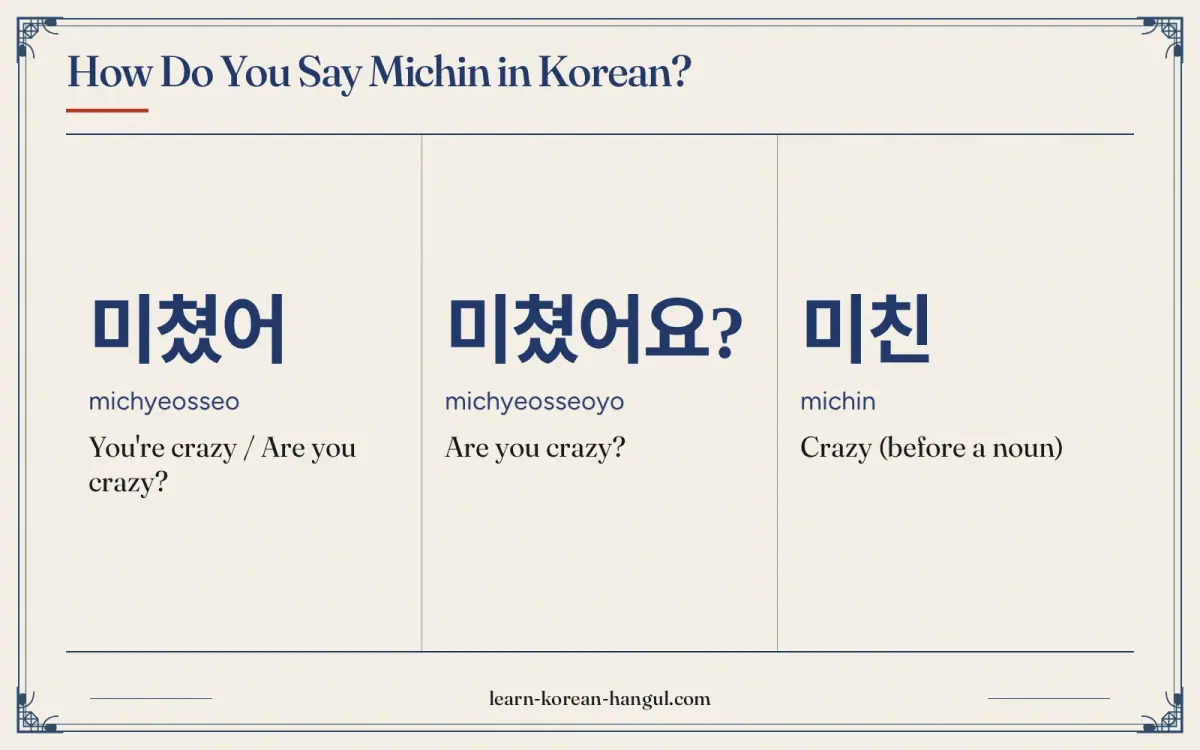
The everyday phrase is 미쳤어. It is the casual past of the verb 미치다 (michida, "to go mad"). The past form is used because the speaker sees a person who has already "gone mad". The word 미친 is the modifier form, used before a noun.
| Korean | Romanization | Meaning | Style |
|---|---|---|---|
| 미쳤어 | michyeosseo | You're crazy / Are you crazy? | Casual, can be rude |
| 미쳤어요? | michyeosseoyo | Are you crazy? | Polite ending, still rude |
| 미친 | michin | Crazy (before a noun) | Casual, rude about people |
| 제정신이야? | jejeongsiniya | Are you out of your mind? | Casual |
Revised Romanization (the South Korean government standard of 2000) is only a reading aid. Learn the Hangul first. The next section goes through each form and its risk.
What Are the Polite and Casual Ways to Say Michin?
None of these is truly polite. The forms range from teasing to hurtful, so each section says how harsh it is.
Casual: 미쳤어 (michyeosseo)
Casual · 반말미쳤어 can be a statement ("you're crazy") or a question ("are you crazy?"). The rising tone makes it a question. Between close friends it is shocked and playful, as in "you bought all of that?". From someone angry it is an insult.
너 그걸 다 샀어? 미쳤어?
neo geugeol da sasseo? michyeosseo
Did you buy all of that? Are you crazy?
Friends also use the sentence in a positive way. 미쳤다 (michyeotda, pronounced [미쳗따]) can mean "this is insane!" when something is amazing, such as a song or a skill. The meaning depends on the tone and the situation.
Polite: 미쳤어요? (michyeosseoyo)
Polite · 해요체Adding 요 makes the grammar polite, but the word is still harsh. It sounds like a polite-looking insult. It can appear between colleagues of the same age who joke together, or in a drama when a character is shocked, but it is risky in real life.
그 비싼 걸 샀어요? 미쳤어요?
geu bissan geol sasseoyo? michyeosseoyo
You bought that expensive thing? Are you crazy?
Casual: 미친 (michin)
Casual · 반말미친 is the modifier. 미친 사람 ("a crazy person") is an insult, and calling someone this can hurt, especially because the word also touches on mental illness. One safe use is the phrase 미친 듯이 (michin deusi), "like crazy" or "like mad".
비가 미친 듯이 와요.
biga michin deusi wayo
It is raining like crazy.
Casual: 제정신이야? (jejeongsiniya)
Casual · 반말제정신 means "sound mind", so 제정신이야? asks "are you in your right mind?". It is a bit less direct than 미쳤어 and appears when someone is shocked. In the polite style it becomes 제정신이에요?, which is still blunt.
지금 제정신이야?
jigeum jejeongsiniya
Are you out of your mind right now?
The grammar here is simple. The sound needs attention, so look at the pronunciation next.
How Do You Pronounce 미쳤어?
미쳤어 is pronounced [미쳐써]: mi-chyeo-sseo, three syllables. The spelling shows a final ㅆ on 쳤, but the sound moves to the next syllable and is pronounced as a tense "ss" at the start of 써.
- 미: "mi", like "mee".
- 쳐: an aspirated ㅊ plus ㅕ, with a clear puff of air. The ㅕ is "yeo", with the unrounded ㅓ sound.
- 써: a tense ㅆ plus ㅓ, spoken tight with a hissing sound.
Sound Changes to Listen For
- Linking. The ㅆ at the end of 쳤 moves to the start of 어, so 쳤어 sounds like 쳐써. This is liaison (linking), and the ㅆ stays tense because it is a tense letter. Tensing caused by a neighbouring sound, as in 미쳤다 below, is explained on the Korean tensification page.
- Aspirated ㅊ. The ㅊ has a strong puff of air, stronger than plain ㅈ.
- ㅓ and ㅕ. The vowels are unrounded: keep your lips relaxed, not round.
- 미쳤다 and 미친. 미쳤다 is [미쳗따], where the final ㅆ sounds like ㄷ and makes the next ㄷ tense. Revised Romanization writes it michyeotda and does not show the tensing. 미친 is [미친] with no change.
| Korean | Sound | Notes |
|---|---|---|
| 미쳤어 | [미쳐써] | linking of ㅆ |
| 미쳤어요 | [미쳐써요] | the same, plus 요 |
| 미쳤다 | [미쳗따] | ㅆ becomes ㄷ, next ㄷ is tense |
| 미친 | [미친] | no change |
| 제정신이야 | [제정시니야] | ㄴ links to 이 |
Practise the three syllables slowly, then say them as one flowing phrase. Once you can say it, learn who can hear it.
When Should You Use 미쳤어, and When Should You Not?
Use 미쳤어 rarely, and only with close friends of your own age. Know it for understanding dramas, but treat it as a word for your ears more than your mouth.
Situations Where It Fits
- Teasing a close friend. A shocked, playful 미쳤어? when a friend does something extreme.
- Praising something amazing, among friends. 이 노래 미쳤다 ("this song is insane").
- Understanding K-dramas. Characters shout it when they are angry or shocked. Hearing it is useful.
- Talking about obsession. 그 가수에 미쳤어요 ("I'm crazy about that singer") uses the word as "obsessed", which is not an insult.
그 가수에 미쳤어요.
geu gasue michyeosseoyo
I am crazy about that singer.
Situations to Avoid
- A teacher, boss or any elder. Even 미쳤어요? is a serious insult.
- Strangers. The word can start a fight.
- Talking about mental health. The word can offend people who live with mental illness. Use 정신 건강 (jeongsin geongang, "mental health") in serious talk.
- Formal writing. Use 이해할 수 없습니다 ("I cannot understand this") if you must object.
Two short dialogues show the playful and the positive uses.
What Does Michin Sound Like in a Real Conversation?
In the first dialogue a friend is shocked, and in the second a friend uses 미쳤다 as praise.
Spending a Whole Salary
Soo-Ah
나 월급을 하루 만에 다 썼어.
na wolgeubeul haru mane da sseosseo
I spent my whole salary in one day.
Tae-Yang
뭐? 미쳤어?
mwo? michyeosseo
What? Are you crazy?
What to notice: 뭐? is a short question word, and 미쳤어? rises like a yes/no question. The friends know each other well, so the harsh word is a joke.
Praise for a Song
Ha-Eun
이 노래 들어 봐.
i norae deureo bwa
Listen to this song.
Yu-Jin
와, 진짜 미쳤다!
wa, jinjja michyeotda
Wow, this is insane!
What to notice: 들어 봐 is the casual form of "try listening", and 진짜 means "really". Here 미쳤다 is high praise. The sentence works between friends, but would sound odd to a stranger.
What Should You Know about the Culture behind Michin?
Korean TV makes this word famous, but Korean daily life treats it more carefully.
- Drama versus life. In K-dramas, characters shout 미쳤어? in anger or shock for drama. The same line to a real person in the same tone would cause offence.
- A word with two directions. 미치다 can mean "to go mad" and "to be obsessed". 그 가수에 미쳤어요 means "I'm obsessed with that singer", which is normal.
- Praise by exaggeration. Young speakers say 미쳤다 for something amazing. The exaggeration is the compliment, in the same way as English "that's insane".
- Respect keeps it out of formal talk. Even an honorific form such as 미치셨어요? is still an insult, so speakers keep the word away from elders.
An expert insight: Korean has a strong habit of showing shock with questions such as 제정신이야? or 말도 안 돼, so you can sound reactive without the harsh word. See no way in Korean for the milder reactions. The mistakes below show where learners go wrong.
What Mistakes Do Learners Make with Michin in Korean?
Most michin mistakes come from level and tone.
| Mistake | Why it is a problem | Fix |
|---|---|---|
| Using 미쳤어요? to a teacher or boss | 요 does not remove the insult | Do not use the word; say 놀랐어요 ("I was surprised") |
| Using 미쳤어 to a new friend | Too familiar, may start a fight | Wait until you know each other well |
| Stopping after 쳤 before saying 어 | The standard sound links as [미쳐써] | Link ㅆ to the next syllable |
| Using 미친 사람 for someone you dislike | It is an insult and may hurt | Describe the behaviour instead |
| Assuming 미쳤다 is always bad | Among friends it can be praise | Check the tone and context |
Learners often copy the K-drama scene exactly. Dramas exaggerate for effect, so the real range is narrower. If you only remember one rule, remember that politeness endings do not cancel a rude word. The English word "crazy" has other Korean partners, as shown next.
Is It the Same as Crazy?
Partly. "Crazy", "are you crazy" and "you're crazy" all lead to 미쳤어, but Korean has other options for different meanings.
- Crazy (insulting): 미쳤어, 미친 사람.
- Are you crazy? (shock): 미쳤어?, 제정신이야?
- Crazy (amazing, among friends): 미쳤다, or the milder 대박 (daebak).
- Crazy about something: X에 미쳤어요.
- Like crazy: 미친 듯이.
- A softer shocked reaction: heol in Korean and no way in Korean.
Now practise what you have learned.
Practice: Say It Aloud
Play the slow clip and repeat 미쳤어 three times, linking the final ㅆ into the next syllable. Then pick the safest phrase for each situation. Answers follow.
- You tell a close friend that a song is amazing.
- You are surprised by something your teacher did.
- You say that you are obsessed with a singer.
- You describe heavy rain.
Answers
- 이 노래 미쳤다!
- Do not use 미쳤어요. Say 정말 놀랐어요 ("I was really surprised").
- 그 가수에 미쳤어요.
- 비가 미친 듯이 와요.
The phrase flashcards drill drama phrases with audio.
Related Phrases to Learn Next
Michin sits in a group of reaction words from dramas.
- Heol in Korean: a milder, very common shock word among young speakers.
- No way in Korean: polite ways to react with disbelief.
- K-drama phrases: the collection of lines you hear in dramas.
This guide belongs to the kdrama Korean phrases collection. What this page does not cover: stronger swear words, regional slang, and how the word is used in news or legal language. Say it rarely and with care, and you can say michin in Korean without causing offence.
Frequently Asked Questions
How do you say michin in Korean?
The phrase is 미쳤어 (michyeosseo), "you're crazy" or, with a rising tone, "are you crazy?". The root verb is 미치다, and 미친 is the modifier "crazy". It is casual and can be an insult, so use it only with close friends.
How do you pronounce 미쳤어?
Say [미쳐써], mi-chyeo-sseo. The ㅊ is aspirated, with a puff of air. The final ㅆ of 쳤 links to the next syllable and becomes a tense "ss" at the start of 써. Keep the vowel ㅕ unrounded. Play the slow clip and repeat after it.
What is the difference between 미쳤어 and 미쳤어요?
미쳤어요 adds the polite ending 요, but the meaning is the same: "are you crazy?" The polite ending only changes the grammar, not the harshness. Both are risky, and neither is safe for a teacher, a boss or an elder.
Is 미쳤어 formal or casual?
It is casual, and it belongs to rude or very informal talk. There is no formal version, because formal speech avoids this word. Among close friends, a form such as 미쳤다 can also mean "insane" as praise.
Can I use 미쳤어 with friends, elders and strangers?
Only with close friends of your age. With elders and strangers, avoid it completely, because it can cause serious offence even with 요. To react to surprising news politely, use a phrase such as 정말요? or 놀랐어요.
What is the most common mistake with michin in Korean?
The most common mistake is thinking 요 makes it polite. 미쳤어요? to a boss or teacher is still an insult. The second mistake is copying drama lines in real life, where the same tone causes offence.