
잘 부탁드립니다
잘 부탁드립니다
What you'll learn
- Say 잘 부탁드립니다, 잘 부탁드려요, 잘 부탁해요 and 앞으로 잘 부탁드립니다, and pick one for each listener.
- Finish a self-introduction the way Koreans do.
- Pronounce 부탁드립니다 as [부탁뜨림니다].
- Avoid the mistake of stopping at "nice to meet you".
Before you start: the forms below depend on the listener, so a quick look at Korean speech levels helps. Time: about 10 minutes. Audio plays only when you press a button.
How Do You Say Nice to Work with You in Korean?
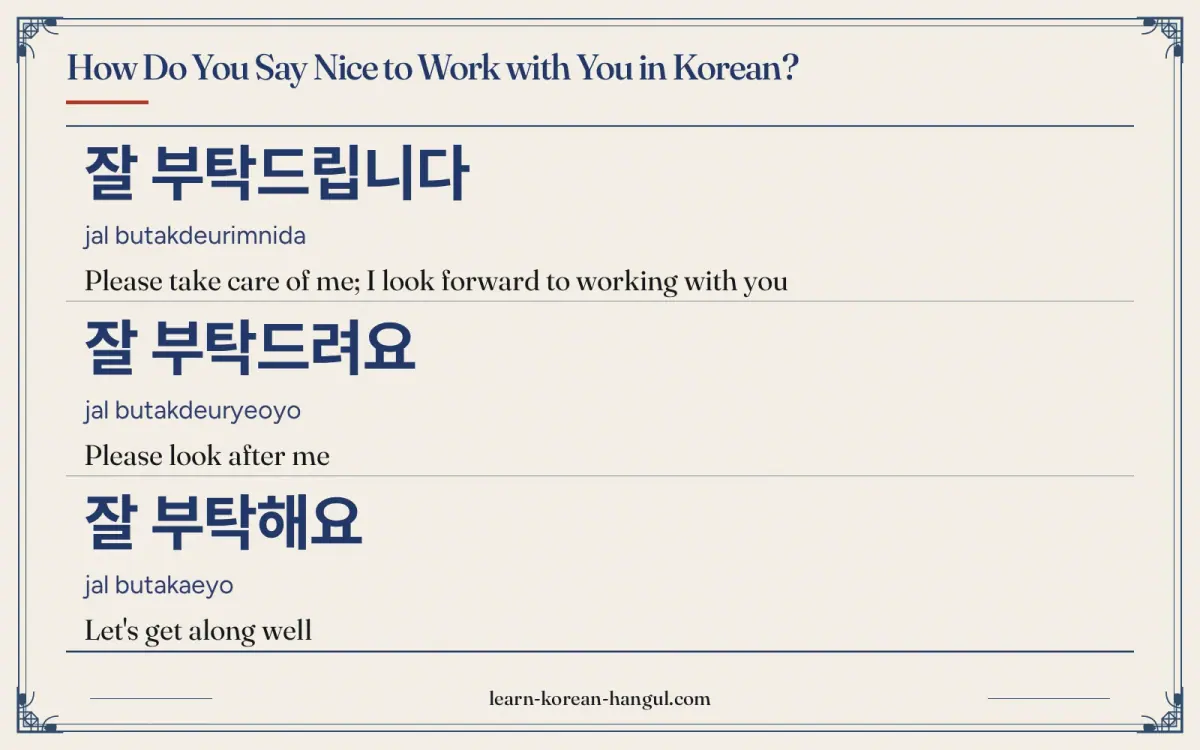
The standard answer is 잘 부탁드립니다. It has three parts: 잘 (jal, "well"), 부탁 (butak, "a request, a favour") and 드립니다 (deurimnida, the formal humble form of "to give"). Together they say "I humbly ask you to treat me well". English has no exact match, so "nice to work with you" and "please take care of me" are both approximate.
| Korean | Romanization | Meaning | Style |
|---|---|---|---|
| 잘 부탁드립니다 | jal butakdeurimnida | Please take care of me; I look forward to working with you | Formal |
| 잘 부탁드려요 | jal butakdeuryeoyo | Please look after me | Polite |
| 잘 부탁해요 | jal butakaeyo | Let's get along well | Polite, to equals |
| 앞으로 잘 부탁드립니다 | apeuro jal butakdeurimnida | I look forward to working with you from now on | Formal |
Revised Romanization (the South Korean government standard of 2000) is only a reading aid. In verb forms it shows the ㄱ + ㅎ blend as one aspirated k, so 부탁해요 is butakaeyo, though many learners type butakhaeyo. Learn the Hangul first. The next section sorts the forms by listener.
What Are the Formal and Polite Ways to Say Nice to Work with You?
All four forms mean nearly the same thing. What changes is how much respect the speaker shows. The ones with 드리다 (humble "give") rank above the ones with 하다.
Formal: 잘 부탁드립니다 (jal butakdeurimnida)
Formal · 합쇼체This is the safest form. It suits a first day at work, an interview, a speech or any meeting with people senior to you. The -ㅂ니다 ending is the formal style of Korean. Say it with a small bow.
안녕하세요, 새로 온 이서준입니다. 잘 부탁드립니다.
annyeonghaseyo, saero on iseojunimnida. jal butakdeurimnida
Hello, I am Lee Seo-jun, the new person. Nice to work with you.
Polite: 잘 부탁드려요 (jal butakdeuryeoyo)
Polite · 해요체잘 부탁드려요 keeps the humble verb but uses the softer -요 ending. It fits relaxed workplaces, clubs, classes and new neighbours. It is warm and polite, without the stiffness of the formal style.
301호에 이사 왔어요. 잘 부탁드려요.
sambaegilho-e isa wasseoyo. jal butakdeuryeoyo
I moved into unit 301. Nice to meet you.
Polite: 잘 부탁해요 (jal butakaeyo)
Polite · 해요체잘 부탁해요 uses the plain verb 하다, not the humble 드리다. It sounds friendly and equal, so use it with peers or younger people. Do not use it to a boss, because it lacks the humble tone. The same phrase without -요, 잘 부탁해 (jal butakae), is casual and works among close friends.
같은 팀이 돼서 기뻐요. 잘 부탁해요.
gateun timi dwaeseo gippeoyo. jal butakaeyo
I'm glad we are on the same team. Let's get along well.
Formal: 앞으로 잘 부탁드립니다 (apeuro jal butakdeurimnida)
Formal · 합쇼체앞으로 means "from now on", so this version looks ahead to a long working relationship. It fits a promotion, a new project or a speech. A senior speaking to a junior might say 잘 부탁합니다 (jal butakamnida), which is formal but without the humble verb.
열심히 하겠습니다. 앞으로 잘 부탁드립니다.
yeolsimhi hagetseumnida. apeuro jal butakdeurimnida
I will work hard. I look forward to working with you from now on.
The phrases are long, so the sounds need practice. That is the next topic.
How Do You Pronounce 잘 부탁드립니다?
잘 부탁드립니다 has seven syllables: 잘 (jal), 부 (bu), 탁 (tak), 드 (deu), 립 (rim), 니 (ni) and 다 (da). It is pronounced [잘 부탁뜨림니다]. Practise it in two parts: "jal" and "butak-deu-rim-ni-da".
- 잘 → "jal", with a light ㄹ at the end.
- 부탁 → "bu-tak", where the final ㄱ is a closed sound and is not released.
- 드 → [뜨], a tense "tteu". The vowel ㅡ is unrounded: keep your lips flat.
- 립니다 → [림니다], where ㅂ becomes ㅁ.
Sound Changes to Listen For
- Tensification after ㄱ. A ㄷ after a final ㄱ is pronounced tense: 탁드 sounds like 탁뜨. Revised Romanization still writes deu, because it does not show tensing caused by a neighbouring sound. See Korean tensification.
- Nasalization of ㅂ. In 립니다 the final ㅂ meets ㄴ, so it becomes ㅁ: [림니다]. The rule is explained in Korean nasalization.
- Aspiration with ㅎ. In 부탁해요, the ㄱ and ㅎ blend into a ㅋ sound: [부타캐요]. RR writes butakaeyo. The formal 부탁합니다 sounds like [부타캄니다].
- 앞으로. The final ㅍ moves to the next syllable: [아프로].
| Spelling | Sound |
|---|---|
| 부탁드립니다 | [부탁뜨림니다] |
| 부탁드려요 | [부탁뜨려요] |
| 부탁해요 | [부타캐요] |
| 부탁합니다 | [부타캄니다] |
| 앞으로 | [아프로] |
The greeting 만나서 반갑습니다 ("nice to meet you") is [만나서 반갑씀니다], and it usually comes just before this phrase. Once you can say both, the question is who should hear them.
When Should You Use 잘 부탁드립니다, and When Should You Not?
Use it at the start of a new relationship or a request. Do not use it for farewells or for people you already know well.
Situations Where It Fits
- A self-introduction to a team. Say your name and role, then 잘 부탁드립니다.
- A new class, club or neighbourhood. The polite 잘 부탁드려요 is friendly and safe.
- The end of a request or an email. 잘 부탁드립니다 can mean "please take care of this" or "thanks in advance".
- Starting a project. 앞으로 잘 부탁드립니다 signals that you expect to work together for a while.
Situations to Avoid
- A boss, with the plain form. 잘 부탁해요 lacks the humble verb and can sound too casual.
- The end of a project. The phrase looks forward, so it does not fit a goodbye. Say 함께 일해서 즐거웠습니다 ("it was a pleasure working together").
- People you meet only once. A passing stranger does not need this request.
- A casual closing in a business email. Use 잘 부탁드립니다 only.
Two short dialogues show the phrase in context.
What Does Nice to Work with You Sound Like in a Real Conversation?
The first dialogue is a first day at work, and the second is a move to a new building.
Joining a New Team
Seo-Jun
안녕하세요, 새로 온 이서준입니다. 잘 부탁드립니다.
annyeonghaseyo, saero on iseojunimnida. jal butakdeurimnida
Hello, I am Lee Seo-jun, the new member. Nice to work with you.
Team Leader
반갑습니다. 저희도 잘 부탁드려요.
bangapseumnida. jeohuido jal butakdeuryeoyo
Nice to meet you. We look forward to working with you too.
What to notice: the team leader answers with the same phrase. 저희 means "we" in a humble way, and 저희도 ("we too") returns the favour. The phrase is not one-way.
A New Neighbour
Newcomer
안녕하세요, 301호에 이사 왔어요. 잘 부탁드려요.
annyeonghaseyo, sambaegilho-e isa wasseoyo. jal butakdeuryeoyo
Hello, I moved into unit 301. Nice to meet you.
Neighbour
반가워요. 저도 잘 부탁드려요.
bangawoyo. jeodo jal butakdeuryeoyo
Nice to meet you. I look forward to being neighbours too.
What to notice: here the polite -요 style is enough, because both people are equals. The phrase asks for goodwill, not for a favour in the strict sense. The cultural reason is the next topic.
What Should You Know about the Culture behind Nice to Work with You?
The phrase expresses a social habit: you ask for kindness before you have earned it.
- Goodwill, not a statement. English "nice to work with you" says how you feel. 잘 부탁드립니다 asks for good treatment, so it fits first meetings at schools and offices.
- Part of every introduction. A typical introduction has three steps: greeting, name, and then 잘 부탁드립니다. People often add 열심히 하겠습니다 ("I will work hard").
- A reply is expected. The listener usually answers with 저도 잘 부탁드립니다 or 저야말로 잘 부탁드립니다 ("I should be the one saying that").
- Emails and requests. At the end of a message it means something like "please handle this" or "thank you in advance". The sense depends on the context.
An expert insight: the same words are used in a very wide range of situations, so the real meaning is "let's have a good relationship". Learners who translate each time as "nice to work with you" miss the flexible meaning. The mistakes below show where that goes wrong.
What Mistakes Do Learners Make with Nice to Work with You in Korean?
The most common error is stopping too early or choosing the wrong level.
| Mistake | Why it is a problem | Fix |
|---|---|---|
| Only saying 만나서 반갑습니다 | It leaves out the closing request | Add 잘 부탁드립니다 |
| Using 잘 부탁해요 to a boss | The plain verb is not humble | Use 잘 부탁드립니다 |
| Saying it at the end of a project | It looks forward, not back | Say 함께 일해서 즐거웠습니다 |
| Saying [부탁드립니다] with a plain ㄷ and ㅂ | The standard sound is [부탁뜨림니다] | Tense the ㄷ and nasalize the ㅂ |
| Sounding the ㅎ of 부탁해요 as a separate "h" | The ㄱ and ㅎ blend into one ㅋ sound | Say [부타캐요] |
Many learners translate the phrase word by word as "well, request, give". That gives the wrong picture, because it is a fixed expression. Think of it as a greeting. There are several English versions, as the next section shows.
Is It the Same as Please Take Care of Me?
Yes. The English phrases below all point to 잘 부탁드립니다, and the choice depends on the situation.
- Please take care of me in Korean: 잘 부탁드립니다, as a new member of a group.
- Looking forward to working together in Korean: 앞으로 잘 부탁드립니다, or 함께 일하게 되어 기쁩니다 ("I am glad to be working together").
- Jal butakhae in Korean: 잘 부탁해 (casual) and 잘 부탁해요 (polite, to equals). RR writes jal butakae and jal butakaeyo.
- Nice to meet you: see nice to meet you in Korean.
- Good work today: see good work today in Korean, the phrase for the end of a working day.
Now practise the phrases yourself.
Practice: Say It Aloud
Play the slow clip and repeat 잘 부탁드립니다 three times, tensing the ㄷ and nasalizing the ㅂ. Then choose the best form for each situation. Answers follow.
- Your first day at a company, speaking to the whole team.
- You moved to a new apartment and meet a neighbour.
- A colleague of the same age joins your team.
- You are finishing an email to a client.
Answers
- 잘 부탁드립니다. (or 앞으로 잘 부탁드립니다)
- 잘 부탁드려요.
- 잘 부탁해요.
- 잘 부탁드립니다.
The phrase flashcards drill workplace phrases with audio.
Related Phrases to Learn Next
Nice to work with you belongs to a group of workplace phrases.
- Nice to meet you in Korean: the greeting that comes first.
- Good work today in Korean: what you say at the end of the day.
- Business Korean phrases: the full set of workplace phrases.
This guide belongs to the business Korean phrases collection. What this page does not cover: business card exchange, workplace titles, or formal email layout. Say it with a small bow and a reply, and you can say nice to work with you in Korean the way new colleagues do.
Frequently Asked Questions
How do you say nice to work with you in Korean?
Say 잘 부탁드립니다 (jal butakdeurimnida). It is formal, and literally asks the listener to look after you well. In a relaxed setting, 잘 부탁드려요 is polite and warm. After a self-introduction, add 앞으로 잘 부탁드립니다 for "from now on".
How do you pronounce 잘 부탁드립니다?
Say [잘 부탁뜨림니다]. The ㄷ after ㄱ is tense, so 드 sounds like "tteu", and the ㅂ before ㄴ becomes ㅁ, so 립니다 sounds like "rim-ni-da". The vowel ㅡ is unrounded. Play the slow clip and repeat after it.
What is the difference between 잘 부탁드립니다 and 잘 부탁드려요?
Both use the humble verb 드리다, and both ask for goodwill. 잘 부탁드립니다 is formal and suits a workplace or a speech. 잘 부탁드려요 is polite and softer, so it fits classes, clubs and neighbours. The meaning is the same.
Is 잘 부탁드립니다 formal or casual?
It is formal. Its polite version is 잘 부탁드려요, and the casual version is 잘 부탁해, used among close friends. There is no more casual form that is safe for a boss.
Can I use 잘 부탁드립니다 with friends, elders and strangers?
Yes with elders, colleagues and clients. With friends, it can sound stiff, so use 잘 부탁해 or 잘 부탁해요. With a stranger you will not meet again, you do not need it.
What is the most common mistake with nice to work with you in Korean?
The most common mistake is saying only 만나서 반갑습니다 and leaving out the closing request. The second is using 잘 부탁해요 with a boss. Finish the introduction with 잘 부탁드립니다 and you will sound natural.