
만나서 반갑습니다
만나서 반갑습니다
What you'll learn
- Choose between the formal, polite, very formal and casual nice to meet you.
- Pronounce 반갑습니다 as [반갑씀니다].
- Build a full first-meeting set: name, nice to meet you, and 잘 부탁드립니다.
- Greet a friend's friend, a coworker and a host family correctly.
Before you start: the natural order is hello in Korean first, then your name, then nice to meet you. Time: about 12 minutes. Audio plays only when you press a button.
Key facts
- 만나서 반가워요 is the softer polite form, and 만나서 반가워 is the casual form for friends.
How Do You Say Nice to Meet You in Korean?
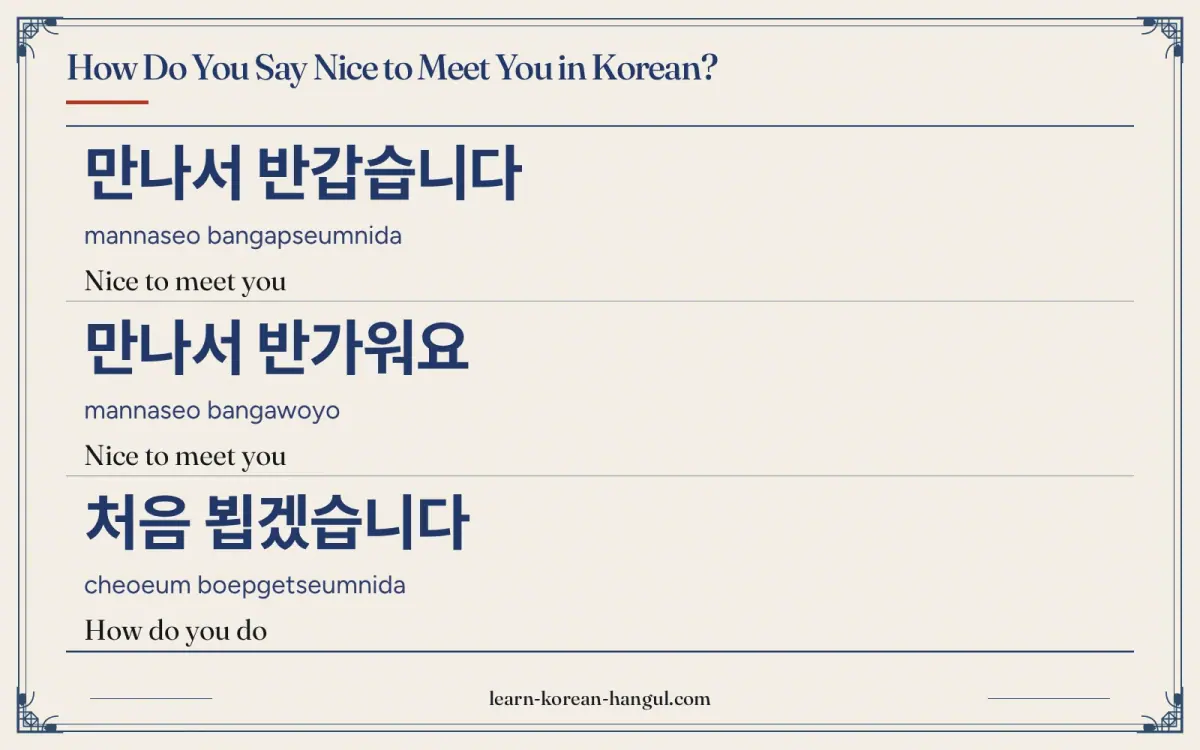
The standard way to say nice to meet you in Korean is 만나서 반갑습니다, which literally means "because we met, I am glad". It is formal and polite, and it is safe with strangers, coworkers, teachers and older people.
| Form | Korean | Romanization | Meaning | Best for |
|---|---|---|---|---|
| Formal | 만나서 반갑습니다 | mannaseo bangapseumnida | Nice to meet you | Adults, work, school |
| Polite | 만나서 반가워요 | mannaseo bangawoyo | Nice to meet you | Friendly everyday meetings |
| Very formal | 처음 뵙겠습니다 | cheoeum boepgetseumnida | How do you do | Business, elders, first contact |
| Casual | 만나서 반가워 | mannaseo bangawo | Nice to meet you | Friends and younger people |
만나서 combines the verb 만나다 (to meet) with -아서/-어서, "because", and 반갑다 is an adjective meaning "to be glad". English says "nice" where Korean says "glad". Each form is explained below with an example.
What Are the Formal, Polite and Casual Ways to Say Nice to Meet You?
Korean changes the sentence ending to match the listener, a system called speech levels. The guide to Korean speech levels explains all of them, and this page uses four forms: very formal, formal, polite and casual.
Very Formal: 처음 뵙겠습니다 (cheoeum boepgetseumnida)
Formal · 합쇼체처음 뵙겠습니다 means "I am meeting you for the first time" and is the most respectful opening. 처음 is "first time", and 뵙다 is the humble verb for "to meet" an elder or senior, so the speaker lowers themselves. It suits business meetings, interviews and first contact with someone clearly senior. Because it says "first time", never use it for someone you have already met.
처음 뵙겠습니다. 잘 부탁드립니다.
cheoeum boepgetseumnida. jal butakdeurimnida
How do you do. I look forward to working with you.
Formal: 만나서 반갑습니다 (mannaseo bangapseumnida)
Formal · 합쇼체만나서 반갑습니다 is the all-purpose formal choice. It works at a company, at school, at an interview, with parents and with any adult you do not know well. Learners who only memorise one form should memorise this one.
만나서 반갑습니다. 저는 박지아입니다.
mannaseo bangapseumnida. jeoneun bakjiaimnida
Nice to meet you. I'm Park Jia.
Polite: 만나서 반가워요 (mannaseo bangawoyo)
Polite · 해요체만나서 반가워요 is warmer and less stiff than the formal version. It suits classmates, neighbours, the friend of a friend and casual events. The shape comes from a pattern: 반갑다 is a ㅂ-irregular adjective, so the ㅂ changes to 우 and the stem becomes 반가우-, which joins -어요 to give 반가워요.
만나서 반가워요. 저는 정훈이에요.
mannaseo bangawoyo. jeoneun jeonghunieyo
Nice to meet you. I'm Jeonghun.
Casual: 만나서 반가워 (mannaseo bangawo)
Casual · 반말Drop the -요 and you get 만나서 반가워, the form for friends, classmates your age and younger people. Often it shrinks further to just 반가워 (I'm glad). Never use it with a teacher, a boss or an older stranger.
만나서 반가워. 잘 부탁해.
mannaseo bangawo. jal butakae
Nice to meet you. Take care of me.
A good rule of thumb is to use the formal 반갑습니다 until the other person speaks to you more casually. The next section covers the phrase that usually follows nice to meet you at work.
What Is the Korean First-Meeting Set?
The Korean first-meeting set has three parts: your name, nice to meet you, and 잘 부탁드립니다. The last part has no direct English equivalent. It asks the other person to treat you well and to look after you in the new relationship.
A complete formal introduction sounds like this: 안녕하세요. 제 이름은 김민수입니다. 만나서 반갑습니다. 잘 부탁드립니다. The name part is explained in my name is in Korean.
- At work or school: finish with 잘 부탁드립니다 (formal) or 잘 부탁드려요 (polite).
- With friends: use 잘 부탁해, for example when joining a club.
- Not a request for a favour: the phrase describes the relationship, not a task.
Omitting 잘 부탁드립니다 at work leaves the introduction feeling unfinished. Now the sounds, because 반갑습니다 hides two sound changes.
How Do You Pronounce 만나서 반갑습니다?
만나서 반갑습니다 is pronounced [만나서 반갑씀니다], in eight syllables. Say it slowly in four beats.
- 만나서 (man-na-seo): two n sounds in a row, "man-na-suh".
- 반 (ban): "bahn".
- 갑씀 (gap-sseum): the ㅂ closes the syllable without a puff of air, then a tense, strong s.
- 니다 (ni-da): "nee-dah".
Sound Changes to Listen For
Two rules change the sound of 반갑습니다.
- Tensification (경음화). After the closing ㅂ of 갑, the ㅅ of 습 becomes a tense [ㅆ]. This is a rule in the National Institute of Korean Language Standard Pronunciation (표준 발음법), explained in Korean tensification.
- Nasalization (비음화). The ㅂ in 습 turns into ㅁ before the ㄴ of 니, so the pair is said [씀니]. This is the same change covered under Korean nasalization.
The very formal phrase has the same pattern: 처음 뵙겠습니다 is said [처음 뵙껟씀니다].
Once the sounds are clear, the next question is when each form fits.
When Should You Use 만나서 반갑습니다, and When Should You Not?
Use 만나서 반갑습니다 in the first minute of any meeting with an adult you do not know well. Use 만나서 반가워요 when the mood is relaxed, 만나서 반가워 only with friends, and 처음 뵙겠습니다 only for a real first meeting with someone senior.
Situations Where It Fits
- Meeting a coworker or client. 처음 뵙겠습니다 or 만나서 반갑습니다, then 잘 부탁드립니다.
- A friend introduces you. 만나서 반가워요 is friendly and correct.
- Meeting a host family or teacher. 만나서 반갑습니다, with a small bow.
- Joining a club. 만나서 반가워요, then 잘 부탁드려요.
Situations to Avoid
- People you have already met. Use 또 만나서 반가워요 (nice to see you again) or 오랜만이에요, not 처음 뵙겠습니다.
- Close friends with 반갑습니다. It sounds stiff or like a joke.
- A stranger older than you with 만나서 반가워. Too casual.
Real conversations show how these phrases sit inside the first exchange.
What Does Nice to Meet You Sound Like in a Real Conversation?
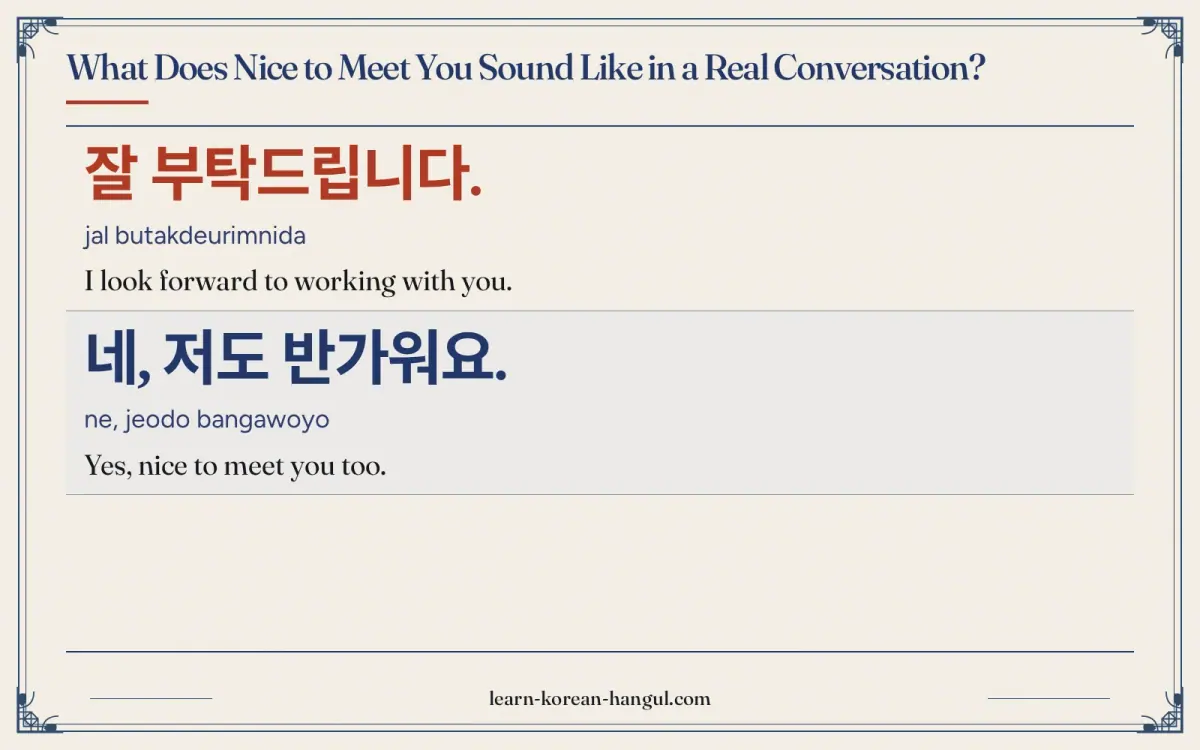
Nice to meet you usually comes right after the name and before the next question. The other person answers with the same phrase or with 저도요 (me too).
First Meeting at a Company
Minsu
처음 뵙겠습니다. 김민수입니다.
cheoeum boepgetseumnida. gimminsuimnida
How do you do. I'm Kim Minsu.
Manager Park
네, 반갑습니다. 박 부장입니다.
ne, bangapseumnida. bak bujangimnida
Yes, nice to meet you. I'm Manager Park.
Minsu
잘 부탁드립니다.
jal butakdeurimnida
I look forward to working with you.
What to notice: the manager drops 만나서 and says 반갑습니다. This is natural, because 반갑습니다 alone means "I'm glad". The title 부장 (department head) follows the surname.
A Friend Introduces a Friend
Seoyeon
지아야, 이쪽은 내 친구 민수야.
jiaya, ijjogeun nae chingu minsuya
Jia, this is my friend Minsu.
Jia
안녕하세요. 만나서 반가워요.
annyeonghaseyo. mannaseo bangawoyo
Hello. Nice to meet you.
Minsu
네, 저도 반가워요.
ne, jeodo bangawoyo
Yes, nice to meet you too.
What to notice: Jia and Minsu are strangers, so they use the polite form even though both are friends of Seoyeon, while Seoyeon speaks casually to Jia. The reply 저도 반가워요 means "I'm glad too". Another common question after this is what's your name in Korean.
Meeting a Host Family
Sarah
안녕하세요. 만나서 반갑습니다. 저는 사라예요.
annyeonghaseyo. mannaseo bangapseumnida. jeoneun sarayeyo
Hello. Nice to meet you. I'm Sarah.
Host Mother
저도 만나서 반갑습니다. 한국에는 처음이세요?
jeodo mannaseo bangapseumnida. hangugeneun cheoeumiseyo?
Nice to meet you too. Is this your first time in Korea?
What to notice: the host uses the formal form with a younger guest, which is a sign of respect and welcome. The next question, 한국에는 처음이세요?, is one of several shown in where are you from in Korean. These habits grow out of the way Koreans mark a first meeting.
What Should You Know about the Culture behind Nice to Meet You?
Koreans usually pair the spoken greeting with a small bow, a handshake, or both. The deeper the bow and the longer the pause, the more respect it shows.
- Bow and handshake. A slight bow of the head and upper body is common. A handshake, often with the left hand supporting the right forearm, is polite with elders and seniors. Follow what the other person does.
- Business cards. In business settings, people commonly give and receive cards with both hands and read them before putting them away.
- Age and rank matter. The first questions often establish who is senior, which decides the speech level. This is why 만나서 반갑습니다 is a safe start.
- Ask for the relationship, not a favour. 잘 부탁드립니다 is a social ritual, not a request.
An expert insight: learners often say 반갑습니다 with a flat English rhythm. Listen for the tense 씀: the strong ㅆ makes the phrase sound confident. The mistakes below collect the other common slips.
What Mistakes Do Learners Make with Nice to Meet You in Korean?
Most errors come from choosing a form that does not match the situation or from skipping the closing phrase.
| Mistake | Why it is a problem | Fix |
|---|---|---|
| 처음 뵙겠습니다 to someone you met before | It says "first time" | Say 또 만나서 반가워요 |
| 만나서 반가워 to a boss or elder | Too casual | Say 만나서 반갑습니다 |
| Leaving out 잘 부탁드립니다 at work | The introduction feels unfinished | Add it after your name |
| Reading 반갑습니다 as "ban-gap-seum-ni-da" | The sound changes are missing | Say [반갑씀니다] |
| Using 반가워요 with a very senior client | Slightly too relaxed | Say 만나서 반갑습니다 |
Learners often assume English "nice to meet you" can be used for any greeting. Actually, 만나서 반갑습니다 belongs to first meetings, and for someone you already know the common phrase is 오랜만이에요 or 또 만나서 반가워요, as in long time no see in Korean.
Is It the Same as Pleased to Meet You or Nice to See You?
Mostly yes. The English variants all map to the same Korean phrases, with one difference for people you already know. The short answers below cover the other searches folded into this page.
- Pleased, glad or good to meet you: 만나서 반갑습니다 or 만나서 반가워요.
- Nice meeting you (when leaving): 만나서 반가웠어요, the past form, said as you part.
- Nice to meet you, formal: 만나서 반갑습니다 or 처음 뵙겠습니다.
- Nice to meet you, casual: 만나서 반가워 or 반가워.
- Nice to see you: 반가워요 or 또 만나서 반가워요 for people you already know.
The pattern holds across all of them: formal 습니다 for adults, polite 요 for friendly settings. Now practise choosing.
Practice: Say It Aloud
Play the slow clip of 만나서 반갑습니다 three times, then say the full set with your own name. Choose a phrase for each situation. Answers follow.
- You meet a client for the very first time.
- A classmate your age introduces herself.
- You see a coworker you have already met at a party.
- You meet your friend's friend at dinner.
Answers
- 처음 뵙겠습니다. 잘 부탁드립니다.
- 만나서 반가워.
- 또 만나서 반가워요.
- 만나서 반가워요.
The phrase flashcards drill these forms with audio.
Related Phrases to Learn Next
A first meeting leads straight into your name and a question about the other person, so these are the natural next phrases.
- My name is in Korean: 제 이름은 ...입니다 and its polite forms.
- What's your name in Korean: the polite question for a new person.
- Hello in Korean: 안녕하세요 and its casual partner.
This guide belongs to the introduce yourself in Korean collection. What this page does not cover: business-card etiquette and honorific verbs in depth, which deserve their own lessons. Pick the ending for the listener, add 잘 부탁드립니다 at work, and you can say nice to meet you in Korean at any first meeting.
Frequently Asked Questions
What does 반갑습니다 mean on its own?
반갑습니다 means I am glad, and it is used when you are happy to meet or see someone. Alone it works for seeing a person you already know, as in nice to see you. Add 만나서 (because I met you) to make it nice to meet you. Both versions are formal and polite.
How do I say nice to see you again in Korean?
Say 또 만나서 반가워요 for polite speech or 또 만나서 반갑습니다 for formal speech. 또 means again. For someone you have not seen for a long time, 오랜만이에요 (long time no see) is more natural, and you can add 반가워요 afterwards.
Do I bow or shake hands when I say nice to meet you?
Both are common. Many Koreans give a small bow, shake hands, or do both at once, often supporting the right forearm with the left hand to show respect. With friends, a smile and a nod are enough. Follow the other person: if they bow, bow back.
What is 잘 부탁드립니다 and when do I use it?
잘 부탁드립니다 means please treat me well, or I look forward to working with you. Say it after your name and 만나서 반갑습니다 at work, school, clubs or when you join a new group. With friends, shorten it to 잘 부탁해. It is not a request for a favour.
Is 만나서 반갑습니다 too formal for friends?
Yes, it can sound stiff or jokey between friends your age. Use 만나서 반가워 or just 반가워 instead. Keep 만나서 반갑습니다 for adults you do not know, for workplaces and for anyone clearly older than you. When unsure, the polite 만나서 반가워요 is a safe middle.