다시 말해 주세요
다시 말해 주세요
What you'll learn
- Say 다시 말해 주세요 aloud and ask someone to repeat a sentence.
- Choose between 다시 말해 주세요, 한 번 더 말해 주세요, 천천히 말해 주세요 and 뭐라고요?.
- Soften a request with 죄송하지만 (sorry, but) and tell the listener you are still learning.
- Avoid the bare 뭐?, which sounds rude to strangers and teachers.
Before you start: knowing i don't understand in Korean helps, because you often say it right before you ask for a repeat. Time: about 10 minutes. Audio plays only when you press a button.
How Do You Say Please Say It Again in Korean?
The standard way to say please say it again in Korean is 다시 말해 주세요. It has three parts: 다시 (dasi, again), 말해 (malhae, say or speak) and 주세요 (juseyo, please do it for me). Put 죄송하지만 (joesonghajiman, sorry but) in front when you are speaking to a teacher or a stranger. Korean uses the same verb for say and speak, so one phrase covers please repeat, say that again and say it again.
| Form | Romanization | Register | Say it to |
|---|---|---|---|
| 다시 말해 주세요 | dasi malhae juseyo | Polite (해요체) | Teachers, strangers, shop staff |
| 한 번 더 말해 주세요 | han beon deo malhae juseyo | Polite (해요체) | Anyone, for one more repeat |
| 천천히 말해 주세요 | cheoncheonhi malhae juseyo | Polite (해요체) | Anyone speaking too fast |
| 다시 말씀해 주세요 | dasi malsseumhae juseyo | Polite, respectful | Teachers, bosses and elders |
| 뭐라고요? | mworagoyo | Polite (해요체) | A quick reaction in conversation |
| 다시 말해 줘 | dasi malhae jwo | Casual (해체) | Close friends only |
Five of the six forms are polite, so you can use them safely with almost anyone. The next section takes the four most useful ones one by one.
What Are the Polite Ways to Say Please Say It Again?
Please say it again follows the Korean speech levels, explained in the guide to Korean speech levels. In a classroom you will almost always use the polite style, so the choices below are about what you want: a repeat, one more repeat, a slower pace or a quick reaction.
Polite: 다시 말해 주세요 (dasi malhae juseyo)
Polite · 해요체다시 말해 주세요 is the basic request. 다시 means again, so the phrase asks for the same words a second time. With a teacher or an older person, switch 말해 to 말씀해 (malsseumhae), the respectful word for speech.
죄송하지만 다시 말해 주세요.
joesonghajiman dasi malhae juseyo
Sorry, but please say it again.
Polite: 한 번 더 말해 주세요 (han beon deo malhae juseyo)
Polite · 해요체한 번 더 means "one more time". The counter 번 (beon) counts occasions, so the phrase asks for exactly one more repetition. Learners use it when they have already asked once and want to hear a sentence a last time before writing it down.
선생님, 한 번 더 말해 주세요.
seonsaengnim, han beon deo malhae juseyo
Teacher, please say it one more time.
Polite: 천천히 말해 주세요 (cheoncheonhi malhae juseyo)
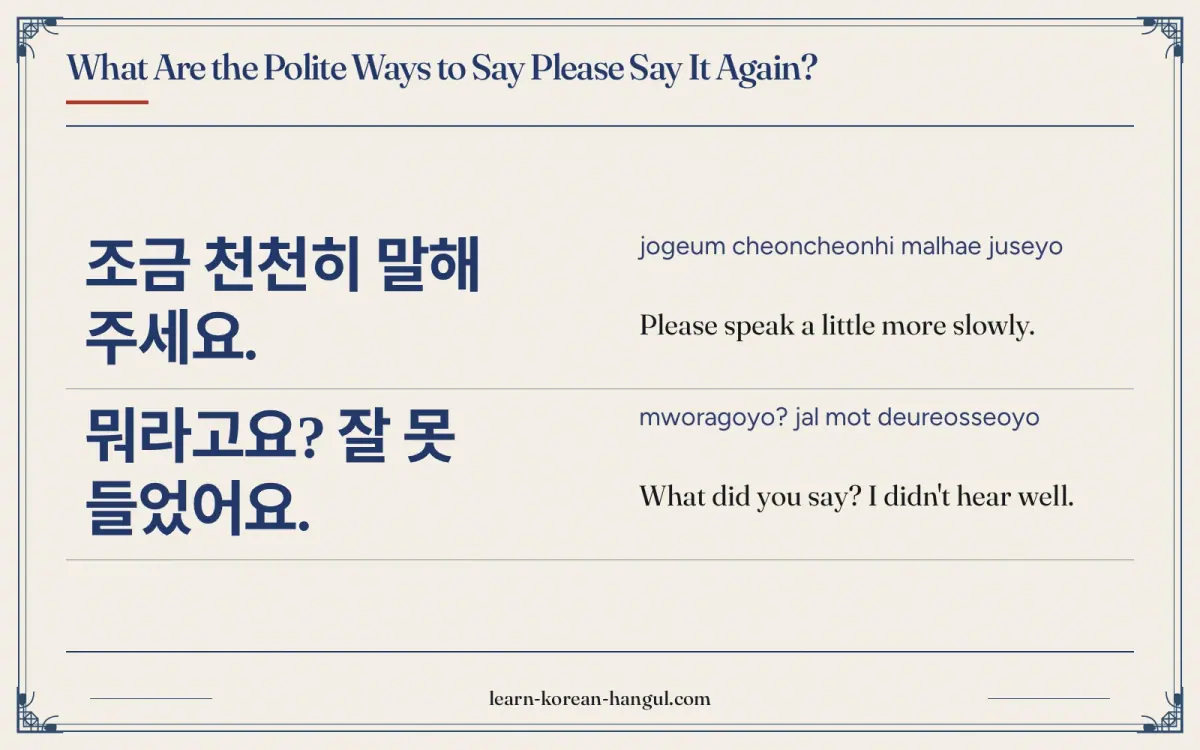
Polite · 해요체천천히 (cheoncheonhi) means slowly or at an easy pace. Use it when the words are clear but too fast. Add 조금 (jogeum, a little) to soften it. A learner who adds 한국어를 잘 못해요 (hangugeoreul jal motaeyo, I'm not good at Korean) first usually gets a slower, simpler reply.
조금 천천히 말해 주세요.
jogeum cheoncheonhi malhae juseyo
Please speak a little more slowly.
Polite: 뭐라고요? (mworagoyo)
Polite · 해요체뭐라고요? repeats the speaker's words back as a question: "you said what?". Say it right away when you did not catch a word. Keep the tone mild, because the same phrase can sound surprised or annoyed if you stress it hard. The stress falls on 뭐라고, and a gentle voice shows that you are asking, not complaining.
뭐라고요? 잘 못 들었어요.
mworagoyo? jal mot deureosseoyo
What did you say? I didn't hear well.
A repeat only helps if you can hear it, so the sounds come next.
How Do You Pronounce 다시 말해 주세요?
다시 말해 주세요 is written with seven syllables and pronounced [다시 말해 주세요], dasi malhae juseyo. Say it as three beats: 다시, 말해, 주세요. The seven syllables sound like this.
- 다 (da): a soft d and "ah".
- 시 (si): "shee", with the s softened before the vowel ㅣ.
- 말 (mal): "mahl", with the tongue touching the roof of the mouth at the end.
- 해 (hae): "heh" with a light h.
- 주 (ju): a soft j and "oo".
- 세 (se): "seh".
- 요 (yo): "yoh".
Sound Changes to Listen For
Four details from the National Institute of Korean Language Standard Pronunciation Rules (표준 발음법) and natural speech matter here.
- Weak ㅎ in 말해. In careful speech, 말해 is [말해], with a light h. In fast speech the ㅎ almost vanishes and the final ㄹ links to the next vowel, so you may hear [마래]. Both are normal, and the spelling stays 말해.
- Soft ㅎ in 천천히. The word is written 천천히 and often heard as [천처니], because the ㅎ is weak between ㄴ and a vowel. Say it as three even syllables.
- Spell 한 번 with a space. The words 한 번 are heard as one flow, [한번], and the standard rules do not turn the ㄴ into ㅁ. Written without a space, 한번 means "once, sometime" and not "one more time".
- Tense sound in 말할게요. When you offer to repeat, 말할게요 (malhalgeyo) is pronounced [말할께요], with a tense ㄲ after the ending -ㄹ.
Once the sounds are right, the next question is which request to use with which person.
When Should You Use 다시 말해 주세요, and When Should You Not?
Use 다시 말해 주세요 when you want the same sentence repeated. Use 천천히 말해 주세요 when the pace is the problem. Use 뭐라고요? when you missed a single word and want it quickly.
Situations Where It Fits
- A lesson. 선생님, 다시 말씀해 주세요. (Teacher, please say it again.)
- Asking for directions. 죄송해요, 천천히 말해 주세요. (Sorry, please speak slowly.)
- A phone call. 뭐라고요? 잘 안 들려요. (What did you say? I can't hear well.)
- Writing something down. 한 번 더 말해 주세요. (Please say it one more time.)
Situations to Avoid
- With a bare 뭐? 뭐 alone means "what?" and sounds abrupt to strangers, elders and teachers.
- With 다시 말해 only. Without 주세요, it is a command.
- With friends. 다시 말해 주세요 can sound a little distant between close friends; 다시 말해 줘 is natural.
- When you do not understand the meaning. A repeat does not explain a word. Use i have a question in Korean to ask what it means.
Short scenes show how the four requests work in real talk.
What Does Please Say It Again Sound Like in a Real Conversation?
A repeat request has an apology, the request and the reply. Each scene below keeps the polite ending 요.
In the Classroom
Student
선생님, 다시 말씀해 주세요.
seonsaengnim, dasi malsseumhae juseyo
Teacher, please say it again.
Teacher
네, 천천히 말할게요.
ne, cheoncheonhi malhalgeyo
Yes, I'll say it slowly.
What to notice: the student uses 말씀해 for a teacher, and the teacher answers with the promise form 말할게요.
Asking for Directions
Passer-By
사거리에서 오른쪽으로 가세요.
sageorieseo oreunjjogeuro gaseyo
Go right at the intersection.
You
죄송해요, 천천히 말해 주세요.
joesonghaeyo, cheoncheonhi malhae juseyo
Sorry, please speak slowly.
Passer-By
사거리에서 오른쪽이에요.
sageorieseo oreunjjogieyo
Right at the intersection.
What to notice: the passer-by shortens the sentence, which is a common way to help a learner.
On the Phone
Friend
내일 일곱 시에 만나요.
naeil ilgop sie mannayo
Let's meet at seven tomorrow.
You
네? 뭐라고요?
ne? mworagoyo
Sorry? What did you say?
Friend
내일 일곱 시요.
naeil ilgop siyo
Tomorrow at seven.
What to notice: 뭐라고요? is a short reaction, and the friend answers with only the missing part.
What Should You Know about the Culture behind Please Say It Again?
Asking for a repeat is normal in Korea, and a polite learner is usually met with patience.
- Say that you are learning. Adding 한국어를 잘 못해요 first often makes people slow down and use simpler words.
- Teachers expect questions. In a language class, asking for a repeat shows effort, and 선생님 will repeat as often as needed.
- Respect shows in the verb. The honorific 말씀 replaces 말 with teachers, bosses and elders, and 하셨어요 replaces 했어요 when you ask what they said.
- Gestures help. A small bow and a hand to the ear, with a polite phrase, make the request clear.
An expert insight: learners often drop 주세요 because it feels long, but 주세요 is what makes the phrase a request. Without it, 다시 말해 is the command "say it again". Keep all three parts, and say 죄송하지만 first when the speaker is a stranger. The mistakes below show the other typical slips.
What Mistakes Do Learners Make with Please Say It Again in Korean?
Most mistakes with please say it again come from dropping the polite ending and from mixing up can't and don't.
| Mistake | Why it is a problem | Fix |
|---|---|---|
| Saying 뭐? alone | It is casual and abrupt | Say 뭐라고요? |
| Saying 다시 말해 without 주세요 | It is a command | Say 다시 말해 주세요 |
| Saying 한국어 안 해요 | It means you choose not to speak Korean | Say 한국어를 잘 못해요 |
| Pronouncing 말해 with a hard h | The ㅎ is weak after ㄹ | Say [말해] lightly, or [마래] in fast speech |
| Using 말 for a teacher | Teachers and elders get the respectful 말씀 | Say 다시 말씀해 주세요 |
Learners often assume that 못해요 and 안 해요 are the same. Actually, 못해요 means "I can't do it well", while 안 해요 means "I don't do it", so only the first one fits a learner. Note that 못해요 is pronounced [모태요] and romanized motaeyo.
Is It the Same as Repeat?
The short answers below cover the other ways people search for this phrase.
- Repeat in Korean: 반복하다 (banbokada) is the textbook verb for repeat, but in speech people say 다시 말해 주세요 or 따라 해 주세요 (ttara hae juseyo, repeat after me).
- Say that again in Korean: 다시 한 번 말해 주세요, with the same meaning as 한 번 더.
- Speak slowly in Korean: 천천히 말해 주세요, with 조금 for a gentle tone.
- What did you say in Korean: 뭐라고요? or the more respectful 뭐라고 하셨어요? (mworago hasyeosseoyo).
The related pages below continue the classroom vocabulary.
Related Phrases to Learn Next
Please say it again sits beside the other lines you use in class.
- I don't understand in Korean: 이해가 안 돼요 when the meaning is the problem.
- I have a question in Korean: 질문 있어요 to start a question.
- Korean speech levels: why 말씀 replaces 말 for teachers.
This guide belongs to the Korean classroom phrases collection. What this page does not cover: explaining a word's meaning or asking for the spelling. Say 죄송하지만 다시 말해 주세요, add 천천히 when you need time, and you can say please say it again in Korean in any class or conversation.
Practice: Say It Aloud
Play the slow clip of 다시 말해 주세요 and repeat it three times, then try 천천히 말해 주세요 and 뭐라고요?. Then choose the phrase for each case. Answers follow.
- The teacher gives an instruction and you missed it.
- A passer-by speaks too fast when giving directions.
- A friend says a word on the phone and the line cuts out.
- You want to hear a sentence one last time before writing it.
Answers
- 선생님, 다시 말씀해 주세요.
- 천천히 말해 주세요.
- 뭐라고요?
- 한 번 더 말해 주세요.
The phrase flashcards drill the four requests with audio.
Frequently Asked Questions
How do you say please say it again in Korean?
Say 다시 말해 주세요 (dasi malhae juseyo). For a teacher or an older person, say 다시 말씀해 주세요 (dasi malsseumhae juseyo). To ask for a slower pace, use 천천히 말해 주세요. Starting with 죄송하지만 (sorry, but) makes the request softer.
How do you pronounce 다시 말해 주세요?
Pronounce it [다시 말해 주세요]. It has seven syllables. The ㅎ in 말해 is weak and, in fast speech, 말해 can sound like [마래]. The Revised Romanization is dasi malhae juseyo.
What is the difference between 다시 말해 주세요 and 한 번 더 말해 주세요?
다시 말해 주세요 asks for a repeat of what was just said. 한 번 더 말해 주세요 asks for exactly one more repetition, usually after you have already asked once. Both are polite, and in practice listeners treat them almost the same.
Can I use 다시 말해 주세요 with friends, elders and strangers?
Yes with strangers, teachers and elders, because it is polite. For teachers and older people, 말씀해 is more respectful than 말해. With close friends, the casual 다시 말해 줘 is natural, and 뭐라고? is also common between friends.
What is the most common mistake with please say it again in Korean?
The most common mistake is saying 뭐? alone, which is casual and sounds rude to strangers and teachers. A second mistake is saying 다시 말해 without 주세요, which turns the request into a command. Use 뭐라고요? or 다시 말해 주세요 instead.