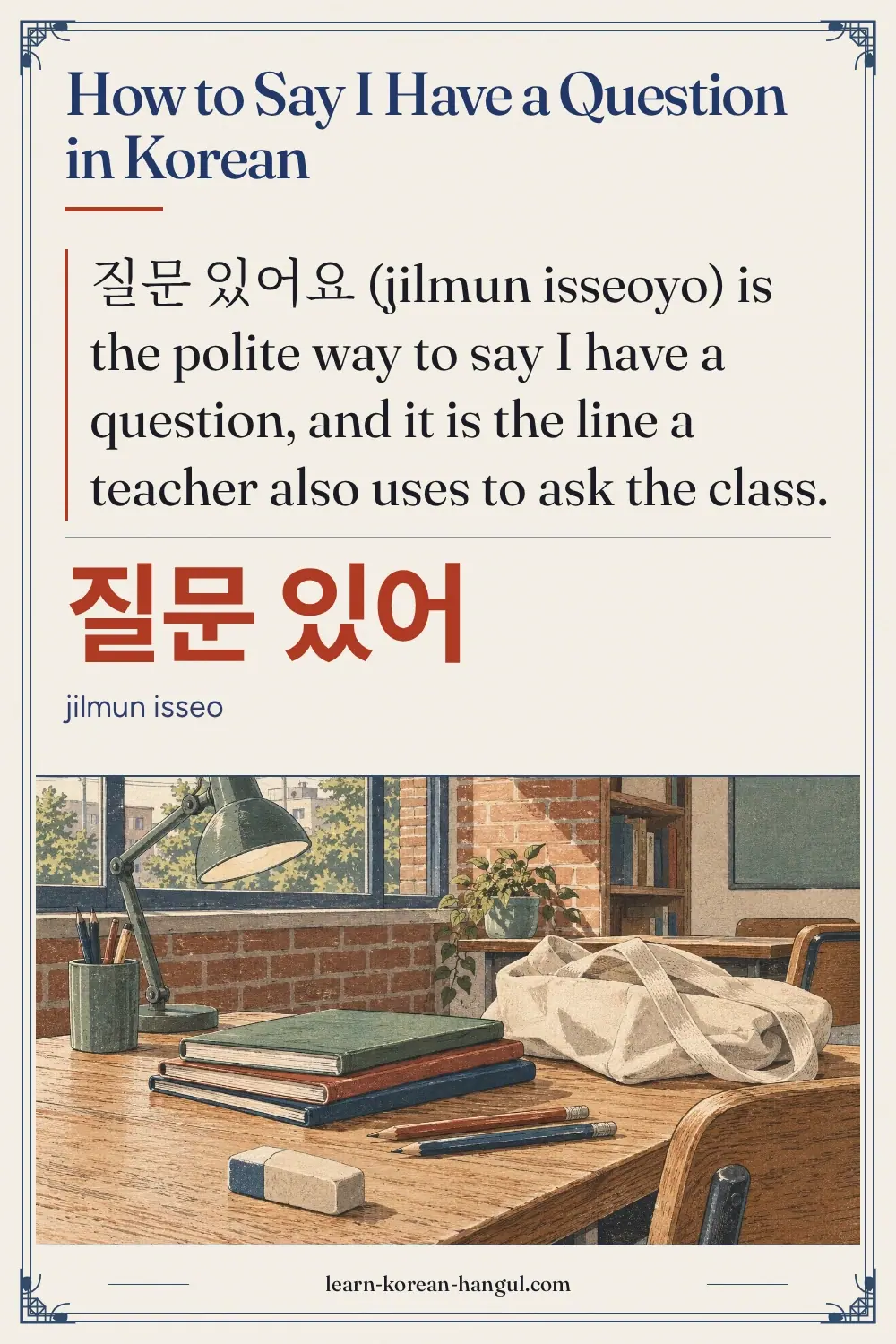
질문 있어요
질문 있어요
What you'll learn
- Say a question with 질문 있어요, 질문이 있습니다 or 질문 있어.
- Ask permission with 질문 하나 해도 돼요? and 여쭤봐도 돼요?
- Tell 질문 (a question you ask) apart from 문제 (a problem or exam question).
- Hear how 질문 있어요 links into [질무니써요].
Before you start: you only need to read Hangul. For a related classroom line, see please say it again in Korean. Time: about 10 minutes. Audio plays only when you press a button.
Key facts
- 질문 있어요 (jilmun isseoyo) is the polite way to say I have a question. It has five syllables.
- 질문이 있습니다 (jilmuni itseumnida) is formal and 질문 있어 (jilmun isseo) is casual.
- 질문 하나 해도 돼요? asks "may I ask one question?"
- 여쭤봐도 돼요? is the humble way to ask a teacher or a senior.
- 질문 is a question you ask, and 문제 is a problem or an exam question.
How Do You Say I Have a Question in Korean?
The standard way to say I have a question in Korean is 질문 있어요. It is built from 질문 (jilmun, a question), the existential verb 있어요 (isseoyo, there is) and no particle at all. Korean often drops the subject marker in speech, so 질문 있어요 and 질문이 있어요 mean the same.
| Situation | Best form | Romanization | Why |
|---|---|---|---|
| Raising your hand in class | 선생님, 질문 있어요 | seonsaengnim, jilmun isseoyo | Polite, direct |
| A teacher asks the class | 질문 있어요? | jilmun isseoyo? | Same words, rising pitch |
| A meeting or a lecture hall | 질문이 있습니다 | jilmuni itseumnida | Formal |
| Asking a friend or a classmate | 질문 있어 | jilmun isseo | Casual |
| Asking permission first | 질문 하나 해도 돼요? | jilmun hana haedo dwaeyo? | Soft and polite |
Notice that the same words can be a statement or a question. The next section sorts the forms by level.
What Are the Formal, Polite and Casual Ways to Say I Have a Question?
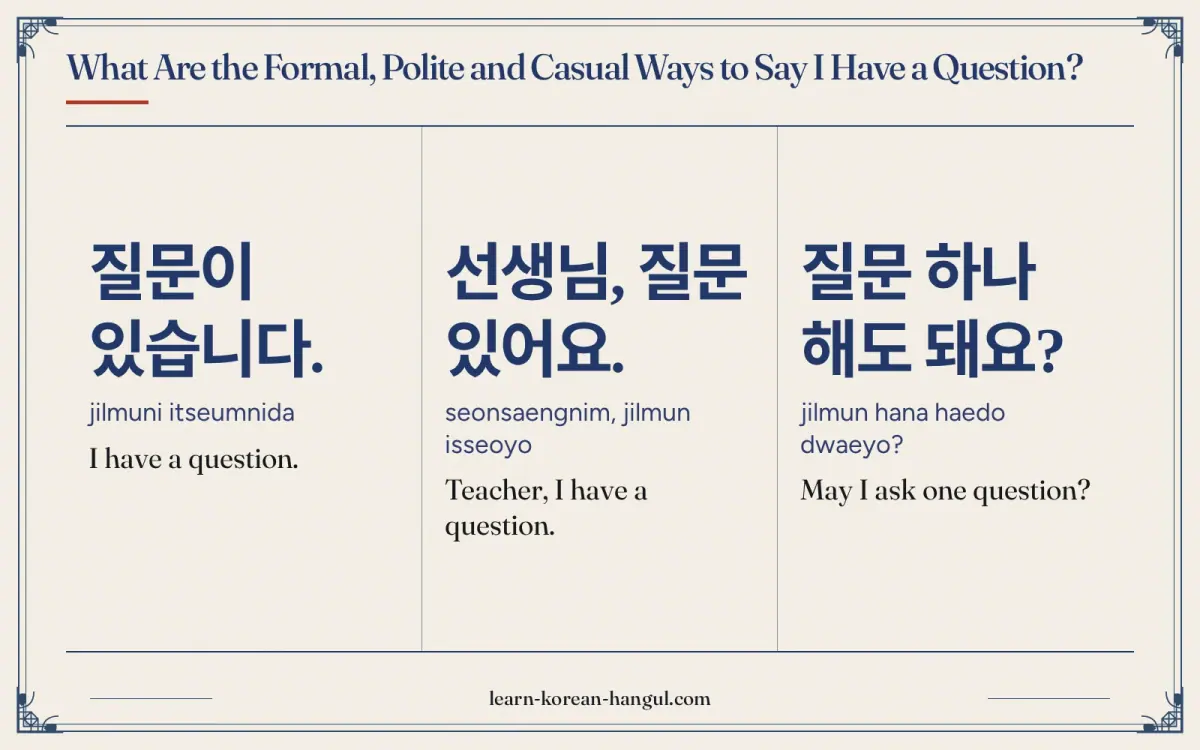
The forms follow the Korean speech levels, explained in the guide to Korean speech levels. Here we move from formal to casual.
Formal: 질문이 있습니다 (jilmuni itseumnida)
Formal · 합쇼체질문이 있습니다 uses the formal -습니다 ending. It fits a lecture, a press conference, a meeting with many people or a written email. It is pronounced [질무니 읻씀니다].
질문이 있습니다.
jilmuni itseumnida
I have a question.
Polite: 질문 있어요 (jilmun isseoyo)
Polite · 해요체질문 있어요 is the everyday default. It suits a teacher, a colleague, a guide or a shop assistant.
선생님, 질문 있어요.
seonsaengnim, jilmun isseoyo
Teacher, I have a question.
Casual: 질문 있어 (jilmun isseo)
Casual · 반말질문 있어 drops the polite 요. Use it with a friend, a classmate or a younger person. A study partner might say 잠깐, 질문 있어, "Wait, I have a question".
Asking Permission: 질문 하나 해도 돼요? (jilmun hana haedo dwaeyo?)
Polite · 해요체When you do not want to interrupt, ask permission first. 하나 (hana) means "one", and it makes the request small and gentle. The ending -아/어도 돼요 asks "is it all right to...?", so the sentence means "may I ask one question?".
질문 하나 해도 돼요?
jilmun hana haedo dwaeyo?
May I ask one question?
Humble: 여쭤봐도 돼요? (yeojjwobwado dwaeyo?)
Polite · 해요체물어보다 (mureoboda) is the plain verb "to ask". Its humble form is 여쭤보다 (yeojjwoboda), used toward a teacher, a boss or an older person, because it lowers the speaker and raises the listener. 하나 여쭤봐도 돼요? is the polite way to ask an elder for a moment.
하나 여쭤봐도 돼요?
hana yeojjwobwado dwaeyo?
May I ask something?
A Soft Opener: 궁금한 게 있어요 (gunggeumhan ge isseoyo)
Polite · 해요체궁금하다 (gunggeumhada) means "to be curious". 궁금한 게 있어요 says "there is something I am curious about". It is pronounced [궁금한 게 이써요] and it feels friendlier than a plain 질문.
궁금한 게 있어요.
gunggeumhan ge isseoyo
There is something I'm curious about.
The Pattern behind It: -아/어도 돼요
The ending -아/어도 돼요 asks for or gives permission. It attaches to a verb stem: 해도 돼요 (may I do it?), 먹어도 돼요 (may I eat?), 앉아도 돼요 (may I sit?). Once you know it, 질문 하나 해도 돼요? is just one use of a pattern that works for hundreds of verbs. The answer is usually 네, 돼요 (yes, it is fine) or a simple 그럼요 (of course).
How Do You Pronounce 질문 있어요?
질문 있어요 is written in two words, but in speech it flows like one: [질무니써요], jil-mu-ni-sseo-yo, in five syllables. The final ㄴ of 질문 links to the vowel of 있어요, and the final ㅆ links to the next vowel too.
- 질 (jil): a clear ㅈ, then the vowel and a light ㄹ.
- 문 (mun): the ㄴ is the final consonant, and it moves to the next syllable.
- 있 (i): when the ㄴ arrives, this syllable sounds like 니.
- 어 (eo): the ㅓ is unrounded, and the ㅆ moves to it, making 써.
- 요 (yo): "yo".
Sounds to Listen For
These notes follow the National Institute of Korean Language standard pronunciation rules (표준 발음법):
- A final consonant moves to a vowel. 질문이 있어요 is clearly [질무니 이써요] (Article 13), and in quick speech 질문 있어요 sounds almost the same, [질무니써요].
- Formal ending. 있습니다 is [읻씀니다]: ㅆ is said as ㄷ at the end of a syllable (Article 9), ㅅ becomes tense ㅆ (Article 23) and ㅂ before ㄴ turns into ㅁ (Article 18). See Korean tensification.
- Question rise. 질문 있어요? ends with a rise when it is a yes/no question to the class. The same words as a statement end flat.
Practise the two ways: first slowly, 질문 / 있어요, then together, 질무니써요.
When Should You Use 질문 있어요, and When Should You Not?
Use 질문 있어요 when you want to ask something and you want attention first. It works as a polite flag, and it tells people to expect a question.
Situations Where It Fits
- In class. 선생님, 질문 있어요.
- In an office or a seminar. 질문이 있습니다 before you speak.
- On a tour. 가이드님, 질문 있어요 gets a guide's attention.
Situations to Avoid
- Quick, simple questions. For "where is it?" or "how much?" go straight to the question, such as 화장실이 어디예요?
- Problems and complaints. 문제 있어요 means "there is a problem", so it signals a complaint and not a question.
- Interrupting a speaker. Wait for a pause, then use 죄송한데 (sorry, but).
Two short conversations show how the phrase sounds.
What Does I Have a Question Sound Like in a Real Conversation?
In real life, the phrase comes first and the question itself follows. Listen for wh-questions, which end with a fall or a rise-fall rather than a sharp rise.
In Class
Student
선생님, 질문 있어요.
seonsaengnim, jilmun isseoyo
Teacher, I have a question.
Teacher
네, 말해 보세요.
ne, malhae boseyo
Yes, go ahead and say it.
Student
이 단어 뜻이 뭐예요?
i daneo tteusi mwoyeyo?
What does this word mean?
Teacher
좋은 질문이에요. 설명해 줄게요.
joeun jilmunieyo. seolmyeonghae julgeyo
That's a good question. I'll explain.
What to notice: 이 단어 뜻이 뭐예요? is a wh-question, so the pitch does not climb at the end. The teacher repeats the word 질문 in 좋은 질문이에요, [조은 질무니에요], to praise the question.
In the Office
Hana
죄송한데, 질문 하나 해도 돼요?
joesonghande, jilmun hana haedo dwaeyo?
Sorry, may I ask one question?
Jun
네, 말씀하세요.
ne, malsseumhaseyo
Yes, please go ahead.
Hana
회의가 몇 시에 시작해요?
hoeuiga myeot sie sijakaeyo?
What time does the meeting start?
Jun
세 시에 시작해요.
se sie sijakaeyo
It starts at three.
What to notice: Hana asks permission first, and Jun answers with 말씀하세요, the honorific form of "speak". The yes/no permission question rises, while the wh-question about time does not.
What Should You Know about the Culture behind I Have a Question?
In many Korean classrooms and offices, people hesitate to ask a question in front of a group. Teachers often invite questions with 질문 있어요?, and a long silence is common. Many learners find it easier to ask after the lesson or in a private message.
- Ask in private. A quiet 선생님, 수업 끝나고 질문해도 돼요? ("Teacher, may I ask a question after class?") is polite and welcome.
- Show you tried. Adding 찾아봤는데 (I looked it up, but...) shows effort and softens the question.
- Use the right title. Address a teacher as 선생님 and a manager with their title, then ask. Dropping the title makes the sentence blunt.
An expert tip: begin with a short 죄송한데 (sorry, but) and end with 요. That small frame turns a direct question into a polite request, which is what Korean listeners expect from learners and colleagues alike.
What Mistakes Do Learners Make with I Have a Question in Korean?
Most mistakes come from using the wrong word for "question" or a wrong level.
| Mistake | Why it is a problem | Fix |
|---|---|---|
| 문제 있어요 | Means "there is a problem" | Say 질문 있어요 |
| 질문을 가지고 있어요 | A word-for-word translation of "I have" | Say 질문 있어요 |
| 질문이 있습니다 to a friend | Stiff, like a speech | Say 질문 있어 |
| 질문 있어요 to a teacher with no title or name | Less warm than with a title | Add 선생님 |
| 물어봐도 돼요 to an elder | Not humble enough | Say 여쭤봐도 돼요 |
Learners often assume that 질문 and 문제 are interchangeable. Actually, 질문 is what you ask, and 문제 is a problem or a test item, so keep them apart.
Is It the Same as Ask Question or May I Ask?
Mostly. The short answers below cover the other searches folded into this page.
- Ask a question in Korean (the action): 질문해요 (jilmunhaeyo) or 물어봐요 (mureobwayo).
- May I ask in Korean: 물어봐도 돼요? or, humbler, 여쭤봐도 돼요?
- Question in Korean (the word): 질문. For the word entry, see question in Korean.
- I have one question: 질문 하나 있어요 (jilmun hana isseoyo).
Now say them aloud.
Practice: Say It Aloud
Play the slow clip of 질문 있어요 three times, then say it as one smooth phrase. Choose a phrase. Answers follow.
- You raise your hand in class.
- You ask a senior colleague for a moment.
- You tell a friend that you have a question.
- You open a talk in a lecture hall.
Answers
- 선생님, 질문 있어요.
- 하나 여쭤봐도 돼요?
- 질문 있어.
- 질문이 있습니다.
The phrase flashcards drill these lines with audio.
Related Phrases to Learn Next
A question opens the door to the next classroom lines.
- Please say it again in Korean: 다시 말해 주세요 when you missed the answer.
- What does it mean in Korean: 무슨 뜻이에요? for a word you do not know.
- How do you say in Korean: 한국어로 뭐라고 해요? for finding the right word.
This guide belongs to the Korean classroom phrases collection. What this page does not cover: forming complex questions, indirect questions and exam wording. Remember that Korean says "a question exists", add 하나 or 죄송한데 to be gentle, and you can say i have a question in Korean with confidence.
Frequently Asked Questions
How do you say I have a question in Korean?
Say 질문 있어요 (jilmun isseoyo) in a polite setting and 질문 있어 (jilmun isseo) to a friend. In a meeting or a lecture, say 질문이 있습니다. The phrase literally means "a question exists". Add 하나 (hana, one) to sound lighter: 질문 하나 있어요, "I have one question".
How do you ask a question politely in Korean?
Ask permission first: 질문 하나 해도 돼요? (jilmun hana haedo dwaeyo?), "may I ask one question?" For a teacher or a senior, use the humble 여쭤봐도 돼요? (yeojjwobwado dwaeyo?). Start with 죄송한데 (joesonghande, sorry, but) to sound gentle, and then ask the question itself after the person agrees.
How do you say may I ask in Korean?
The everyday form is 물어봐도 돼요? (mureobwado dwaeyo?), which means "may I ask?" With a teacher, a boss or an older person, say 여쭤봐도 돼요? You can also say 질문해도 돼요? (jilmunhaedo dwaeyo?). All three use -아/어도 돼요, which asks for permission, so a short 네 (yes) from the listener is enough.
What is the difference between 질문 and 문제?
질문 (jilmun) is a question that a person asks, such as 질문 있어요. 문제 (munje) is a problem or an exam question, as in 시험 문제 (an exam question) or 문제가 있어요 (there is a problem). If you say 문제 있어요 in class, the teacher may think something is wrong, so use 질문 for a question you want to ask.
How do I ask a question about a word in Korean?
Use 이 단어 뜻이 뭐예요? (i daneo tteusi mwoyeyo?), which means "what does this word mean?" Start with 질문 있어요 to get attention, then ask. For a softer tone, say 궁금한 게 있어요 (gunggeumhan ge isseoyo), "there is something I am curious about", and then name the word.
What is the most common mistake with I have a question in Korean?
Learners say 질문을 가지고 있어요 or 나는 질문 있어요 for every situation, which sounds like a translation. Use 질문 있어요 or 질문이 있어요. A second slip is using 문제 for a question. A third is saying the formal 질문이 있습니다 to a friend, which sounds like a speech.