문자 보내 주세요
문자 보내 주세요
What you'll learn
- Say 문자 보내 주세요, 문자 주세요 and 카톡 보내 주세요 and choose the one that fits.
- Pronounce the seven syllables of 문자 보내 주세요 clearly.
- Tell 문자 (a text message) apart from 카톡 (a chat app).
- Avoid asking with 문자해요, which describes you instead of asking the listener.
Before you start: if you still need the other person's details, see what's your phone number in Korean. Time: about 12 minutes. Audio plays only when you press a button.
How Do You Say Text Me in Korean?
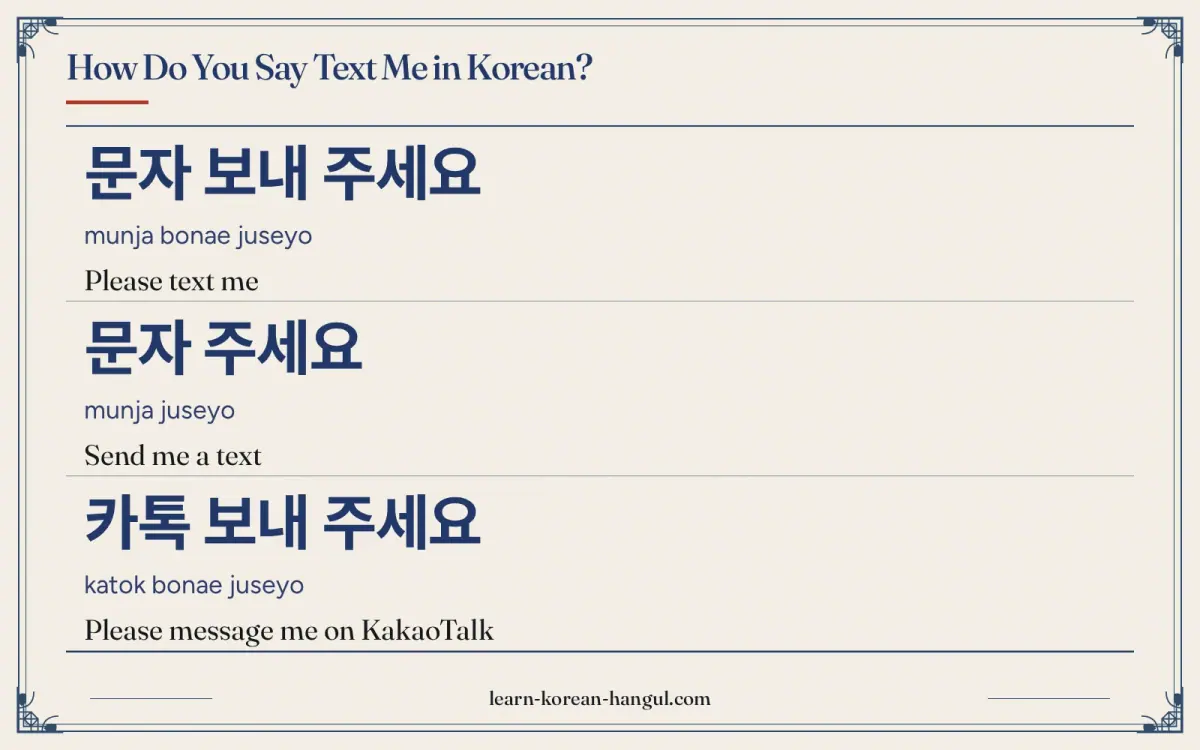
The standard way to say text me in Korean is 문자 보내 주세요. Here 문자 means "text message", 보내다 is the verb "to send", and the ending -아/어 주세요 means "please do this for me". The verb is spelled 보내 before 주세요. Put together, the phrase literally asks the listener to "send me a text".
| Korean | Romanization | Meaning | Where you hear it |
|---|---|---|---|
| 문자 보내 주세요 | munja bonae juseyo | Please text me | Most people, daily life |
| 문자 주세요 | munja juseyo | Send me a text | Colleagues, acquaintances |
| 카톡 보내 주세요 | katok bonae juseyo | Please message me on KakaoTalk | When you both use the app |
| 문자 보내 주시면 감사하겠습니다 | munja bonae jusimyeon gamsahagetseumnida | I would be grateful if you texted me (formal) | Customers, seniors |
| 문자 보내 줘 | munja bonae jwo | Text me (casual) | Friends, family |
Revised Romanization (the South Korean government standard of 2000) is only a reading aid here. Learn the Hangul first. The next section shows how the forms differ.
What Are the Polite and Casual Ways to Say Text Me?
Text me in Korean has polite, formal and casual choices. The middle of the sentence stays the same, and the ending and the app name change.
Polite: 문자 보내 주세요 (munja bonae juseyo)
Polite · 해요체문자 보내 주세요 is the safe default. It works with a neighbour, a shop assistant or a new colleague. The pattern "message + 보내 주세요" also works for other things: 사진 보내 주세요 ("please send a photo") and 주소 보내 주세요 ("please send the address").
회의 시간이 바뀌면 문자 주세요.
hoeui sigani bakkwimyeon munja juseyo
Text me if the meeting time changes.
Polite: 문자 주세요 (munja juseyo)
Polite · 해요체문자 주세요 drops 보내다 and keeps only the verb of giving. It literally says "please give me a text" and is the most common short form at work. Staff in shops and offices often answer 문자 드리겠습니다 ("I will text you").
Polite: 카톡 보내 주세요 (katok bonae juseyo)
Polite · 해요체카톡 is the everyday short name for KakaoTalk (카카오톡). Use it when you already chat with the person in the app. Friends often use a verb form, 카톡해 (katokae), meaning "message me on KakaoTalk".
사진 찍었어? 카톡으로 보내 줘.
sajin jjigeosseo? katogeuro bonae jwo
Did you take the photo? Send it to me on KakaoTalk.
Formal: 문자 보내 주시면 감사하겠습니다 (munja bonae jusimyeon gamsahagetseumnida)
Formal · 합쇼체This is the careful version for customers, clients and seniors. It means "I would be grateful if you texted me". The honorific -(으)시- in 주시면 shows respect to the listener. Say it as [문짜 보내 주시면 감사하겓씀니다].
Casual: 문자 보내 줘 (munja bonae jwo)
Casual · 반말문자 보내 줘 ("text me") fits friends and family. Said without 줘, the bare 문자 보내 can sound like an order. It never fits a boss, an elder or a stranger.
The forms share one core. The next section shows how to say it out loud.
How Do You Pronounce 문자 보내 주세요?
문자 보내 주세요 is pronounced [문짜 보내 주세요] in seven syllables: mun-ja bo-nae ju-se-yo. The one sound change is the tense [짜] in 문자, so the rest of the work is in the vowels and a steady rhythm.
- 문 (mun): a plain m, the vowel ㅜ, and a short n.
- 자 (ja): tense [짜] in this word, because the standard pronunciation of 문자 is [문짜]. Revised Romanization keeps munja.
- 보 (bo): a plain b and a rounded o.
- 내 (nae): n plus ㅐ, an open "ae" sound.
- 주 (ju): a plain j and a rounded u.
- 세 (se): s plus ㅔ.
- 요 (yo): a short, light ending.
Sound Changes to Listen For
- ㅐ in 내 and ㅔ in 세. Most Seoul speakers pronounce ㅐ and ㅔ almost the same, so you do not need to separate them to be understood.
- No tensing in 주세요. The ㅈ stays plain after 내, so say [주세요], not "jjuseyo".
- Aspiration in 카톡해. The ㄱ of 톡 meets the ㅎ of 해, and together they sound like [ㅋ]: [카토캐]. The Revised Romanization for the verb form shows this as katokae.
- Tense [께] in -ㄹ게요. The promise ending in 보낼게요 sounds like [보낼께요].
- Spacing. Write 문자 보내 주세요 with spaces before 보내 and 주세요 (attaching the helper verb, 보내주세요, is also allowed).
- No rising pitch in a request. A request ends calmly. A sharp rise would turn it into a question.
Aim for even syllables and a calm ending. Next, when does each form fit?
When Should You Use 문자 보내 주세요, and When Should You Not?
Use 문자 보내 주세요 when you want a written message and you are not close friends. Use 문자 주세요 with colleagues and 문자 보내 줘 with friends. Age and closeness decide the choice, and so does the app: 문자 for a phone number, 카톡 for a chat contact.
Situations Where It Fits
- A host or landlord. 도착하시면 문자 주세요 is a common instruction to a guest.
- A work change. 회의 시간이 바뀌면 문자 주세요 asks for a heads-up.
- A photo or an address. 주소 문자로 보내 주세요 ("please send the address by text") is clear and polite.
Situations to Avoid
- 문자 보내 with an elder. Without 주세요, the request sounds like an order.
- 카톡해 with a boss. The verb 카톡하다 is casual shorthand.
- 문자해요 as a request. That form means "I text" or "let's text", not "please text me".
Three short scenes show the forms in use.
What Does Text Me Sound Like in a Real Conversation?
Requests for a message are short. Listen for the ending of each sentence.
Asking a Colleague
Min-Su
회의 시간이 바뀌면 문자 주세요.
hoeui sigani bakkwimyeon munja juseyo
Please text me if the meeting time changes.
Ha-Na
네, 알겠어요. 바로 보내 드릴게요.
ne, algesseoyo. baro bonae deurilgeyo
Yes, I understand. I'll send it right away.
What to notice: Ha-na says 보내 드릴게요 [보내 드릴께요]. 드리다 is the humble verb for "give", and -ㄹ게요 is a promise. The tense 께 comes from the -ㄹ ending.
Asking a Friend for a Photo
Ji-Ho
사진 찍었어? 카톡으로 보내 줘.
sajin jjigeosseo? katogeuro bonae jwo
Did you take the photo? Send it to me on KakaoTalk.
Su-Bin
응, 지금 보낼게.
eung, jigeum bonaelge
Yes, I'll send it now.
What to notice: Both lines drop 요, because the friends are close. 찍었어 sounds like [찌거써], and 보낼게 sounds like [보낼께]. 카톡으로 sounds like [카토그로].
A Host Asks a Guest to Text
Host
도착하시면 문자 주세요.
dochakasimyeon munja juseyo
Please text me when you arrive.
Guest
네, 도착하면 바로 문자 드리겠습니다.
ne, dochakamyeon baro munja deurigetseumnida
Yes, I'll text you as soon as I arrive.
What to notice: 도착하시면 sounds like [도차카시면], with an aspirated ㅋ. 드리겠습니다 sounds like [드리겓씀니다]. The guest answers with the humble 드리다 and the formal -겠습니다 to stay polite to the host.
What Should You Know about the Culture behind Text Me?
These are general patterns, not rules.
- 문자 and 카톡 are different tools. Banks, delivery services and clinics usually send a 문자 to your phone number. Friends and colleagues usually chat on KakaoTalk, a widely used messaging app in Korea.
- Ask which one. A polite way to check is 카톡으로 보내 드릴까요, 문자로 보내 드릴까요? ("Shall I send it on KakaoTalk or by text?").
- Reply. 답장 주세요 [답짱 주세요] (dapjang juseyo) means "please reply". See what's your kakaotalk id in Korean for how to get connected.
- Short messages. Chat is casual, and abbreviations are common among friends. For abbreviations, see korean texting abbreviations.
An expert tip: 문자 has two meanings. It is the "text message" here, and it also means a written character or script, as in 표음 문자 (a phonetic script). So 문자 보내다 means "send a text", not "send a letter of the alphabet". Once you know this, 문자 메시지 ("text message", munja mesiji) also makes sense. For the way endings carry politeness, see Korean speech levels.
What Mistakes Do Learners Make with Text Me in Korean?
Most errors come from the wrong verb form or the wrong app.
| Mistake | Why it is a problem | Fix |
|---|---|---|
| Saying 문자해요 to ask for a text | It means "I text" or "let's text" | Say 문자 보내 주세요 |
| Using 카톡해 with a boss | Casual shorthand | Use 카톡 보내 주세요 |
| Leaving out 주세요 | The request sounds like an order | Add 주세요 |
| Saying 카톡 to someone who does not chat in the app | They may not understand the request | Ask for 문자 |
| Writing 문자보내주세요 as one word | Hard to read | Write 문자 보내 주세요 |
Learners often translate "text" word for word and reach for a verb. In Korean, you ask for the noun to be sent: 문자, 카톡, 사진.
Is It the Same as Text in Korean, Send a Message or Message Me?
Not exactly. Each English phrase is covered by the forms above, with a small difference in tone.
- Text in Korean: the noun is 문자, and the verb is 문자하다 or 문자를 보내다.
- Send message in Korean: 메시지 보내 주세요 (mesiji bonae juseyo) is the general "please send a message".
- Message me in Korean: 톡 주세요 (tok juseyo) or 카톡 보내 주세요 for the app.
- Leave a message in Korean: 메시지 남겨 주세요 (mesiji namgyeo juseyo) asks for a message to be left, for example on a voicemail or at a desk.
Practice: Say It Aloud
Play the slow clip and repeat 문자 보내 주세요 three times. Then choose the best request for each scene. Answers follow.
- A friend should send you a photo on KakaoTalk.
- A colleague should text you if the plan changes.
- A host wants a guest to text on arrival.
- How do you say "please reply"?
Answers
- 카톡으로 사진 보내 줘.
- 계획이 바뀌면 문자 주세요.
- 도착하시면 문자 주세요.
- 답장 주세요.
The phrase flashcards drill these requests with audio.
Related Phrases to Learn Next
Asking for a message leads to other contact phrases.
- call me in Korean: the phone-call version of the same request.
- what's your kakaotalk id in Korean: get the contact before you ask for the message.
- i'll text you in Korean: the usual answer to a request to text.
This guide belongs to the korean texting phrases collection. What this page does not cover: chat slang, emoji and business email wording. Learn one polite and one casual request, and you can say text me in Korean to anyone.
Frequently Asked Questions
How do you say text me in Korean?
Say 문자 보내 주세요 (munja bonae juseyo) for "please text me". With a colleague, 문자 주세요 is shorter. For a chat app, say 카톡 보내 주세요. With a friend, say 문자 보내 줘. The word 문자 means a text message, and 보내다 means to send.
How do you pronounce 문자 보내 주세요?
It has seven syllables: mun-ja bo-nae ju-se-yo. Say ㅐ in 내 as an open "ae" and keep the rhythm even. The ㅈ in 문자 is tense in the standard pronunciation, [문짜], though RR still writes munja. The ㅈ of 주세요 stays plain. Revised Romanization writes munja bonae juseyo.
What is the difference between 문자 and 카톡?
문자 is a text message sent with a phone number, and 카톡 is short for KakaoTalk, a chat app. Service messages from banks, deliveries and clinics usually arrive as 문자. Friends and colleagues usually chat on 카톡. Use 문자 when you are unsure which one the person uses.
Is 문자 보내 주세요 formal or casual?
It is polite. The ending 주세요 is a respectful request that suits strangers and colleagues. The formal version is 문자 보내 주시면 감사하겠습니다. Casual versions, such as 문자 보내 줘, only fit friends and family. Choose the polite form when you are unsure.
What is the most common mistake with text me in Korean?
Saying 문자해요 or 카톡해요 to ask for a message. Those forms mean "I text" or "I message", so they describe you, not the listener. Ask with 보내 주세요 or 주세요 instead. Another mistake is using the casual 카톡해 with a boss or an elder.