문자 드릴게요
문자 드릴게요
What you'll learn
- Say I'll text you with 문자 드릴게요, 카톡 보낼게요 or 연락할게요, depending on the app and the listener.
- Understand why 드리다 makes the phrase humble.
- Tell 연락해요 (I contact you) from 연락할게요 (I promise to contact you).
- Pronounce 문자 as [문짜] and 연락할게요 as [열라칼께요].
Before you start: you only need to read Hangul. When someone asks you to text them, learn text me in Korean. Time: about 10 minutes. Audio plays only when you press a button.
How Do You Say I'll Text You in Korean?
The standard polite way to say I'll text you in Korean is 문자 드릴게요. The noun 문자 (munja) is short for 문자 메시지, a text message. 드릴게요 comes from 드리다, the humble verb for "to give", plus the promise ending -ㄹ게요. So the line means "I will give you a text". Korean usually drops "you", so the sentence is complete.
| Situation | Best form | Romanization | Why |
|---|---|---|---|
| Promising a text to a senior or a customer | 문자 드릴게요 | munja deurilgeyo | Humble, SMS |
| Promising a KakaoTalk message | 카톡 보낼게요 | katok bonaelgeyo | Polite, app |
| Promising to get in touch | 연락할게요 | yeollakalgeyo | General, polite |
| A formal reply | 문자 드리겠습니다 | munja deurigetseumnida | Formal |
| Telling a close friend | 문자할게 / 연락할게 | munjahalge / yeollakalge | Casual |
The next section sorts these forms by listener and by app.
What Are the Polite Ways to Say I'll Text You?
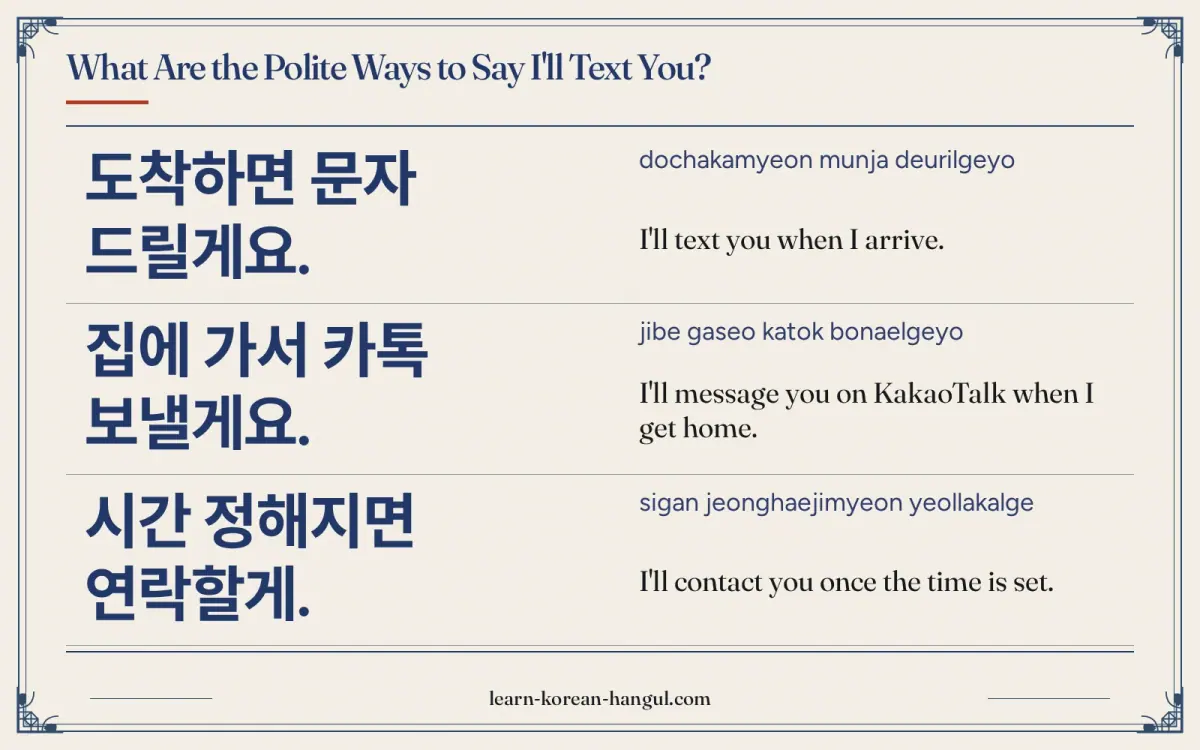
The forms follow the Korean speech levels, explained in the guide to Korean speech levels. Here the verb and the app change, and the polite ending stays.
Humble: 문자 드릴게요 (munja deurilgeyo)
Polite · 해요체문자 드릴게요 is the form to learn first for someone you respect. It suits an older acquaintance, a teacher, a client or a new contact. The humble 드리다 lowers you slightly and raises the listener, so use it only when you send to them.
도착하면 문자 드릴게요.
dochakamyeon munja deurilgeyo
I'll text you when I arrive.
KakaoTalk: 카톡 보낼게요 (katok bonaelgeyo)
Polite · 해요체카톡 is the short name for KakaoTalk, the chat app most people in Korea use. 보내다 means to send, and the polite 보낼게요 is neutral, not humble. It suits coworkers, classmates and friends you speak politely to.
집에 가서 카톡 보낼게요.
jibe gaseo katok bonaelgeyo
I'll message you on KakaoTalk when I get home.
Casual: 연락할게 (yeollakalge)
Casual · 반말연락할게 drops the polite ending. Use it with close friends, siblings and people younger than you. It is the most flexible of the three, because it does not name an app.
시간 정해지면 연락할게.
sigan jeonghaejimyeon yeollakalge
I'll contact you once the time is set.
Formal: 문자 드리겠습니다 (munja deurigetseumnida)
Formal · 합쇼체문자 드리겠습니다 is the formal version, used by shops, schools and offices. A company may write 결과는 문자로 안내드리겠습니다 (we will let you know the result by text). It is pronounced [문짜 드리겓씀니다].
The humble verb is the part that makes this phrase special.
Why Does 드리다 Make It Humble?
드리다 is the humble form of 주다 (to give). Korean uses humble verbs to lower yourself when your action goes toward someone you respect. Here you "give" a text to that person. The ending -(으)ㄹ게요 then adds a promise, so 드리 + ㄹ게요 → 드릴게요.
- 주다 → 드리다 (give, humble)
- 전화하다 → 전화드리다 (call, humble): 전화드릴게요
- 말하다 → 말씀드리다 (tell, humble): 말씀드릴게요
- 연락하다 → 연락드리다 (contact, humble): 연락드릴게요
After action nouns such as 전화, 연락 and 말씀, -드리다 is written together with the noun (전화드릴게요, 연락드릴게요). 문자 드릴게요 keeps a space, because here 드리다 is the full verb "give" and 문자 is the thing given. A humble verb lowers the giver toward a respected receiver, so 제가 문자 드릴게요 is right, but when your teacher sent you a text, 선생님이 문자 드리셨어요 is wrong. For a teacher's action, use 보내셨어요 (bonaesyeosseoyo, they sent). Next, the sounds.
How Do You Pronounce 문자 드릴게요?
문자 드릴게요 is pronounced [문짜 드릴께요], mun-jja deu-ril-kke-yo, in six syllables. Two sounds differ from the spelling. The ㅈ in 문자 is pronounced tense, [문짜], and the ㄱ after the final ㄹ in 드릴게요 is also tense, [드릴께요].
- 문 (mun): "moon", with a short vowel.
- 자 (jja): a tight ch/j with no puff of air, "jjah".
- 드 (deu): "deu", with unrounded lips for ㅡ.
- 릴 (ril): a light tap of the tongue, then "l" at the end.
- 게 (kke): a tense "kk" and "eh".
- 요 (yo): "yo".
The word 문자 is listed in the standard dictionary with a tense ㅈ. This is specific to the word, not a general rule, so learn it as a unit. Revised Romanization does not show either tensing, so you see munja deurilgeyo.
Sound Changes to Listen For
These notes follow the National Institute of Korean Language standard pronunciation rules (표준 발음법):
- Liquid assimilation. In 연락, ㄴ turns into ㄹ next to ㄹ, giving [열락] (Article 20). RR writes yeollak.
- Aspiration. In 연락할게요, ㄱ meets ㅎ, giving ㅋ, so the whole phrase is [열라칼께요] (Article 12). RR shows the aspiration in a predicate: yeollakalgeyo.
- Tense after ㄱ. In 연락드릴게요, the ㄷ after ㄱ is tense, so it sounds like [열락뜨릴께요] (Article 23).
- Tense -ㄹ게요. The ㄱ after the final ㄹ is heard as ㄲ. See Korean tensification.
With the sound clear, here is when each form fits.
When Should You Use 문자 드릴게요, and When Should You Not?
Use 문자 드릴게요 when you promise a message to someone you respect or do not know well. Choose the app and the level with care.
Situations Where It Fits
- After a first meeting. 오늘 감사했습니다. 내일 문자 드릴게요. (Thank you for today. I'll text you tomorrow.)
- A business or school contact. 확인 후에 문자 드릴게요. (I'll text you after I check.)
- Arriving home safely. 도착하면 문자 드릴게요. (I'll text you when I arrive.)
Situations to Avoid
- A close friend. 문자 드릴게요 sounds stiff. Say 문자할게 or 카톡할게.
- Someone who only uses KakaoTalk. If both of you use the app, 카톡 보낼게요 is more natural than 문자.
- A promise you may not keep. In Korea, a vague 연락할게요 can sound like a polite brush-off, so only say it when you mean it.
Two short conversations show how it sounds.
What Does I'll Text You Sound Like in a Real Conversation?
In real life, the line comes at the end of a meeting. Notice the answers.
Saying Goodbye after Dinner
Host
오늘 정말 즐거웠어요. 조심히 들어가세요.
oneul jeongmal jeulgeowosseoyo. josimhi deureogaseyo
I had a great time today. Please get home safely.
Guest
감사합니다. 집에 도착하면 문자 드릴게요.
gamsahamnida. jibe dochakamyeon munja deurilgeyo
Thank you. I'll text you when I get home.
Host
네, 기다릴게요!
ne, gidarilgeyo!
Yes, I'll wait!
What to notice: the guest uses the humble 드릴게요 to the host, and the host answers with a plain promise, 기다릴게요, because waiting is not an action toward the guest.
Fixing a Time
Seojun
내일 몇 시에 만나?
naeil myeot sie manna?
What time shall we meet tomorrow?
Haerin
아직 몰라. 시간 정해지면 연락할게.
ajik molla. sigan jeonghaejimyeon yeollakalge
I don't know yet. I'll contact you when the time is set.
Seojun
응, 카톡 해 줘!
eung, katok hae jwo!
Okay, message me on KakaoTalk!
What to notice: 몇 시에 is a wh-question, so it does not end with a sharp rise. The casual 연락할게 fits between friends, and 카톡 해 줘 asks for the app.
What Should You Know about the Culture behind I'll Text You?
KakaoTalk (카톡) is the default messaging app in Korea, and 문자 is the plain SMS that many people now use for official messages, codes and short notices. Because of this, you often hear 카톡 해요 or 카톡 주세요 for "message me", while 문자 is used by businesses, schools and clinics. Choose the word that matches the app you expect to use.
- Official contact. Offices say 문자로 안내해 드리겠습니다 (we will inform you by text).
- Friends. Plans are made in KakaoTalk chats, not by phone calls.
- Pace. A quick reply is polite, but nobody expects an answer at once.
If you swap contact details, a natural question is 카카오톡 아이디가 뭐예요? (what is your KakaoTalk ID?), which the page on what's your KakaoTalk ID in Korean explains. The next section covers the mistakes learners make.
What Mistakes Do Learners Make with I'll Text You in Korean?
Most mistakes come from the ending and from the humble verb.
| Mistake | Why it is a problem | Fix |
|---|---|---|
| 연락해요 for a promise | It states "I contact", not a promise | Say 연락할게요 |
| 문자 드려요 | Present tense, no promise | Say 문자 드릴게요 |
| 문자 드릴게 to a friend | Humble verb with casual ending | Say 문자할게 |
| 선생님이 문자 드리셨어요 (for a text sent to you) | Humble verb for a text you received | Say 보내셨어요 |
| 문짜 in writing | The spelling is 문자 | Write 문자, say [문짜] |
| 연락할게요 as a firm plan | It can sound like a brush-off | Add a time: 내일 연락할게요 |
The key pair is 연락해요 and 연락할게요. 연락해요 says that you contact someone, as a habit or fact, as in 가끔 연락해요 (I contact them sometimes). 연락할게요 is a promise at the moment of speaking. The first states, the second commits.
How Do You Ask Someone to Text You?
Use the request ending -(어)주세요. To a colleague, say 문자 주세요 (munja juseyo) or 연락 주세요 (yeollak juseyo). To a friend, say 문자 줘 or 카톡 해 줘. To ask when, use 언제 연락할까요? (eonje yeollakalkkayo?), "when shall I contact you?". A wh-question like this falls or rises and falls, and does not end with a sharp rise.
| Purpose | Phrase | Romanization |
|---|---|---|
| Ask a colleague to text | 문자 주세요 | munja juseyo |
| Ask a friend to message | 카톡 해 줘 | katok hae jwo |
| Ask when to contact | 언제 연락할까요? | eonje yeollakalkkayo |
The page on text me in Korean covers the request in detail, and the page on call me in Korean covers phone calls.
Is It the Same as I'll Message You, I Will Text You or Contact You?
Close. The short answers below cover the other searches folded into this page.
- I'll message you in Korean: 메시지 보낼게요 (mesiji bonaelgeyo) or 카톡 보낼게요.
- I will text you in Korean: 문자 드릴게요, or in formal speech 문자 드리겠습니다.
- Contact you in Korean: 연락할게요, or the humble 연락드릴게요 (yeollakdeurilgeyo).
- I'll call you back: 다시 전화드릴게요 (dasi jeonhwadeurilgeyo).
- I'll text you later: 나중에 문자 드릴게요.
Now practise aloud.
Practice: Say It Aloud
Play the slow clip of 문자 드릴게요 three times and keep the ㅈ tight. Then choose a phrase. Answers follow.
- You promise a text to a new client.
- You promise a KakaoTalk message to a coworker.
- You tell a close friend you'll get in touch.
- You write a formal reply from a shop.
Answers
- 문자 드릴게요.
- 카톡 보낼게요.
- 연락할게.
- 문자 드리겠습니다.
The phrase flashcards drill these lines with audio.
Related Phrases to Learn Next
Texting leads to requests and to calls.
- Text me in Korean: 문자 보내 주세요 to ask for a message.
- Call me in Korean: 전화 주세요 for a phone call.
- I'll call you back in Korean: 다시 전화드릴게요 for the next step.
This guide belongs to the Korean texting phrases collection, and the Korean texting abbreviations lesson covers short chat words. What this page does not cover: emoji, chat slang and long messages. Remember that 드리다 is humble, -ㄹ게요 is a promise, and 문자 sounds like [문짜], and you can say i'll text you in Korean naturally.
Frequently Asked Questions
How do you say I'll text you in Korean?
Say 문자 드릴게요 (munja deurilgeyo) to someone you respect, 카톡 보낼게요 (katok bonaelgeyo) for a KakaoTalk message and 연락할게요 (yeollakalgeyo) for a general promise to be in touch. With close friends, say 문자할게 or 연락할게. In formal speech, say 문자 드리겠습니다.
What does 드릴게요 mean in 문자 드릴게요?
드릴게요 combines 드리다, the humble form of 주다 (to give), with the promise ending -(으)ㄹ게요. It means you humbly give a text to the listener and promise to do so. Use it for a senior, a customer or a new contact. With friends, use 보낼게 or 할게 instead.
What is the difference between 연락해요 and 연락할게요?
연락해요 means "I contact" and states a fact or habit, as in 가끔 연락해요. 연락할게요 is a promise made at the moment you speak, so it is the line to use when you say goodbye. Because 연락할게요 can sound like a polite brush-off if vague, add a time, such as 내일 연락할게요.
How do you pronounce 문자 드릴게요?
It is pronounced [문짜 드릴께요]. The ㅈ in 문자 is tense in the standard dictionary pronunciation, and the ㄱ after the ㄹ of 드릴 also becomes tense. Revised Romanization shows neither tensing, so you see munja deurilgeyo. 연락할게요 is [열라칼께요].
Should I say 문자 or 카톡 in Korea?
Use 카톡 when you plan to use KakaoTalk, which is the usual chat app, and 문자 for SMS, official messages and businesses. Friends make plans on 카톡, while shops and clinics send 문자. If you are not sure, 연락할게요 works for both.
Can I use 문자 드릴게요 with a friend?
It is possible, but it sounds stiff, like speaking to a teacher. With a friend, say 문자할게 or 카톡할게. Use the humble 드리다 only when the message goes toward someone you respect, never for yourself or for a person who is below you in the situation.