왜
왜
What you'll learn
- Say 왜, 왜요 and 왜 그래 aloud with the short "weh" sound.
- Choose between 왜, 왜요? and 왜 그러세요? for a friend, a coworker and an elder.
- Ask "what's wrong?" with 왜 그래? and 왜 그래요? and hear the difference between concern and irritation.
- Avoid the blunt bare 왜? with people older than you.
Before you start: you need to read Hangul; romanization is shown as an aid and can be hidden. Time: about 9 minutes. Audio plays only when you press a button.
How Do You Say Wae in Korean?
The Korean word for "why" is 왜 (wae). It is a single syllable and works as a complete question, as in "Why?" Four forms cover almost every situation.
| Form | Romanization | Meaning | Register | Say it to |
|---|---|---|---|---|
| 왜 | wae | why | Casual (반말) | Close friends, younger people |
| 왜요? | waeyo | why? | Polite (해요체) | Coworkers, shop staff, acquaintances |
| 왜 그래? | wae geurae | what's wrong? | Casual (반말) | Close friends, younger people |
| 왜 그래요? | wae geuraeyo | what's the matter? | Polite (해요체) | Coworkers, acquaintances |
The table lists the forms. The next section shows each one in a sentence.
What Are the Polite and Casual Ways to Say Wae?
Korean changes the ending of a sentence to match the listener's age, status and closeness. These endings are called speech levels, and the guide to Korean speech levels explains them in full. For "why," the casual form has no ending at all, and the polite form adds 요.
Casual: 왜 (wae)
Casual · 반말왜 is the bare word. It is 반말 (casual speech), so it fits close friends, siblings and younger people. It can be a neutral question or a sharp one, depending on your tone. Often a friend adds a short follow-up, such as 무슨 일 있어? (is something up?).
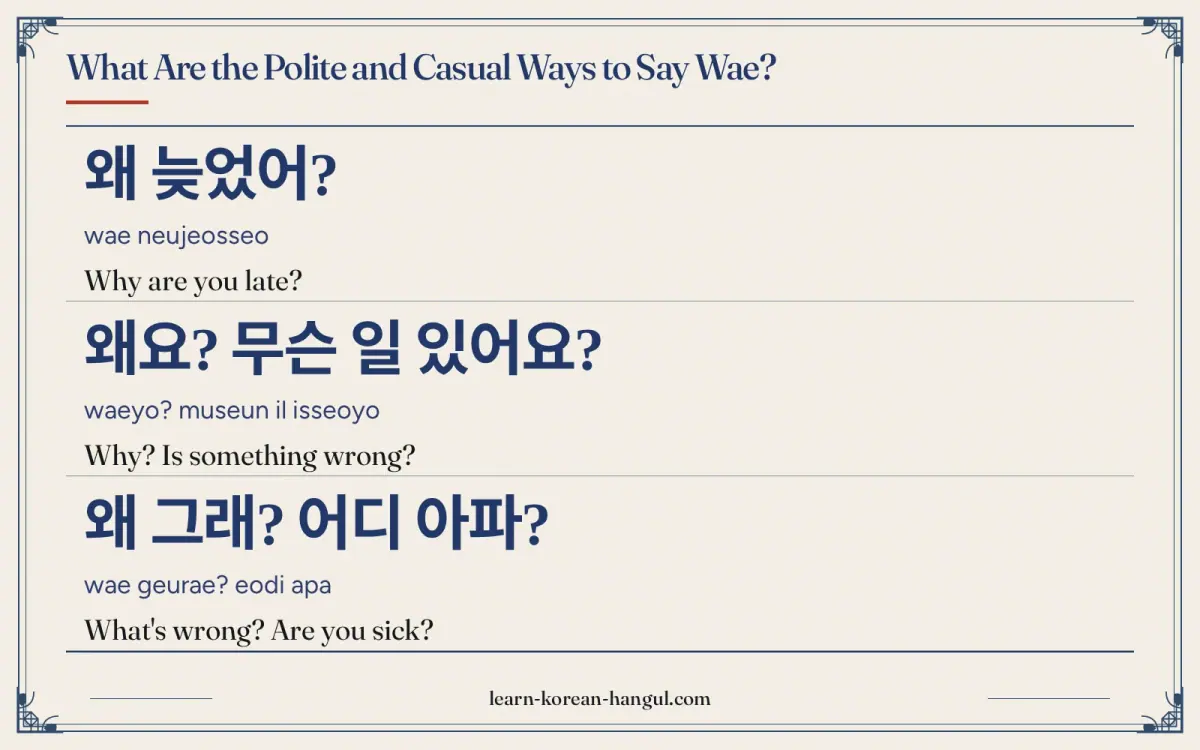
왜 늦었어?
wae neujeosseo
Why are you late?
Polite: 왜요? (waeyo)
Polite · 해요체왜요? adds the polite ending 요 (yo). It is the standard way to ask "why?" or "why do you ask?" in daily life. Coworkers, shop staff and new acquaintances all hear it without offence. Its meaning also covers "what for?" when someone asks you something unexpected.
왜요? 무슨 일 있어요?
waeyo? museun il isseoyo
Why? Is something wrong?
Casual: 왜 그래? (wae geurae)
Casual · 반말왜 그래? joins 왜 (why) with 그래 (be like that). It asks "what's wrong?" or "why are you acting like that?" Friends say it when someone looks upset, tired or unwell. The same words can also show irritation, so tone decides whether it is care or complaint.
왜 그래? 어디 아파?
wae geurae? eodi apa
What's wrong? Are you sick?
Polite: 왜 그래요? (wae geuraeyo)
Polite · 해요체왜 그래요? is the polite version of 왜 그래?. It fits a coworker who looks worried or a neighbour who seems upset. For an elder or a senior person, replace 그래요 with the honorific 그러세요, and say 왜 그러세요? (wae geureoseyo). The honorific -세요 treats the listener with respect.
왜 그래요? 얼굴이 안 좋아 보여요.
wae geuraeyo? eolguri an joa boyeoyo
What's the matter? You don't look well.
Four forms and four sentences are enough to start. How they sound comes next.
How Do You Pronounce 왜?
왜 is pronounced [왜], like the English "weh" in "went." The letters are ㅇ (silent at the start) plus ㅙ, a compound vowel made of ㅗ and ㅐ. Say a quick "w," then open into a short "eh."
- Round your lips as for "w," then drop them quickly.
- Open your mouth a little and say "eh."
- Keep it one beat. Do not say "way," which is a different sound in English.
Sound Changes to Listen For
왜, 왜요 and 왜 그래 have no sound changes. Each syllable sounds as it is written. Three points still matter.
- The Revised Romanization misleads. The system of 2000 writes ㅙ as "wae," but the vowel sounds like "weh," not "way."
- Similar vowels. The standard pronunciation rules (표준 발음법, National Institute of Korean Language) treat ㅙ, ㅚ and ㅞ as three different vowels, and allow ㅚ to be said as the diphthong [we]. Most Seoul speakers pronounce all three almost the same, so 왜, 외 and 웨 sound close. Spelling is what tells them apart.
- Question tone. A one-word 왜? or 왜요? usually rises at the end. In a longer question such as 왜 늦었어?, the stress falls on 왜, and the end often falls or rises and then falls.
With the sound clear, the next question is who you can say it to.
When Should You Use 왜, and When Should You Not?
Use 왜요? with almost everyone, and keep bare 왜 for friends. Ask 왜 그래? only when you can see that something is wrong.
Situations Where It Fits
- A friend skips plans. 왜? is quick and natural.
- A coworker declines a task. 왜요? asks for the reason without sounding cold.
- Someone looks upset. 왜 그래? or 왜 그래요? shows that you noticed.
- A child asks for a reason. 왜? is the usual question, and adults answer patiently.
Situations to Avoid
- A bare 왜? to an elder or boss. It sounds like a challenge. Say 왜 그러세요? or 혹시 이유가 있으세요? (is there a reason?).
- 왜 그래? to a stranger. It sounds like you are scolding them.
- A flat tone with 왜요? A sharp, fast 왜요? can sound hostile. Soften the voice, and add a short reason for asking.
These rules are easier to feel in real exchanges, so here are three.
What Does Wae Sound Like in a Real Conversation?
A short "why" exchange is usually two or three lines. The asker wants a reason, and the answerer gives a short one.
Coworkers
Daeho
내일 회의에 못 가요.
naeil hoeuie mot gayo
I can't come to tomorrow's meeting.
Sora
왜요?
waeyo
Why?
Daeho
아이가 아파요.
aiga apayo
My child is sick.
What to notice: Sora uses polite 왜요? with a coworker, and the answer is short and honest.
Friends
Minsu
나 오늘 일찍 갈게.
na oneul iljjik galge
I'll leave early today.
Yuna
왜? 무슨 일 있어?
wae? museun il isseo
Why? Is something up?
What to notice: both friends use casual forms, and 왜? is followed by a caring second question.
A Worried Friend
Jia
왜 그래? 어디 아파?
wae geurae? eodi apa
What's wrong? Are you sick?
Hana
아니야, 그냥 피곤해.
aniya, geunyang pigonhae
No, I'm just tired.
What to notice: 왜 그래? carries concern here. Hana answers with 그냥 (just), which downplays the problem. The next section explains why tone matters so much.
What Should You Know about the Culture behind Wae?
Korean drama dialogue often uses 왜 그래? at moments of tension, so learners hear it often. The same words can mean "are you okay?" or "what is your problem?" The difference is in the voice: a soft, falling tone shows care, and a sharp, rising tone shows irritation.
- Direct questions need a softener. Koreans often soften a "why" with 요, a gentle voice, or a reason for asking.
- Elders get the honorific. 왜 그러세요? keeps the respect even when you are surprised.
- Children say it constantly. Young Korean children ask 왜? again and again, just as English-speaking children ask "why?"
- It can be a challenge. Between adults, 왜? alone can mean "why should I?" when said sharply.
An expert tip: listen for the second beat. If a speaker says 왜 그래 and then 무슨 일이야 (what happened?), the tone is caring. If 왜 그래 is followed by a complaint, the tone is irritated. This page covers 왜 as a stand-alone reaction. How 왜 builds full sentences, such as 왜 안 가요? (why aren't you going?), lives on the page about 왜 why in Korean.
What Mistakes Do Learners Make with Wae in Korean?
Most mistakes with 왜 come from register, spelling and tone.
| Mistake | Why it is a problem | Fix |
|---|---|---|
| Saying 왜? to a teacher or boss | Bare 왜 is casual and blunt | Say 왜요? or 왜 그러세요? |
| Pronouncing 왜 like "way" | The vowel is a short "weh" | Say [왜] with a quick w |
| Writing 웨 or 외 for 왜 | Different letters, close sounds | Write 왜 (ㅇ + ㅙ) |
| Using 왜 그래? to ask for a reason | 왜 그래 means "what's wrong?" | Use 왜요? or 왜 그런 거예요? |
| Rising sharply on 왜요? | It sounds hostile | Soften the tone |
Learners often think 왜 only means "why." In practice it is also a reaction, as in 왜? (what do you want?) or 왜요? (what is it?), so tone and context decide the meaning.
Does Wae Mean the Same as "Why" in Korean?
Yes, 왜 is the Korean word for "why," but it also works as a reaction word. The short answers below cover the other ways people search for it.
- Wae meaning: 왜 means "why." The romanization wae is only a spelling aid for the Korean letters, not an English word.
- Why in Korean: 왜 is the question word for "why." Use 왜요? to ask politely, and 왜 그래요? to ask what is wrong.
- Why not: 왜 안 돼요? (wae an dwaeyo) asks "why not?" or "why isn't it working?"
- Because: the answer pattern uses 때문에 (ttaemune) or an ending such as -아서/-어서, which belong to grammar lessons.
Knowing the forms is one thing; saying them on cue is another, so practise now.
Practice: Say It Aloud
Play the slow clip of 왜, repeat it three times, then say 왜요? in a polite voice. Then choose a form for each situation. Answers follow.
- A close friend says she cannot come tonight.
- A coworker looks very tired.
- A senior colleague refuses your idea and you want the reason.
- How do you say "why not?"
Answers
- 왜? (casual, friend)
- 왜 그래요? (polite) or 왜 그래? (if you are close)
- 왜 그러세요? or 혹시 이유가 있으세요?
- 왜 안 돼요?
The phrase flashcards drill all four forms with audio.
Related Phrases to Learn Next
Wae belongs with the phrases people say in tense or surprising moments.
- Korean drama phrases: the collection that lists every phrase in this cluster.
- What happened in Korean: the natural next question after 왜 그래?
- I don't understand in Korean: the phrase you will often hear in the same conversation.
- Korean speech levels: why 왜 and 왜요 differ in register.
What this page does not cover: full "why" sentences and the grammar of giving reasons. Use 왜요? when in doubt, and you can say wae in Korean to almost anyone.
Frequently Asked Questions
How do you say wae in Korean?
Say 왜 (wae), which means "why." For a polite question add 요 and say 왜요? (waeyo). To ask "what's wrong?" say 왜 그래? with friends or 왜 그래요? with people you address politely. A bare 왜 is casual, so add 요 whenever the listener is not a close friend.
How do you pronounce 왜?
왜 is one syllable, pronounced like "weh" in "went." Start with a quick w sound and open straight into the vowel. The Revised Romanization is wae, but the English letters "ae" mislead learners into saying "ay." Keep the vowel short. As a one-word question, 왜? or 왜요? usually rises at the end.
What is the difference between 왜 and 왜요?
Both mean "why?" 왜 is casual and short, so it suits friends and younger people. 왜요 adds the polite ending 요 and suits coworkers, shop staff and anyone you address politely. With elders, 왜 그러세요? is safer, because it uses the honorific -세요 and sounds gentler than a bare 왜요.
Is 왜 formal or casual?
It is casual. Bare 왜 belongs to the casual style (반말), which Koreans use with close friends, siblings and younger people. The polite form is 왜요, and the polite honorific is 왜 그러세요. In formal settings Koreans usually rephrase the question and give the reason for asking, instead of using 왜 alone.
Can I use 왜 with friends, elders and strangers?
Use 왜 with close friends only. With strangers, coworkers and teachers use 왜요, spoken softly. With elders use 왜 그러세요? or give a reason for asking. A bare 왜? aimed at an elder sounds like a challenge, even when you only wanted to know the reason.
What is the most common mistake with wae in Korean?
The most common mistake is saying a bare 왜? to someone older or senior. It sounds blunt or angry. Add 요, and soften your tone. The second mistake is spelling: 왜 has ㅇ plus ㅙ, and learners often write 웨 or 외, which are different letters that most speakers pronounce almost the same.