무슨 일이에요?
무슨 일이에요?
What you'll learn
- Say 무슨 일이에요? aloud as [무슨 니리에요], with the inserted ㄴ.
- Choose between 무슨 일이에요?, 무슨 일 있어요?, 무슨 일이야? and 어떻게 된 거예요? for a stranger, a senior and a friend.
- Understand typical replies such as 별일 아니에요 (it is nothing much).
- Avoid 뭐 했어요?, which asks what you did, not what happened.
Before you start: you need to read Hangul; romanization is shown as an aid and can be hidden. Time: about 9 minutes. Audio plays only when you press a button.
How Do You Say What Happened in Korean?
The most natural way to ask what happened is 무슨 일이에요?. It joins 무슨 (what kind of), 일 (matter, event) and 이에요 (it is). Four forms cover the question, from a stranger to a friend.
| Form | Romanization | Register | Say it to |
|---|---|---|---|
| 무슨 일이에요? | museun irieyo | Polite (해요체) | Strangers, colleagues, elders, anyone who looks upset |
| 무슨 일 있어요? | museun il isseoyo | Polite (해요체) | Colleagues, friends of any age, people who look tired |
| 무슨 일이야? | museun iriya | Casual (반말) | Close friends and people younger than you |
| 어떻게 된 거예요? | eotteoke doen geoyeyo | Polite (해요체) | Anyone, after you already know something happened |
The table lists the choices. The next section shows when each one fits.
What Are the Polite and Casual Ways to Say What Happened?
Korean changes the sentence ending to match the listener's age, status and closeness. These endings are called speech levels, and the guide to Korean speech levels explains them in full. In a formal setting, such as a company meeting, the ending becomes 무슨 일입니까? (museun irimnikka). In daily life, the four forms below are enough.
Polite: 무슨 일이에요? (museun irieyo)
Polite · 해요체무슨 일이에요? is the standard question after an odd event, a shout or a sudden change. It sounds neutral, so tone does the work: said gently, it shows concern. Said sharply, it can sound like "what do you want?".
저기요, 무슨 일이에요?
jeogiyo, museun irieyo
Excuse me, what is the matter?
Polite: 무슨 일 있어요? (museun il isseoyo)
Polite · 해요체무슨 일 있어요? literally asks "is there some matter?". It shows concern and gives the other person room to say no. Koreans ask it when a friend is quiet or looks tired. With a rising end it is a yes/no question: "Is something wrong?".
표정이 안 좋아요. 무슨 일 있어요?
pyojeongi an joayo. museun il isseoyo
You look upset. Is something wrong?
Casual: 무슨 일이야? (museun iriya)
Casual · 반말무슨 일이야? drops the polite ending. Use it with close friends, siblings and younger people. It is quick and warm, but it is too familiar for a boss or a stranger.
무슨 일이야? 목소리가 이상해.
museun iriya? moksoriga isanghae
What happened? Your voice sounds odd.
Polite: 어떻게 된 거예요? (eotteoke doen geoyeyo)
Polite · 해요체어떻게 된 거예요? asks how something came about. Use it after you learn that something happened and want the story. 된 comes from 되다 (to become), so the phrase means "how did it turn out this way?".
어떻게 된 거예요? 자세히 말해 주세요.
eotteoke doen geoyeyo? jasehi malhae juseyo
How did it happen? Please tell me in detail.
Four lines cover the whole range. Saying the main question cleanly comes next.
How Do You Pronounce 무슨 일이에요?
무슨 일이에요? is written with six syllables and spoken as [무슨 니리에요], museun irieyo. The spelling and the sound differ, so say it slowly once.
- 무 (mu): "moo"
- 슨 (seun): the vowel ㅡ is unrounded: spread your lips
- 일 (-ni-): a new ㄴ is added in front of the vowel, so you say "ni"
- 이 (-ri-): the final ㄹ of 일 moves forward and lands here as "ri"
- 에 (e): "eh"
- 요 (yo): "yoh"; with a question word the end usually falls
Sound Changes to Listen For
Three points matter here, from the National Institute of Korean Language Standard Pronunciation (표준 발음법) and everyday speech.
- ㄴ-insertion. When a word ending in a consonant is followed by a word starting with 이 or a similar vowel, a ㄴ sound is often added. So 무슨 일 is said [무슨 닐]. Revised Romanization still writes the two words separately as museun il, because it does not carry sound changes across a space. See N-insertion.
- Liaison after the insertion. The ㄹ of 닐 then moves onto 이 of 이에요, so the full phrase is [무슨 니리에요]. In 있어요, the ㅆ links to the next syllable and you say [이써요].
- Question pitch. 무슨 is a question word, so 무슨 일이에요? usually ends with a fall or a rise-fall. The yes/no reading of 무슨 일 있어요? rises at the end.
With the sounds set, the next question is when to ask it.
When Should You Use 무슨 일이에요?, and When Should You Not?
Ask 무슨 일이에요? when something clearly happened, and 무슨 일 있어요? when someone only looks off. Both are polite.
Situations Where It Fits
- A shout or a crash. 무슨 일이에요? is the natural reaction.
- A quiet colleague. 무슨 일 있어요? is gentle.
- A friend who looks upset. 무슨 일이야? is warm and quick.
- After you hear bad news. 어떻게 된 거예요? invites the whole story.
Situations to Avoid
- Using 뭐 했어요? It asks what you did, not what happened.
- Using 무슨 일 하세요? It asks about someone's job.
- Using 무슨 일이야? with a boss or a stranger. The casual ending is too familiar.
- Asking in a sharp tone. 무슨 일이에요? can sound like "what do you want?".
These choices are easier to feel in real exchanges, so here are three.
What Does What Happened Sound Like in a Real Conversation?
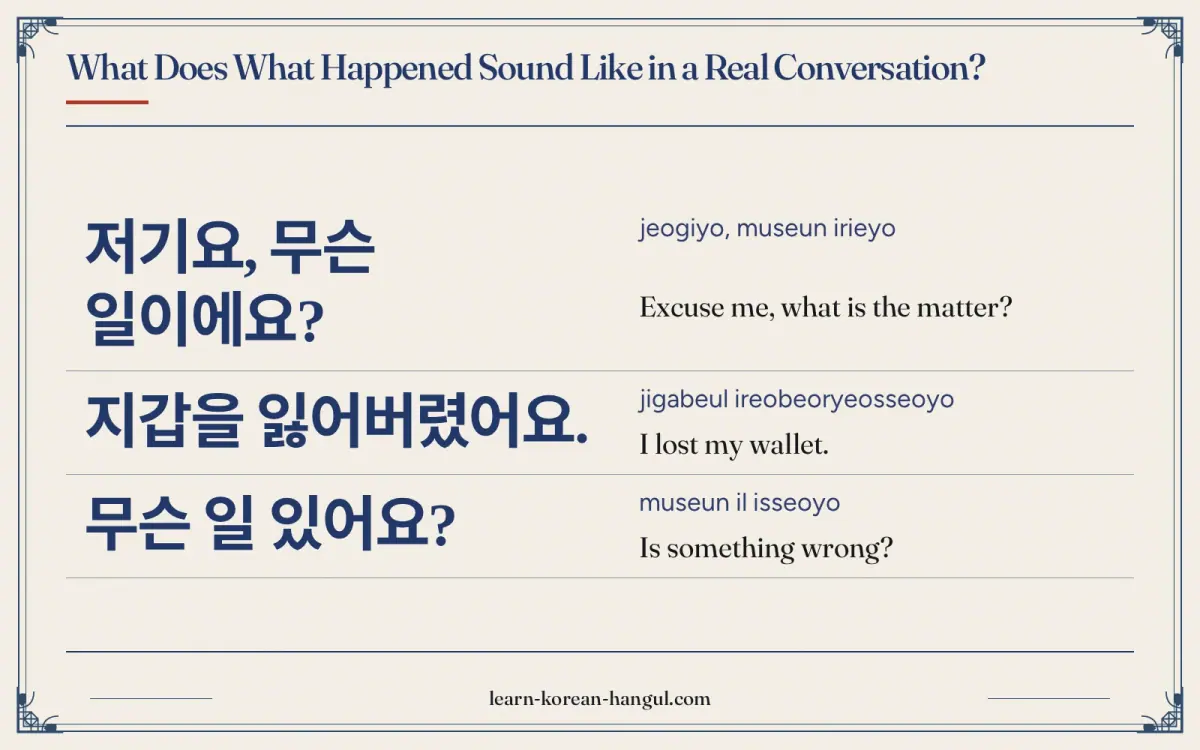
A what-happened exchange is short. The asker shows concern, and the answer gives one fact or brushes the question off.
A Stranger in Trouble
Passerby
저기요, 무슨 일이에요?
jeogiyo, museun irieyo
Excuse me, what is the matter?
Woman
지갑을 잃어버렸어요.
jigabeul ireobeoryeosseoyo
I lost my wallet.
What to notice: the passerby starts with 저기요 (excuse me) to get attention before asking.
A Tired Colleague
Sujin
무슨 일 있어요?
museun il isseoyo
Is something wrong?
Tae
별일 아니에요. 조금 피곤해요.
byeollil anieyo. jogeum pigonhaeyo
It is nothing much. I am a little tired.
What to notice: 별일 아니에요 is a common soft reply, and it does not always mean nothing is wrong.
Friends
Dae
무슨 일이야? 얼굴이 안 좋아 보여.
museun iriya? eolguri an joa boyeo
What happened? You do not look well.
Eun
시험을 망쳤어.
siheomeul mangchyeosseo
I messed up the exam.
What to notice: both friends use casual endings, and 안 좋아 보여 (you look unwell) explains why Dae asks.
Behind these lines sits some social culture worth knowing.
What Should You Know about the Culture behind What Happened?
Koreans often notice mood before words, so the question is common among people who know each other.
- Noticing a friend. Koreans ask 무슨 일 있어요? when a friend is quiet or looks tired, even if nothing has been said.
- Soft replies. A typical answer is 별일 아니에요 or 괜찮아요, even when something is wrong. A kind second question, such as 정말요? (really?), shows you mean it.
- Offering help. After the answer, 도와드릴까요? (shall I help?) is a natural next line.
- Privacy. With a stranger, one gentle question is enough. Do not press for details.
An expert tip: 일 means a matter or an event here, and the same word means work in 일하다 (to work). Context separates them, so 무슨 일이에요? is "what's the matter" while 무슨 일 하세요? is "what do you do". This page covers asking what happened in daily life. Emergency phrases are on separate pages.
What Mistakes Do Learners Make with What Happened in Korean?
Most mistakes come from the word 일, the level and the sound change.
| Mistake | Why it is a problem | Fix |
|---|---|---|
| Saying 뭐 했어요? | It asks what you did | Say 무슨 일이에요? |
| Saying 무슨 일 하세요? | It asks about someone's job | Say 무슨 일 있어요? |
| Saying [무슨 이리에요] | The inserted ㄴ is missing | Say [무슨 니리에요] |
| Using 무슨 일이야? to a boss | The casual ending is too familiar | Use 무슨 일이에요? |
| Asking 어떻게 된 거예요? before you know anything happened | It assumes an event | Ask 무슨 일이에요? first |
Learners often translate "what happened" with a past tense. Korean usually asks in the present, 무슨 일이에요?, because the matter is still in front of you. Use the past, 무슨 일 있었어요?, only when you ask about an event that is already over.
Is It the Same as What's Wrong or What's the Matter?
Partly. The short answers below cover the other ways people search for this phrase.
- What's wrong in Korean: ask 무슨 일 있어요?. For a body problem, ask 어디 아파요? (eodi apayo, are you hurt or sick?).
- What's the matter in Korean: 무슨 일이에요?. To ask about the problem itself, say 문제가 뭐예요? (munjega mwoyeyo, what is the problem?).
- What happened to you in Korean: ask 무슨 일 있었어요? (museun il isseosseoyo), pronounced [무슨 닐 이써써요], or 어떻게 된 거예요?.
Reading the forms is one thing; producing them on cue is another, so practise now.
Practice: Say It Aloud
Play the slow clip of 무슨 일이에요?, repeat it three times, then choose a form for each situation. Answers follow.
- A stranger shouts for help.
- A colleague looks tired.
- Your close friend looks sad.
- Why does 무슨 일 sound like [무슨 닐]?
Answers
- 무슨 일이에요?
- 무슨 일 있어요?
- 무슨 일이야?
- A ㄴ is inserted before 일 (N-insertion).
The phrase flashcards drill all four lines with audio.
Related Phrases to Learn Next
Asking what happened sits with the other caring phrases.
- Are you okay in Korean: the next step when you want to check on someone.
- Sorry in Korean: the word to use when the answer is your fault.
- Don't worry in Korean: a kind reply once you know the problem.
This guide belongs to the korean small talk collection. What this page does not cover: emergency calls and medical phrases. When in doubt, ask 무슨 일 있어요?, and you can ask what happened in Korean to almost anyone.
Frequently Asked Questions
How do you say what happened in Korean?
Say 무슨 일이에요? (museun irieyo) for "what is the matter?". If someone looks upset, say 무슨 일 있어요? (is something wrong?). With a friend, say 무슨 일이야?. To ask how it came about, say 어떻게 된 거예요?.
How do you pronounce 무슨 일이에요?
It is [무슨 니리에요]. A ㄴ is inserted before 일, and the ㄹ then moves onto 이. Revised Romanization does not show the insertion, because it romanizes each spaced word on its own: museun irieyo. The end falls or rises and then falls, because 무슨 is a question word.
What is the difference between 무슨 일이에요? and 무슨 일 있어요?
무슨 일이에요? asks what the matter is, usually after something visible happened. 무슨 일 있어요? asks if something is wrong and is gentler. Use the second for a person who only looks tired or quiet.
Is 무슨 일이에요? formal or casual?
It is polite, in the 해요체 style. It is not stiff, and it fits strangers and colleagues. For friends use 무슨 일이야?, and for a formal meeting use 무슨 일입니까?.
Can I use 무슨 일이에요? with friends, elders and strangers?
Yes with strangers and elders, because -요 is polite. With close friends it sounds a little distant, so 무슨 일이야? is warmer. Keep your tone soft with elders so it does not sound like "what do you want?".
What is the most common mistake with what happened in Korean?
The most common mistake is using 뭐 했어요?, which asks what you did. The second is 무슨 일 하세요?, which asks about someone's job. Use 무슨 일이에요? or 무슨 일 있어요? for what happened.