잘생겼어요
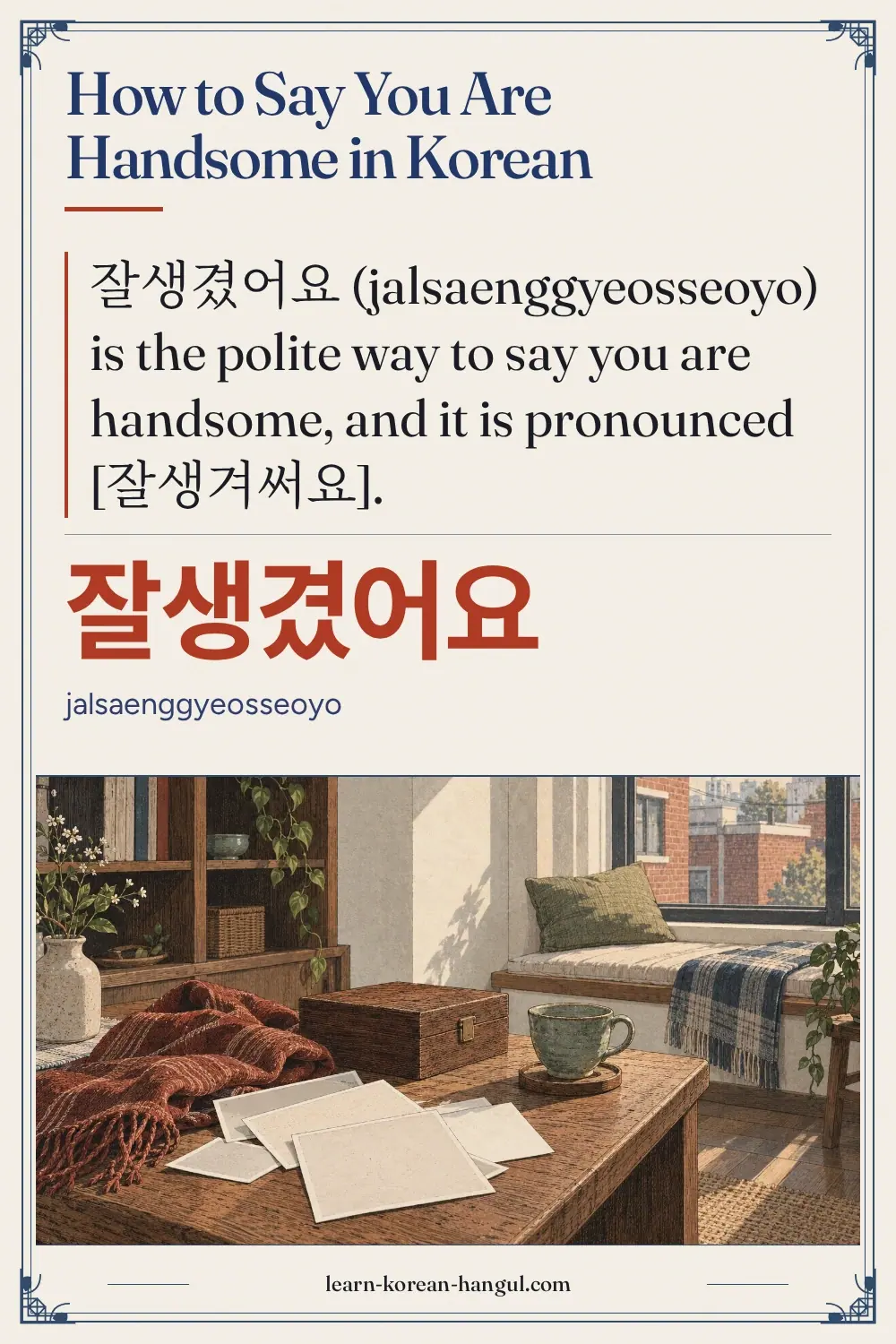
잘생겼어요
What you'll learn
- Say you are handsome with 잘생겼어요, 잘생기셨어요 or 잘생겼다, depending on the listener.
- Understand why 잘생기다 uses the past form for a present fact.
- Choose between praising looks (잘생겼어요) and style (멋있어요).
- Pronounce 잘생겼어요 as [잘생겨써요].
Before you start: you only need to read Hangul. This page pairs with you are beautiful in Korean, the matching praise for women. Time: about 10 minutes. Audio plays only when you press a button.
How Do You Say You Are Handsome in Korean?
The standard answer is 잘생겼어요. It comes from 잘생기다 (jalsaenggida), a word made of 잘 (jal, well) and 생기다 (saenggida, to take shape), so it means "to have taken shape well", or "to be good-looking". Korean usually drops "you", so 잘생겼어요 alone is a whole sentence. If the person is not clear, add their name or title: 민준 씨, 잘생겼어요.
| Situation | Best form | Romanization | Why |
|---|---|---|---|
| Telling a peer or colleague politely | 잘생겼어요 | jalsaenggyeosseoyo | Polite, clear |
| Telling an older man or a boss | 잘생기셨어요 | jalsaenggisyeosseoyo | Honorific |
| Telling a close friend | 잘생겼어 | jalsaenggyeosseo | Casual |
| Reacting with excitement | 잘생겼다! | jalsaenggyeotda | Casual exclamation |
| Praising style, any gender | 멋있어요 | meosisseoyo | "You look great" |
The word "handsome" in English is flexible, but the Korean word is mostly for men. The next section sorts the forms by listener.
What Are the Formal, Polite and Casual Ways to Say You Are Handsome?
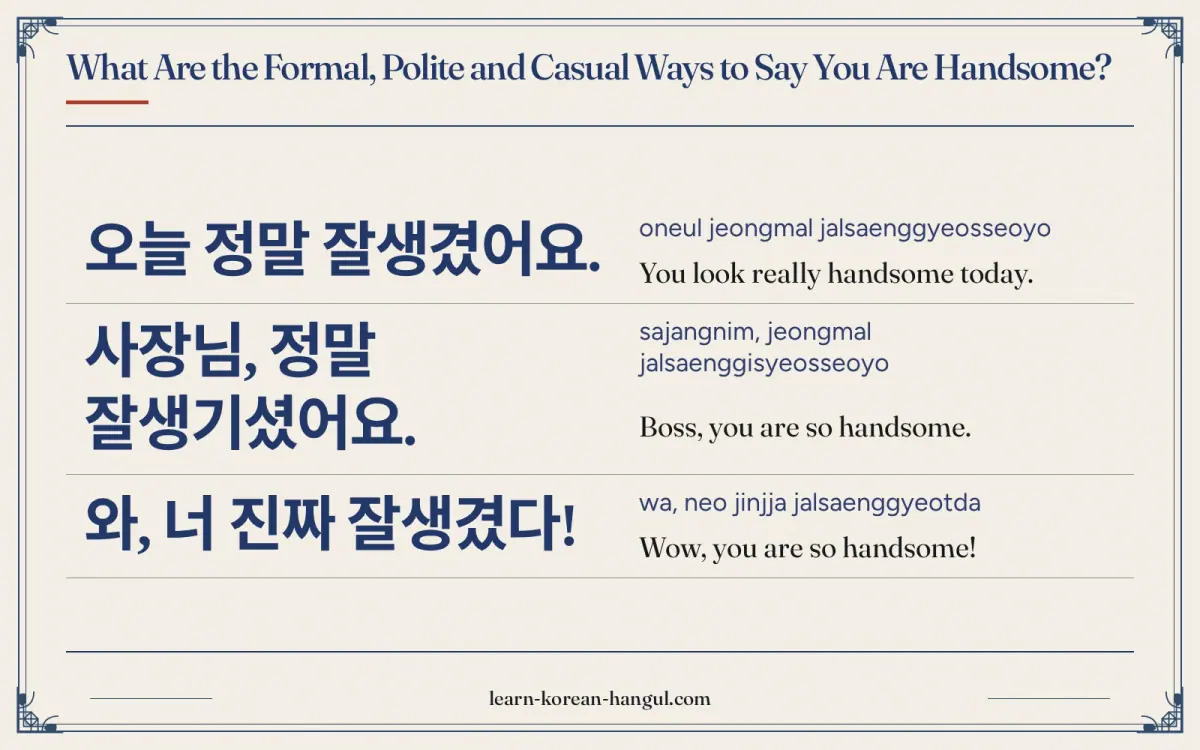
The forms follow the Korean speech levels, the endings that change with the listener. The guide to Korean speech levels explains each level. Here the stem 잘생기- stays the same, and the past marker and the ending change.
Polite: 잘생겼어요 (jalsaenggyeosseoyo)
Polite · 해요체잘생겼어요 is the form to learn first. It suits friends, classmates, coworkers and younger people. The ending is made like this: 잘생기 + 었어요, and 기 + 었 joins into 겼.
오늘 정말 잘생겼어요.
oneul jeongmal jalsaenggyeosseoyo
You look really handsome today.
Respectful: 잘생기셨어요 (jalsaenggisyeosseoyo)
Polite · 해요체잘생기셨어요 adds the honorific -(으)시- to the stem: 잘생기시 + 었어요 becomes 잘생기셨어요. The honorific shows respect to the person you describe. Use it for an older man, a boss, a customer or a teacher. It is pronounced [잘생기셔써요].
사장님, 정말 잘생기셨어요.
sajangnim, jeongmal jalsaenggisyeosseoyo
Boss, you are so handsome.
Be careful with tone. Praising a boss's looks can sound like flattery, so many people choose 멋있으세요 (meosisseuseyo), which praises style.
Casual: 잘생겼다 (jalsaenggyeotda)
Casual · 반말잘생겼어 (jalsaenggyeosseo) is the casual sentence for close friends. The ending -다 in 잘생겼다 is the plain statement form. People use it for an excited reaction or a remark, as in 와, 잘생겼다! (Wow, handsome!). Use it only with people your own age or younger, or about someone on a screen.
와, 너 진짜 잘생겼다!
wa, neo jinjja jalsaenggyeotda
Wow, you are so handsome!
Polite: 멋있어요 (meosisseoyo)
Polite · 해요체멋있어요 means "cool", "stylish" or "great-looking". It praises clothes, manner, style and charm, and it works for men and women. It is the safest choice when you do not know someone well. It is pronounced [머시써요].
그 셔츠가 정말 멋있어요.
geu syeocheuga jeongmal meosisseoyo
That shirt looks really cool.
For a purely formal style, use 잘생겼습니다 (jalsaenggyeotseumnida), pronounced [잘생겯씀니다]. You may hear it in a TV segment or a speech, but not in daily talk.
Why Is It 잘생겼어요 and Not 잘생겨요?
This is the question learners ask most. 잘생기다 describes the result of how someone "took shape". Korean treats it as a state that has already happened, so it is said in the past form when it means "is handsome" now.
- Now: 잘생겼어요 means "he is handsome".
- Before a noun: 잘생긴 사람 (jalsaengin saram) means "a handsome person". The form 잘생긴 looks like a past modifier but is the normal present one.
- Becoming: 잘생겨요 describes a change in progress, "he is turning handsome", which is not what you want.
Another common word works the same way: 늙다 (neukda, to be old) is said as 늙었어요 when it means "is old". The rule is not about time. It is about a state that came about. If you use 잘생겼어요, you are talking about the person's face now. Next, the sounds.
How Do You Pronounce 잘생겼어요?
잘생겼어요 is pronounced [잘생겨써요], jal-saeng-gyeo-sseo-yo, in five syllables. The spelling has a final ㅆ in 겼, but you do not say it as a final sound.
- 잘 (jal): "jal", with a light l at the end.
- 생 (saeng): "seng", with the ㅐ vowel, then a soft ng.
- 겨 (gyeo): a y glide into ㅓ. The ㅓ is unrounded: keep your lips relaxed.
- 써 (sseo): a tense ㅆ, hissed and held a little longer than a plain s.
- 요 (yo): "yo".
The ㅆ moves to the next syllable because the next syllable starts with the silent ㅇ (Article 13 of the standard pronunciation rules). So 겼어요 sounds like 겨써요. See Korean liaison.
Sound Changes to Listen For
These notes follow the National Institute of Korean Language standard pronunciation rules (표준 발음법):
- 잘생겼어요 is [잘생겨써요]. The final ㅆ links to the vowel that follows. Revised Romanization writes the ㅆ at the start of the next syllable as ss, so you see jalsaenggyeosseoyo.
- 잘생기셨어요 is [잘생기셔써요]. The same linking happens after 셨.
- 잘생겼다 is [잘생겯따]. A final ㅆ is said as [ㄷ], and the ㄷ after it becomes tense (Article 23), so the word sounds like [겯따]. Romanization shows jalsaenggyeotda.
- 잘생겼습니다 is [잘생겯씀니다]. The ㅆ becomes [ㄷ], the ㅅ becomes tense, and the ㅂ before ㄴ becomes ㅁ (Article 18). See Korean nasalization.
With the sounds clear, here is when each form fits.
When Should You Use 잘생겼어요, and When Should You Not?
Use 잘생겼어요 when you mean it as a warm, light compliment to a man or to talk about a man. Do not treat it as a general word for any person.
Situations Where It Fits
- A friend's new look. 오늘 정말 잘생겼어요. (You look really handsome today.)
- Talking about an actor. 저 배우 정말 잘생겼어요. (That actor is really handsome.)
- Teasing a close friend. 잘생겼다, 너! (You handsome thing!)
Situations to Avoid
- A woman. Say 예뻐요; see you are beautiful in Korean.
- A stranger on the street. A comment on looks can feel intrusive. 멋있어요 about a coat or a bag is easier.
- An older man, with the plain form. Use 잘생기셨어요, not 잘생겼어요 or 잘생겼어.
Two conversations show how it sounds.
What Does You Are Handsome Sound Like in a Real Conversation?
A compliment is usually short and followed by a smile, a thanks or a joke. Listen for the answers.
Talking about an Actor
Doyun
저 배우 어때요?
jeo baeu eottaeyo
What do you think of that actor?
Seoyun
정말 잘생겼어요!
jeongmal jalsaenggyeosseoyo
He is so handsome!
Doyun
연기도 잘해요.
yeongido jalhaeyo
He acts well too.
What to notice: 어때요 asks "how is it?", a wh-question, so the pitch does not rise sharply at the end. Seoyun's 잘생겼어요 is about a third person, so the subject is clear from the question. The particle 도 in 연기도 means "also".
A Compliment at Work
Jiwon
민준 씨, 오늘 정말 잘생겼어요.
minjun ssi, oneul jeongmal jalsaenggyeosseoyo
Minjun, you look really handsome today.
Minjun
아, 감사합니다. 오늘 소개팅이 있어요.
a, gamsahamnida. oneul sogaetingi isseoyo
Oh, thank you. I have a blind date today.
Jiwon
아, 그래서요?
a, geuraeseoyo
Oh, is that why?
What to notice: Minjun answers with a polite 감사합니다 and explains the reason. 소개팅 (sogaeting) is a blind date arranged by a friend. Jiwon's 그래서요? is a light, teasing "so that is the reason?".
What Should You Know about the Culture behind You Are Handsome?
Koreans often use 잘생겼다 about actors, singers and celebrities, and it is a common word in everyday gossip. Related nouns are 미남 (minam, a handsome man) and 잘생긴 사람 (a good-looking person). Compliments on looks are common between friends, but at work or with strangers many people keep to compliments on style, effort or manner.
- Style over face. 멋있어요 and 잘 어울려요 (it suits you) are safe and welcome.
- Humble replies. A common answer is 아니에요 (no, not really) with a smile, then 감사합니다.
- Respect for elders. Use the honorific 잘생기셨어요 or the style word 멋있으세요.
You will also hear the phrase 잘생겼다 used when someone is showing off a photo, as a friendly reaction. When in doubt, a sincere 멋있어요 is the easiest choice.
What Mistakes Do Learners Make with You Are Handsome in Korean?
Most mistakes come from the tense or from choosing the word for the wrong person.
| Mistake | Why it is a problem | Fix |
|---|---|---|
| 잘생겨요 | It describes a change in progress | Say 잘생겼어요 |
| 잘생기고 있어요 | It means "is becoming handsome" | Say 잘생겼어요 |
| 잘생겼어요 for a woman | It is typically used for men | Say 예뻐요 |
| 잘생겼어 to an older man | Too casual | Say 잘생기셨어요 |
| [잘생겼어요] with a final ㅆ | The ㅆ moves on to the next syllable | Say [잘생겨써요] |
The first row matters most. Because the dictionary form is 잘생기다, many learners build 잘생겨요, the way they would build 먹어요 from 먹다. The pattern does not carry over here. Keep the past form for the present fact, and use 잘생긴 before a noun.
Is It the Same as Handsome or You Look Handsome?
Nearly. Each of the searches folded into this page has a short answer.
- Handsome in Korean: 잘생겼다 as a sentence, or 잘생긴 before a noun, as in 잘생긴 남자 (jalsaengin namja, a handsome man).
- You're handsome in Korean: the same as you are handsome: 잘생겼어요.
- You look handsome in Korean: 오늘 멋있어 보여요 (oneul meosisseo boyeoyo), "you look cool today".
- So handsome in Korean: 정말 잘생겼어요 or 너무 잘생겼어요. In casual talk, 진짜 잘생겼다.
- A handsome man (noun): 미남 (minam).
For a woman, the matching phrase is in you are beautiful in Korean. Now say them aloud.
Practice: Say It Aloud
Play the slow clip of 잘생겼어요 three times, and move the ㅆ to the next syllable. Then choose a phrase. Answers follow.
- You compliment a coworker politely.
- You compliment an older man with respect.
- You react to a friend's photo, casually.
- You praise someone's style.
Answers
- 잘생겼어요.
- 잘생기셨어요.
- 잘생겼다!
- 멋있어요.
The phrase flashcards drill these lines with audio.
Related Phrases to Learn Next
Compliments lead to warmer feelings.
- You are beautiful in Korean: 예뻐요 for women.
- You're cute in Korean: 귀여워요 for a playful compliment.
- I like you in Korean: 좋아해요 for a confession.
- I love you in Korean: 사랑해요 for deeper feelings.
This guide belongs to the Korean love phrases collection. What this page does not cover: the full conjugation of 잘생기다, compliments on body shape, and dating customs. Use the past form, choose the level for the listener, and you can say you are handsome in Korean naturally.
Frequently Asked Questions
How do you say you are handsome in Korean?
Say 잘생겼어요 (jalsaenggyeosseoyo) in polite speech, 잘생겼어 (jalsaenggyeosseo) or 잘생겼다 (jalsaenggyeotda) to a close friend, and 잘생기셨어요 (jalsaenggisyeosseoyo) to an older man or a boss. Korean often drops 'you', so add the name, as in 민준 씨, 잘생겼어요, if the person is not clear.
How do you pronounce 잘생겼어요?
It is pronounced [잘생겨써요], jal-saeng-gyeo-sseo-yo, in five syllables. The ㅆ at the end of 겼 moves to the next syllable, so you hear 겨 and 써, not a final consonant. The vowel ㅕ in 겨 starts with a y glide, and the ㅓ in 써 is unrounded. Revised Romanization writes jalsaenggyeosseoyo.
What is the difference between 잘생겼어요 and 잘생기셨어요?
Both mean you are handsome. 잘생겼어요 is polite and fits peers, younger people and colleagues. 잘생기셨어요 adds the honorific -(으)시- and shows respect to an older man, a boss or a customer. It is pronounced [잘생기셔써요]. Never use the honorific about yourself.
Is 잘생겼어요 formal or casual?
It is polite. The ending -어요 suits most situations. The casual form is 잘생겼어 or the exclamation 잘생겼다, and the formal form is 잘생겼습니다 (jalsaenggyeotseumnida), pronounced [잘생겯씀니다]. Choose by listener, not by the word.
Can I use 잘생겼어요 with friends, elders and strangers?
With friends, yes, in the casual form. With peers and colleagues, use 잘생겼어요. With an older man, use 잘생기셨어요. With a stranger, take care: a comment on looks can feel personal. Praise style instead, as in 멋있어요.
What is the most common mistake with you are handsome in Korean?
Learners make a present form, 잘생겨요, from the dictionary form. 잘생기다 describes a state that is already true, so Koreans say it in the past form: 잘생겼어요 means 'is handsome'. 잘생겨요 sounds like 'is becoming handsome'. A second mistake is using 잘생겼어요 for a woman, where 예뻐요 is typical.