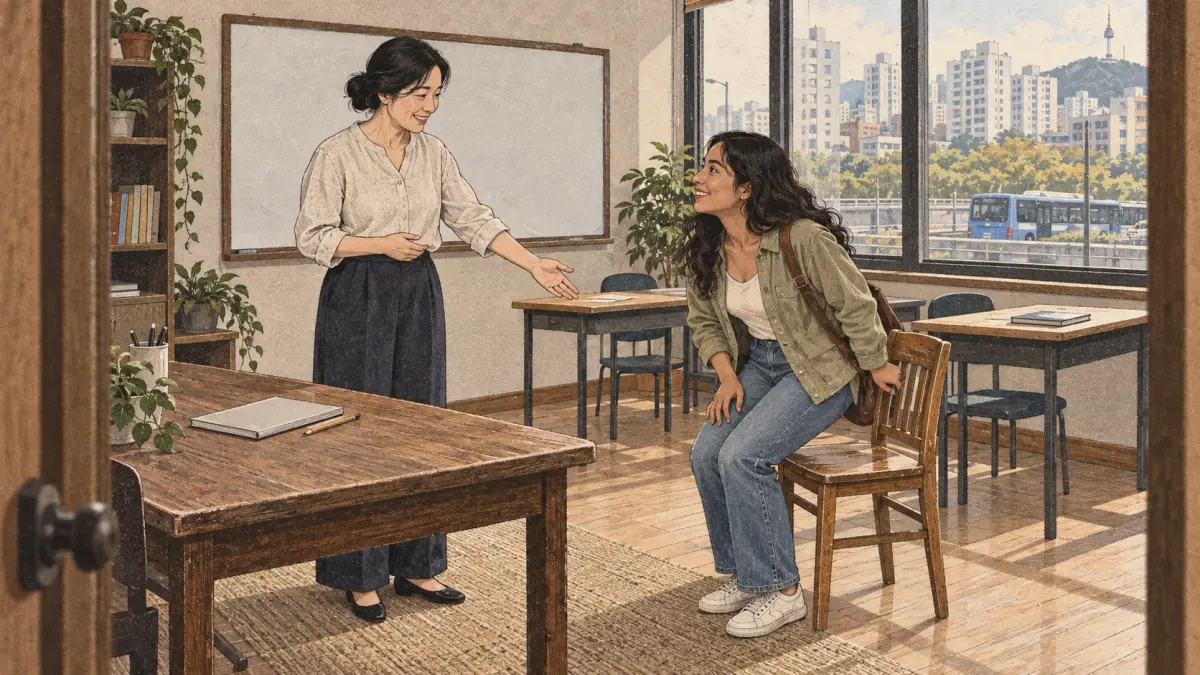
The Korean double batchim ㄵ is pronounced [ㄴ] at the end of a word and before a consonant, so 앉다 (to sit) is [안따] and 얹다 (to put on top) is [언따]. Before a vowel, the ㅈ moves to the next syllable, so 앉아요 (sit, polite) is [안자요] and 앉으세요 (please sit) is [안즈세요].
Key facts
- Before ㄱ, ㄷ, ㅅ or ㅈ, the next sound is tense: 앉다 [안따], 앉고 [안꼬]. A following ㄴ stays plain: 앉는 [안는].
- The source is the Standard Pronunciation Rules (표준 발음법) of the National Institute of Korean Language (국립국어원), Articles 10, 14 and 24.
What you'll learn
- Say 앉다 [안따] and 얹다 [언따] without a final ㅈ sound.
- Say 앉아요 [안자요] and 앉으세요 [안즈세요] with the ㅈ linked into the next syllable.
- Explain why 앉다 and 안다 sound the same.
- Use ㄵ in a short classroom dialogue.
Prerequisites: you know the left-letter idea from double batchim rules, and you can say a final [ㄴ]. Estimated time: 25 minutes.
What Is the Korean Double Batchim ㄵ?
The Korean double batchim ㄵ is a final consonant position filled by two letters, ㄴ and ㅈ, written together under a vowel, as in 앉다 (to sit). A double batchim (겹받침, gyeopbatchim) is a two-letter ending. Korean allows only one consonant sound at the end of a syllable, so one of the two letters stays silent unless a vowel follows.
For ㄵ, the left letter wins. The ㄴ is kept, and the ㅈ is silent. In 앉다, you say [안] for the first syllable. The ㅈ you see in the spelling does not appear in the sound.
ㄵ is one of the eight left-letter pairs in the full table of double batchim rules. It is also the smallest lesson in this set, because only a few verbs use it. That makes it a good place to practise the complete switch between "one letter" and "both letters". The next section explains why English speakers find the switch hard.
Why English Speakers Struggle with ㄵ
English speakers struggle with ㄵ because English says both consonants of a cluster. Words such as "lunge", "hinge" and "binds" end in an n plus another consonant, and the speaker pronounces both. A learner who carries the habit into 앉다 says "anj-da", and a Korean listener hears an extra ㅈ that does not belong to the word.
Three problems appear again and again.
- Adding the ㅈ. The eye sees ㄴ and ㅈ, so the mouth says both. Korean wants only [ㄴ].
- Forgetting the tense consonant. English has no rule that makes the next consonant tight. Learners say 앉다 as [안다], which a Korean ear hears as 안다 (to hug), a different word.
- Dropping the ㅈ before a vowel. Learners who have learned "ㅈ is silent" say 앉아요 as [아나요]. That is the sound of 안아요 (hugs), not 앉아요.
The fix is the same switch as for every double batchim: one letter when nothing follows, two letters when a vowel follows. The next section starts with the one-letter setting.
How Is ㄵ Pronounced at the End of a Word?
At the end of a word and before a consonant, ㄵ is pronounced [ㄴ]. Touch the tongue tip to the ridge behind your upper teeth and let the sound come through your nose, as in the final consonant of "sun". Do not move the tongue afterwards. Do not add a ㅈ, a "j" sound or an "uh".
When a consonant follows, the consonant is also changed. After a verb stem that ends in ㄵ, the next ㄱ, ㄷ, ㅅ or ㅈ is said tense: ㄲ, ㄸ, ㅆ or ㅉ. This is part of verb stem tensification. A nasal such as ㄴ is not changed.
| Written | Spoken | Meaning | What happens |
|---|---|---|---|
| 앉다 | [안따] | to sit | ㅈ silent, ㄷ becomes ㄸ |
| 앉고 | [안꼬] | sit, and | ㅈ silent, ㄱ becomes ㄲ |
| 앉지 | [안찌] | sit (-지 form) | ㅈ silent, ㅈ becomes ㅉ |
| 앉는 | [안는] | sitting | ㅈ silent, ㄴ unchanged |
| 앉습니다 | [안씀니다] | sit (formal) | ㅈ silent, ㅅ becomes ㅆ, ㅂ becomes ㅁ |
| 얹다 | [언따] | to put on top | same pattern |
A quick self-check is the tongue test. Say 안 and hold the final [ㄴ] for two seconds. If you feel your tongue tip leave the ridge to make a ㅈ, you are adding a sound. Keep the tip still. You now have the one-letter setting. The next section adds the vowel setting.
What Happens to ㄵ before a Vowel?
Before a vowel, both letters are pronounced: ㄴ stays in the first syllable and ㅈ moves to the next syllable. Korean writes a vowel-initial syllable with a silent ㅇ, so 아 in 앉아 has an empty first slot. The ㅈ fills that slot. Article 14 of the Standard Pronunciation Rules gives 앉아 as [안자].
Unlike the ㅅ in ㅄ, the moved ㅈ stays plain. It does not become tense. You hear [안자요], not [안짜요].
Build 앉아요 in steps.
- Write it: 앉 + 아요.
- See that 아요 starts with a vowel (the ㅇ is silent).
- Keep ㄴ in the first syllable: [안].
- Move ㅈ to the second syllable, plain: [자].
- Say it as one flow: [안자요].
The same pattern applies to every ending that begins with a vowel.
| Written | Spoken | Meaning |
|---|---|---|
| 앉아 | [안자] | sit (casual) |
| 앉아요 | [안자요] | sit (polite) |
| 앉았어요 | [안자써요] | sat |
| 앉으면 | [안즈면] | if you sit |
| 앉으니까 | [안즈니까] | because you sit |
| 앉으세요 | [안즈세요] | please sit |
| 얹어요 | [언저요] | puts on top |
Compare this with the tense ㅆ in Korean double batchim ㅄ, where the moved ㅅ becomes tense. The vowel-linking rule for all pairs is in double batchim before a vowel. With both settings clear, the next question is which words need them.
Verbs That Use ㄵ
Only a few verbs use ㄵ: 앉다 (to sit), 얹다 (to put on top) and 앉히다 (to make someone sit). That is why ㄵ is called a rare pair in word lists, even though 앉다 is among the first verbs a learner meets. Honest scope: this lesson does not teach a long vocabulary list, because there is none.
| Written | Spoken | Meaning | Example |
|---|---|---|---|
| 앉다 | [안따] | to sit | 의자에 앉다 (sit on a chair) |
| 얹다 | [언따] | to put on top of | 선반에 얹다 (put on a shelf) |
| 앉히다 | [안치다] | to seat someone | 아이를 앉히다 (seat a child) |
The last row shows a case worth noting. In 앉히다, the ㅈ of ㄵ meets ㅎ, and the two merge into an aspirated [ㅊ]: [안치다]. This is the same merging you see in other ㅎ cases (see aspiration).
Because 앉다 is the one frequent word, the rest of this lesson uses it as the model. The next section shows it inside the request that learners need most.
How Do I Say "Please Sit"?
To say "please sit", say 앉으세요 and link the ㅈ: [안즈세요]. The ending -(으)세요 is a polite request ending. The verb stem 앉 ends in a consonant, so the ending takes the form 으세요 and starts with a vowel. The ㅈ of 앉 moves in front of 으, and the result is [안 즈 세 요].
| Written | Spoken | Meaning | Situation |
|---|---|---|---|
| 앉으세요. | [안즈세요] | Please sit. | teacher to a class |
| 여기 앉으세요. | [여기 안즈세요] | Please sit here. | host to a guest |
| 앉아도 돼요? | [안자도 돼요] | May I sit? | asking permission |
| 앉아요. | [안자요] | (We/I) sit. | statement |
| 앉지 마세요. | [안찌 마세요] | Please don't sit. | warning |
The grammar behind the ending is explained in -(으)세요 grammar, and the difference between -(으)세요 and -아요/어요 is in -(으)세요 vs -아요/어요. Here is a short classroom dialogue to say aloud.
| Speaker | Korean | Spoken |
|---|---|---|
| 선생님 | 여러분, 앉으세요. | [여러분 안즈세요] |
| 학생 | 여기 앉아도 돼요? | [여기 안자도 돼요] |
| 선생님 | 네, 앉으세요. | [네 안즈세요] |
| 학생 | 감사합니다. | [감사함니다] |
Notice that 앉아도 돼요? is a yes/no question, so it ends with the rising melody covered in Korean question intonation. Before the worked example, one confusion needs its own section.
Is 앉다 the Same as 안다?
앉다 (to sit) and 안다 (to hug) sound the same when a consonant follows: both are [안따]. 안다 has a single ㄴ, and the ㄷ after a verb-stem ㄴ also becomes tense. The sounds only separate when a vowel follows. 앉아요 is [안자요] with a ㅈ, and 안아요 is [아나요] with a linked ㄴ.
| Verb | Before ㄷ | Before ㄱ | Before 아요 |
|---|---|---|---|
| 앉다 (sit) | [안따] | [안꼬] | [안자요] |
| 안다 (hug) | [안따] | [안꼬] | [아나요] |
| 않다 (not do) | [안타] | [안코] | [아나요] |
The third verb, 않다, is a different pair. It ends in ㄶ, and its ㅎ merges with the following consonant to make an aspirated sound. That is covered in Korean double batchim ㄶ. The spelling choice between 안 and 않 is explained in 안 vs 않.
Listeners tell 앉다 from 안다 by context. If someone says [안따] near a chair, it is "sit". If they say it near a baby, it is "hug". The next section brings the pieces together.
Worked Example: 앉다 in Five Forms
The verb 앉다 shows every ㄵ setting. Follow the three checks for each form.
- 앉다 (dictionary form). A consonant follows. Keep ㄴ, drop ㅈ, tense the ㄷ. Say [안따].
- 앉고 (sit, and). A consonant follows. Keep ㄴ, drop ㅈ, tense the ㄱ. Say [안꼬].
- 앉는 (sitting). A nasal follows. Keep ㄴ, drop ㅈ, leave ㄴ plain. Say [안는].
- 앉아요 (sit, polite). A vowel follows. Keep ㄴ, move ㅈ, keep it plain. Say [안자요].
- 앉으세요 (please sit). A vowel follows. Keep ㄴ, move ㅈ, keep it plain. Say [안즈세요].
You will know it worked when 앉다 and 안다 sound identical, 앉아요 has a clear "ja" in the middle, and no ㅈ is heard at the end of 안 in [안따]. If 앉아요 sounds like [아나요], the ㅈ was lost. If 앉다 sounds like [안다], the tense ㄸ was missed.
ㄵ Compared with ㄶ
ㄵ and ㄶ both keep ㄴ, but they handle the second letter differently. In ㄵ, the ㅈ comes back before a vowel and a consonant is tensed. In ㄶ, the ㅎ disappears before a vowel and merges with a following consonant into an aspirated sound.
| Pair | Word | Before ㄷ | Before 아요 |
|---|---|---|---|
| ㄵ | 앉다 | [안따] (tense) | [안자요] (ㅈ returns) |
| ㄶ | 많다 | [만타] (aspirated) | [마나요] (ㅎ silent) |
The practical test is the next syllable. If you hear a ㅈ in the vowel form, the pair is ㄵ. If you hear a smooth link of ㄴ into the vowel, it is ㄶ. The contrast helps with the next lesson set. The following section lists the mistakes this contrast prevents.
Common Mistakes with ㄵ
Mistake 1: saying both letters at the end. Learners often assume 앉다 is "anj-da"; actually it is [안따], because Korean allows only one final consonant sound. Fix: say 안 and 앉 back to back until they match.
Mistake 2: plain ㄷ after ㄵ. Learners often say 앉다 as [안다] and 앉고 as [안고]. Actually the next consonant is tense: [안따], [안꼬]. Fix: tighten the throat on the second consonant, as if holding a small breath.
Mistake 3: losing ㅈ before a vowel. Learners often say 앉아요 as [아나요] or [안아요]. Actually the ㅈ moves: [안자요]. Fix: say [안] then [자요], and join the two parts.
Mistake 4: tensing the moved ㅈ. Learners who have learned the tense ㅆ of ㅄ say 앉아요 as [안짜요]. Actually the moved ㅈ stays plain: [안자요]. Fix: relax the tongue on ㅈ.
Mistake 5: mixing ㄵ with ㄶ. Learners often say 앉다 as [안타] after meeting 많다 [만타]. Actually only ㄶ contains ㅎ. Fix: practise the table above with one pair per minute.
Each mistake comes from skipping one check. The practice set tests them one at a time.
Practice: Korean Double Batchim ㄵ
Exercise 1. Write the spoken form of each word.
- 앉다
- 얹다
- 앉고
- 앉는
Exercise 2. Write the spoken form. Decide first whether a vowel, a nasal or another consonant follows.
- 앉아요
- 앉으세요
- 앉았어요
- 앉지
- 앉히다
Exercise 3. Say each pair aloud and mark the difference.
- 앉아요 and 안아요
- 앉다 and 않다
Answers.
Exercise 1: 1 [안따], 2 [언따], 3 [안꼬], 4 [안는].
Exercise 2: 1 [안자요], 2 [안즈세요], 3 [안자써요], 4 [안찌], 5 [안치다].
Exercise 3: 1 [안자요] has a ㅈ in the middle; [아나요] has a linked ㄴ. 2 [안따] has a tense ㄸ; [안타] has an aspirated ㅌ.
If you missed Exercise 1, return to the end-of-word table. If you missed Exercise 2, review the vowel table and the 앉히다 note.
Where to Go Next
The next lesson is Korean Double Batchim ㅄ, which adds the tense ㅆ when ㅅ moves in 없어요 and 값이. The ㅎ pairs are in ㄶ and ㅀ. The full set of eleven pairs is in Double Batchim. For a single-word guide, see how to pronounce 앉다.
This lesson does not teach grammar beyond the ending -(으)세요 and does not cover regional pronunciations.
In short, the Korean double batchim ㄵ is a left-letter pair: say [ㄴ] alone or before a consonant, tense the next consonant, and let the plain ㅈ return before a vowel.
Frequently Asked Questions
How do I say 앉아요? Say [안자요]. Pronounce [안] with a closed nasal ㄴ, then move the ㅈ into the second syllable and say [자], keeping it plain. Finish with [요]. Do not say [아나요], which is the sound of 안아요 (hugs), and do not make the ㅈ tense.
Why is 앉다 [안따]? The ㅈ of ㄵ is silent before a consonant, so only [ㄴ] is heard. The ㄷ that follows becomes tense because the stem ends in ㄵ, a pattern from Article 24 of the Standard Pronunciation Rules. The result is [안따], which sounds the same as 안다.
Is ㄵ common? No. Only a handful of verbs use it, mainly 앉다, 얹다 and 앉히다. However, 앉다 is among the first verbs learners meet, so you will hear [안자요] and [안즈세요] often. Learning this one word well covers almost all everyday uses of ㄵ.
How is 앉으세요 pronounced? It is [안즈세요]. The ㅈ moves from 앉 into 으, so the sound is [안], then [즈], then [세요]. The ㅈ is plain, not tense. Say it slowly in four beats first, then speed up until it feels like one phrase.
How is 얹다 conjugated? It follows the same pattern as 앉다. Before a consonant it is [언따] and [언꼬]. Before a vowel the ㅈ moves, so 얹어요 is [언저요] and 얹으세요 is [언즈세요]. Only the first vowel differs from 앉다. It is a regular verb.