IPA Meaning in Korean
Spelling hides sounds. English "though", "through" and "tough" end in the same letters but sound different. Every language has the same problem, so linguists use one symbol for one sound, in any language. That system is the IPA.
On this site IPA appears in square brackets, such as [k], to show the actual sound. The lessons also put spoken forms written in Hangul in square brackets, such as 국물 [궁물]: Hangul inside the brackets is the spoken form, and phonetic symbols inside them are IPA. Revised Romanization appears in plain letters or in parentheses, such as bap. The two have different jobs, and the table shows them on the same word.
| System | What it records | 밥 (rice) | 강 (river) |
|---|---|---|---|
| Hangul | Korean spelling | 밥 | 강 |
| Revised Romanization | spelling for foreigners | bap | gang |
| IPA | the sound | [pap̚] | [kaŋ] |
IPA is optional for learners. The lessons always give Hangul first and a plain-English cue next. Use IPA only when you want to be exact.
How Do You Read the IPA Symbols on This Site?
IPA letters look like English letters, but many have a fixed sound unlike English. A short list covers most of what appears in the lessons.
| Symbol | Sound | Korean example |
|---|---|---|
| [p̚] | p with no release | final ㅂ in 밥 |
| [ŋ] | "ng" of "sing" | final ㅇ in 강 |
| [ɾ] | quick tap | ㄹ in 나라 |
| [l] | l sound | final ㄹ in 물 |
| [ɕ] | close to "sh" | ㅅ before ㅣ, as in 시 |
| [j] | y of "yes" | start of 야 |
| [w] | w of "wet" | start of 와 |
| [ʌ] | open o-like vowel | ㅓ in 어 |
| [ɯ] | ㅡ vowel, unrounded | ㅡ in 그 |
| [kʰ] | k with a puff of air | ㅋ |
The small raised ʰ marks a puff of breath, the small ̚ marks a stop with no release, and the small double line under a letter, as in [k͈], marks a tense sound. Some books write tense sounds as [k*] instead. The full chart with every Hangul letter is on the page for the korean ipa chart.
What Are Examples of IPA in Korean?
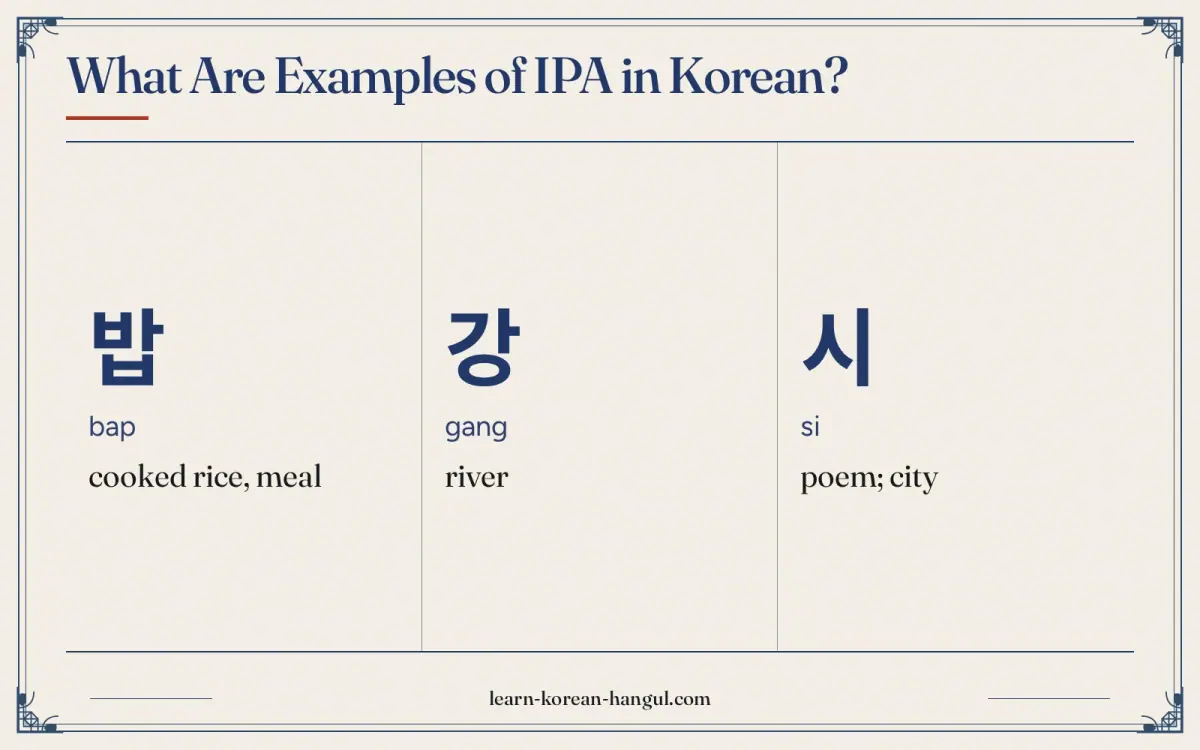
Four words show the sounds that cause most surprises.
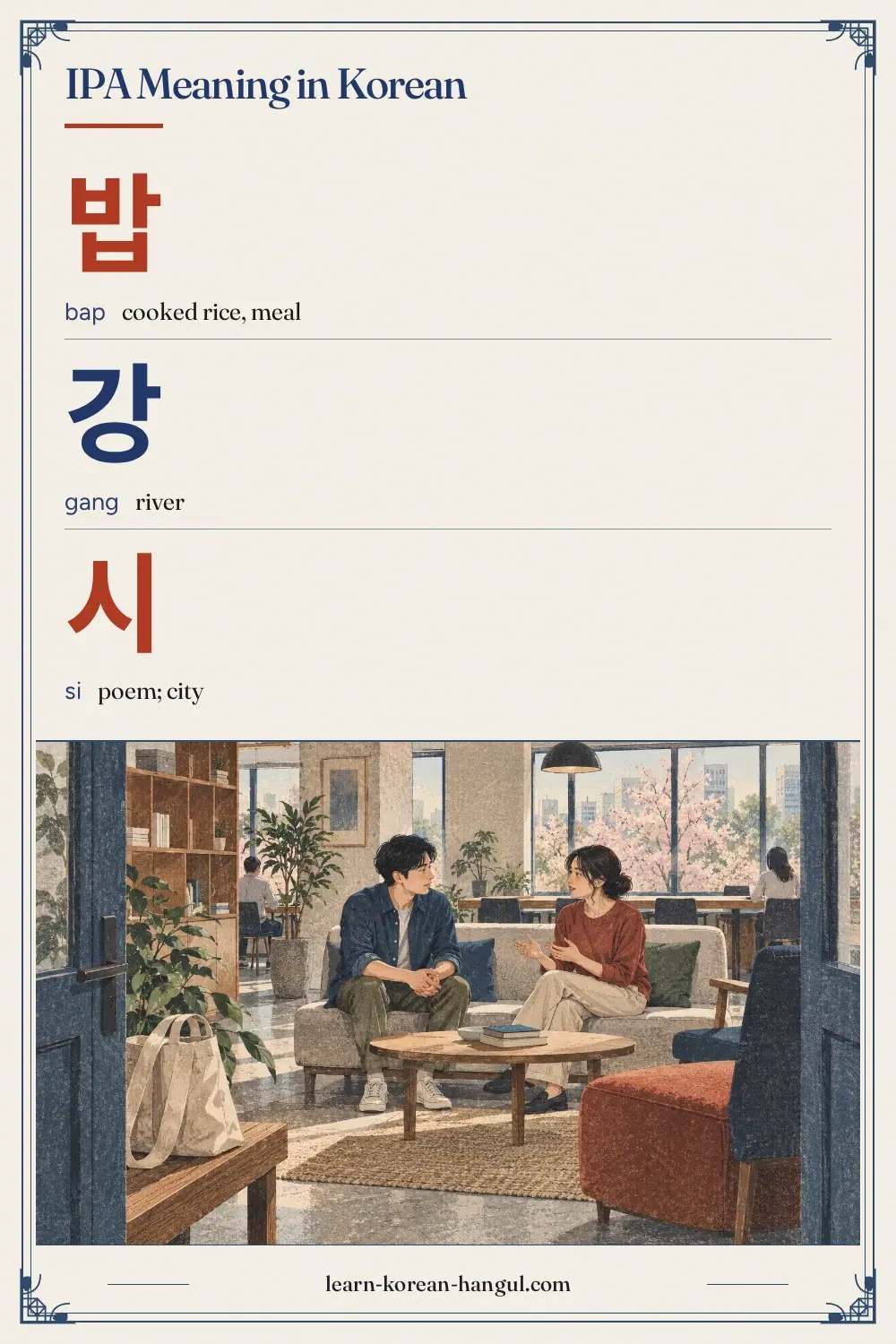
밥
bap
cooked rice, meal
강
gang
river
시
si
poem; city
그
geu
that
The word 강 looks like "gang" in Revised Romanization but is closer to "kang" in IPA. IPA shows what the mouth does, and romanization shows how the letters map.
IPA Versus Revised Romanization
The two are often mixed up, so the difference deserves a clear line.
| Feature | IPA | Revised Romanization |
|---|---|---|
| Purpose | record exact sounds | spell Korean in Latin letters |
| Written in | [square brackets] | plain letters |
| Depends on spelling | no | yes, it follows the Hangul |
| Example for 밥 | [pap̚] | bap |
| Where it is official | no, it is a scientific system | yes, Korean government standard since 2000 |
See Korean romanization for the official rules.
What Do Learners Get Wrong about IPA?
The most common error is to read IPA symbols as English letters. The symbol [j] stands for the English "y", not for "j" as in "jam". The symbol [ɯ] has no English equivalent. The second error is to expect exact agreement between sources, since different dictionaries use slightly different symbols for the same Korean vowel, such as [ʌ] or [ɔ] for ㅓ.
- Thinking you must learn IPA first. You can read every lesson on this site without it.
- Treating IPA as spelling. It records sound only, so it ignores Hangul spelling rules.
- Mixing brackets. Square brackets mean sounds, while slashes mean phonemes, as in phoneme.
IPA is run by the International Phonetic Association, and this page shows only the small part used for Korean. The overview of Korean sounds is on the Korean sound system page.
Frequently Asked Questions
What is IPA? IPA stands for the International Phonetic Alphabet. It is a system of symbols that records speech sounds exactly, whatever the language or spelling. This site writes IPA in square brackets, for example [pap̚] for 밥. It sits beside the Hangul and the romanization as a third, more exact view of the sound.
Do I need to learn IPA? No. Every lesson gives Hangul first and a plain English cue next, so you can learn Korean sounds without IPA. IPA helps when you want precision, for example to see that final ㅂ is unreleased or that ㅅ before ㅣ is close to "sh". Treat it as an optional extra, not a prerequisite.
Is IPA the same as romanization? No. Romanization spells Korean in Latin letters and follows the Hangul. IPA records the sound and ignores the spelling. Revised Romanization writes 밥 as bap and IPA writes [pap̚]. Romanization is an official Korean standard, while IPA is an international scientific system with no tie to any spelling.
Which symbols are used? The lessons use a small set. The main ones are [ŋ] for final ㅇ, [ɾ] and [l] for ㄹ, [ɕ] for ㅅ before ㅣ, [j] and [w] for the glides, [ʌ] and [ɯ] for ㅓ and ㅡ, and the marks ʰ, ̚ and ͈ for breath, no release and tension. The IPA chart page lists every Hangul letter.
Related Terms and Lessons
IPA meaning in Korean is the glossary entry for the full korean ipa chart, which maps every Hangul letter to its symbols. Related reading includes Korean romanization, the Korean sound system and the term phoneme. All terms are listed in the Korean Pronunciation Glossary.