Before you start
- What it covers: all 19 consonants with positional variants, 21 vowels, and three short phrases transcribed in full.
- You'll be able to: give the IPA for each Hangul letter, including variants such as [k]/[g]/[k̚] for ㄱ and [ɾ]/[l] for ㄹ.
- Prerequisites: none, although knowing the basic IPA symbols for English helps.
- Time: 15 minutes to read; the printable version is for reference.
- Transcription type: broad, standard Seoul Korean. Speakers vary; see the limits section.
Korean IPA Chart: Consonants and Vowels
The Korean IPA chart below gives each letter its main IPA value and the positional variants a learner actually hears. IPA (International Phonetic Alphabet) is a system of symbols, maintained by the International Phonetic Association, in which each symbol stands for one speech sound in any language. Square brackets, as in [k], mark a pronounced sound.
| Korean | Name | Romanization | Family | Sound |
|---|---|---|---|---|
| ㄱ | 기역 (giyeok) | g / k | plain | g in "go", softer at the start of a word |
| ㄴ | 니은 (nieun) | n / n | other | n in "no" |
| ㄷ | 디귿 (digeut) | d / t | plain | d in "do" |
| ㄹ | 리을 (rieul) | r / l | other | quick tap between r and d |
| ㅁ | 미음 (mieum) | m / m | other | m in "me" |
| ㅂ | 비읍 (bieup) | b / p | plain | b in "boy" |
| ㅅ | 시옷 (siot) | s / t | plain | s in "sun" |
| ㅇ | 이응 (ieung) | none / ng | other | silent |
| ㅈ | 지읒 (jieut) | j / t | plain | j in "jam" |
| ㅊ | 치읓 (chieut) | ch / t | aspirated | ch in "cheese" with a puff |
| ㅋ | 키읔 (kieuk) | k / k | aspirated | k in "kite" with a puff |
| ㅌ | 티읕 (tieut) | t / t | aspirated | t in "top" with a puff |
| ㅍ | 피읖 (pieup) | p / p | aspirated | p in "pin" with a puff |
| ㅎ | 히읗 (hieut) | h / t | other | h in "hat" |
| ㄲ | 쌍기역 (ssanggiyeok) | kk / k | tense | k with a tight throat |
| ㄸ | 쌍디귿 (ssangdigeut) | tt / none | tense | t with a tight throat |
| ㅃ | 쌍비읍 (ssangbieup) | pp / none | tense | p with a tight throat |
| ㅆ | 쌍시옷 (ssangsiot) | ss / t | tense | s said with tension |
| ㅉ | 쌍지읒 (ssangjieut) | jj / none | tense | j with a tight throat |
| ㅏ | 아 | a | basic | a in "father" |
| ㅑ | 야 | ya | basic | ya in "yacht" |
| ㅓ | 어 | eo | basic | between u in "cup" and aw in "law" |
| ㅕ | 여 | yeo | basic | y + ㅓ |
| ㅗ | 오 | o | basic | o in "go", shorter and pure |
| ㅛ | 요 | yo | basic | yo in "yoga" |
| ㅜ | 우 | u | basic | oo in "moon" |
| ㅠ | 유 | yu | basic | "you" |
| ㅡ | 으 | eu | basic | oo in "moon" with lips spread |
| ㅣ | 이 | i | basic | ee in "see" |
| ㅐ | 애 | ae | compound | e in "bed" |
| ㅒ | 얘 | yae | compound | ye in "yes" |
| ㅔ | 에 | e | compound | e in "bed" |
| ㅖ | 예 | ye | compound | ye in "yes" |
| ㅘ | 와 | wa | compound | "wah" |
| ㅙ | 왜 | wae | compound | we in "wet" |
| ㅚ | 외 | oe | compound | we in "wet" |
| ㅝ | 워 | wo | compound | "wuh" |
| ㅞ | 웨 | we | compound | we in "wet" |
| ㅟ | 위 | wi | compound | "wee" |
| ㅢ | 의 | ui | compound | ㅡ gliding into ㅣ |
Consonants
| Letter | Name | Start of word | Between voiced sounds | End of syllable | Notes |
|---|---|---|---|---|---|
| ㄱ | 기역 | [k] | [g] | [k̚] | 가방 [kabaŋ] |
| ㄴ | 니은 | [n] | [n] | [n] | [ɲ] before ㅣ and y-vowels |
| ㄷ | 디귿 | [t] | [d] | [t̚] | 바다 [pada] |
| ㄹ | 리을 | [ɾ] | [ɾ] | [l] | ㄹㄹ = [lː], 빨리 [p͈alːi] |
| ㅁ | 미음 | [m] | [m] | [m] | |
| ㅂ | 비읍 | [p] | [b] | [p̚] | 나비 [nabi] |
| ㅅ | 시옷 | [s] | [s] | [t̚] | [ɕ] before ㅣ and y-vowels |
| ㅇ | 이응 | silent | silent | [ŋ] | 강 [kaŋ] |
| ㅈ | 지읒 | [tɕ] | [dʑ] | [t̚] | 바지 [padʑi] |
| ㅊ | 치읓 | [tɕʰ] | [tɕʰ] | [t̚] | |
| ㅋ | 키읔 | [kʰ] | [kʰ] | [k̚] | |
| ㅌ | 티읕 | [tʰ] | [tʰ] | [t̚] | |
| ㅍ | 피읖 | [pʰ] | [pʰ] | [p̚] | |
| ㅎ | 히읗 | [h] | [ɦ] or silent | see note | [ç] before ㅣ, [ɸ] before ㅜ |
| ㄲ | 쌍기역 | [k͈] | [k͈] | [k̚] | |
| ㄸ | 쌍디귿 | [t͈] | [t͈] | never final | |
| ㅃ | 쌍비읍 | [p͈] | [p͈] | never final | |
| ㅆ | 쌍시옷 | [s͈] | [s͈] | [t̚] | [ɕ͈] before ㅣ |
| ㅉ | 쌍지읒 | [t͈ɕ] | [t͈ɕ] | never final |
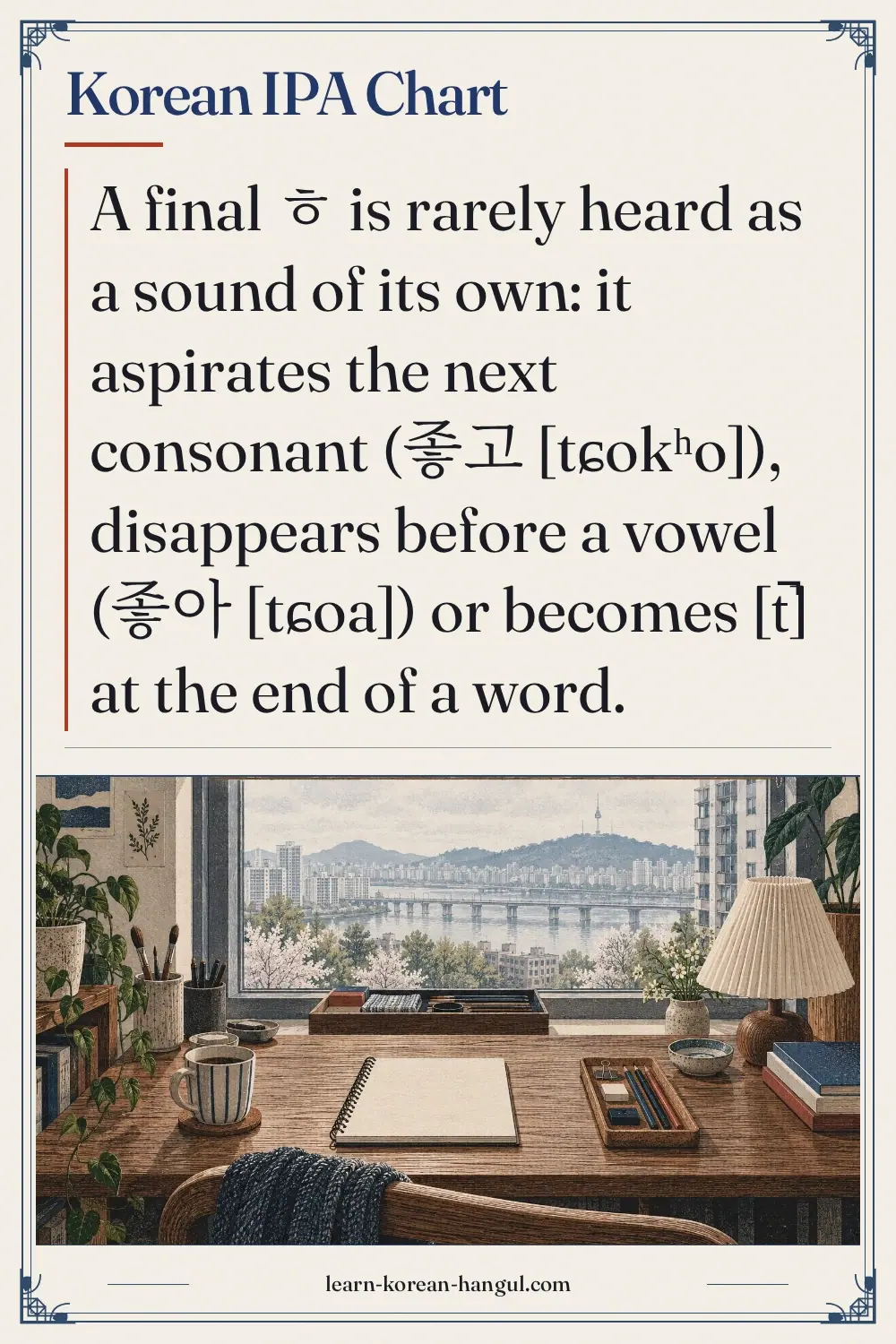
A final ㅎ is rarely heard as a sound of its own: it aspirates the next consonant (좋고 [tɕokʰo]), disappears before a vowel (좋아 [tɕoa]) or becomes [t̚] at the end of a word.
Vowels
| Letter | IPA | Example | Notes |
|---|---|---|---|
| ㅏ | [a] | 아 | |
| ㅓ | [ʌ] | 어 | rounded [ɔ] in some descriptions |
| ㅗ | [o] | 오 | lips rounded |
| ㅜ | [u] | 우 | lips rounded |
| ㅡ | [ɯ] | 으 | some sources write [ɨ] |
| ㅣ | [i] | 이 | |
| ㅐ | [ɛ], merged to [e̞] | 개 | merged with ㅔ for most speakers |
| ㅔ | [e], merged to [e̞] | 게 | |
| ㅚ | [ø] or [we] | 회사 | [we] is now usual |
| ㅟ | [y] or [wi] | 위 | [wi] is now usual |
| ㅑ ㅕ ㅛ ㅠ | [ja] [jʌ] [jo] [ju] | 야, 여, 요, 유 | y-glide + vowel |
| ㅒ ㅖ | [jɛ] [je] | 얘, 예 | often both [je] |
| ㅘ ㅝ | [wa] [wʌ] | 와, 워 | w-glide + vowel |
| ㅙ ㅞ | [wɛ] [we] | 왜, 웨 | usually identical, [we] |
| ㅢ | [ɰi] | 의사 | [i] or [e] in some positions |
Hangul Chart PDF (includes the IPA columns)
The beginner-friendly version of the consonant rows, without IPA, is the consonants chart. The next section explains how to read these symbols.
How Do You Read the Korean IPA Chart?
Read the Korean IPA chart by row: find the letter, then pick the column that matches where the letter sits in the word. A consonant at the very start of a word uses the "start of word" column; one between two vowels, or after ㄴ, ㅁ, ㅇ or ㄹ, uses the "between voiced sounds" column; one at the bottom of a block uses the "end of syllable" column.
Four marks carry most of the information:
- [ʰ] raised h: aspiration, a strong puff of air after the consonant. [kʰ] is ㅋ.
- [͈] double line under the symbol: tense (fortis) articulation, a tight throat and no puff. [k͈] is ㄲ.
- [̚] corner mark: an unreleased stop, where the mouth closes and does not open again. [k̚] is final ㄱ.
- [ː] length mark: a long sound, as in the doubled [lː] of 빨리.
Example: 국 is [kuk̚]. The first ㄱ is at the start of a word, so it is [k]; the vowel ㅜ is [u]; the final ㄱ is unreleased, [k̚]. To hear the difference between these symbols rather than just read it, use the audio in the plain, tense and aspirated lesson. The consonant rows are the densest part of the chart, so they come next.
Which IPA Symbols Do the Consonants Use?
Korean consonants use a small set of IPA base symbols plus three modifiers: aspiration [ʰ], tenseness [͈] and non-release [̚]. The base symbols are the familiar [k t p s h m n ŋ l], the tap [ɾ], and the alveolo-palatal [tɕ] and [ɕ], which are made with the front of the tongue raised toward the hard palate.
The table below groups the stops and affricates by place (where the mouth closes) and type (how the air is released). This three-by-four grid is the core of Korean phonetics.
| Place | Plain | Aspirated | Tense |
|---|---|---|---|
| Lips (bilabial) | ㅂ [p] | ㅍ [pʰ] | ㅃ [p͈] |
| Tongue tip (alveolar) | ㄷ [t] | ㅌ [tʰ] | ㄸ [t͈] |
| Tongue front (alveolo-palatal) | ㅈ [tɕ] | ㅊ [tɕʰ] | ㅉ [t͈ɕ] |
| Tongue back (velar) | ㄱ [k] | ㅋ [kʰ] | ㄲ [k͈] |
Add the fricatives ㅅ [s] and ㅆ [s͈], the glottal ㅎ [h], the nasals ㅁ [m], ㄴ [n] and ㅇ [ŋ], and the liquid ㄹ [ɾ]/[l], and you have all 19 letters.
How Is Tenseness Shown in IPA?
Tenseness is shown with the double-line diacritic [͈] under the symbol, so ㄲ, ㄸ, ㅃ, ㅆ and ㅉ are [k͈ t͈ p͈ s͈ t͈ɕ]. This diacritic belongs to the extensions of the IPA and means "strong articulation". Because it is hard to type, many authors write [k*] instead, and some older textbooks use [kʼ]. The apostrophe normally marks ejectives, a different sound type found in languages such as Georgian, so it can mislead. This site uses [k͈] and treats [k*] as equivalent.
Why Does ㄱ Have Three IPA Values?
ㄱ has three IPA values because Korean plain stops change with their position, and IPA records those changes while Hangul does not. At the start of a word ㄱ is a voiceless [k] with light aspiration, clearly weaker than the strong [kʰ] of ㅋ (some narrow transcriptions mark this light puff); between voiced sounds it becomes voiced [g]; at the end of a syllable it is unreleased [k̚].
These positional versions are called allophones: different pronunciations of one sound unit (phoneme) that never distinguish words. The same pattern holds for ㄷ ([t], [d], [t̚]), ㅂ ([p], [b], [p̚]) and ㅈ ([tɕ], [dʑ], [t̚]). The aspirated and tense letters do not become voiced between vowels, which is one more way to tell them apart by ear. Vowels have their own set of choices, covered next.
Vowels in IPA
Korean vowels in IPA fall into two groups: monophthongs, where the tongue stays in one position, and diphthongs, which glide from [j], [w] or [ɰ] into a vowel. The Standard Pronunciation Rules (표준 발음법, Article 4) list ten monophthongs, ㅏ ㅐ ㅓ ㅔ ㅗ ㅚ ㅜ ㅟ ㅡ ㅣ, but most speakers today use seven or eight in practice.
The two vowels that surprise learners most are ㅓ and ㅡ. ㅓ is [ʌ], an open-mid back vowel close to the vowel in British English "thought" said with relaxed, unrounded lips. ㅡ is [ɯ], a close back vowel like [u] but with spread lips, as in a tight smile. Neither has an exact English equivalent, which is why romanization writes them with two letters, eo and eu.
Are ㅐ and ㅔ the Same in IPA?
For most younger speakers of Seoul Korean, ㅐ and ㅔ are pronounced the same, as a mid front vowel written [e̞] or simply [e]. The Standard Pronunciation Rules still distinguish ㅐ [ɛ] from ㅔ [e], and dictionaries keep separate spellings, so 개 (dog) and 게 (crab) are spelled differently but usually sound alike. Learners should learn the spelling of each word and use one [e̞] sound for both.
The same pattern applies to ㅚ and ㅟ. The rules list them as monophthongs [ø] and [y] but explicitly allow the diphthongs [we] and [wi], and the diphthongs are what you hear in most speech: 회사 (company) is usually [hwesa]. The next section puts consonants and vowels together in real phrases.
Worked Example: 감사합니다 in IPA
A full transcription takes four steps: apply the sound-change rules in Hangul first, split into syllables, transcribe each sound by position, then add the narrow details if you need them.
- Apply sound changes. 감사합니다 has a final ㅂ before ㄴ, which becomes [ㅁ] by nasalization. The spoken form is [감사함니다].
- Split into syllables. 감 . 사 . 함 . 니 . 다.
- Transcribe by position. 감 [kam]: ㄱ starts the word, so [k]. 사 [sa]. 함 [ham]. 니 [ni]. 다 [da]: ㄷ is between vowels, so voiced [d].
- Result (broad): [kamsahamnida]. A narrower version shows ㅎ voiced between vowels and ㄴ palatalised before ㅣ: [kamsaɦamɲida].
Two more common phrases follow the same steps:
| Phrase | Spoken form | Broad IPA | Phrase page |
|---|---|---|---|
| 감사합니다 | [감사함니다] | [kamsahamnida] | thank you in Korean |
| 안녕하세요 | [안녕하세요] | [annjʌŋhasejo] | hello in Korean |
| 괜찮아요 | [괜차나요] | [kwɛntɕʰanajo] | it's okay in Korean |
In 괜찮아요, the ㅎ of the cluster ㄶ drops before the vowel ending, and the ㄴ moves forward: [괜차나요]. Most of the errors people make with an IPA chart come from skipping step 1, as the next section shows.
Common Mistakes with the Korean IPA Chart
Five mistakes are common when learners use a Korean IPA chart.
- Transcribing the spelling instead of the speech. Writing 감사합니다 as [kamsahapnida] ignores nasalization. Always apply the sound-change rules in Hangul first.
- Reading [ʌ] as English "uh". The English vowel in "cup" is more central and shorter. Use the audio for ㅓ, not the symbol alone.
- Treating [g], [d], [b] as separate letters. They are positional versions of ㄱ, ㄷ and ㅂ. Korean has no separate voiced letters.
- Reading [kʼ] as an ejective. Korean tense consonants are made with a tight throat, not with the glottal pop of an ejective.
- Expecting one fixed value for every speaker. Vowels such as ㅐ/ㅔ and ㅚ vary by age and region, and phoneticians disagree on details such as the exact aspiration of plain stops.
Limits of this chart. The transcription here is broad, meaning it shows the sounds that matter for meaning plus the main positional variants. It does not show pitch, vowel length (which older Seoul speakers still use in pairs such as 눈 "eye" and 눈ː "snow"), or every regional variant. Treat the IPA as a precise description, and the audio as the reference. The practice below checks that you can apply the chart.
Practice with the Chart
Use the chart to answer each question, then check the answers at the end of this section.
- Consonants. Give the IPA for the first consonant in 달, 탈 and 딸.
- Positions. Give the IPA for each ㄹ in 나라 and 달.
- Vowels. Which Hangul vowels are [ʌ] and [ɯ]?
- Transcription. Transcribe 바지 (trousers) in broad IPA.
Answers
- 달 [t], 탈 [tʰ], 딸 [t͈].
- 나라: [ɾ] (before a vowel). 달: [l] (end of syllable).
- ㅓ is [ʌ]; ㅡ is [ɯ].
- [padʑi]: ㅂ starts the word, so [p]; ㅈ sits between vowels, so it is voiced [dʑ].
What to Learn Next
The Korean IPA chart is one of all Hangul charts on this site. If you prefer English letters to phonetic symbols, see Korean alphabet A to Z, which matches each Hangul letter to its closest English spelling.
To turn these symbols into sounds you can produce, use the chart alongside the Korean pronunciation hub, starting with the plain, tense and aspirated contrast. For a one-sentence definition of the term itself, see IPA meaning in Korean study. For printed practice, use the Hangul worksheets.
What this chart does not cover: pitch and intonation, regional dialects such as Gyeongsang pitch accent, and the full rules of sound change. The values follow standard Seoul Korean as described in the Standard Pronunciation Rules and the phonetics literature, including Lee Hyun Bok's 1993 Korean illustration in the Journal of the International Phonetic Association.
Questions about the Korean IPA Chart
Which IPA notation do linguists use for tense consonants? There is no single agreed symbol. Many phonetics texts use the double-line diacritic [k͈], meaning strong or tense articulation. Others use [k*] in plain text, and older works sometimes use [kʼ], although Korean tense consonants are not ejectives. This site uses [k͈] and lists [k*] as an equivalent.
Do I need IPA to learn Korean? No. Most learners read Hangul directly and use audio, which is more accurate than any symbol system. IPA helps if you already know it from another language, if you study linguistics, or if you want a precise way to describe a sound you are struggling with, such as ㅓ or the three-way ㄱ ㅋ ㄲ contrast.
Why is ㅅ written [ɕ] sometimes? Before the vowel ㅣ and the y-vowels, the tongue rises toward the hard palate and ㅅ sounds between s and sh. IPA writes that version as [ɕ], so 시 is [ɕi] and 샤워 starts with [ɕa]. Before other vowels ㅅ is [s]. Both are the same Korean letter and the same sound unit.
Is ㅚ [ø] or [we]? Both are standard. The Standard Pronunciation Rules list ㅚ as a single vowel, [ø], like the vowel in German "schön", but allow it to be pronounced as the diphthong [we]. Most speakers in Seoul today say [we], so 회사 (company) usually sounds like [hwesa]. The same rule allows ㅟ as [y] or [wi].
Is IPA better than romanization? For pronunciation, yes. Revised Romanization is a spelling system for names and signs: it writes 가방 as gabang although the first sound is [k], and writes ㅓ as eo without saying how to pronounce it. IPA gives [kabaŋ] and [ʌ], showing the actual sounds. For reading Korean text, Hangul with audio beats both.