
What Are the Basic Korean Consonants?
The basic Korean consonants are the 14 consonant letters that Hangul spelling rules list as its original consonants, and every other consonant is built from them. The 한글 맞춤법 (Hangul Orthography rules, National Institute of Korean Language, Article 4) sets the alphabet at 24 basic letters: these 14 consonants and 10 vowels. Doubling five of the consonants and combining vowels gives the 40 letters in full.
Each letter has three things to learn: a name, a sound at the start of a syllable, and a sound at the end of a syllable. The table gives all three. The names follow a pattern explained on the consonant names page, and a printable consonant chart lists the same letters.
The 14 Letters at a Glance
The table shows each letter in dictionary order, with its name, its Revised Romanization and the sound it makes at the start and at the end of a syllable.
| Letter | Name | Romanization | Start of syllable | End of syllable |
|---|---|---|---|---|
| ㄱ | 기역 | g / k | soft g | k |
| ㄴ | 니은 | n | n | n |
| ㄷ | 디귿 | d / t | soft d | t |
| ㄹ | 리을 | r / l | quick tap | l |
| ㅁ | 미음 | m | m | m |
| ㅂ | 비읍 | b / p | soft b | p |
| ㅅ | 시옷 | s | s (sh before ㅣ) | t |
| ㅇ | 이응 | none / ng | silent | ng |
| ㅈ | 지읒 | j | j | t |
| ㅊ | 치읓 | ch | ch with a puff | t |
| ㅋ | 키읔 | k | k with a puff | k |
| ㅌ | 티읕 | t | t with a puff | t |
| ㅍ | 피읖 | p | p with a puff | p |
| ㅎ | 히읗 | h | h | t, usually merged |
Listen to the letter names:
| Korean | Name | Romanization | Family | Sound |
|---|---|---|---|---|
| ㄱ | 기역 (giyeok) | g / k | plain | g in "go", softer at the start of a word |
| ㄴ | 니은 (nieun) | n / n | other | n in "no" |
| ㄷ | 디귿 (digeut) | d / t | plain | d in "do" |
| ㄹ | 리을 (rieul) | r / l | other | quick tap between r and d |
| ㅁ | 미음 (mieum) | m / m | other | m in "me" |
| ㅂ | 비읍 (bieup) | b / p | plain | b in "boy" |
| ㅅ | 시옷 (siot) | s / t | plain | s in "sun" |
| ㅇ | 이응 (ieung) | none / ng | other | silent |
| ㅈ | 지읒 (jieut) | j / t | plain | j in "jam" |
| ㅊ | 치읓 (chieut) | ch / t | aspirated | ch in "cheese" with a puff |
| ㅋ | 키읔 (kieuk) | k / k | aspirated | k in "kite" with a puff |
| ㅌ | 티읕 (tieut) | t / t | aspirated | t in "top" with a puff |
| ㅍ | 피읖 (pieup) | p / p | aspirated | p in "pin" with a puff |
| ㅎ | 히읗 (hieut) | h / t | other | h in "hat" |
| ㄲ | 쌍기역 (ssanggiyeok) | kk / k | tense | k with a tight throat |
| ㄸ | 쌍디귿 (ssangdigeut) | tt / none | tense | t with a tight throat |
| ㅃ | 쌍비읍 (ssangbieup) | pp / none | tense | p with a tight throat |
| ㅆ | 쌍시옷 (ssangsiot) | ss / t | tense | s said with tension |
| ㅉ | 쌍지읒 (ssangjieut) | jj / none | tense | j with a tight throat |
The 14 letters are split across two teaching sets, so the next two sections show how.
The 10 Core Letters: ㄱ ㄴ ㄷ ㄹ ㅁ ㅂ ㅅ ㅇ ㅈ ㅎ

The core set hosts the lessons for 10 of the 14 letters, grouped here by how the sound is made. Learning by sound type lets you see patterns instead of memorizing 10 separate facts. Each lesson covers the sound, the stroke order, example words with audio and a short practice set.
Soft Stops and One Affricate: ㄱ ㄷ ㅂ ㅈ
The letters ㄱ, ㄷ, ㅂ and ㅈ are made by blocking the air briefly and releasing it softly, with a light breath. They have two spellings each in romanization, because the same letter is voiceless with a light breath at the start of a word, often voiced between vowels (as in 고기), and unreleased at the end.
- ㄱ (giyeok) is a soft g at the start and k at the end, as in 가 (ga) and 고기 (gogi, meat).
- ㄷ (digeut) is a soft d at the start and t at the end, as in 다리 (dari, leg; bridge).
- ㅂ (bieup) is a soft b at the start and p at the end, as in 바다 (bada, sea) and 밥 (bap, rice).
- ㅈ (jieut) is a j at the start and t at the end, as in 저 (jeo, I, humble) and 낮 (nat, daytime).
Nasals and the Liquid: ㄴ ㅁ ㅇ ㄹ
The letters ㄴ, ㅁ, ㅇ and ㄹ keep the sound flowing, through the nose for ㄴ, ㅁ and ㅇ and over the tongue for ㄹ. ㄴ and ㅁ keep the same sound in every position, which makes them the easiest letters to read at the end of a syllable.
- ㄴ (nieun) is an n in every position, as in 나 (na, I) and 눈 (nun, eye; snow).
- ㅁ (mieum) is an m in every position, as in 엄마 (eomma, mom) and 몸 (mom, body).
- ㅇ (ieung) is silent at the start of a syllable and ng at the end, as in 아이 (ai, child) and 강 (gang, river).
- ㄹ (rieul) is a quick tap between vowels and an l at the end, as in 나라 (nara, country) and 물 (mul, water).
Air-Flow Sounds: ㅅ and ㅎ
The letters ㅅ and ㅎ let air flow through a narrow gap, which linguists call fricatives. ㅅ uses the tongue tip near the gum ridge behind the upper teeth, and ㅎ uses the throat.
- ㅅ (siot) is s at the start (sh before ㅣ) and t at the end, as in 사과 (sagwa, apple), 시간 (sigan, time) and 옷 (ot, clothes).
- ㅎ (hieut) is h at the start, weakens or disappears between voiced sounds, and joins ㄱ ㄷ ㅂ ㅈ to make aspirated sounds, as in 하나 (hana, one) and 좋아요 (joayo, it's good).
The remaining four letters share one feature, which the next section explains.
What Are the Four Aspirated Letters: ㅋ ㅌ ㅍ ㅊ?

The four aspirated letters ㅋ ㅌ ㅍ ㅊ are the basic consonants made with a strong puff of air. They are counted in the 14, but they are taught in their own subhub, Korean aspirated consonants, so the 10 + 4 split changes how the lessons are grouped and not the official count.
- ㅋ (kieuk) is a k with a puff, the aspirated partner of ㄱ.
- ㅌ (tieut) is a t with a puff, the aspirated partner of ㄷ.
- ㅍ (pieup) is a p with a puff, the aspirated partner of ㅂ.
- ㅊ (chieut) is a ch with a puff, the aspirated partner of ㅈ.
If you want the tense versions with no puff, see the double consonants.
In What Order Should You Learn the Basic Consonants?
Learn the 10 core letters first in dictionary order, then the 4 aspirated letters. The order ㄱ ㄴ ㄷ ㄹ ㅁ ㅂ ㅅ ㅇ ㅈ ㅎ follows the Korean alphabet, and each letter appears in a common first word, so you can start reading real words early.
- Start with the vowel ㅏ, because every example on these pages uses it.
- Learn ㄱ, ㄴ, ㄷ and ㄹ, then ㅁ, ㅂ and ㅅ.
- Add ㅇ, ㅈ and ㅎ.
- Finish with the aspirated four, ㅋ ㅌ ㅍ ㅊ.
A reasonable pace is three to four letters per sitting, with a short review of the earlier letters each time. This is a suggestion, not a measured rule, and your pace may differ.
Which Basic Consonants Sound Different at the End of a Syllable?
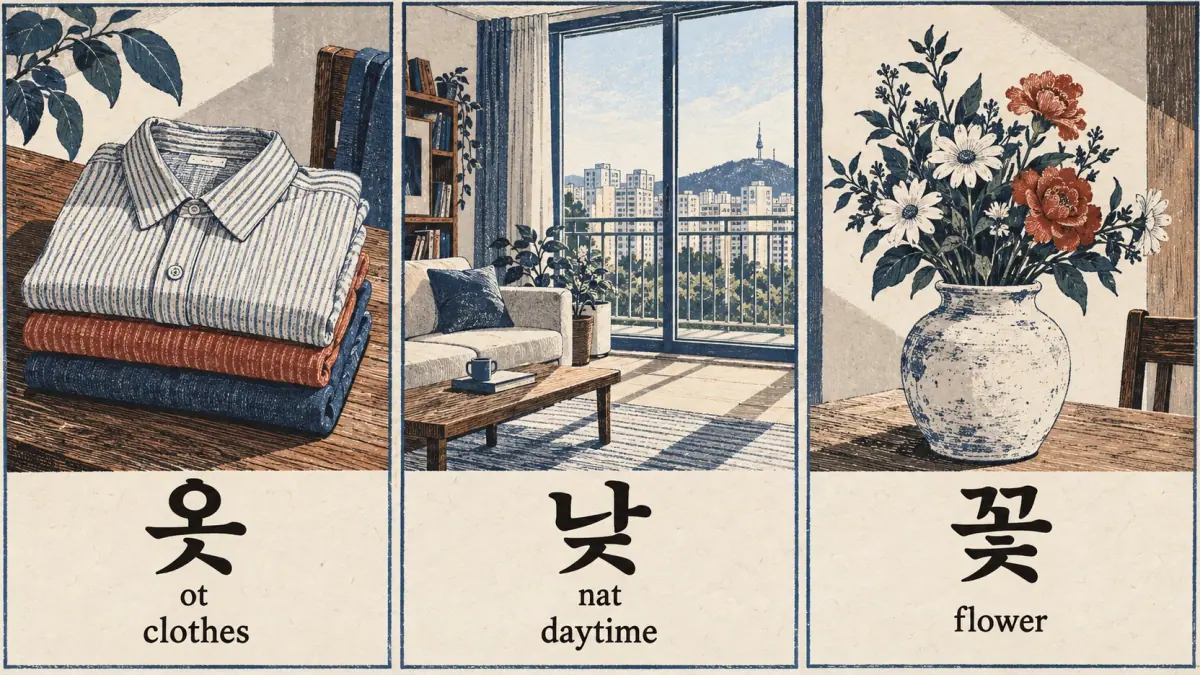
Seven of the basic consonants change at the end of a syllable. Korean allows only 7 final sounds ([k], [n], [t], [l], [m], [p] and [ng]), so the others are reduced to the nearest one. The 국립국어원 표준 발음법 (Standard Pronunciation Rules) lists these reductions.
| Letter | Heard at the end | Example |
|---|---|---|
| ㅅ | [t] | 옷 [옫] (clothes) |
| ㅈ | [t] | 낮 [낟] (daytime) |
| ㅊ | [t] | 꽃 [꼳] (flower) |
| ㅌ | [t] | 밭 [받] (field) |
| ㅋ | [k] | 부엌 [부억] (kitchen) |
| ㅍ | [p] | 앞 [압] (front) |
| ㅎ | [t], rarely heard alone | 히읗 [히읃] |
The full explanation is on the seven final sounds.
Which Basic Consonants Confuse English Speakers?
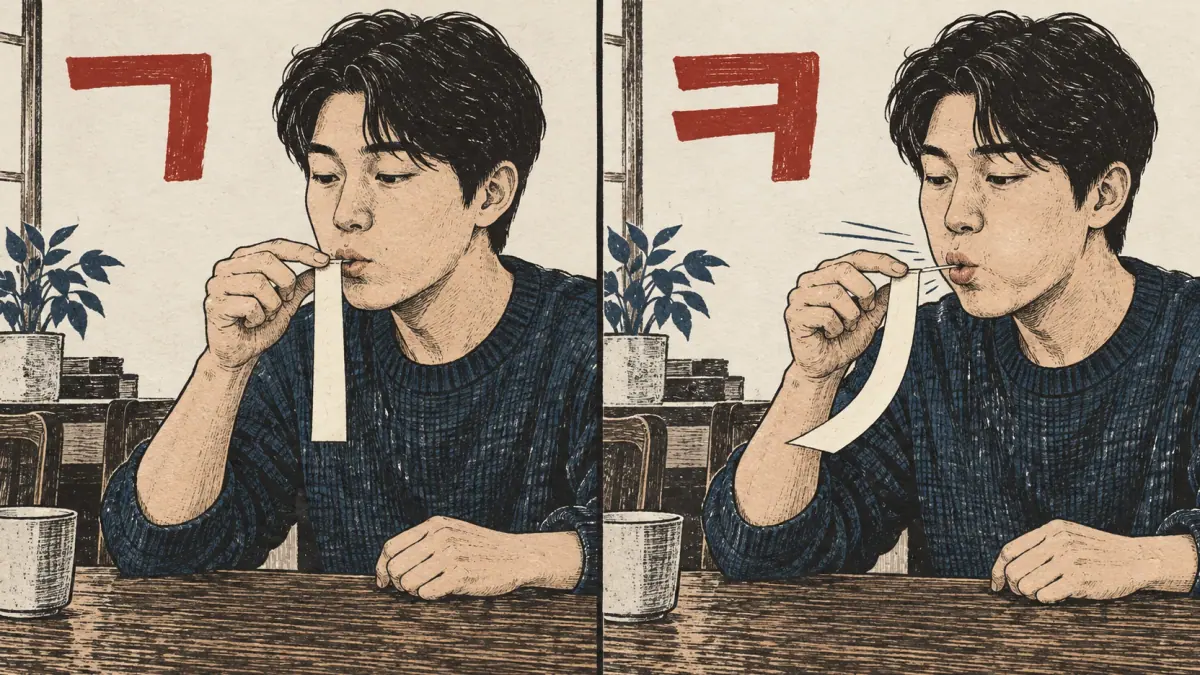
Three pairs cause most of the early mistakes, and each has a quick fix.
- ㄱ and ㅋ. English speakers hear both as k. The difference is the puff of air. Fix: hold a strip of paper in front of your lips. ㅋ moves it, ㄱ barely does.
- ㄹ as r or l. The letter is neither the English r nor the English l. Fix: use a quick tap of the tongue tip between vowels and a clear l at the end of a syllable.
- Final ㅅ heard as s. At the end of a syllable ㅅ is [t], so 옷 sounds like "ot". Fix: stop the tongue on the ridge and do not hiss.
Practice: Decks, Quizzes and Worksheets

After each lesson, review the letters with the Hangul flashcard decks, test your ear with the Hangul quizzes and trace the shapes on the Hangul worksheets. Audio on these pages is machine-generated and its review status is shown beside each clip. The Korean content is a draft until a Korean specialist signs it off.
Back in the main path, all Korean consonants shows the three groups side by side. The first lesson is the letter ㄱ.
Questions about the Basic Korean Consonants
Is ㅎ a basic consonant? Yes. ㅎ (hieut) is the last of the 14 basic consonants in dictionary order. It is taught in the core set on this page and not with the aspirated letters, because it works as a letter in its own right. It also helps make aspirated sounds when it meets ㄱ, ㄷ, ㅂ or ㅈ.
Why are ㄱ, ㄷ, ㅂ romanized two ways? Revised Romanization writes ㄱ, ㄷ and ㅂ as g, d and b before a vowel, and as k, t and p at the end of a syllable or before another consonant. The letters are the same, and the sounds change slightly with position. Hangul spelling stays the same, so only the romanization shows the difference.
How many basic consonants should I learn per day? Three or four letters per sitting is a comfortable pace for most beginners, with a quick review of earlier letters at the start of each session. This is a teaching suggestion, not a measured figure. Since the 14 letters are few, many learners finish the set in a few days of regular practice.
Are the basic consonants the same in North Korea? The 14 basic letters are the same in North Korea. Two things differ: the names, which are regular (기윽, 디읃, 시읏), and the dictionary order, which places the doubled letters at the end of the list. The consonant names page compares the two systems in a table.