What you'll learn
- Sort the Korean diphthongs into y-glides, w-glides and ㅢ.
- Pronounce one example word from each group, such as 야구, 와요 and 의사.
- Explain why 쳐 is pronounced like 처 in verb forms.
- Read the letter counts (10, 11, 13, 21) without confusion.
Before you start: review Korean Simple Vowels, because every glide ends in a simple vowel. The lesson takes about 20 minutes, and audio plays only when you press a button.
Key facts
- The English words "yes" and "yawn", and "water" and "wing", show the same glides.
What Are Korean Diphthongs?
Korean diphthongs are vowel sounds that begin with a short glide, either y or w, and end in a steady vowel. A glide, also called a semivowel, is a very quick vowel-like sound that leads into the next vowel. The y-glide in ㅑ is the "y" of English "yard", and the w-glide in ㅘ is the "w" of English "water".
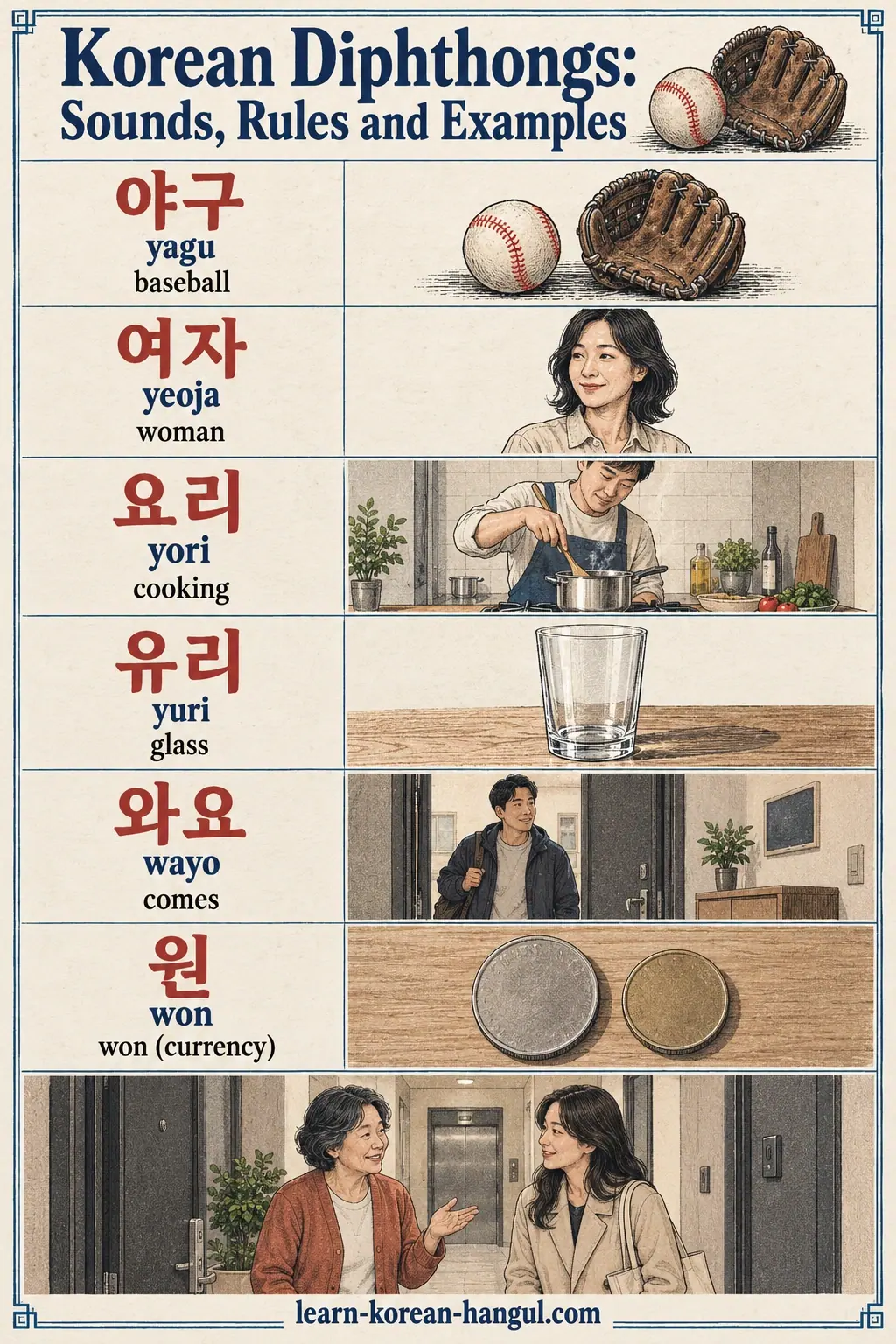
Hear three of them in everyday words.
The clips are 여자 (woman), 요리 (cooking) and 유리 (glass). Each starts with a quick "y" and then holds a steady vowel. Linguists call the pattern glide plus vowel, and Korean tradition calls these letters 이중 모음, or "double vowels".
The thirteen glide vowels fall into three groups, and the group tells you how to say each one. First, why this is easier than it looks.
Why English Speakers Struggle with Korean Diphthongs
English speakers struggle less with Korean glides than with other Korean sounds, because English already has "y" and "w". The real difficulty is that the learner treats each glide letter as a new, unknown vowel. Another difficulty is that Korean spells several glides differently that sound the same, so the eye sees more differences than the ear hears.
Three habits cause most errors:
- Long glides. The y or w lasts too long, so 야 sounds like "ee-ah".
- Wrong second vowel. Learners say ㅛ (yo) when they mean ㅕ (yeo), because both begin with a glide.
- Treating ㅢ as ordinary. The letter has several readings, and learners apply one of them everywhere.
Treat each glide as a small step in front of a vowel you already know. The next section shows how the steps work.
How Do Korean Glides Work?
A Korean glide works by starting the mouth in the position of ㅣ (for y) or ㅜ/ㅗ (for w) and moving quickly into the vowel that follows. The movement is fast and the vowel that follows carries the length. Only the second part is held.
The letters follow this logic. The basic y-glide letters add a second short stroke to a simple vowel, and each w-glide joins two vowel letters.
| Group | Idea | Example | Spoken as |
|---|---|---|---|
| y-glide | ㅣ-position, then a vowel | ㅑ = ㅏ + short stroke | y + a |
| w-glide | ㅗ or ㅜ position, then a vowel | ㅘ = ㅗ + ㅏ | w + a |
| ㅢ | ㅡ position, then ㅣ | ㅢ = ㅡ + ㅣ | eu + i, in one beat |
How many diphthongs does Korean have? The answer depends on how you count, and four counts appear in books and websites.
| Count | What it counts | Letters |
|---|---|---|
| 10 | Single vowels in the standard | ㅏ ㅐ ㅓ ㅔ ㅗ ㅚ ㅜ ㅟ ㅡ ㅣ |
| 11 | "Double vowels" in the standard | ㅑ ㅒ ㅕ ㅖ ㅘ ㅙ ㅛ ㅝ ㅞ ㅠ ㅢ |
| 13 | Glide vowels in this lesson | the 11 plus ㅚ and ㅟ |
| 21 | All vowel letters | 10 + 11 |
The two lists of 11 are different. The standard's list puts ㅚ and ㅟ with the single vowels, while Korean compound vowels groups letters by how they are built. This lesson uses 13 because ㅚ and ㅟ are usually heard as glides in Seoul speech. Now the first group.
Which Letters Are Y-Glides?

The y-glide vowels are ㅑ, ㅕ, ㅛ, ㅠ, ㅒ and ㅖ, six letters that each begin with the y sound. The first four add a stroke to ㅏ, ㅓ, ㅗ and ㅜ. The last two add ㅣ.
| Letter | Revised Romanization | Built from | Anchor word | Meaning |
|---|---|---|---|---|
| ㅑ | ya | ㅏ | 야구 (yagu) | baseball |
| ㅕ | yeo | ㅓ | 여자 (yeoja) | woman |
| ㅛ | yo | ㅗ | 요리 (yori) | cooking |
| ㅠ | yu | ㅜ | 유리 (yuri) | glass |
| ㅒ | yae | ㅑ + ㅣ | 얘기 (yaegi) | talk |
| ㅖ | ye | ㅕ + ㅣ | 예 (ye) | yes; example |
The vowel after the glide keeps its simple-vowel shape. So ㅛ is a quick "y" followed by ㅗ, with rounded lips, and ㅕ is a quick "y" followed by ㅓ, with relaxed lips. This is why ㅛ and ㅕ differ in the same way that ㅗ and ㅓ differ, as explained in ㅓ versus ㅗ. The letters ㅒ and ㅖ sound alike for most speakers.
For the full lesson, see y-glide vowels. Now the other group.
Which Letters Are W-Glides?

The w-glide vowels are ㅘ, ㅝ, ㅙ, ㅞ, ㅚ and ㅟ, six letters that begin with a quick w sound. Each is built from ㅗ or ㅜ followed by another vowel letter.
| Letter | Revised Romanization | Built from | Anchor word | Meaning |
|---|---|---|---|---|
| ㅘ | wa | ㅗ + ㅏ | 와요 (wayo) | comes |
| ㅝ | wo | ㅜ + ㅓ | 원 (won) | won (currency) |
| ㅙ | wae | ㅗ + ㅐ | 왜 (wae) | why |
| ㅞ | we | ㅜ + ㅔ | 웨이터 (weiteo) | waiter |
| ㅚ | oe | ㅗ + ㅣ | 외국 (oeguk) | foreign country |
| ㅟ | wi | ㅜ + ㅣ | 위 (wi) | above |
Hear three of them.
The clips are 와요 (comes), 원 (won) and 위 (above). Most Seoul speakers say ㅙ, ㅞ and ㅚ almost the same, a "we" sound, so these three differ mainly in spelling. That group is the subject of vowels that sound the same. For the full lesson, see w-glide vowels. One vowel remains.
What Is Special about ㅢ?

ㅢ is special because it has several accepted pronunciations that depend on where it appears. It begins with ㅡ (spread lips) and glides to ㅣ. At the start of a word, as in 의사 (doctor), it is said as a quick ㅡ followed by ㅣ. After a consonant, as in 희망 (hope), it is said as ㅣ alone. As the possessive particle 의, it may be said as ㅔ.
The clip is 의사 (doctor). The details, with audio for each position, are in how to pronounce ㅢ. For now, remember that ㅢ is the one glide vowel that needs its own lesson. Now a rule that causes many misreadings of spelling.
The 져, 쪄, 쳐 Rule
In verb forms, 져, 쪄 and 쳐 are pronounced like 저, 쩌 and 처. For example, 가져요 (brings) is said [가저요], and 다쳐요 (gets hurt) is said [다처요]. The rule appears in the 표준 발음법 (Standard Pronunciation Rules), Article 5, as an exception to the general rule for ㅕ.
Why does this happen? The consonants ㅈ, ㅉ and ㅊ are made with the tongue against the roof of the mouth, close to the position of y. A separate y-glide after them adds nothing, so speakers drop it. In Seoul speech, ㅈ followed by ㅓ and by ㅕ sound the same, but the spelling stays. This is the first of several places where spelling and sound differ.
The rule also shows that glide letters can be silent in effect. When you write, still spell the word with the ㅕ. Next, how long a glide should last.
How Long Should the Glide Last?

The glide should last a fraction of the whole vowel, so short that the listener hears one syllable with a quick start. As a rule of thumb, spend most of the time on the second vowel. If you can hold the "y" or "w" for a full second, it is too long.
A drill makes this concrete. Say English "yes" and notice that the "y" is brief and the "e" is held. Now say 여자 with the same rhythm. Say English "wing" and then 위, again with a brief start. If the glide stretches, the word turns into two syllables, such as "ee-eo-ja".
Telling similar letters apart is the next problem.
Telling Similar Glide Letters Apart
Several glide letters look or sound close, and a table of the common mix-ups shortens the learning time. Each row pairs letters that learners confuse and names the cue that separates them.
| Confusable set | What differs | Cue |
|---|---|---|
| ㅕ and ㅛ | the vowel after the glide | relaxed lips for ㅕ, rounded lips for ㅛ |
| ㅑ and ㅕ | the vowel after the glide | wide jaw for ㅑ, half-open jaw for ㅕ |
| ㅒ and ㅖ | spelling only for most speakers | learn the spelling with the word |
| ㅙ, ㅞ and ㅚ | spelling only for most speakers | learn the spelling with the word |
| ㅟ and ㅢ | the first part of the glide | rounded w for ㅟ, spread eu for ㅢ |
Sets that differ in sound deserve ear training, and sets that differ only in spelling deserve memory work. The first kind connects to vowel minimal pairs. The second kind connects to the spelling advice in the ㅐ and ㅔ lesson. Now one word in detail.
Worked Example: 야구

This worked example takes 야구 (baseball) apart from letter to sound. Do the steps in order.
- Spot the glide. The first syllable, 야, is ㅇ + ㅑ. The ㅇ is silent, and ㅑ is the y-glide plus ㅏ.
- Say the glide. Make the "y" of English "yard", and stop there for a moment.
- Add the vowel. Slide quickly into a wide-open ㅏ. The glide should last a fraction of the vowel.
- Say the second syllable. 구 is ㄱ + ㅜ, with rounded lips.
- Join them.
야구
yagu
baseball
- Check the meaning. 야구 is baseball, a popular sport in Korea.
The same two parts, a quick glide and a held vowel, work for 여자, 요리 and 유리. The reverse mistake is to hold the y and shorten the vowel. Next, the errors that matter most.
Common Learner Mistakes
Learners often assume that ㅕ is pronounced like "yo". Actually ㅕ is a "y" followed by ㅓ, with relaxed lips, while ㅛ uses rounded lips. The result of mixing them is that 여자 (woman) sounds like 요자, which is not a word.
Four more mistakes:
- Learners often assume that the glide must be long. Actually it is short, and the vowel carries the length.
- Learners often assume that every spelling has its own sound. Actually ㅒ and ㅖ, and ㅙ ㅞ ㅚ, sound alike for most speakers.
- Learners often assume that ㅟ must be a rounded front vowel, like French "u". Actually the standard allows that, but Seoul speech usually uses a quick w plus ㅣ, like "wee".
- Learners often assume that ㅢ has one sound. Actually it changes with position, so learn it as a separate case.
Test yourself now.
Practice and Answer Key
Do these exercises after listening. Cover the answer key until you finish.
Practice · 8
Which group does ㅠ belong to?
Show answer
y-glide
ㅠ adds a second short stroke to ㅜ and begins with a y sound: yu.
Which group does ㅟ belong to?
Show answer
w-glide
ㅟ is ㅜ + ㅣ and begins with a quick w sound.
Which two letters make up ㅘ?
Show answer
ㅗ and ㅏ
Each w-glide joins ㅗ or ㅜ with another vowel; ㅘ is ㅗ + ㅏ.
How is 다쳐요 pronounced?
Show answer
[다처요]
In verb forms 져, 쪄 and 쳐 are pronounced 저, 쩌 and 처 (Standard Pronunciation Rules, Article 5).
Which word means 'woman'?
Show answer
여자
여자 uses ㅕ (y + relaxed ㅓ); saying it with rounded ㅛ gives 요자, which is not a word.
In a glide vowel such as ㅑ, which part should last longer?
Show answer
The vowel after the glide
The glide is quick and the following vowel carries the length; a long glide splits the word into two syllables.
How is ㅢ said after a consonant, as in 희망?
Show answer
As ㅣ alone
After a consonant ㅢ is said as ㅣ; the ㅡ-to-ㅣ glide is used at the start of a word, as in 의사.
Which set of glide vowels differs mainly in spelling for most Seoul speakers?
Show answer
ㅙ, ㅞ and ㅚ
Most Seoul speakers say ㅙ, ㅞ and ㅚ almost the same; ㅕ/ㅛ and ㅑ/ㅕ differ in the vowel after the glide.
- Group. Is ㅠ a y-glide, a w-glide or ㅢ?
- Group. Is ㅟ a y-glide, a w-glide or ㅢ?
- Word. Which word means "woman": 여자 or 요자?
- Built from. Which two letters make up ㅘ?
- Rule. How is 다쳐요 pronounced?
Answer key: 1. A y-glide. 2. A w-glide. 3. 여자. 4. ㅗ and ㅏ. 5. [다처요].
Common questions follow.
Frequently Asked Questions
How many diphthongs does Korean have? It depends on the count. The standard lists 11 "double vowels", and this lesson counts 13 glide vowels by adding ㅚ and ㅟ. Together with the eight simple vowels, the 13 give 21 vowel letters. Learners can ignore the debate: pronounce the glide, then the vowel.
Is ㅢ a diphthong? Yes, it is a glide vowel, but it is a special one. It begins with ㅡ and moves to ㅣ at the start of a word. After a consonant or as a possessive, it is often said as ㅣ or ㅔ. Learn it as a separate case in its own lesson.
Why is 쳐 pronounced 처? The consonants ㅈ, ㅉ and ㅊ already involve the tongue position of the y sound, so a following y-glide adds nothing. The Standard Pronunciation Rules state that 져, 쪄 and 쳐 in verb forms are pronounced 저, 쩌 and 처. The spelling still keeps ㅕ.
Are diphthongs hard for English speakers? Less than most Korean sounds, because English has "y" and "w" glides. The difficulty is keeping the glide short and choosing the right second vowel, such as ㅕ versus ㅛ. Practise one anchor word per vowel, such as 야구, 여자, 요리 and 유리, and the system looks small.
Where to Go Next
Korean diphthongs are 13 vowels that follow one pattern, a short glide plus a held vowel. This lesson does not teach each vowel in detail, it does not cover every regional variation of ㅢ, ㅚ and ㅟ, and it does not score your speech. Where a letter has more than one accepted reading, the page gives the Seoul reading that learners meet most often, and Min-ji Park reviewed and signed off that reading on 15 October 2026. Continue with the y-glide vowels, the w-glide vowels and how to pronounce ㅢ. For the term itself, see the diphthong glossary entry, and return to Korean Vowel Sounds for the section overview.
Next in the series: Korean Y Vowels ㅑ ㅕ ㅛ ㅠ.