
| Korean | Name | Romanization | Family | Sound |
|---|---|---|---|---|
| ㅏ | 아 | a | basic | a in "father" |
| ㅑ | 야 | ya | basic | ya in "yacht" |
| ㅓ | 어 | eo | basic | between u in "cup" and aw in "law" |
| ㅕ | 여 | yeo | basic | y + ㅓ |
| ㅗ | 오 | o | basic | o in "go", shorter and pure |
| ㅛ | 요 | yo | basic | yo in "yoga" |
| ㅜ | 우 | u | basic | oo in "moon" |
| ㅠ | 유 | yu | basic | "you" |
| ㅡ | 으 | eu | basic | oo in "moon" with lips spread |
| ㅣ | 이 | i | basic | ee in "see" |
| ㅐ | 애 | ae | compound | e in "bed" |
| ㅒ | 얘 | yae | compound | ye in "yes" |
| ㅔ | 에 | e | compound | e in "bed" |
| ㅖ | 예 | ye | compound | ye in "yes" |
| ㅘ | 와 | wa | compound | "wah" |
| ㅙ | 왜 | wae | compound | we in "wet" |
| ㅚ | 외 | oe | compound | we in "wet" |
| ㅝ | 워 | wo | compound | "wuh" |
| ㅞ | 웨 | we | compound | we in "wet" |
| ㅟ | 위 | wi | compound | "wee" |
| ㅢ | 의 | ui | compound | ㅡ gliding into ㅣ |
What Are Korean Compound Vowels?
Compound vowels (합용 모음, habyong moeum) are vowel letters written by joining two vowel shapes into one letter. Hangul Orthography, the spelling rules of the National Institute of Korean Language, lists ten basic vowels, and the eleven others are combinations of them. Together the two sets make the 21 Korean vowels. This page sits one level below that overview, and it builds on the basic Korean vowels.
Each compound vowel is one letter and one syllable core. The two shapes it contains show how it was built, not that it holds two syllables. For example, ㅐ is ㅏ plus ㅣ, but 개 "dog" is a single beat.
Are Compound Vowels the Same as Diphthongs?
No. "Compound" describes how a letter is written, and "diphthong" describes how a vowel sounds. A diphthong is a vowel sound that glides from one position to another, like the "oy" of "boy". Some compound letters are not diphthongs: Standard Pronunciation Article 4 of the National Institute of Korean Language rules counts ㅐ, ㅔ, ㅚ and ㅟ as single steady vowels (monophthongs), though it allows ㅚ and ㅟ to be said as diphthongs. Article 5 lists the eleven diphthongs, including ㅑ and ㅠ, which are not compound letters.
So the two lists overlap but are not equal. For the sound side, see korean diphthongs, the page that answers that query in full.
How the 11 Korean Compound Vowels Are Built
The 11 Korean compound vowels are built by joining one of seven vowels (ㅏ ㅑ ㅓ ㅕ ㅗ ㅜ ㅡ) with ㅣ or with another vowel. The table groups them by their first part.
| Vowel | Built from | Revised Romanization | Family |
|---|---|---|---|
| ㅐ | ㅏ + ㅣ | ae | ㅣ-compound |
| ㅔ | ㅓ + ㅣ | e | ㅣ-compound |
| ㅒ | ㅑ + ㅣ | yae | y-version |
| ㅖ | ㅕ + ㅣ | ye | y-version |
| ㅘ | ㅗ + ㅏ | wa | w-vowel |
| ㅙ | ㅗ + ㅐ | wae | w-vowel |
| ㅚ | ㅗ + ㅣ | oe | w-vowel |
| ㅝ | ㅜ + ㅓ | wo | w-vowel |
| ㅞ | ㅜ + ㅔ | we | w-vowel |
| ㅟ | ㅜ + ㅣ | wi | w-vowel |
| ㅢ | ㅡ + ㅣ | ui | ㅣ-compound |
Eleven letters look like a lot, but four patterns explain them: add ㅣ, add ㅣ to a y-vowel, start with ㅗ or ㅜ, or join ㅡ and ㅣ. Once you see the patterns, the set is smaller than it looks.
The ㅐ and ㅔ Pair
ㅐ and ㅔ are the most frequent compound vowels, and they sound the same to most present-day speakers. ㅐ is ㅏ + ㅣ and ㅔ is ㅓ + ㅣ. You will see them in 개 "dog", 내 "my", and 네 "yes", so they appear in your first words. Start with ㅐ and ㅔ, the most common compound vowels, because they appear in words like 개 and 네. That lesson gives both with audio and a spelling strategy.
Y-Vowels: ㅒ and ㅖ
ㅒ and ㅖ are the y-versions of ㅐ and ㅔ, read as "yeh". ㅖ is common in words like 예 "yes" (polite) and 시계 "clock". ㅒ is rare and appears in a few words such as 얘 "this child". Both are taught with the other y-vowels.
W-Vowels: ㅘ ㅙ ㅚ ㅝ ㅞ ㅟ
Six compound vowels start with a short "w" glide: ㅘ ㅙ ㅚ ㅝ ㅞ ㅟ. Each begins with ㅗ or ㅜ, and each is written around its consonant in a mixed layout. All six are grouped as w-vowels, where ㅘ and ㅝ each have a lesson.
The Special Vowel ㅢ
ㅢ is the only compound vowel made from ㅡ and ㅣ, and it has three common readings. At the start of a word it sounds like [ui], as in 의사 "doctor". After a consonant it is read [i], as in 희망 "hope" (read [히망]). As the word for "of" it is read [e]. Leave the vowel ㅢ and its three pronunciations until last, because the readings depend on position.
Which Compound Vowels Sound the Same?
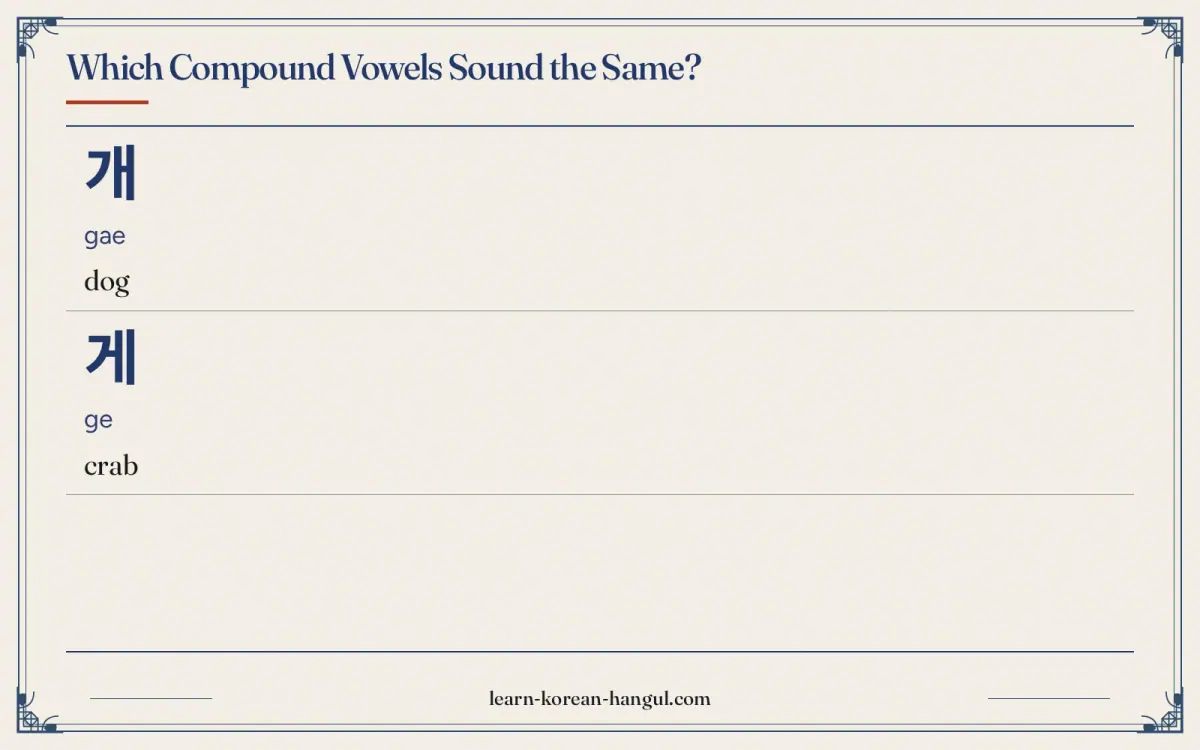
For most present-day speakers, the 11 spellings collapse to about seven sounds. The merger table shows which letters share a sound today. Learn the spelling by word, not by ear.
| Sound heard today | Letters that share it | Example |
|---|---|---|
| "eh" | ㅐ, ㅔ | 개 "dog", 게 "crab" |
| "yeh" | ㅒ, ㅖ | 얘, 예 |
| "wa" | ㅘ | 사과 "apple" |
| "weh" | ㅙ, ㅚ, ㅞ | 왜 "why", 외국 "foreign country", 웨딩 "wedding" |
| "wuh" | ㅝ | 뭐 "what" |
| "wee" | ㅟ | 귀 "ear" |
| "ui" glide | ㅢ | 의사 "doctor" |
For Most Speakers Today These Two Sound the Same; Spelling Tells Them Apart.
| Korean | Romanization | Meaning | Sound |
|---|---|---|---|
| 개 | gae | dog | |
| 게 | ge | crab |
Treat this as a statement about most present-day speakers, not about everyone. Some older speakers and some regions still keep ㅐ and ㅔ apart, and the standard rules still list them as separate vowels. Mouth positions for all vowels are on Korean vowel sounds.
Where Should You Start?
Start with ㅐ and ㅔ, then ㅘ and ㅝ, then ㅟ, then the three that share a sound, then ㅒ and ㅖ, and ㅢ last. This order follows how often each appears in beginner words and how much each reuses what you already know.
- ㅐ and ㅔ, for frequency (개, 네, 에서).
- ㅘ and ㅝ, because they appear in verbs such as 봐요 and 줘요.
- ㅟ, which is ㅜ plus ㅣ (귀).
- ㅙ, ㅚ and ㅞ, learned as one sound with three spellings.
- ㅒ and ㅖ, the y-versions.
- ㅢ, last, because it has three readings.
You can skip ahead if you are reading signs or menus in a hurry: learn ㅐ, ㅔ, ㅘ and ㅝ, and come back for the rest. If you only want to hear the set, try the interactive hangul alphabet.
How Do Compound Vowels Fit in Syllable Blocks?
Four compound vowels (ㅐ ㅒ ㅔ ㅖ) are vertical, so the consonant sits on the left. The other seven are written around the consonant in a mixed layout: the consonant at the top left, with the vowel parts underneath and to the right, as in 과 and 의. Seven compound vowels wrap around the consonant, as shown in mixed-vowel blocks. Drill all 11 with the Hangul flashcard decks.
Frequently Asked Questions
Why do textbooks give different vowel counts? Some textbooks count 10 basic and 11 compound vowels, giving 21. Others count spoken vowels instead: the Standard Pronunciation rules list 10 monophthongs, and descriptions of present-day speech often give 7 or 8. The difference is what is being counted: written letters, as in Hangul Orthography, or spoken vowels, as in the Standard Pronunciation rules.
Do I have to learn all 11 at once? No. Learn them in groups. Most beginners start with ㅐ, ㅔ, ㅘ and ㅝ, then add the others as they appear in words. Since several share a sound, you can learn the sound once and the spelling word by word. ㅢ, with three readings, is best left until you have seen it in words.
Are compound vowels harder than basic vowels? Not in sound, since four patterns explain all 11, but they are harder to spell. The reason is the mergers: ㅐ and ㅔ sound alike to most speakers, as do ㅙ, ㅚ and ㅞ. Reading is easy once you know the letter shapes. Spelling needs vocabulary, so memorise words, not rules.
Do Koreans use all 11 in everyday words? Yes, although with different frequency. ㅐ, ㅔ, ㅘ and ㅢ are very common. ㅒ is rare, appearing in a few words such as 얘. The others fall in between. All 11 appear in ordinary text, so learners should be able to read each one even if they rarely write some.
How do I type compound vowels? On a standard Korean two-set keyboard, type the keys for the parts in order, and the computer joins them: ㅗ then ㅏ gives ㅘ, and ㅜ then ㅣ gives ㅟ. The vowels ㅐ, ㅔ, ㅒ and ㅖ have their own keys, which are the "o", "p", "O" and "P" keys.