
The best Korean drama for beginners has clear everyday speech, a contemporary setting, standard Seoul pronunciation and a limited slang load, rather than historical or heavily dialectal dialogue. This page sets out six criteria, compares four named dramas and two types of drama to avoid, and gives a four-week plan for turning one episode into study. It uses no ratings, and it names no streaming platform, because availability differs by country and changes often.
Our top picks
- Best first watch for everyday speech: 응답하라 1988 (Reply 1988), a family and neighbourhood drama set in Seoul.
- Best for workplace Korean: 미생 (Misaeng), an office drama with polite and formal speech.
- Best for friends talking naturally: 슬기로운 의사생활 (Hospital Playlist), with relaxed talk among friends and hospital vocabulary.
- Best for hearing a regional dialect later: 응답하라 1997 (Reply 1997), set in Busan; not a first watch.
- Avoid at the start: historical dramas and fantasy or thriller dramas.
Key facts
- Choose contemporary, standard-accent shows first; add dialect and period dramas after A2.
- Avoid historical drama early, because its vocabulary and endings are archaic.
- Use a subtitle ladder: English subtitles, then Korean subtitles, then none.
- Study ten minutes at a time, and learn five words from each segment.
- Titles and settings were checked against reference entries on 2026-10-09; no ratings are used.
Last updated: 2026-10-09.
Best Korean Drama for Beginners: the Essentials
A beginner should pick a drama for how it sounds and where it is set, not for its popularity. Speech that is clear and set in everyday places such as homes, offices and streets repeats the same vocabulary, and repetition is what beginners need. A show full of palace language, fantasy terms or heavy dialect teaches you things you cannot use.
| Genre | Speech clarity | Setting | Dialect load | Slang and register | Difficulty |
|---|---|---|---|---|---|
| Slice of life and family | High: everyday sentences | Home, neighbourhood | Low to medium | Casual, family terms | Easiest |
| Workplace | Medium: formal and polite speech | Office | Low | Polite and formal, business terms | Medium |
| Hospital or professional ensemble | Medium: friends talk fast; jargon in work scenes | Workplace plus friends' homes | Low | Casual among friends, technical at work | Medium |
| Regional dialect drama | Low for beginners | Local, often a city outside Seoul | High | Dialect endings and words | Hard |
| Historical | Low | Past | Low, but archaic | Archaic endings and vocabulary | Hardest |
| Fantasy and thriller | Medium | Mixed | Low | Specialised or violent vocabulary | Hard |
Reading down the table, the easiest genre is the one with the most repetition: family and neighbourhood life. A fuller method for using any show is on the page about how to learn Korean by watching K-dramas, and the Korean for K-drama fans course teaches the language drama characters use.
How Did We Choose?
We chose six criteria that predict whether a beginner can learn from a show, and we judge each drama against them without scores.
- Speech clarity and speed. Do characters speak in complete, clear sentences, or in fragments and shouts?
- Contemporary everyday setting. Is the story set in a place where you might use the language?
- Dialect load. Is the speech standard (Seoul) or a regional dialect?
- Slang and register mix. How much slang, and does the register change a lot between scenes?
- Episode length and availability. How long is an episode, and can you watch it legally where you live?
- Korean subtitles. Are Korean subtitles available, so you can read along?
The dramas below are named because their setting and genre are well documented. Whether a drama suits you depends on your level and on what you want to learn, and the reasons are given for each one. Streaming availability is not listed, because it varies by country and changes; check the platforms in your region for the title in Korean.
Which Has the Clearest Speech?

Family and neighbourhood dramas have the clearest speech for beginners, because characters talk in short exchanges at home and around the table. The same greetings, requests and small talk return in every episode. Listen for these polite lines, which appear across contemporary dramas:
| Korean | Romanization | Meaning |
|---|---|---|
| 괜찮아요? | gwaenchanayo [괜차나요] | Are you okay? |
| 진짜요? | jinjjayo | Really? |
| 잠깐만요 | jamkkanmanyo [잠깐만뇨 in common speech] | Just a moment |
| 고마워요 | gomawoyo | Thank you |
Short everyday lines like these are the ones to catch first. Words and phrases for your viewing are collected on the K-drama phrases and K-drama words pages.
1. 응답하라 1988 (Reply 1988) — Best First Watch for Everyday Speech
응답하라 1988 (eungdapara 1988) is the best first drama for most beginners because it follows families and neighbours in one Seoul district, so everyday speech repeats across scenes.
Specs: tvN, 2015 to 2016, 20 episodes; family and neighbourhood life in Seoul; set in 1988; standard-accent speech with some period details.
The story is set in the Ssangmun-dong district of Seoul, in 1988, and centres on five friends and their families. Meals, errands, school and neighbours supply plain conversation. Because the cast is large and families are close, kinship terms and family speech recur, which makes it a good source for words you will use.
Drawback: it is set in 1988, so some objects, expressions and attitudes are dated, and many scenes move fast with several people talking at once.
Choose this if you want home and neighbourhood speech with repetition. Skip it if you only want modern city life and phone-era language.
2. 미생 (Misaeng) — Best for Workplace Korean
미생 (misaeng) is the best choice for workplace Korean because it is an office drama about the daily life of employees at a trading company.
Specs: tvN, 2014, 20 episodes; contemporary office; polite and formal speech between colleagues of different rank; business vocabulary.
The drama is based on a webtoon and follows a new employee through his work. Because the characters have ranks, you hear how speech changes with the listener: polite speech to a superior, casual talk with a friend, formal presentations in meetings. This makes it a strong choice for learners who will use Korean at work. The register lesson is the real value, and the Korean speech levels page explains the endings you will hear.
Drawback: office jargon and Sino-Korean business words appear often, and the story is serious and emotional, so a beginner may follow the plot but not the words.
Choose this if you will work with Koreans or want formal and polite speech. Skip it if you want light entertainment at A1.
3. 슬기로운 의사생활 (Hospital Playlist) — Best for Friends Talking Naturally
슬기로운 의사생활 (seulgiroun uisasaenghwal) is the best choice for hearing friends talk naturally because it centres on five doctors who are old friends.
Specs: tvN, 2020; contemporary hospital and friends' home settings; casual speech among friends, polite speech with patients; medical vocabulary in work scenes.
The relaxed conversations between friends give you casual speech endings (-어, -지) in context, while work scenes with patients show polite speech. This contrast between friends and workplace is a useful picture of how speech levels change in real life.
Drawback: medical terms and fast, overlapping talk between friends make some scenes hard to follow, and the casual endings are best learned after the polite ones.
Choose this if you already know the polite endings and want to hear casual speech among peers. Skip it if you are still at the first lessons of A1.
4. 응답하라 1997 (Reply 1997) — Best for Hearing a Regional Dialect Later
응답하라 1997 (eungdapara 1997) is the best drama on this list for hearing a regional dialect, and it is not a first watch.
Specs: tvN, 2012; set in Busan, with scenes in 1997 and 2012; Gyeongsang dialect among the main characters; high school life and a reunion.
The story is set in Busan, a city in the south-east, and its characters speak the regional dialect of that area. Dialect forms differ from the standard you learn in lessons. For example, the question 뭐 하노? (mwo hano) in Busan speech corresponds to the standard 뭐 해? (mwo hae) or the polite 뭐 해요? (mwo haeyo). Hearing this contrast teaches you that Korean has regional variety.
Drawback: a beginner who learns from this show will learn dialect endings as if they were standard, and may be misunderstood in Seoul.
Choose this if you are A2 or above and curious about dialect. Skip it if you are still building the standard base.
5. Historical Dramas — Avoid at the Start
Historical dramas are the wrong choice for beginners because they use archaic vocabulary, formal endings and titles that no one uses today.
Specs: set before the modern era; archaic endings and court titles; heavy use of Sino-Korean vocabulary.
They are popular and can be enjoyable with subtitles, but the language you hear does not match daily conversation. Learn the modern language first, and watch historical drama later for pleasure and cultural background.
Drawback of this advice: some learners are motivated by these shows, and motivation counts. If you love them, watch them for fun and study with a contemporary show.
Choose this if your Korean is B1 or above and you enjoy period stories. Skip it if your goal is conversation.
6. Fantasy and Thriller Dramas — Avoid at the Start
Fantasy and thriller dramas are a hard start because they use specialised vocabulary, such as legal, criminal or supernatural terms, and emotional or shouted speech.
Specs: mixed settings; specialised vocabulary; fast, intense dialogue.
The story may be gripping, but the words you learn are less useful in daily life. The speech is often shouted or whispered, which is harder to catch.
Drawback of this advice: the genre keeps some learners watching, which is useful for motivation.
Choose this if you are B1 or above and want specialised vocabulary. Skip it if you want repeated everyday phrases.
Which Has the Least Slang?
Workplace and family dramas have the least slang, and shows aimed at teens and young adults have the most. Slang changes quickly, and a slang word from a drama may sound outdated within a few years. The wise approach is to learn the slang you hear as recognition vocabulary only. Mark it in your notes as slang, and use standard words in your own speech.
Which Is the Best First Watch?
Start with 응답하라 1988 if you want home and neighbourhood speech, and with 미생 if you want polite and formal speech. If you are not sure, watch the first ten minutes of each and answer three questions: Can I catch five words? Are the sentences complete? Is the speed bearable with subtitles? The one that scores best for you is your first watch.
How Do You Turn an Episode into a Study Plan?
Use ten-minute segments and a subtitle ladder, and learn five words per segment. The plan below runs for four weeks with three 30-minute sessions per week, which is 4 × 3 × 30 = 360 minutes, or 6 hours.
| Week | Subtitles | Task per 30-minute session |
|---|---|---|
| 1 | English | Watch one 10-minute segment, pause to write five words, rewatch once |
| 2 | Korean | Watch the same segment with Korean subtitles, read the lines aloud |
| 3 | None | Watch the segment without subtitles and write what you understood |
| 4 | None | Shadow two lines: repeat right after the actor, copying the rhythm |
Each week you reuse the same segment, so the words stay in memory and the ladder builds confidence. The method for shadowing is on the page about how to shadow Korean with K-dramas.
Checkpoints: by week 2 you should recognise the five words when you hear them. By week 4 you should understand most of the segment without English. If not, repeat week 3 once.
Common mistakes:
- Watching a full episode with English subtitles and calling it study.
- Learning slang before polite speech.
- Choosing a show for its story and ignoring its dialect.
- Skipping the review of the five words the next day.
What Are the Drawbacks of Learning from Dramas?
Dramas are fast, emotional and scripted. Characters shout, whisper, interrupt and use shortened forms, and a beginner can lose the thread. Dramas also model situations that are dramatic rather than ordinary: you will hear more arguments and declarations than greetings at a shop. For that reason, use dramas as a supplement to lessons, not a replacement. The page on Kdramas to learn Korean explains the whole approach.
How Do You Test Any Drama in Ten Minutes?
Watch the first ten minutes of any candidate and answer five questions, so you do not commit to a series that is too hard. The test costs ten minutes and saves hours.
| Question | Good sign for a beginner | Warning sign |
|---|---|---|
| Can I catch five words in ten minutes? | Yes, mostly repeated words | Fewer than two |
| Are the sentences complete? | Mostly full sentences | Fragments, shouts or mumbling |
| Is the setting a place I could visit? | Home, office, street, shop | Palace, battlefield, fantasy world |
| Does the dialect sound like lesson audio? | Close to the standard | Very different endings and rhythm |
| Can I follow with subtitles at normal speed? | Yes, with some pauses | I read subtitles and miss the picture |
If you get at least four good signs, the show is a candidate. If you get three or more warning signs, save it for later. Run the same test on a second show and compare. The Kdramas to learn Korean hub covers other types of show, such as movies.
What Does a Five-Word Segment Look Like?
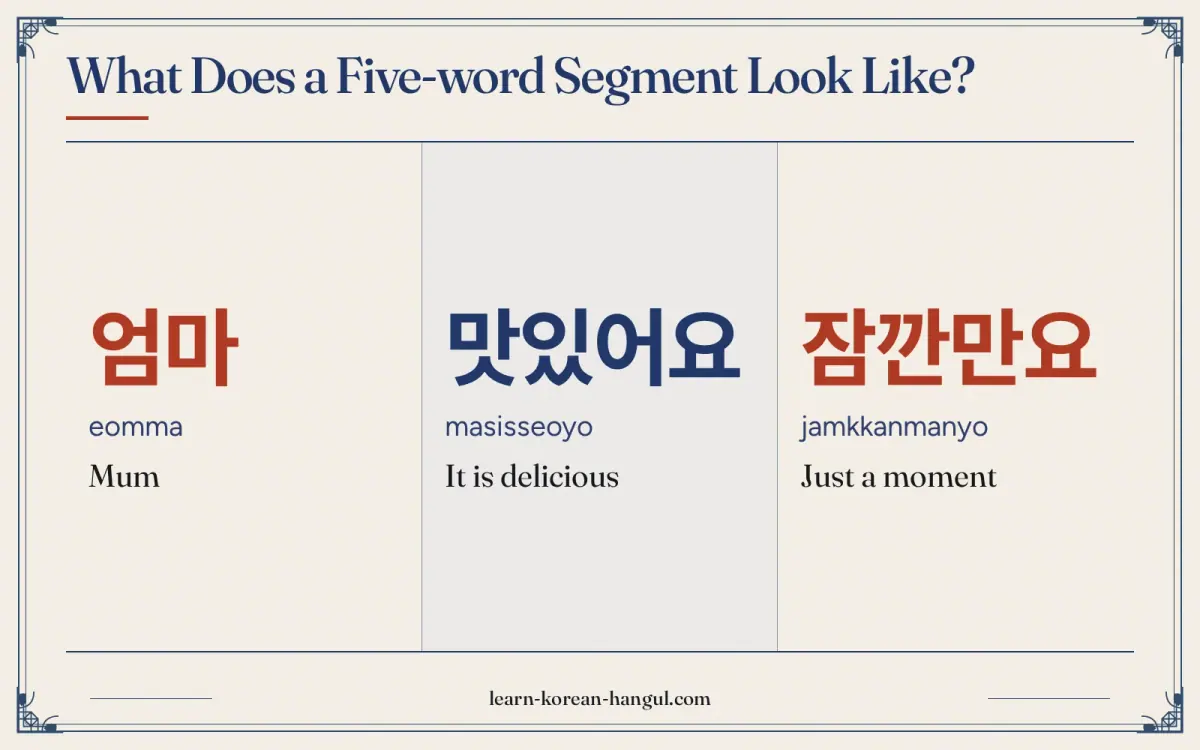
A five-word segment is a ten-minute clip from which you keep only the five words you hear most or need most. The example below is a made-up family dinner scene, not a quotation from any show, to show the pattern.
| Word or phrase | Romanization | Meaning | Why keep it |
|---|---|---|---|
| 밥 먹자 | bap meokja [밥 먹짜] | Let us eat | Heard before every meal scene |
| 엄마 | eomma | Mum | Family word that recurs |
| 많이 드세요 | mani deuseyo [마니 드세요] | Please eat a lot | Honorific request to elders |
| 맛있어요 | masisseoyo | It is delicious | Reaction after every meal |
| 잠깐만요 | jamkkanmanyo | Just a moment | Polite interruption |
Choose words that return in the same episode, not words that appeared once. After the clip, write each word on a card with the line it came from. Review the cards the next day and again after a week. The cards from five segments, 25 words, are worth more than 100 words you never review. For ready-made decks, see the K-drama phrases and Korean flashcards pages.
What Should You Do about Slang and Fast Speech?
Treat slang and fast speech as recognition practice, not as speaking models. A drama character may drop endings, merge words or use slang that sounds right to a friend and wrong to a stranger. When you hear a form you do not know, do three things.
- Pause and read the Korean subtitle.
- Look up the base form in a dictionary, such as the Naver dictionary.
- Write whether it is polite, casual or slang beside the word.
The register note is the most useful part. Learners who copy a character's casual speech to a teacher or an elder sound rude without meaning to. Keep your own speech in the polite endings you learn in lessons, and use drama to hear the rest.
How Can You Pair a Drama with Your Lessons?
Match each week of viewing to the lesson you are studying, so the drama shows the grammar in use. If this week's lesson is the polite ending -아요/-어요, watch for it in the segment and count how often you hear it. If the lesson is numbers, listen for prices, ages and times. A show then becomes a listening quiz for the lesson, and the lesson explains what you hear.
A simple weekly rhythm is two lesson days, two drama days and one review day. On drama days, use the ten-minute segment plan above. On the review day, go through your five cards and say each line aloud. Keep the show to the same segment all week, because variety is less useful than repetition at this stage.
Do Movies and Variety Shows Work as Well?
Movies are shorter and self-contained, which suits learners with little time, but they often pack a lot of plot into two hours and use more dramatic language. Variety shows have on-screen Korean captions that repeat what is said, which helps reading practice, but their speech is fast, full of slang and built on jokes that depend on culture. For a beginner, a drama episode in ten-minute pieces is easier to control than either. Add movies and variety shows once you can follow a drama with Korean subtitles.
Which Should You Pick?
Pick by your goal.
| Your goal | Pick | Why |
|---|---|---|
| Everyday speech at home | 응답하라 1988 | Repeated family and neighbour talk |
| Work and formal speech | 미생 | Ranks and registers |
| Natural talk among friends | 슬기로운 의사생활 | Casual and polite contrast |
| Dialect awareness at A2+ | 응답하라 1997 | Regional speech in a Busan setting |
| Conversation for travel | Slice-of-life first | Repetition of common phrases |
The honest limitation is that no drama is built for learners. Each has fast speech, cultural context and emotional scenes. Use pauses, subtitles and short segments to make them workable.
Frequently Asked Questions
Can I learn Korean from dramas? You can learn vocabulary, listening and a feel for natural speech, but not the whole language. Dramas are scripted, fast and emotional, and they do not explain grammar. Use them alongside lessons: study a short segment, learn five words and review them the next day.
Should I use English subtitles? Start with English subtitles at A1, then move to Korean subtitles as soon as you can read Hangul comfortably, and later drop subtitles. Reading Korean subtitles while you listen links sound and spelling. Staying on English subtitles forever turns the drama into a reading exercise in English.
Which genre is easiest? Slice-of-life and family dramas are the easiest, because the setting is everyday and the vocabulary repeats. Workplace dramas are next, with more formal speech. Historical, fantasy and thriller dramas are the hardest at the beginning, because their vocabulary and endings are less useful in daily life.
Are dramas too fast for beginners? Often yes. Characters speak at natural speed, interrupt each other and use shortened forms. Make the speed manageable by watching ten-minute segments, pausing to read subtitles, repeating a segment and slowing the playback if your player allows it.
The Bottom Line
The best Korean drama for beginners is a contemporary, standard-accent show with clear everyday speech, such as 응답하라 1988 for home life or 미생 for work. Choose by the six criteria, avoid historical and fantasy dramas at the start, keep dialect dramas such as 응답하라 1997 for later and study in ten-minute segments with a subtitle ladder. Treat the drama as a supplement to lessons, and expect fast speech.