What you will learn
- Say where it hurts with a body part and 이/가: 머리가 아파요.
- Give the time with -부터 and add a symptom with -도.
- Understand the doctor's polite questions and instructions.
Before you start: you should know the polite ending -아요/-어요, the particles 이/가 and 도, and the native numbers up to ten. Time: about 25 minutes. Level: A2. Audio plays only when you press a button.
Please note: this is language practice, not medical advice. In a real emergency in Korea, call 119.
안녕하세요. 어디가 아프세요? / 머리가 아파요. / 언제부터 아프셨어요? / 어제부터 머리가 아파요. / 열도 나세요? / 네, 열도 나고 기침도 해요. / 목도 아프세요? / 네, 목도 조금 아파요. / 감기예요. 약을 드릴게요. 하루에 세 번 드세요. / 식사 후에 먹어요? / 네, 식후 삼십 분에 드세요. 그리고 푹 쉬세요. / 네, 감사합니다.
Key Facts
- 어디가 아프세요? asks where it hurts, and you answer with the body part and 이/가: 머리가 아파요.
- 어제부터 머리가 아파요 gives the duration with -부터 (since).
- 열도 나고 기침도 해요 lists symptoms with -도 (also).
- Body parts take 이/가 with 아프다, never 을/를: 머리가 아파요, not 머리를 아파요.
- The doctor uses honorific forms such as 아프세요 and 드세요, but you never use them about yourself.
- This page is language practice, not medical advice. In an emergency in Korea, call 119.
*Last updated: 2026-10-09. The Korean text, romanization and audio on this page are AI-assisted drafts.
What Is a Korean Doctor Visit Conversation?
A Korean doctor visit conversation is a short scripted scene in which a patient describes a health problem and a doctor responds. You say your lines aloud, answer the doctor's questions in turn and understand the instructions at the end. It trains the exchange you would need at a clinic: where it hurts, since when, what else is wrong and how to take the medicine.
The scene has twelve turns, six for each role. The patient's lines use only a few patterns: body part + 이/가 + 아파요, time + -부터, and symptom + -도. The doctor's lines are longer and polite, with honorific endings such as -세요 and -셨어요. That mirrors the real situation, because you describe a little and understand more. The lesson is part of Korean conversation practice.
This is not a medical guide. The medicine instructions here are invented for practice. For emergencies and urgent help, see Korean emergency phrases, and in a real emergency in Korea, call 119 for an ambulance. Next, why it is hard.
Why Is This Hard for English Speakers?
It is hard because Korean says pain differently and because the patient must handle three particles at once. In English, "I have a headache" and "my head hurts" use "my" and a direct verb. In Korean, the head is the subject, so it takes 이/가: 머리가 아파요, literally "the head is painful". English speakers usually add 을/를 by reflex and say 머리를 아파요, which is wrong.
| English habit | Korean reality | What to do |
|---|---|---|
| "I hurt my head" with an object | 머리가 아파요, head as subject | Use 이/가 after the body part |
| "Since yesterday" as a separate phrase | 어제부터, attached | Attach -부터 to the time word |
| "and also" as a separate word | -도 on each item | Put 도 on 열 and 기침 |
| Add "my" before the body part | 저는 or nothing; the body part is clear | Drop "my" |
| Use the same politeness as the doctor | Doctor says 아프세요; you say 아파요 | Never use -세요 about yourself |
The doctor's honorific forms are for you as the patient. You understand them, but you answer in plain polite -요 style. Next, how the exercise works.
How Does the Role Play Work?
Do the role play in four passes. Each pass takes about six minutes.
- Listen. Play the whole scene once at normal speed with the transcript hidden. Say in English where it hurts, since when and what else is wrong.
- Read and repeat. Open the transcript, play each turn and say it back, matching rhythm.
- Play the patient. Play the doctor's turns from the audio and say the patient's turns yourself, using the prompt card, not the script.
- Swap. Say the doctor's turns and let the audio play the patient. This teaches the honorific questions.
Use the slow version for turns you find hard. A partner can replace the audio. If you work alone, pause after each doctor turn and answer aloud before you hear the patient.
Role a and Role B Prompt Cards
The prompt cards give the goal and the facts but not the words, so you can improvise.
| Role | Goal | Facts |
|---|---|---|
| Role A: patient | Say where it hurts and since when, add one more symptom, and ask how to take the medicine | Head, since yesterday, fever and cough, throat a little |
| Role B: doctor | Ask where, since when and what else, explain the diagnosis, and give instructions | Cold, medicine three times a day, thirty minutes after meals, rest |
A second card changes the problem.
| Variation | Role A (patient) | Role B (doctor) |
|---|---|---|
| Card 2 | Stomach ache since this morning, no fever, ate raw fish last night | Ask what the patient ate, give medicine, advise rest |
For card 2, the key sentences are 배가 아파요 (my stomach hurts), 오늘 아침부터요 (since this morning), 열은 없어요 (I have no fever) and 어제 저녁에 회를 먹었어요 (I ate raw fish last night). The 은 in 열은 contrasts the fever with the pain: "as for a fever, I have none".
Model Answers and Alternatives
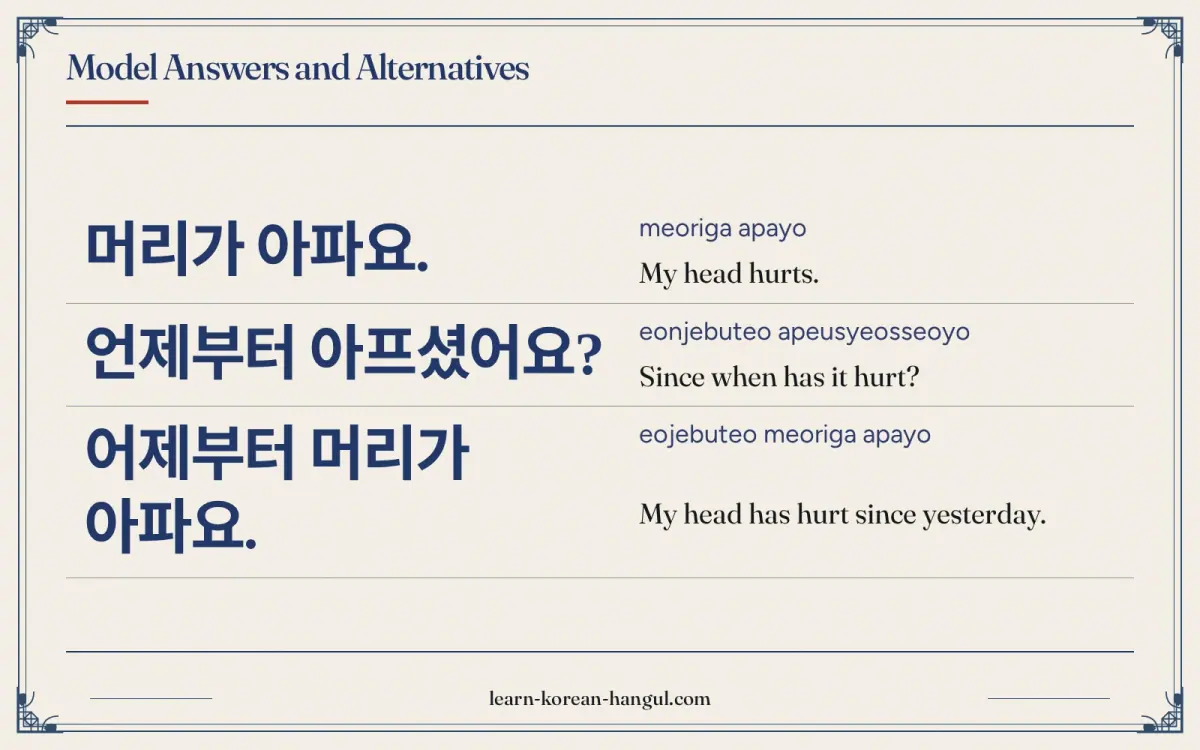
Here is the model dialogue. Press each line to hear it, and read along with the table.
A Visit to the Doctor with a Headache
Doctor
안녕하세요. 어디가 아프세요?
annyeonghaseyo. eodiga apeuseyo
Hello. Where does it hurt?
Patient
머리가 아파요.
meoriga apayo
My head hurts.
Doctor
언제부터 아프셨어요?
eonjebuteo apeusyeosseoyo
Since when has it hurt?
Patient
어제부터 머리가 아파요.
eojebuteo meoriga apayo
My head has hurt since yesterday.
Doctor
열도 나세요?
yeoldo naseyo
Do you have a fever too?
Patient
네, 열도 나고 기침도 해요.
ne, yeoldo nago gichimdo haeyo
Yes, I have a fever and I cough too.
Doctor
목도 아프세요?
mokdo apeuseyo
Does your throat hurt too?
Patient
네, 목도 조금 아파요.
ne, mokdo jogeum apayo
Yes, my throat hurts a little too.
Doctor
감기예요. 약을 드릴게요. 하루에 세 번 드세요.
gamgiyeyo. yageul deurilgeyo. harue se beon deuseyo
It is a cold. I will give you medicine. Take it three times a day.
Patient
식사 후에 먹어요?
siksa hue meogeoyo
Do I take it after meals?
Doctor
네, 식후 삼십 분에 드세요. 그리고 푹 쉬세요.
ne, sikhu samsip bune deuseyo. geurigo puk swiseyo
Yes, take it thirty minutes after meals. And rest well.
Patient
네, 감사합니다.
ne, gamsahamnida
Yes, thank you.
| # | Speaker | Korean | Revised Romanization | English |
|---|---|---|---|---|
| 1 | Doctor | 안녕하세요. 어디가 아프세요? | annyeonghaseyo. eodiga apeuseyo | Hello. Where does it hurt? |
| 2 | Patient | 머리가 아파요. | meoriga apayo | My head hurts. |
| 3 | Doctor | 언제부터 아프셨어요? | eonjebuteo apeusyeosseoyo | Since when has it hurt? |
| 4 | Patient | 어제부터 머리가 아파요. | eojebuteo meoriga apayo | My head has hurt since yesterday. |
| 5 | Doctor | 열도 나세요? | yeoldo naseyo | Do you have a fever too? |
| 6 | Patient | 네, 열도 나고 기침도 해요. | ne, yeoldo nago gichimdo haeyo | Yes, I have a fever and I cough too. |
| 7 | Doctor | 목도 아프세요? | mokdo apeuseyo | Does your throat hurt too? |
| 8 | Patient | 네, 목도 조금 아파요. | ne, mokdo jogeum apayo | Yes, my throat hurts a little too. |
| 9 | Doctor | 감기예요. 약을 드릴게요. 하루에 세 번 드세요. | gamgiyeyo. yageul deurilgeyo. harue se beon deuseyo | It is a cold. I will give you medicine. Take it three times a day. |
| 10 | Patient | 식사 후에 먹어요? | siksa hue meogeoyo | Do I take it after meals? |
| 11 | Doctor | 네, 식후 삼십 분에 드세요. 그리고 푹 쉬세요. | ne, sikhu samsip bune deuseyo. geurigo puk swiseyo | Yes, take it thirty minutes after meals. And rest well. |
| 12 | Patient | 네, 감사합니다. | ne, gamsahamnida | Yes, thank you. |
안녕하세요. 어디가 아프세요? / 머리가 아파요. / 언제부터 아프셨어요? / 어제부터 머리가 아파요. / 열도 나세요? / 네, 열도 나고 기침도 해요. / 목도 아프세요? / 네, 목도 조금 아파요. / 감기예요. 약을 드릴게요. 하루에 세 번 드세요. / 식사 후에 먹어요? / 네, 식후 삼십 분에 드세요. 그리고 푹 쉬세요. / 네, 감사합니다.
Four spoken forms are worth practising on their own.
| Written | Spoken | What happens |
|---|---|---|
| 아프셨어요 | [아프셔써요] | ㅆ links to 어요 |
| 목도 | [목또] | ㄷ is tense after the stop ㄱ |
| 식사 후에 | [식싸 후에] | ㅅ is tense after ㄱ |
| 식후에 | [시쿠에] | ㄱ and ㅎ blend into ㅋ |
| 먹어요 | [머거요] | ㄱ links to 어 |
The Revised Romanization (RR) shows the h in nouns, so 식후 is written sikhu, while it sounds like [시쿠]. It does not show the tensing in 목도 or 식사. Verbs and adjectives differ: RR shows the aspiration in 축하해요 (chukahaeyo), but the h of a noun stays.
Body Parts and Pain Phrases
Every body part follows the same pattern: body part + 이/가 + 아파요. Use 이 after a final consonant and 가 after a vowel.
| Body part | Meaning | Pain phrase |
|---|---|---|
| 머리 | head | 머리가 아파요 |
| 목 | throat, neck | 목이 아파요 |
| 배 | stomach, belly | 배가 아파요 |
| 이 | tooth | 이가 아파요 |
| 눈 | eye | 눈이 아파요 |
| 귀 | ear | 귀가 아파요 |
| 어깨 | shoulder | 어깨가 아파요 |
| 팔 | arm | 팔이 아파요 |
| 허리 | lower back | 허리가 아파요 |
| 다리 | leg | 다리가 아파요 |
| 무릎 | knee | 무릎이 아파요 |
| 발 | foot | 발이 아파요 |
More body words are in the Korean body words lesson. The topic and subject particles are explained in Korean topic and subject particles.
Symptoms, Time and Addition
| You want to say | Korean | Note |
|---|---|---|
| I have a fever | 열이 나요 | fever "comes out" |
| I cough | 기침해요 | 기침 + 하다 |
| I have a runny nose | 콧물이 나요 | 콧물 = nose water |
| I feel dizzy | 어지러워요 | ㅂ-irregular |
| I caught a cold | 감기에 걸렸어요 | 걸리다 = catch |
| I am not feeling well | 몸이 안 좋아요 | general |
| since yesterday | 어제부터 | attach -부터 |
| since this morning | 오늘 아침부터 | no space before 부터 |
| since two days ago | 이틀 전부터 | 전 = ago |
| also | 열도, 기침도 | -도 on each item |
The doctor may ask other questions, such as 많이 아프세요? ("does it hurt a lot?") or 심하세요? ("is it severe?"). Answer with 조금 아파요 (a little) or 많이 아파요 (a lot). Now score yourself.
The Self-Check Rubric
Use the same four-part rubric as every speaking page: 0, 1 or 2 points per part, for a total out of 8. The same rubric is used on every role play in Korean conversation practice.
| Part | What to check on this page | 0 | 1 | 2 |
|---|---|---|---|---|
| Sounds | [아프셔써요] understood in the doctor's question, [목또] and [시쿠에] said clearly | Often not understood | Understood with effort | Clear, with small slips |
| Flow | Each answer follows the doctor's question without a long gap | Long pauses inside sentences | Pauses between sentences | Steady, natural pace |
| Form | 머리가 아파요 (이/가), 어제부터 (-부터) and 열도 (-도) | Endings or particles often missing | Mostly correct -요 forms | Correct throughout |
| Task | Where it hurts, since when, one more symptom and the medicine question | Not completed | Completed with the script | Completed without the script |
Eight is a perfect score. Six or more on your second pass means you can move on, and a score below five means repeating the first pass. A score of exactly five means one more practice round before you move on. A self-score is a rough guide, so ask a partner to check the Sounds row now and then. If you freeze, use a repair phrase: 천천히 말해 주세요 (please speak slowly) or 다시 한번 말해 주세요 (please say it once more).
What to Do after the Role Play
Spend five minutes on review, because that is where most of the learning happens.
- Mark the misses. Write down each turn where you hesitated or looked at the script.
- Check the particles. Reread your own sentences and confirm that every body part has 이/가 and every time word has -부터.
- Shadow the doctor. Play the doctor's turns and say them at the same time, until 아프셨어요 and 드세요 come out smoothly.
- Run card 2. Use the variation card with the script closed.
- Move on. When you score 6 or more on your second pass, go to Korean Conversation Questions, or review the earlier Korean Phone Call Role Play, which practises booking by phone.
Worked Example: 어디가 아프세요?
The worked example takes the doctor's first question and the patient's answer apart.
어디가 아프세요?
eodiga apeuseyo
Where does it hurt?
- Find the question word. 어디 means "where". It takes 가 here because it is the subject of the question: "where is painful?"
- Split the verb. 아프세요 is 아프다 (to hurt) + -세요 (honorific polite). The doctor uses the honorific for you, the patient. You never use it for yourself.
- Hear the tune. This is a wh-question, so it does not end with a sharp rise. It falls or rise-falls.
- Answer with the body part. Say the body part, then 이/가, then 아파요.
머리가 아파요.
meoriga apayo
My head hurts.
- Check the form. 머리 is the head, 가 is the subject marker, and 아파요 is the polite form of 아프다: the ㅡ of 프 drops, and -아요 follows because the syllable before it, 아, has ㅏ.
- Add the time. The doctor asks 언제부터 아프셨어요?, and you add the time with -부터.
어제부터 머리가 아파요.
eojebuteo meoriga apayo
My head has hurt since yesterday.
- Say it as one unit. 어제부터 is one word with no space. Korean uses the present tense for pain that has lasted until now.
You will know it worked when you can answer "where" and "since when" without looking at the script. The same steps work for 배, 목 and 허리. A few mistakes catch learners out.
What Mistakes Do Learners Make Here?
The most common mistakes are using 을/를 with 아프다, using the honorific about yourself and using medical words that are too formal.
- Learners often say 머리를 아파요. Actually it is 머리가 아파요, because 아프다 has no object and the body part is its subject.
- Learners often say 머리가 아프세요 about themselves. Actually -세요 honours the other person, so say 아파요 about yourself, because you never use the honorific for your own pain.
- Learners often write 어제 부터 with a space. Actually -부터 attaches directly, so write 어제부터, because it is a particle.
- Learners often say 두통이 있어요 for "I have a headache". Actually 두통이 있어요 is correct but sounds more clinical, so in conversation 머리가 아파요 is more usual, because it is what most patients say.
- Learners often use 아파요 for every bad feeling. Actually 아프다 is mostly physical, so use 피곤해요 for tired and 슬퍼요 for sad; 마음이 아파요 (my heart aches) is a figure of speech.
Test these in the practice set next.
Practice and Answer Key
Exercise 1: Say it in Korean.
- My stomach hurts.
- My head has hurt since yesterday.
- I have a fever and I cough too.
- My throat hurts a little too.
- Do I take it after meals?
Exercise 2: Choose the right particle: 이/가, -도 or -부터.
- 허리( ) 아파요.
- 어제( ) 열이 나요.
- 열이 나고 기침( ) 해요.
- 이틀 전( ) 목이 아파요.
Exercise 3: Match the doctor's question with an answer.
- 어디가 아프세요?
- 언제부터 아프셨어요?
- 열도 나세요?
- 목도 아프세요?
a. 네, 목도 조금 아파요. b. 오늘 아침부터요. c. 머리가 아파요. d. 네, 열이 나요.
Answer key:
Exercise 1: (1) 배가 아파요. (2) 어제부터 머리가 아파요. (3) 열도 나고 기침도 해요. (4) 목도 조금 아파요. (5) 식사 후에 먹어요?
Exercise 2: (1) 가. (2) 부터. (3) 도. (4) 부터 (이틀 전부터).
Exercise 3: 1-c, 2-b, 3-d, 4-a.
For a speaking task, say the patient's six turns aloud without the script, then record yourself and compare with the audio.
Where to Go Next
This lesson covers one scripted clinic visit, with a body-part table, a symptom table and one variation. It does not cover emergencies, surgery, pharmacy conversations, insurance forms or detailed medical terms, and the medicine instructions are invented for practice. A real doctor may speak faster, use technical words or ask other questions. The audio is AI-generated pronunciation audio, so real speakers may sound different. In a real emergency in Korea, call 119.
Next: Korean Conversation Questions, a list of 100 questions for solo or partner practice. Before this lesson, Korean Phone Call Role Play covers booking by phone. For more words, see Korean health phrases, Korean vocabulary and Korean audio dialogues.
Frequently Asked Questions
How do I say my head hurts? Say 머리가 아파요. The body part takes the subject marker 이/가, and 아파요 is the polite form of 아프다 (to hurt). Do not say 머리를 아파요, because 아프다 has no object. To add time, put -부터 on the time word: 어제부터 머리가 아파요 (my head has hurt since yesterday).
What does -부터 mean? -부터 means "from" or "since" and attaches directly to a time word, with no space: 어제부터 (since yesterday), 오늘 아침부터 (since this morning), 이틀 전부터 (since two days ago). The doctor asks 언제부터 아프셨어요? (since when has it hurt?) and you answer with the time plus -부터.
How do I say I have a fever? Say 열이 나요 (literally "a fever comes out"). To add another symptom, use -도 (also): 열도 나고 기침도 해요 means "I have a fever and I also cough". The doctor may ask 열이 있으세요? or 열도 나세요?, and you can answer 네, 열이 나요.
Is 아프다 used for feelings? 아프다 means "to hurt" or "to be ill" and is mostly physical: 배가 아파요 (my stomach hurts) or 아파요 on its own (I am sick). It can be figurative in 마음이 아파요 (my heart aches), which is sadness or sympathy. For tiredness, use 피곤해요, not 아파요.
What should I do in a real emergency in Korea? Do not use this practice page. Call 119 for an ambulance or fire service, or ask someone nearby for help. This lesson teaches language for a clinic visit and is not medical advice, and the medicine instructions in the role play are invented for practice. Follow the real doctor or pharmacist.