
What Are the Most Useful Korean Medical Phrases to Learn First?
Learn six Korean medical phrases first: 머리가 아파요 (meoriga apayo, I have a headache), 배가 아파요 (baega apayo, I have a stomachache), 어지러워요 (eojireowoyo, I feel dizzy), 감기에 걸렸어요 (gamgie georyeosseoyo, I caught a cold), 의사가 필요해요 (uisaga piryohaeyo, I need a doctor) and 약국이 어디예요? (yakgugi eodiyeyo, where is the pharmacy?). Together they cover most small illnesses and the first steps to get help.
| Order | Job | Korean | Revised Romanization | Page |
|---|---|---|---|---|
| 1 | Pain in the head | 머리가 아파요 | meoriga apayo | I have a headache in Korean |
| 2 | Pain in the belly | 배가 아파요 | baega apayo | I have a stomachache in Korean |
| 3 | Dizziness | 어지러워요 | eojireowoyo | I feel dizzy in Korean |
| 4 | Cold | 감기에 걸렸어요 | gamgie georyeosseoyo | I caught a cold in Korean |
| 5 | Ask for a doctor | 의사가 필요해요 | uisaga piryohaeyo | I need a doctor in Korean |
| 6 | Find a pharmacy | 약국이 어디예요? | yakgugi eodiyeyo | Where is the pharmacy in Korean |
Revised Romanization (the South Korean government standard of 2000) is shown only as a reading aid. Learn the Hangul first. The next section shows the pattern behind most of these lines.
How Do You Describe a Pain or Symptom in Korean?
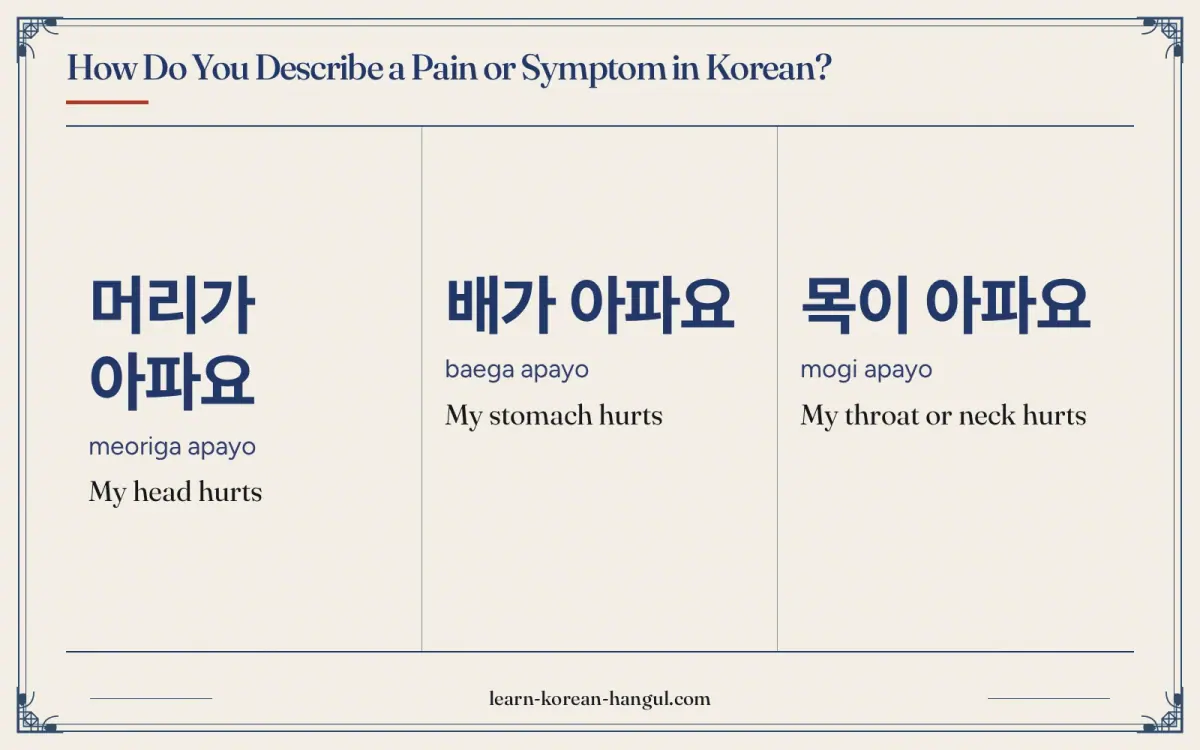
Name the body part, add the subject marker 이 or 가, then say 아파요 (apayo, hurts). The pattern is "body part + 이/가 + 아파요", and it works for almost every pain. Use 가 after a vowel and 이 after a consonant.
| Body part | Korean | Revised Romanization | Meaning |
|---|---|---|---|
| Head | 머리가 아파요 | meoriga apayo | My head hurts |
| Stomach | 배가 아파요 | baega apayo | My stomach hurts |
| Throat or neck | 목이 아파요 | mogi apayo | My throat or neck hurts |
| Back | 허리가 아파요 | heoriga apayo | My lower back hurts |
| Tooth | 이가 아파요 | iga apayo | My tooth hurts |
For symptoms that are not pains, Korean uses the verb 나다 (nada, to come out): 열이 나요 (yeori nayo) means "I have a fever", and 기침이 나요 (gichimi nayo) means "I am coughing". Never put an object marker on the body part: say 머리가 아파요, not 머리를 아파요.
One pattern covers dozens of situations. The next question is how polite to be while using it.
How Do You Choose between Formal, Polite and Casual Korean Medical Phrases?
Use the polite -요 style with doctors, nurses, pharmacists and hotel staff, and save the casual style for family and close friends. Korean marks the listener with three speech styles, explained in the guide to Korean speech levels.
| Situation | Style | Example |
|---|---|---|
| Doctor, nurse, pharmacist | Polite (해요체) | 배가 아파요 |
| Hospital form or written notice | Formal (합쇼체) | 두통이 있습니다 |
| Close friend or family member | Casual (반말) | 배가 아파 |
Name the body part, add 아파요, and the sentence is polite enough for any health worker. The right place to say it matters too, as the next section shows.
Where Should You Go First for a Minor Health Problem?
For a minor problem, go to a pharmacy (약국) first. Pharmacists can suggest medicine for colds, headaches and stomach upsets, and stronger medicine needs a doctor's prescription (처방전, cheobangjeon). Ask 약국이 어디예요? to find the nearest one.
- Pharmacy (약국): colds, small aches and stomach upsets.
- Clinic or hospital (병원): fever that does not go down, ongoing pain or a need for tests. Ask 병원이 어디예요?
- Emergency (119): serious injury, chest pain or loss of consciousness. Say 도와주세요 first, as covered in help in Korean, then give the place and the problem.
For urgent phrases such as calling an ambulance, use the Korean emergency phrases collection. Now the full list of guides follows.
All Korean Medical Phrases Guides
The list below has all 6 guides, each with its lead phrase and a short audio clip. The Korean phrases hub holds the other situation clusters, and Korean greetings cover the first words to say at any desk.
Start Here
I Have a Headache in Korean
The key phrase is 머리가 아파요 (meoriga apayo), which means "I have a headache."
I Have a Stomachache in Korean
The key phrase is 배가 아파요 (baega apayo), which means "I have a stomachache."
I Feel Dizzy in Korean
The key phrase is 어지러워요 (eojireowoyo), which means "I feel dizzy."
I Caught a Cold in Korean
The key phrase is 감기에 걸렸어요 (gamgie georyeosseoyo), which means "I caught a cold."
More Phrases
The remaining 2 guides are listed in the order a traveller is likely to need them.
I Need a Doctor in Korean
The key phrase is 의사가 필요해요 (uisaga piryohaeyo), which means "I need a doctor."
Where Is the Pharmacy in Korean
The key phrase is 약국이 어디예요? (yakgugi eodiyeyo), which means "where is the pharmacy?"
How Do You Practise Korean Medical Phrases?
Practise Korean medical phrases in three steps: listen, repeat, then choose. Play the clip on a guide once, say the phrase aloud twice, then decide which body part or situation it fits. The phrase flashcards drill this cluster with audio, and each guide ends with a short practice set with answers.
Start with the pattern: say 머리가 아파요, 배가 아파요 and 목이 아파요 until the 이/가 and 아파요 feel automatic. Then swap in your own body part. Practising aloud with a friend, one as patient and one as pharmacist, trains the exchange that happens in real life. After this cluster, continue with Korean greetings, because every medical visit begins with a greeting.
Common Mistakes with Korean Medical Phrases
Most mistakes come from using English word order, adding the wrong particle or going to the wrong place first.
| Mistake | Why it is a problem | Fix |
|---|---|---|
| 머리를 아파요 | The body part is the subject, not the object | Say 머리가 아파요 |
| Saying 의사 for hospital | 의사 is a doctor and 병원 is a hospital | Say 병원이 어디예요? |
| Going straight to a hospital for a cold | A pharmacy is faster for minor problems | Ask 약국이 어디예요? |
| Using casual 배가 아파 with a doctor | Casual speech is rude to a health worker | Say 배가 아파요 |
| Shouting 살려 주세요 for a headache | It means "save me" and is for danger only | Say 의사가 필요해요 |
On its own, 아파요 covers both "it hurts" and "I am sick", so a doctor will ask 어디가 아파요? (where does it hurt?). Answer with the body part, or say 몸이 안 좋아요 (I do not feel well) for a general unwell feeling with no single pain. Use these Korean medical phrases as a reference, and return to a guide whenever a symptom is unfamiliar.
Frequently Asked Questions
How do I say I am sick in Korean?
Say 아파요 (apayo, I am sick, it hurts) or 몸이 안 좋아요 (momi an joayo, I do not feel well). For a specific problem, name the body part first, as in 머리가 아파요 (my head hurts). Add 열이 나요 (yeori nayo, I have a fever) if you feel hot. Polite -요 endings suit doctors and pharmacists.
Where do I buy medicine in Korea?
Pharmacies (약국, yakguk) are the main place, and pharmacists can suggest medicine for colds, headaches and stomach upsets. Stronger medicine needs a doctor's prescription (처방전, cheobangjeon). A small set of basic medicines, such as common painkillers, is also sold at 24-hour convenience stores. Ask 약국이 어디예요? to find one.
How do I say I have a fever in Korean?
Say 열이 나요 (yeori nayo), which means "I have a fever". The verb 나다 means "to come out", so the fever "comes out". At a pharmacy, add 감기약 주세요 (gamgiyak juseyo, cold medicine, please). With a high fever, 의사가 필요해요 (I need a doctor) is the safer line, and 119 reaches an ambulance.
How do I find a hospital in Korean?
Ask 병원이 어디예요? (byeongwoni eodiyeyo, where is the hospital?). Hotel front desks can also name the nearest clinic. For an emergency, skip the question and say 구급차를 불러 주세요 (gugeupchareul bulleo juseyo, please call an ambulance), or phone 119 yourself and say 도와주세요 (please help me).
Can I use casual Korean with a doctor?
No. Use the polite -요 style with doctors, nurses and pharmacists, as in 배가 아파요. The casual style, 배가 아파, is for family and close friends. At a hospital reception, staff may use the formal -ㅂ니다 style, but you do not need to match it. Polite -요 is always safe.