여보세요? / 안녕하세요. 예약하고 싶은데요. / 네, 언제 오실 거예요? / 내일 두 시에 가능해요? / 네, 가능해요. 몇 분이세요? / 네 명이에요. / 알겠습니다. / 네, 감사합니다.
What you'll learn
- Shadow a booking call from answering to confirmation.
- Say 예약하고 as [예야카고], with an aspirated [카].
- Use the soft ending -(으)ㄴ데요 and a light rise on yes/no questions such as 가능해요?
- Tell 몇 분 (the honorific count for the other person) from 네 명 (your own group).
Before you start: you need to read Hangul and know the polite -요 ending. Level: A2. Time: about 20 minutes. If shadowing is new, read how to shadow Korean first. Audio plays only when you press a button.
Key facts
- -(으)ㄴ데요 ends a request softly, and it leaves the sentence open for the other person to respond.
What Does a Korean Booking Call Sound Like?
A Korean booking call is a short sequence in which the caller states a wish, the other side asks for details, and both confirm. The speakers cannot see each other, so every line is spoken a little more carefully and politely than in a face-to-face chat. You can find the meanings and extra phrases in Korean phone phrases.
For a listening version of the same situation, play the Korean phone call dialogue. Here you do the speaking: the set uses the plain all-purpose answer 여보세요, although a business often answers with its name, such as 한강 식당입니다.
The next question is why a short call is hard to copy.
Why Is This Hard for English Speakers?
Phone lines are hard because the polite softeners are almost invisible to English ears. English softens a request with "if possible" or a trailing "but...". Korean puts that softness into the ending -(으)ㄴ데요. There are also two sound traps in the first half of the call.
| What you see | What you hear | Why it surprises English speakers |
|---|---|---|
| 예약하고 | [예야카고] | ㄱ and ㅎ merge into an aspirated ㅋ, so there is no "ha" |
| 싶은데요 | [시픈데요] | The ㅍ of 싶 moves to 은 and gives [시픈] |
| 오실 거예요 | [오실꺼예요] | After the ending -ㄹ, the ㄱ of 거 turns tense |
| 몇 분이세요 | [멷뿌니세요] | 몇 closes as [ㄷ], 분 turns tense, and ㄴ moves to 이 |
The merge in 예약하고 is the aspiration rule of the standard pronunciation rules (표준 발음법) of the National Institute of Korean Language (국립국어원), Article 12, and the tensing follows Articles 23 and 27. Read more in Korean aspiration rule. Revised Romanization shows the aspirated sound in a predicate as yeyakago, but it does not show tensing that comes from a neighbouring sound, so the brackets here show the spoken form.
With the traps named, here is how a session runs.
How Does the Korean Shadowing Phone Calls Set Work?
The set works in four passes, and you speak both roles. The session takes about 20 minutes. The passes compress the six steps of how to shadow Korean into one session; for step 6, record your last pass and compare it with the audio.
- Listen and read (3 minutes). Play the normal clip once with the script. Mark every line that ends in a question mark.
- Shadow slowly (6 minutes). Use the slow player. Speak a beat behind and keep the softness of -(으)ㄴ데요.
- Shadow at normal speed (6 minutes). Keep going when you slip.
- Shadow without the script (5 minutes). Hide the text and run the call. Count the stumbles.
You will know it worked when the call sounds like two people taking turns, with no silence between lines. A common mistake is to speak only the caller's lines, which hides the honorific forms in the restaurant's lines.
여보세요? / 안녕하세요. 예약하고 싶은데요. / 네, 언제 오실 거예요? / 내일 두 시에 가능해요? / 네, 가능해요. 몇 분이세요? / 네 명이에요. / 알겠습니다. / 네, 감사합니다.
In the script, ↗ marks a light rise and ↘ marks a fall.
Script Lines 1 to 4
Lines 1 to 4 cover the answer, the wish, the question about time and the request.
여보세요 ↗
yeoboseyo
Hello? (restaurant)
안녕하세요. / 예약하고 싶은데요 ↗
annyeonghaseyo. yeyakago sipeundeyo
Hello. I would like to make a booking. (caller)
네, / 언제 오실 거예요 ↘
ne, eonje osil geoyeyo
Yes, when will you come? (restaurant)
내일 두 시에 / 가능해요 ↗
naeil du sie ganeunghaeyo
Is two o'clock tomorrow possible? (caller)
Lines 1 to 4 set up the request, so lines 5 to 8 confirm the details.
Script Lines 5 to 8
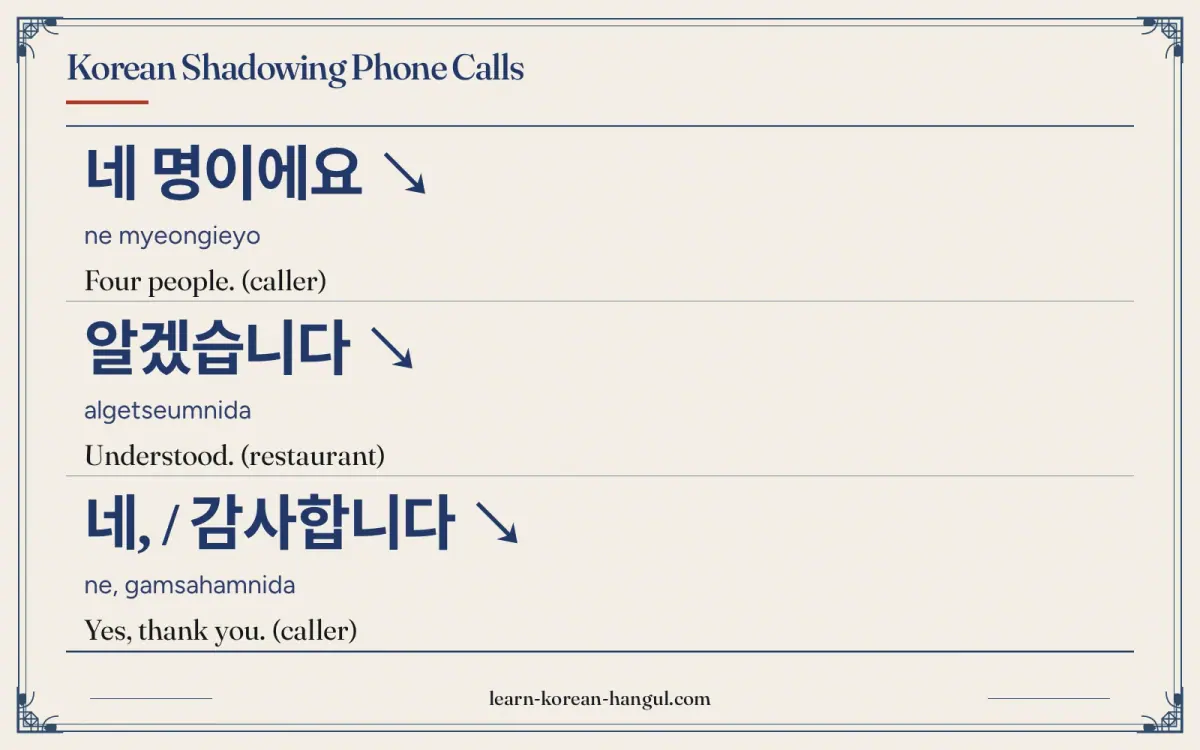
Lines 5 to 8 give the answer, the group size and the closing words.
네, 가능해요. / 몇 분이세요 ↘
ne, ganeunghaeyo. myeot buniseyo
Yes, it is possible. How many people? (restaurant)
네 명이에요 ↘
ne myeongieyo
Four people. (caller)
알겠습니다 ↘
algetseumnida
Understood. (restaurant)
네, / 감사합니다 ↘
ne, gamsahamnida
Yes, thank you. (caller)
The two counters in lines 5 and 6 are worth a closer look.
| Word | Who it counts | Style | Example |
|---|---|---|---|
| 분 | the other person's group | honorific | 몇 분이세요? |
| 명 | your own group or neutral | plain | 네 명이에요 |
What Is the Speed Ladder?
The speed ladder is a fixed order of speeds that you climb only when the step below feels easy. On a phone call the ladder protects the soft ending, because fast speech makes -(으)ㄴ데요 sound abrupt.
| Step | Speed | Script | Move up when |
|---|---|---|---|
| 1 | Slow (0.8x) | visible | you keep [예야카고] and the soft ending every time |
| 2 | Normal | visible | the turns join with no silent gap |
| 3 | Normal | hidden | you finish the call with few stumbles |
A stumble is a hesitation, a repeated syllable or a lost beat. If the ending turns blunt at normal speed, go back one step.
How Do I Check Myself?
Record the whole call, listen once and tick each point.
- Aspiration. Do you say [예야카고], not "ye-yak-ha-go"?
- Soft ending. Does 싶은데요 stay light and open instead of dropping firmly?
- Tense sound. Do you say [오실꺼예요]?
- Counters. Do you use 분 for the other person and 명 for your own group?
- Close. Does 감사합니다 end with a firm fall?
Fix one point per session.
Worked Example: 예약하고 싶은데요
Take the key request apart in four moves.
예약하고 싶은데요.
yeyakago sipeundeyo
I would like to make a booking.
- Hear it. You hear [예야카고 시픈데요], with the second word held light at the end.
- Split the written form. 예약하- (to book) + -고 싶- (want to) + -은데요 (soft sentence ending). So the sentence means "I would like to book (and I hope that works)".
- Match the sounds. ㄱ and ㅎ merge into ㅋ, which gives [카]. The ㅍ of 싶 moves to the next block, which gives [시픈].
- Shadow it. Speak a beat behind: "ye-ya-ka-go si-peun-de-yo", with a light lift or hold on 요.
Compare the soft request with a question about time, which also lifts lightly because it is a yes/no question.
Next, look at the slips learners make most often.
What Mistakes Do Learners Make Here?
Learners often assume that a polite request should end with a firm fall, as in English. Korean calls differ, and four slips are common.
- Saying 예약하고 as "ye-yak-ha-go". The spoken form is [예야카고].
- Dropping the pitch hard on 싶은데요. The ending is soft and open. A hard fall makes it sound like a demand.
- Counting the other person with 명. For the restaurant's question, 분 is the honorific counter. Use 명 for your own party.
- Skipping 안녕하세요. On the phone nobody can see you, so open with a greeting before the request.
Fixing these slips takes one more pass, so the practice below tests them.
Practice and Answer Key
Answer from memory, then check the key.
- How is 예약하고 pronounced?
- Which counter does the restaurant use when it asks about your group?
- How do you say "at two in the afternoon"?
- Which line should end with a firm fall: 싶은데요 or 감사합니다?
Answers
- [예야카고]
- 분, in 몇 분이세요?
- 오후 두 시에, with 오후 before the hour.
- 감사합니다. The soft 싶은데요 stays light.
Where to Go Next
Shadow the call again tomorrow with the script hidden. When the soft ending is steady, continue with Shadow Korean with kdramas, which moves from scripted sets to real scenes. To revisit the earlier set, go to Korean shadowing directions. For the hour words, see telling time in Korean. Pitch is explained in Korean intonation, and more scripts are in Korean shadowing.
What this set does not cover. It does not teach the full phone vocabulary, such as wrong-number phrases or voicemail, which have their own pages. The audio is generated by text-to-speech and checked by a Korean teacher before publication, so a real call may be faster and noisier. Shadowing builds rhythm and sound, not new vocabulary.
Return to this Korean shadowing phone calls set whenever a call line starts to sound blunt.
Frequently Asked Questions
Why is 예약하고 said [예야카고]?
When a final ㄱ meets ㅎ, the two sounds merge into an aspirated ㅋ. In 예약하고, the ㄱ of 약 and the ㅎ of 하 become [카], so the word is spoken 예야카고. Revised Romanization shows this in predicates as yeyakago. The spelling stays 예약하고 because the stem is 예약하-.
What does -는데요 do?
It makes a sentence soft and open. 예약하고 싶은데요 states a wish without pressing, and it invites the other person to answer. English would add "but" or "if possible". After a verb the ending is -는데요, after an adjective with a final consonant it is -은데요, as in 싶은데요, and in the past it is -었는데요.
Does the call end with a rise?
Not always. Yes/no questions, such as 가능해요?, and the soft 싶은데요 lift or hold lightly. Wh-questions, such as 언제 오실 거예요?, and closing lines, such as 감사합니다, fall. The last line of the call should land with a firm, gentle fall so that it sounds finished and polite.
How do I say 'at two in the afternoon'?
Say 오후 두 시에. Put 오후, meaning afternoon, before the hour, then the native number 두 for two, then 시 for o'clock, and the particle 에 for "at". Say it as [오후 두 시에], with a plain 시. For two in the morning, replace 오후 with 오전.