어서 오세요. 몇 분이세요? / 두 명이에요. / 이쪽으로 앉으세요. 주문하시겠어요? / 비빔밥 하나, 김치찌개 하나 주세요. / 네. 매운 음식 괜찮으세요? / 맵지 않게 해 주세요. 그리고 저는 땅콩 알레르기가 있어요. / 알겠습니다. 주방에 말씀드릴게요. / 감사합니다. 물도 좀 주세요. / 네, 맛있게 드세요. / 잘 먹었습니다. 계산은 따로 해 주세요. / 네, 따로 계산해 드릴게요. 카드로 하시겠어요? / 네, 카드로 할게요.
What you'll learn
- Give the party size with 두 명이에요 after the server's 몇 분이세요?
- Order with a noun, a number and 주세요.
- Ask for a mild dish with 맵지 않게 해 주세요 and state an allergy.
- Ask for separate bills with 계산은 따로 해 주세요.
Before you start: you need to read Hangul, know the native numbers one to four and have heard the Korean restaurant dialogue audio. Time: about 20 minutes. Level: A2.
What Is Korean Restaurant Role Play?
A Korean restaurant role play is a practice conversation in which you play a diner and a partner or the audio plays the server. The script covers a full visit: the greeting, the table, the order, special requests and the bill. A role play differs from a listening dialogue because you must produce the diner's lines aloud, not just follow them.
Two parts of this script matter more than the rest, because mistakes there have real consequences. One is the spice request. The other is the allergy turn, which is a safety sentence. Both are practised in turn 6, together with the vocabulary in Korean restaurant phrases.
First, see why this visit is harder than ordering in English.
Why Is This Hard for English Speakers?
English restaurant talk is built from "I'll have" and "I'm allergic to", but Korean uses different structures for each request. Five habits cause trouble.
| English | Korean | Why it feels strange |
|---|---|---|
| "A table for two" | 두 명이에요 (du myeongieyo) | The counter 명 follows the number, and the server says 분 for the same people |
| "I'll have the bibimbap" | 비빔밥 하나 주세요 (bibimbap hana juseyo) | The number comes after the noun, then 주세요 "please give" |
| "Not spicy, please" | 맵지 않게 해 주세요 (maepji anke hae juseyo) | Korean says "please make it so it is not spicy" |
| "I'm allergic to peanuts" | 땅콩 알레르기가 있어요 (ttangkong allereugiga isseoyo) | Korean says "there is a peanut allergy" with 있어요 |
| "Separate checks" | 계산은 따로 해 주세요 (gyesaneun ttaro hae juseyo) | 따로 means "separately" |
The counters deserve a closer look. A server asks 몇 분이세요? with 분, the honorific counter for people, but you answer with 명, the plain counter, because you do not raise yourself. Both take the native number 두. The counter is covered in Korean counter for people.
Now the practice routine.
How Does the Role Play Work?
You say the diner's twelve-turn script twice, with a new order in round two.
- Listen once to the whole role play without reading.
- Read the server's lines aloud and answer as the diner from the model answers.
- Cover the diner's lines and answer from the prompt card.
- Swap roles so you also say the server's honorific lines.
- Record round two and compare it with the audio.
- Score yourself with the rubric.
If you practise alone, say the server's line, pause, and then say the diner's reply. The slip to avoid is skipping the allergy turn because it feels awkward. It is the most useful turn on the page.
Role a and Role B Prompt Cards
The cards change the party size, the dishes and the allergy so that you practise the pattern, not one script.
| Role A (diner), round one | Role A (diner), round two | Role B (server) | |
|---|---|---|---|
| People | 두 명 (du myeong) | 세 명 (se myeong) | Asks 몇 분이세요? |
| Order | 비빔밥 하나, 김치찌개 하나 | 불고기 이 인분, 된장찌개 하나 | Asks 주문하시겠어요? |
| Spice | 맵지 않게 | 조금 맵게 (jogeum maepge) | Asks 매운 음식 괜찮으세요? |
| Allergy | 땅콩 (ttangkong, peanut) | 새우 (saeu, shrimp) | Replies with a promise to tell the kitchen |
| Bill | 따로 (ttaro, separately) | 같이 (gachi, together) | Asks 카드로 하시겠어요? |
More allergy words: 우유 (uyu, milk), 계란 (gyeran, egg), 밀 (mil, wheat) and 콩 (kong, soy or beans). In round two, a party of three says 세 명이에요, with 세 as the native "three" before a counter.
Model Answers and Alternatives
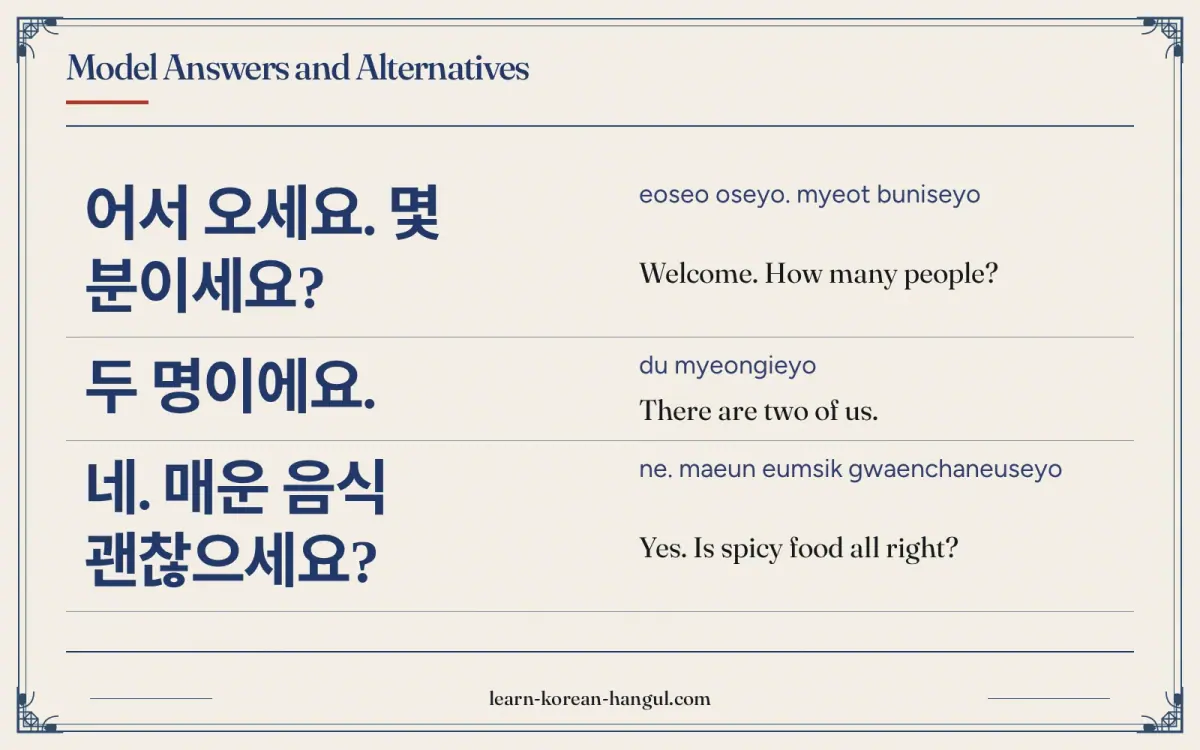
Here is the whole role play. Each turn has its own clip, so shadow one at a time.
Ordering a Meal with a Spice and Allergy Request
Server (B)
어서 오세요. 몇 분이세요?
eoseo oseyo. myeot buniseyo
Welcome. How many people?
Diner (A)
두 명이에요.
du myeongieyo
There are two of us.
Server (B)
이쪽으로 앉으세요. 주문하시겠어요?
ijjogeuro anjeuseyo. jumunhasigesseoyo
Please sit this way. Would you like to order?
Diner (A)
비빔밥 하나, 김치찌개 하나 주세요.
bibimbap hana, gimchijjigae hana juseyo
One bibimbap and one kimchi stew, please.
Server (B)
네. 매운 음식 괜찮으세요?
ne. maeun eumsik gwaenchaneuseyo
Yes. Is spicy food all right?
Diner (A)
맵지 않게 해 주세요. 그리고 저는 땅콩 알레르기가 있어요.
maepji anke hae juseyo. geurigo jeoneun ttangkong allereugiga isseoyo
Please make it not spicy. Also, I have a peanut allergy.
Server (B)
알겠습니다. 주방에 말씀드릴게요.
algetseumnida. jubange malsseumdeurilgeyo
Understood. I will tell the kitchen.
Diner (A)
감사합니다. 물도 좀 주세요.
gamsahamnida. muldo jom juseyo
Thank you. Some water too, please.
Server (B)
네, 맛있게 드세요.
ne, masitge deuseyo
Yes, enjoy your meal.
Diner (A)
잘 먹었습니다. 계산은 따로 해 주세요.
jal meogeotseumnida. gyesaneun ttaro hae juseyo
Thank you for the meal (at the counter, after eating). Separate bills, please.
Server (B)
네, 따로 계산해 드릴게요. 카드로 하시겠어요?
ne, ttaro gyesanhae deurilgeyo. kadeuro hasigesseoyo
Yes, I will do separate bills. Will you pay by card?
Diner (A)
네, 카드로 할게요.
ne, kadeuro halgeyo
Yes, I will pay by card.
Swap parts of the diner's turns for these alternatives.
| Turn | Model | Alternative |
|---|---|---|
| 2 | 두 명이에요. | 세 명이에요. |
| 4 | 비빔밥 하나, 김치찌개 하나 주세요. | 불고기 이 인분 주세요. |
| 6 | 맵지 않게 해 주세요. | 조금 맵게 해 주세요. |
| 6 | 저는 땅콩 알레르기가 있어요. | 저는 새우 알레르기가 있어요. |
| 10 | 계산은 따로 해 주세요. | 계산은 같이 해 주세요. |
Turn 10 happens after the meal, at the counter, so there is a jump in time. 불고기 이 인분 uses the Sino-Korean 이 with 인분, "portion". The server's 말씀드릴게요 in turn 7 is humble: 말씀드리다 is the humble verb for telling someone, built from 말씀 (speech) and the humble 드리다 (give), so the server lowers themselves. The server's 매운 in turn 5 is the modifier of the adjective 맵다, "spicy".
A safety note. A short sentence does not guarantee a safe meal. Say your allergy before you order, point to the word written on your phone if you can, and ask again when the dish arrives. Kitchens can use the same pan or oil for different dishes, and this page cannot know what a particular restaurant does.
The Self-Check Rubric
Score yourself with the same four-part rubric as every speaking page: 0, 1 or 2 points per part, for a total out of 8.
| Part | What to check on this page | 0 | 1 | 2 |
|---|---|---|---|---|
| Sounds | [비빔빱], [맵찌 안케] and [할께요] | Often not understood | Understood with effort | Clear, with small slips |
| Flow | Twelve turns with no long gaps | Long pauses inside sentences | Pauses between sentences | Steady, natural pace |
| Form | 명 not 분 for yourself, -지 않게 해 주세요, 있어요 for the allergy | Endings or particles often missing | Mostly correct -요 forms | Correct throughout |
| Task | Party size, order, spice, allergy and bill, all five | Not completed | Completed with the script | Completed without the script |
Six or more in round two means you can move on. Under five means round one again tomorrow. A score of exactly five means one more practice round before you move on. A self-score is a rough guide, so ask a partner to check your Sounds row now and then.
What to Do after the Role Play
Say the allergy turn again with a word that is true for you, even if you have no allergy, so that the sentence feels natural. Then shadow the server's lines until you can understand them at the pace of the audio. Finally, try the shopping role play, which uses 주세요 in a new setting. If ordering still feels slow, review the Korean coffee order role play, which uses the same 주세요 pattern in a cafe.
Which Sound Changes Are Hidden in the Role Play?
Four spellings sound different from what you read. Listen to each, then say it twice.
In 비빔밥 the last syllable is said tense, [비빔빱]. Revised Romanization writes bibimbap, because it does not show tensing caused by a sound change. In 맵지 않게 the ㅈ after ㅂ is tense, and the ㅎ of 않 joins the ㄱ to make one ㅋ sound, so you hear [맵찌 안케] and Revised Romanization writes maepji anke. In 괜찮으세요 the ㅎ is silent before a vowel, giving [괜차느세요]. In 할게요 the ㄱ after ㄹ is tense, [할께요]. Revised Romanization writes halgeyo. These rules come from the standard pronunciation rules (표준 발음법) of the National Institute of Korean Language (국립국어원).
Worked Example: 두 명이에요.
The first answer shows how Korean counts people.
두 명이에요.
du myeongieyo
There are two of us.
- Read the number. 두 is the native "two" before a counter.
- Read the counter. 명 counts people plainly.
- Read the ending. 이에요 follows 명 because 명 ends in a consonant.
The spice request needs a longer pattern.
맵지 않게 해 주세요.
maepji anke hae juseyo
Please make it not spicy.
- Build the first part. 맵다 (to be spicy) plus -지 않다 (not) makes 맵지 않다. Adding -게 gives "so that it is not spicy".
- Add the request. 해 주세요 means "please do it for me", from 하다 and 주세요.
The bill request is shorter.
계산은 따로 해 주세요.
gyesaneun ttaro hae juseyo
Please do separate bills.
- Read 계산은. 계산 is "calculation" or "paying a bill", and 은 marks it as the topic.
- Read 따로. It means "separately". Its opposite is 같이, "together".
Finally the safety sentence.
저는 땅콩 알레르기가 있어요.
jeoneun ttangkong allereugiga isseoyo
I have a peanut allergy.
- Read the allergen. 땅콩 is peanut. Swap it for 새우 or 우유.
- Read 알레르기가 있어요. Literally, "there is an allergy". The subject particle 가 follows 알레르기 because it ends in a vowel.
What Mistakes Do Learners Make Here?
Learners often assume the two people counters are interchangeable, but 분 raises the person and 명 does not. Five slips are common.
- Answering 두 분이에요. Use 두 명이에요 for yourself.
- Saying 맵지 않아요 for the request. That means "it is not spicy" as a fact. The request is 맵지 않게 해 주세요.
- Saying 알레르기예요. That means "I am an allergy". Say 알레르기가 있어요.
- Saying 이 명 for two people. People take native numbers, so say 두 명. Only 인분 takes the Sino-Korean 이.
- Waiting silently for the server. Call staff with 저기요 or press the table bell if there is one.
Test these in the practice set.
Practice and Answer Key
- How do you tell the server there are three of you?
- How do you ask for a dish that is not spicy?
- Say "I have a shrimp allergy."
- How do you ask for separate bills?
- Which counter does the server use for people, 분 or 명?
Answers
- 세 명이에요.
- 맵지 않게 해 주세요.
- 저는 새우 알레르기가 있어요.
- 계산은 따로 해 주세요.
- 분 (the honorific counter).
Where to Go Next
Play the role play again tomorrow, cover the English column and change the order. When it feels easy, continue with Korean shopping role play, which moves from food to prices. To go back a step, review the Korean coffee order role play. All role plays are in Korean conversation practice, and similar listening practice is in Korean audio dialogues.
What this page does not cover. It does not cover ordering by tablet, grilling at the table or medical-level allergy advice.
Frequently Asked Questions
How do I say there are two of us?
Say 두 명이에요 (du myeongieyo). 두 is the native number "two" and 명 is the plain counter for people. The server will ask 몇 분이세요? with the honorific counter 분, but you do not use 분 for yourself. For three people say 세 명이에요 and for four say 네 명이에요.
How do I ask for no spice?
Say 맵지 않게 해 주세요 (maepji anke hae juseyo), "Please make it not spicy". You can also say 안 맵게 해 주세요. For a little heat, say 조금 맵게 해 주세요. Some dishes are cooked spicy by default, so asking before you order is more reliable than asking afterwards.
How do I split the bill?
Say 계산은 따로 해 주세요 (gyesaneun ttaro hae juseyo), "Please do the bills separately". 따로 means "separately", and 같이 means "together". Many Korean restaurants have one payment counter and may ask you to pay together, so say it at the counter, not at the table.
How do I mention an allergy?
Say the food and then 알레르기가 있어요: 저는 땅콩 알레르기가 있어요, "I have a peanut allergy". Say it before you order, and ask 땅콩 들어가요? ("Is there peanut in it?") for a specific dish. This is a communication aid, not a guarantee, so confirm with the staff again.