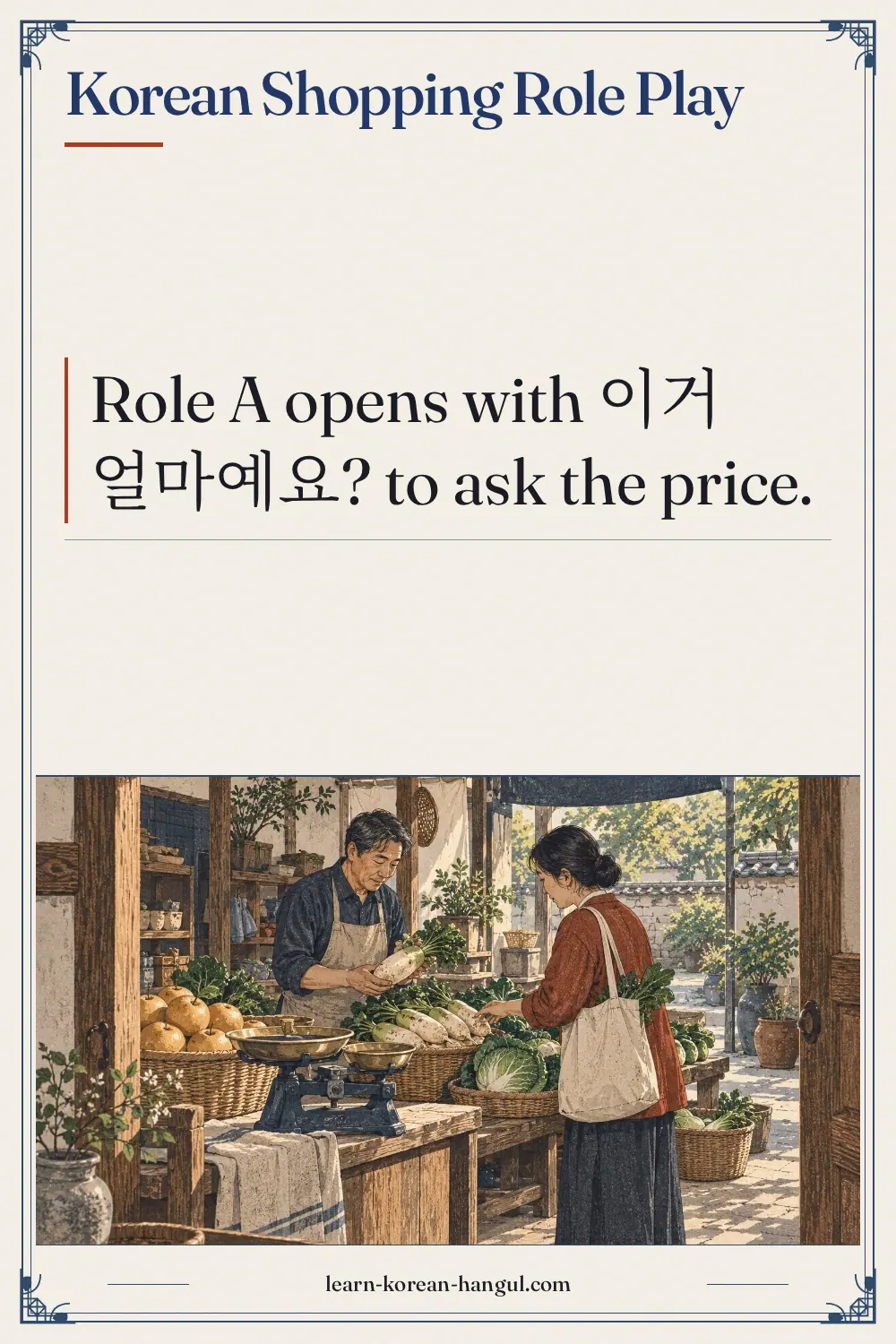
어서 오세요. / 저기요, 이거 얼마예요? / 만 이천 원이에요. / 다른 색 있어요? / 네, 파란색이랑 검은색 있어요. / 파란색 좀 보여 주세요. / 네, 여기 있어요. 사이즈가 어떻게 되세요? / 중간 사이즈요. 좀 깎아 주세요. / 음, 만 원에 드릴게요. 카드로 하시겠어요? / 네, 카드로 할게요. 영수증도 주세요.
What you'll learn
- Ask a price with 이거 얼마예요? and understand answers such as 만 이천 원.
- Ask for another colour with 다른 색 있어요?
- Ask politely for a discount with 좀 깎아 주세요, and know when it is acceptable.
- Pay by card and ask for a receipt.
Before you start: you need to read Hangul and know the Sino-Korean numbers up to ten thousand. Time: about 20 minutes. Level: A2.
What Is Korean Shopping Role Play?
A Korean shopping role play is a practice conversation in which you play a customer and a partner, or the audio, plays the shop assistant. The script is short but dense. It has a price question, a stock question, a request, a size, a discount and a payment, so it covers most of what you say in a small shop.
The words are listed in Korean shopping phrases, and the number system behind the prices is in Korean money numbers. If you want to hear the exchange first, play the Korean shopping dialogue audio. This page asks you to say it.
First, see why prices and requests are tricky.
Why Is This Hard for English Speakers?
English prices are counted in thousands, but Korean counts in ten-thousands. Requests also work differently. Four habits cause the most trouble.
| English habit | Korean pattern | Example |
|---|---|---|
| "Twelve thousand" groups by thousands | Korean groups by 만 (10,000) | 만 이천 원 (man icheon won) |
| "Do you have another colour?" uses "have" | Korean asks "Is there another colour?" | 다른 색 있어요? (dareun saek isseoyo) |
| "Can I have a discount?" is a question | Korean makes a polite request | 좀 깎아 주세요 (jom kkakka juseyo) |
| "Show me" is a command | Korean adds 주세요 to soften it | 보여 주세요 (boyeo juseyo) |
The first row is the hardest to hear. 만 is one short syllable, and a learner who misses it hears 이천 원, 2,000, instead of 만 이천 원, 12,000. Listen for 만 first, then for the thousands. In the second row, 있어요 means both "there is" and "have". And in the third, 좀 means "a little", and it makes a request gentler.
Next comes the plan for the practice.
How Does the Role Play Work?
You say the customer's ten turns twice, with a different item in round two.
- Listen once to the whole role play and write the final price in digits.
- Read the assistant's lines aloud and answer as the customer from the model answers.
- Cover the customer's lines and answer from your prompt card.
- Swap roles and say the assistant's lines, including the prices.
- Record round two and compare it with the audio.
- Score yourself with the rubric.
The most useful skill is hearing the price. Pause after turn 3 and write the number, then check it. Practising alone, you can read the prices in the table below aloud and write the digits as a self-test.
Role a and Role B Prompt Cards
The cards change the item, the price, the colour and the payment, so that you practise the pattern and not one script.
| Role A (customer), round one | Role A (customer), round two | Role B (assistant) | |
|---|---|---|---|
| Item | 셔츠 (syeocheu, shirt) | 가방 (gabang, bag) | Says the price |
| Price | 만 이천 원 → 만 원 | 삼만 오천 원 → 삼만 원 | Offers a small discount |
| Colour | 파란색 (paransaek) | 흰색 (huinsaek) | Lists two colours |
| Size | 중간 (junggan, medium) | 큰 (keun, large) | Asks the size |
| Payment | 카드 (kadeu, card) | 현금 (hyeongeum, cash) | Asks how you will pay |
Prices to practise reading aloud:
| Digits | Korean | Revised Romanization |
|---|---|---|
| 10,000 | 만 원 | man won |
| 12,000 | 만 이천 원 | man icheon won |
| 23,000 | 이만 삼천 원 | iman samcheon won |
| 35,000 | 삼만 오천 원 | samman ocheon won |
| 150,000 | 십오만 원 | siboman won |
Colours: 빨간색 (ppalgansaek, red), 파란색 (paransaek, blue), 검은색 (geomeunsaek, black), 흰색 (huinsaek, white), 노란색 (noransaek, yellow), 초록색 (choroksaek, green).
Model Answers and Alternatives
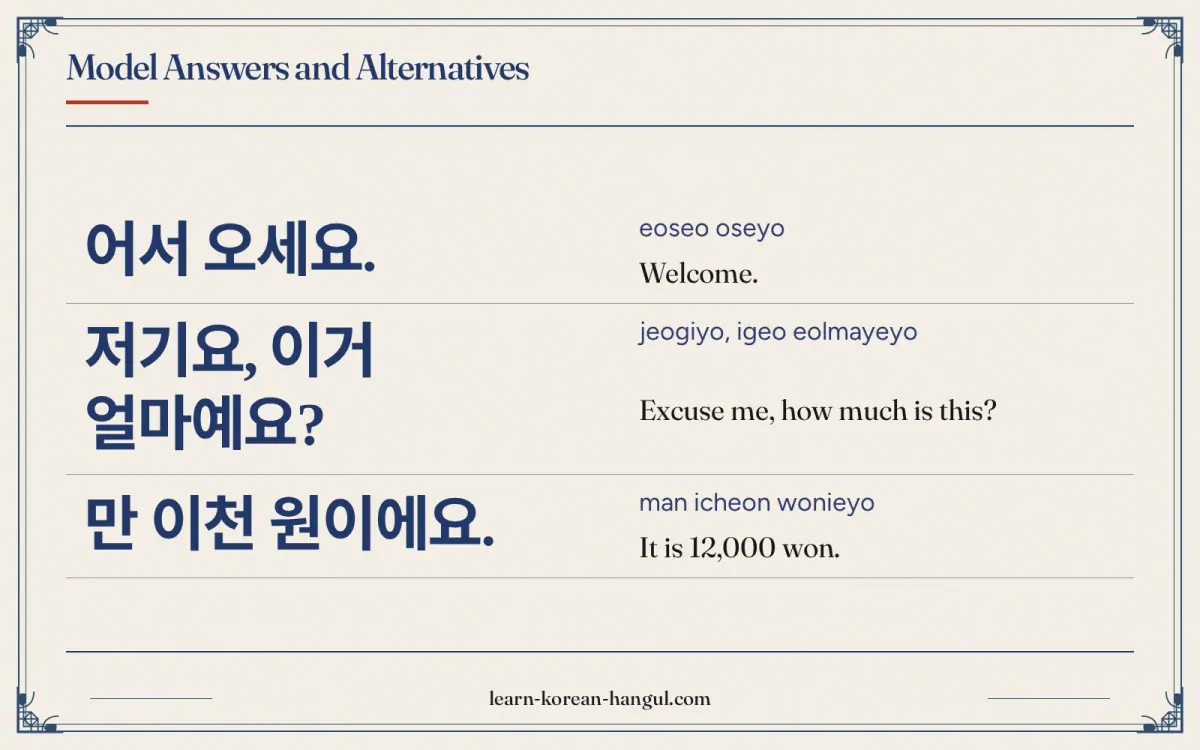
Here is the whole role play. Each turn has its own clip, so shadow one at a time.
Buying a Shirt and Asking for a Discount
Assistant (B)
어서 오세요.
eoseo oseyo
Welcome.
Customer (A)
저기요, 이거 얼마예요?
jeogiyo, igeo eolmayeyo
Excuse me, how much is this?
Assistant (B)
만 이천 원이에요.
man icheon wonieyo
It is 12,000 won.
Customer (A)
다른 색 있어요?
dareun saek isseoyo
Do you have another colour?
Assistant (B)
네, 파란색이랑 검은색 있어요.
ne, paransaegirang geomeunsaek isseoyo
Yes, we have blue and black.
Customer (A)
파란색 좀 보여 주세요.
paransaek jom boyeo juseyo
Please show me the blue one.
Assistant (B)
네, 여기 있어요. 사이즈가 어떻게 되세요?
ne, yeogi isseoyo. saijeuga eotteoke doeseyo
Here you are. What is your size?
Customer (A)
중간 사이즈요. 좀 깎아 주세요.
junggan saijeuyo. jom kkakka juseyo
Medium. Please give me a discount.
Assistant (B)
음, 만 원에 드릴게요. 카드로 하시겠어요?
eum, man wone deurilgeyo. kadeuro hasigesseoyo
Hmm, I will give it to you for 10,000 won. Will you pay by card?
Customer (A)
네, 카드로 할게요. 영수증도 주세요.
ne, kadeuro halgeyo. yeongsujeungdo juseyo
Yes, I will pay by card. A receipt too, please.
Swap parts of the customer's turns for these alternatives.
| Turn | Model | Alternative |
|---|---|---|
| 4 | 다른 색 있어요? | 더 큰 사이즈 있어요? |
| 6 | 파란색 좀 보여 주세요. | 흰색 좀 보여 주세요. |
| 8 | 좀 깎아 주세요. | 좀 싸게 해 주세요. |
| 10 | 카드로 할게요. | 현금으로 할게요. |
좀 싸게 해 주세요 (jom ssage hae juseyo) means "please make it a bit cheaper" and is a softer way to ask for a discount. The assistant's 드릴게요 in turn 9 is the humble "I will give", the same verb 드리다 that servers use.
When bargaining is appropriate. Asking for a discount is common in traditional markets (시장) and at small stalls. It is not usual in department stores, convenience stores or most chain shops, where prices are fixed. Ask once, with a smile, and accept a refusal. A reply of 안 돼요 ("I can't") or 정가예요 ("it is the set price") means the price will not change.
The Self-Check Rubric
Score yourself with the same four-part rubric as every speaking page: 0, 1 or 2 points per part, for a total out of 8.
| Part | What to check on this page | 0 | 1 | 2 |
|---|---|---|---|---|
| Sounds | [까까] for 깎아 and the linked [마눠네] | Often not understood | Understood with effort | Clear, with small slips |
| Flow | Ten turns, with prices said without stopping | Long pauses inside sentences | Pauses between sentences | Steady, natural pace |
| Form | 있어요 for stock, 주세요 and -아/어 주세요 for requests | Endings or particles often missing | Mostly correct -요 forms | Correct throughout |
| Task | Price, colour, size, discount, payment and receipt | Not completed | Completed with the script | Completed without the script |
Six or more in round two means you can move on. Under five means round one again tomorrow. A score of exactly five means one more practice round before you move on. A self-score is a rough guide, so ask a partner to check your price reading now and then.
What to Do after the Role Play
Say each price in the table aloud, then cover the Korean and say it from the digits. After that, change the item and the colour and run turns 2 to 6 again from memory. Finally, try the directions role play, which is the next page on the ladder. If the large numbers still slow you down, go back to Korean money numbers and read the price table again.
Which Sound Changes Are Hidden in the Role Play?
Four spellings sound different from what you read. Listen to each, then say it twice.
In 만 원에 [마눠네], the ㄴ of 만 moves onto 원, and the ㄴ of 원 moves onto 에. In 깎아 [까까], the double ㄲ is a tense sound that links to the vowel, and Revised Romanization writes kkakka. In 색 있어요 [새기써요], the final ㄱ links to the vowel of 있어요, and the ㅆ stays tense. In 검은색 [거믄색], the ㅁ links to the 은, and the ㅡ is said without rounding the lips. These rules come from the standard pronunciation rules (표준 발음법) of the National Institute of Korean Language (국립국어원).
Worked Example: 이거 얼마예요?
The first question is a pattern you can use for anything with a price.
이거 얼마예요?
igeo eolmayeyo
How much is this?
- Read 이거. It is the spoken short form of 이것, "this thing".
- Read 얼마. It means "how much".
- Read 예요. It is the polite "is" after a vowel. This is a wh-question, so it does not end with a sharp rise; it falls or rise-falls.
Point at the item and use 저거 (jeogeo, that over there) or 그거 (geugeo, that near you) for other positions.
The discount request has a different shape.
좀 깎아 주세요.
jom kkakka juseyo
Please give me a discount.
- Read 좀. It means "a little" and softens the request.
- Read 깎아. 깎다 means "to cut or reduce", and 깎아 is the linking form.
- Read 주세요. It means "please give". Together, 깎아 주세요 is "please reduce it for me".
Next, the stock question.
다른 색 있어요?
dareun saek isseoyo
Do you have another colour?
- Read 다른 색. 다른 means "other", and 색 means "colour".
- Read 있어요. Here it means "is there". A rising pitch shows a yes/no question.
Finally, the number that matters.
만 이천 원이에요.
man icheon wonieyo
It is 12,000 won.
- Split the number. 만 is 10,000 and 이천 is 2,000. Do not say 일만, because spoken prices drop 일 before 만.
- Add the unit. 원 is won, and 이에요 follows it because 원 ends in a consonant.
What Mistakes Do Learners Make Here?
Learners often assume that Korean prices work like English ones, but Korean groups by 만. Five slips are common.
- Missing the 만. 만 이천 원 is 12,000, and 이천 원 is 2,000. Listen for 만 first.
- Saying 일만 원 for 10,000. Say 만 원.
- Using native numbers for money. Prices use Sino-Korean numbers, so 2,000 won is 이천 원, never 두천 원.
- Asking 깎아 주세요 in a fixed-price shop. It can sound out of place. Check whether the prices are fixed.
- Leaving out 좀. 깎아 주세요 alone is blunt. Add 좀 and a smile.
Test these in the practice set.
Practice and Answer Key
- Ask the price of the item you are pointing at.
- Ask if the shop has another colour.
- Say "Please show me the white one."
- Write 23,000 won in Korean.
- Say "Please give me a discount" politely.
Answers
- 이거 얼마예요?
- 다른 색 있어요?
- 흰색 좀 보여 주세요.
- 이만 삼천 원.
- 좀 깎아 주세요.
Where to Go Next
Play the role play again tomorrow, cover the English column and write the prices you hear. When it feels easy, continue with Korean directions role play, which moves from the shop to the street. To go back a step, review the Korean restaurant role play. All role plays are in Korean conversation practice, and similar listening practice is in Korean audio dialogues.
What this page does not cover. It does not cover refunds, online shopping or tax-free forms.
Frequently Asked Questions
Can I bargain in every shop?
No. Asking for a discount is common in traditional markets and at small stalls, but department stores, convenience stores and most chain shops have fixed prices. Ask once, politely, with 좀 깎아 주세요, and accept a refusal. If the price is clearly printed on a tag and the staff wear uniforms, do not ask.
How do I say a price like 만 이천 원 in digits?
만 이천 원 is 12,000 won. 만 is 10,000 and 이천 is 2,000, so you add them. In speech, 10,000 is just 만, not 일만 (일만 appears only in some formal written documents). Likewise 이만 삼천 원 is 23,000 and 삼만 오천 원 is 35,000. Learn to hear 만 first and the thousands second.
What does 깎아 주세요 mean?
깎아 주세요 means "please reduce it for me". 깎다 is "to cut", and in shopping it means to take money off the price. 주세요 adds the polite request. Adding 좀 ("a little") makes it gentler. A softer alternative is 좀 싸게 해 주세요, "please make it a bit cheaper".
How do I ask for a different colour?
Ask 다른 색 있어요? (dareun saek isseoyo), "Is there another colour?". If you know the colour, name it and add 좀 보여 주세요: 파란색 좀 보여 주세요, "Please show me the blue one". The word 색 means "colour" and many colour names end in it, such as 파란색 and 검은색.