두 명이에요. / 메뉴판 좀 주세요. / 뭐가 맛있어요? / 비빔밥 하나 주세요. / 물도 좀 주세요. / 덜 맵게 해 주세요. / 계산해 주세요. / 잘 먹었습니다.
What you'll learn
- Shadow a full ordering sequence, from sitting down to paying, in order.
- Use 좀 as a softener and 주세요 as a polite request.
- Say 비빔밥 as [비빔빱] and 맛있어요 as [마시써요].
- Keep a falling pitch on the wh-question 뭐가 맛있어요?
Before you start: you need to read Hangul and know the polite -요 ending. Level: A1. Time: about 20 minutes. If shadowing is new, read how to shadow Korean first. Audio plays only when you press a button.
Key facts
- 비빔밥 하나 주세요 uses the native number 하나 after the dish.
What Does a Korean Restaurant Order Sound Like?
A Korean restaurant order is a chain of short requests, and almost every request ends in 주세요 ("please give me"). The set follows the real sequence: say how many people, ask for the menu, ask what is good, order, add water, adjust the dish, pay and thank. You can find the meanings and the extra phrases in Korean restaurant phrases.
The set matches the listening task in the Korean restaurant dialogue audio, so you can hear the server's side there. If you want to read a real menu before you order, see how to read a Korean menu.
First, look at why these short requests are hard to copy by ear.
Why Is This Hard for English Speakers?
Restaurant lines are hard for English speakers because the sounds of plain and tense consonants differ in ways English does not mark. English speakers hear 비빔밥 with a plain "b", but Korean has three different ㅂ sounds in it. The set also has a softener, 좀, that English handles with tone and the word "please".
| What you see | What you hear | Why it surprises English speakers |
|---|---|---|
| 비빔밥 | [비빔빱] | The middle ㅂ is voiced like "b", and the final syllable is tense and closed |
| 맛있어요 | [마시써요] | The ㅅ of 맛 moves to the next block, and [마디써요] is also standard |
| 맵게 | [맵께] | After a closed ㅂ, ㄱ turns tense |
| 먹었습니다 | [머걷씀니다] | ㅆ closes as [ㄷ], ㅅ turns tense, and ㅂ becomes nasal [ㅁ] |
The tensing after ㅂ in 맵게 and in the last syllable of 비빔밥 is covered by Article 23 of the standard pronunciation rules (표준 발음법) of the National Institute of Korean Language (국립국어원). Read more in Korean tensification. Revised Romanization follows the pronunciation, as in meogeotseumnida, but it does not show tensing that comes from a neighbouring sound, so the brackets here show the spoken form. The three-way contrast in the consonants is explained in plain, tense and aspirated sounds.
With the traps named, here is how a session runs.
How Does the Korean Shadowing Ordering Food Set Work?
The set works in four passes. The whole session takes about 20 minutes. The passes compress the six steps of how to shadow Korean into one session; for step 6, record your last pass and compare it with the audio.
- Listen and read (3 minutes). Play the normal clip once with the script in view. Mark the lines that end in 주세요.
- Shadow slowly (6 minutes). Use the slow player. Speak a beat behind the voice, line by line.
- Shadow at normal speed (6 minutes). Keep going when you slip; do not restart.
- Shadow without the script (5 minutes). Hide the text and say the whole sequence. Count the stumbles.
You will know it worked when you can run from 두 명이에요 to 잘 먹었습니다 without looking at the script. A common mistake is saying every request with a rising tone, as in English. Korean requests end with a gentle fall.
두 명이에요. / 메뉴판 좀 주세요. / 뭐가 맛있어요? / 비빔밥 하나 주세요. / 물도 좀 주세요. / 덜 맵게 해 주세요. / 계산해 주세요. / 잘 먹었습니다.
The script marks a gentle fall with ↘ and a falling question with ↘ as well, because Korean wh-questions do not end with a sharp rise.
Script Lines 1 to 4
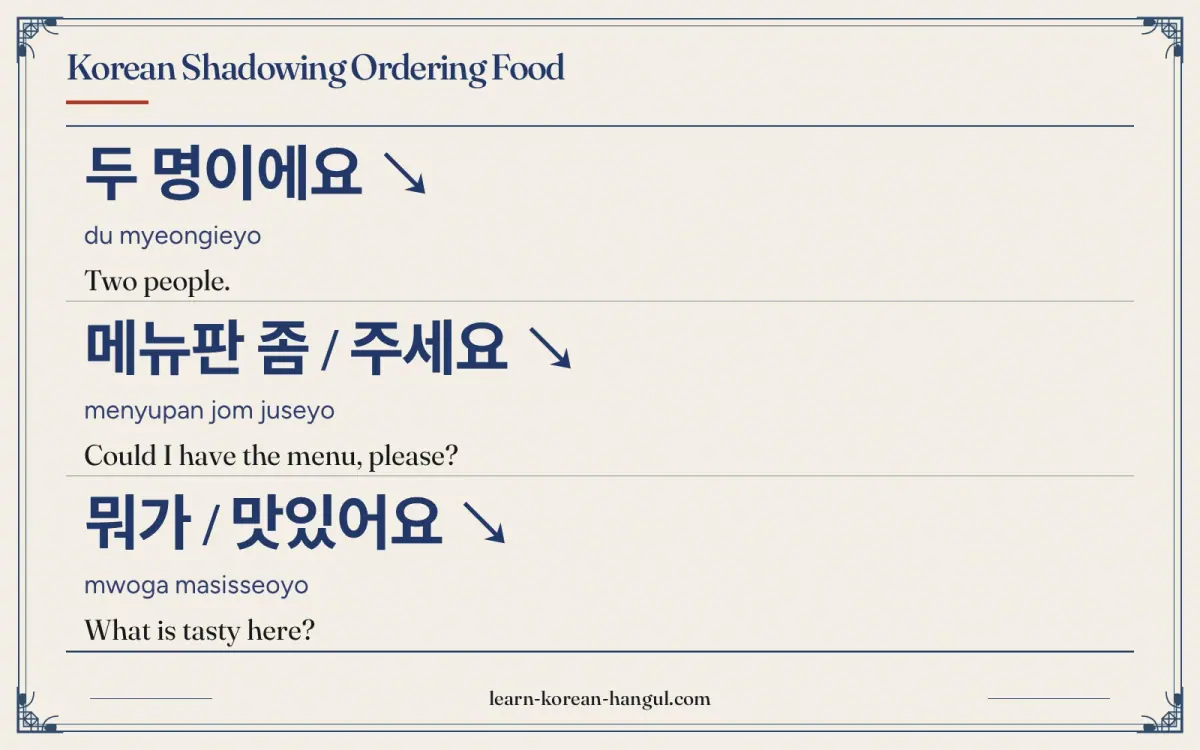
Lines 1 to 4 take you from sitting down to placing the main order.
두 명이에요 ↘
du myeongieyo
Two people.
메뉴판 좀 / 주세요 ↘
menyupan jom juseyo
Could I have the menu, please?
뭐가 / 맛있어요 ↘
mwoga masisseoyo
What is tasty here?
비빔밥 하나 / 주세요 ↘
bibimbap hana juseyo
One bibimbap, please.
Lines 1 to 4 place the order, so lines 5 to 8 adjust it and close the meal.
Script Lines 5 to 8
Lines 5 to 8 add water, change the spice, pay and thank the host.
물도 좀 / 주세요 ↘
muldo jom juseyo
Some water too, please.
덜 맵게 / 해 주세요 ↘
deol maepge hae juseyo
Please make it less spicy.
계산해 / 주세요 ↘
gyesanhae juseyo
The bill, please.
잘 / 먹었습니다 ↘
jal meogeotseumnida
Thank you for the meal.
Before checking yourself, compare the two numbers you can attach to a dish.
| Form | Where it appears | Example |
|---|---|---|
| 하나 | alone, after the dish | 비빔밥 하나 주세요 |
| 한 | directly before a counter | 비빔밥 한 그릇 주세요 |
What Is the Speed Ladder?
The speed ladder is a fixed order of speeds that you climb only when the step below feels easy. Ordering lines are short, so the risk is rushing the end of each request.
| Step | Speed | Script | Move up when |
|---|---|---|---|
| 1 | Slow (0.8x) | visible | you can run all eight lines in order |
| 2 | Normal | visible | the 주세요 endings sound the same each time |
| 3 | Normal | hidden | you finish the sequence with few stumbles |
A stumble is a hesitation, a repeated syllable or a lost beat. Once step 3 is steady, swap one dish for another and keep the rhythm.
How Do I Check Myself?
Record the full sequence, then listen once and tick each item.
- Softener. Is 좀 short and light, not stressed like "a little"?
- Tense sounds. Do you say [비빔빱] and [맵께]?
- Question pitch. Does 뭐가 맛있어요? fall instead of rising sharply?
- Endings. Do all 주세요 requests end with the same gentle fall?
- Closing. Does 잘 먹었습니다 sound slower and more formal than the rest?
Fix one item per session rather than all five.
Worked Example: 메뉴판 좀 주세요
Take the first request apart in four moves.
메뉴판 좀 주세요.
menyupan jom juseyo
Could I have the menu, please?
- Hear it. You hear [메뉴판 좀 주세요], seven even beats with a small rest after 좀.
- Split the written form. 메뉴판 (menu board, menu) + 좀 (softener, "just; please") + 주- (give) + -세요 (polite request ending).
- Match the sounds. Nothing changes between the words, so say each exactly as it is spelled.
- Shadow it. Speak a beat behind: "me-nyu-pan jom ju-se-yo", falling on 요.
The same pattern swaps in any noun: 물 좀 주세요 asks for water, and 김치 좀 주세요 asks for kimchi. Next, look at the slips learners make most often.
What Mistakes Do Learners Make Here?
Learners often assume that 좀 means "a little" and can be dropped. In fact it softens the request, and four slips are common.
- Dropping 좀 or stressing it. Without 좀 the line is still correct but blunter. With a strong stress it sounds like "a little", so keep it short.
- Saying 비빔밥 with one plain "b". The spoken form is [비빔빱]: voiced middle ㅂ, then a closed and tense last syllable.
- Rising at the end of 뭐가 맛있어요? A sharp rise can turn the question word into "something", as if you asked "Is something tasty?". Let the pitch fall.
- Mixing up 잘 먹겠습니다 and 잘 먹었습니다. 잘 먹겠습니다 is said before eating, and 잘 먹었습니다 is said after.
Fixing these slips takes one more pass, so the practice below tests them.
Practice and Answer Key
Answer from memory, then check the key.
- What does 좀 do in 메뉴판 좀 주세요?
- How is 비빔밥 pronounced?
- You want one bowl of kimchi stew. Which number do you use in 김치찌개 ___ 주세요?
- Which phrase do you say after the meal: 잘 먹겠습니다 or 잘 먹었습니다?
Answers
- It softens the request, much like "please" or "just", and it does not mean "a little" here.
- [비빔빱]
- 하나: 김치찌개 하나 주세요. Use 한 only before a counter, as in 한 그릇.
- 잘 먹었습니다, because the meal is finished.
Where to Go Next
Shadow the sequence again tomorrow with the script hidden. When it feels steady, continue with Korean shadowing shopping, where the requests become questions. For a gentler start, go back to Korean shadowing greetings. Pitch is explained in Korean intonation, and more scripts are in Korean shadowing.
What this set does not cover. It does not teach the server's side, menu vocabulary or the full number system, which have their own pages. The audio is generated by text-to-speech and checked by a Korean teacher before publication, so a real server may speak faster. Shadowing builds rhythm and sound, not new vocabulary.
Return to this Korean shadowing ordering food set whenever a restaurant request feels clumsy.
Frequently Asked Questions
What does 좀 mean here?
In 메뉴판 좀 주세요, 좀 is a softener that makes a request gentler, much like "please" or "just". It is a shortened form of 조금, "a little", but here it does not describe quantity. Say it short and light, and keep it before 주세요 in requests.
Why does the ㅂ in 비빔밥 sound like b?
The plain consonants ㄱ, ㄷ, ㅂ and ㅈ become voiced between vowels, so the ㅂ of 빔 sounds like an English b. The last syllable is different: it is tense and closed, giving [비빔빱]. English has only one b sound, so learners need to hear both.
How do I ask for the bill?
Say 계산해 주세요 to ask the server to total the bill. In many casual restaurants you pay at the counter by the door, so you can also stand up and say 계산할게요 there. Both are polite. Finish with 잘 먹었습니다 to thank the host for the meal.
Is 하나 or 한 used after the dish?
Use 하나 when the number stands alone after the dish: 비빔밥 하나 주세요. Use 한 only when it comes directly before a counter noun, as in 비빔밥 한 그릇 주세요. Both mean "one". The same pattern holds for two: 둘 stands alone, and 두 comes before a counter.