이거 좀 입어 봐도 돼요? / 좀 작아요. / 더 큰 사이즈 있어요? / 네, 잘 맞아요. / 이거 얼마예요? / 조금 깎아 주세요. / 카드로 할게요. / 봉투도 주세요.
What you'll learn
- Shadow eight shopping lines with the correct question rises.
- Tell a yes/no question, which rises, from a wh-question, which does not.
- Say 할게요 as [할께요], with a tense ㄲ.
- Use the permission pattern in 입어 봐도 돼요? and the modifier 큰 in 더 큰 사이즈.
Before you start: you need to read Hangul and know the polite -요 ending. Level: A2. Time: about 20 minutes. If shadowing is new, read how to shadow Korean first. Audio plays only when you press a button.
Key facts
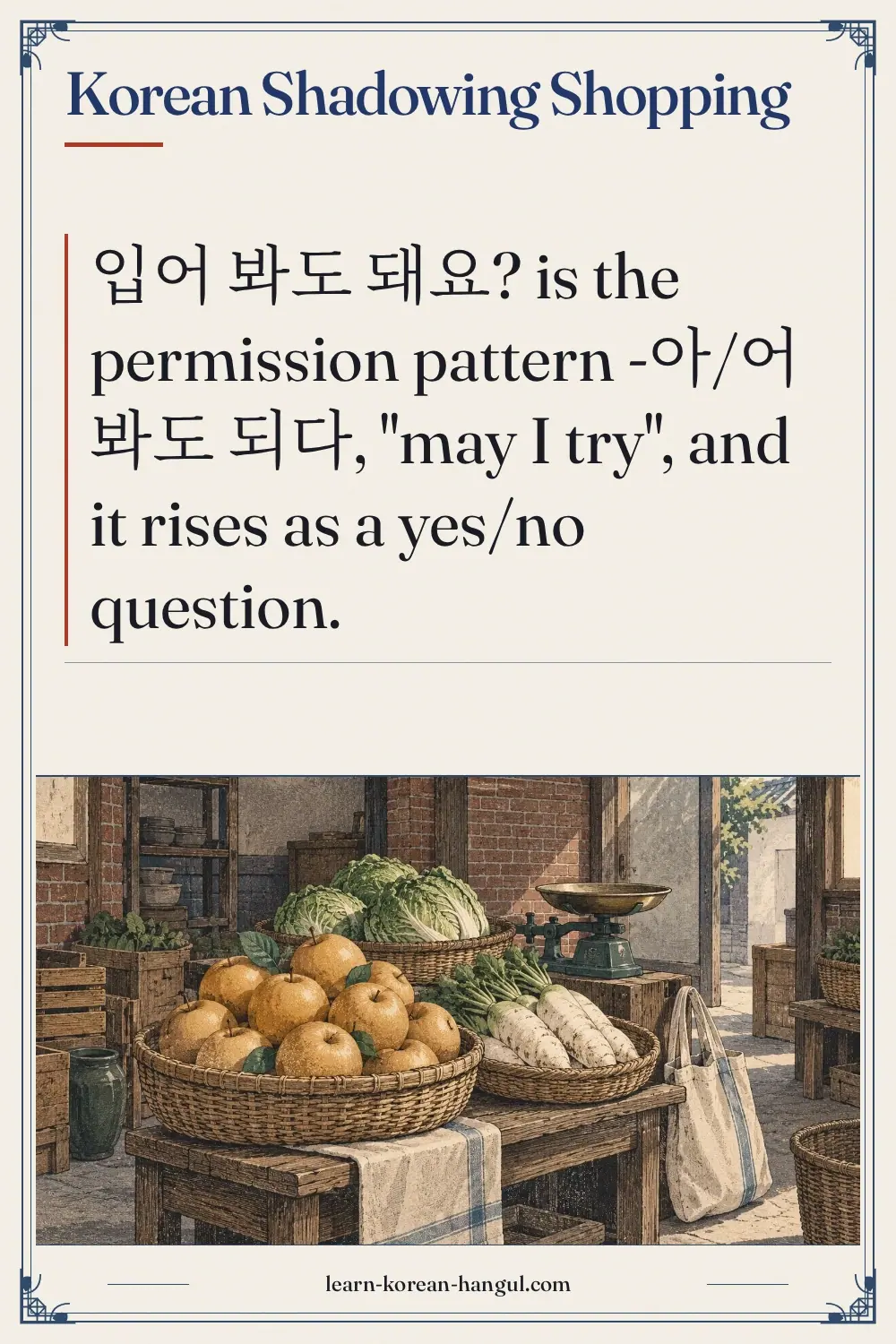
- 입어 봐도 돼요? is the permission pattern -아/어 봐도 되다, "may I try".
- 카드로 할게요 ends with the tense [할께요].
- Yes/no questions such as 있어요? end with a rise, while 얼마예요? is a wh-question and does not.
What Do Shop Lines Sound Like in Korean?
Shop lines are short requests and questions, and the pitch tells the listener which is which. A yes/no question lifts at the end, as in 사이즈 있어요?, while a statement such as 좀 작아요 falls. The set follows a real visit: try on, say the size is wrong, ask for another, confirm the fit, ask the price, bargain, pay and ask for a bag. Meanings and extra phrases are in Korean shopping phrases.
If you want to hear the shop assistant's side first, play the Korean shopping dialogue audio. For the grammar behind line 1, see Korean obligation and permission grammar.
The next question is why English speakers slip on questions that look simple.
Why Is This Hard for English Speakers?
Question lines are hard because English uses a rise for almost every question, but Korean splits questions into two pitch patterns. English speakers also hear 할게요 as "hal-ge-yo", while the spoken form has a tense consonant.
| What you see | What you hear | Why it surprises English speakers |
|---|---|---|
| 입어 봐도 | [이버 봐도] | The ㅂ of 입 moves to 어, so 입어 sounds like "i-beo" |
| 있어요? | [이써요] with a rise | The ㅆ moves to the next block, and the pitch lifts on 요 |
| 얼마예요? | [얼마예요] with no sharp rise | The question word 얼마 already marks the question |
| 할게요 | [할께요] | After -ㄹ, the ㄱ turns tense, but the spelling keeps ㄱ |
The tense sound in 할게요 follows the tensing after -(으)ㄹ in the standard pronunciation rules (표준 발음법) of the National Institute of Korean Language (국립국어원). The spelling keeps ㄱ under the Hangul Orthography (한글 맞춤법), which writes this ending with a plain consonant. Revised Romanization writes halgeyo and does not show the tense sound, so the brackets here show the spoken form. See Korean tensification for the full set of cases.
With the traps named, here is how a session runs.
How Does the Korean Shadowing Shopping Set Work?
The set works in four passes, and you speak the customer's side. The session takes about 20 minutes. The passes compress the six steps of how to shadow Korean into one session; for step 6, record your last pass and compare it with the audio.
- Listen and read (3 minutes). Play the normal clip once. Mark every line that ends in a question mark.
- Shadow slowly (6 minutes). Use the slow player and speak a beat behind. Lift only on the yes/no questions.
- Shadow at normal speed (6 minutes). Keep going when you slip.
- Shadow without the script (5 minutes). Hide the text and run the visit from try-on to bag. Count the stumbles.
You will know it worked when you rise on lines 1 and 3 and fall on every other line without checking the script. A common mistake is rising on all eight lines. Marking the rises on the script first prevents it.
이거 좀 입어 봐도 돼요? / 좀 작아요. / 더 큰 사이즈 있어요? / 네, 잘 맞아요. / 이거 얼마예요? / 조금 깎아 주세요. / 카드로 할게요. / 봉투도 주세요.
In the script, ↗ marks a rise and ↘ marks a fall.
Script Lines 1 to 4
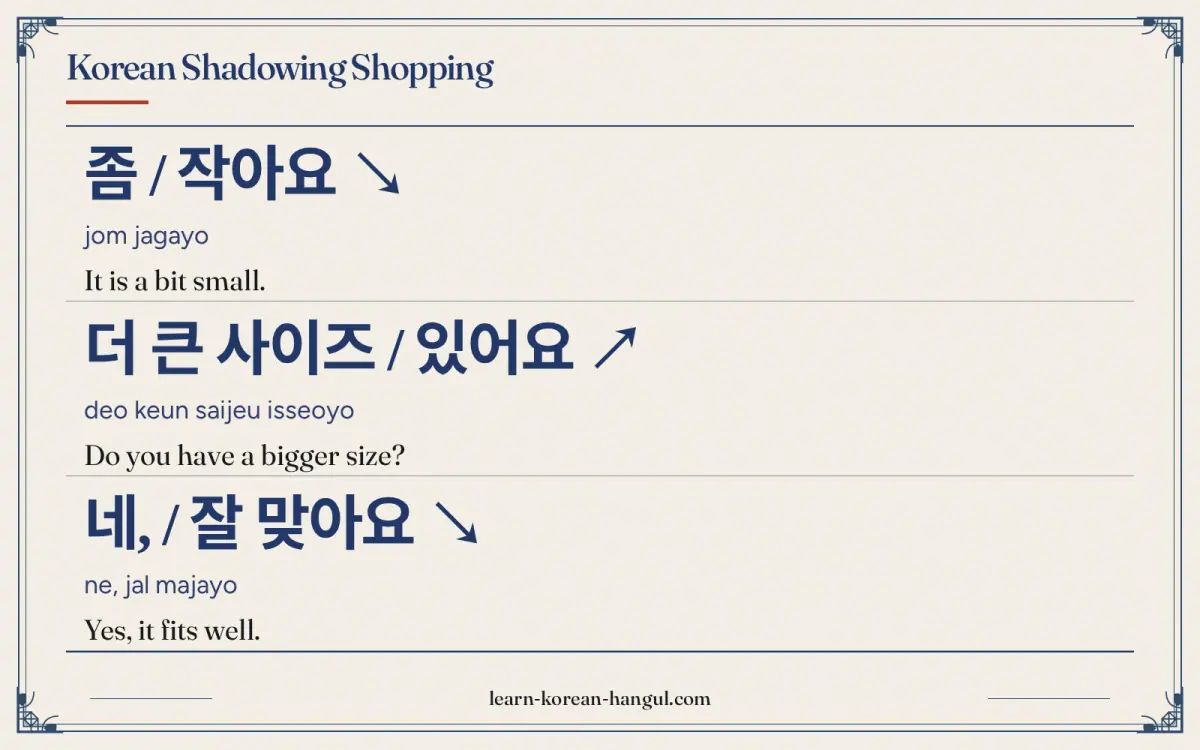
Lines 1 to 4 cover the fitting room. Two lines are yes/no questions with a rise.
이거 좀 / 입어 봐도 돼요 ↗
igeo jom ibeo bwado dwaeyo
May I try this on?
좀 / 작아요 ↘
jom jagayo
It is a bit small.
더 큰 사이즈 / 있어요 ↗
deo keun saijeu isseoyo
Do you have a bigger size?
네, / 잘 맞아요 ↘
ne, jal majayo
Yes, it fits well.
Lines 1 to 4 end with the fit, so lines 5 to 8 handle the price and payment.
Script Lines 5 to 8
Lines 5 to 8 cover price, discount, card and bag. Line 5 is a wh-question and does not rise.
이거 / 얼마예요 ↘
igeo eolmayeyo
How much is this?
조금 / 깎아 주세요 ↘
jogeum kkakka juseyo
Please take a little off.
카드로 / 할게요 ↘
kadeuro halgeyo
I will pay by card.
봉투도 / 주세요 ↘
bongtudo juseyo
A bag too, please.
A short word list keeps the shopping vocabulary straight.
| Word | Romanization | Meaning | Used in line |
|---|---|---|---|
| 사이즈 | saijeu | size | 3 |
| 큰 | keun | big (before a noun) | 3 |
| 작아요 | jagayo | it is small | 2 |
| 맞아요 | majayo | it fits; that is right | 4 |
| 얼마 | eolma | how much | 5 |
| 카드 | kadeu | card | 7 |
| 봉투 | bongtu | bag; envelope | 8 |
What Is the Speed Ladder?
The speed ladder is a fixed order of speeds that you climb only when the step below feels easy. In this set the ladder protects the question pitch, because speed tends to flatten it.
| Step | Speed | Script | Move up when |
|---|---|---|---|
| 1 | Slow (0.8x) | rises marked | you lift on lines 1 and 3 every time |
| 2 | Normal | rises marked | you keep the fall on the other six lines |
| 3 | Normal | hidden | you finish the visit with few stumbles |
A stumble is a hesitation, a repeated syllable or a lost beat. If a rise disappears at normal speed, go back one step.
How Do I Check Myself?
Record the whole visit, listen once, then tick each point.
- Rises. Do lines 1 and 3 lift on the last syllable?
- Falls. Do the other six lines, including 얼마예요?, settle downward?
- Tense sound. Do you say [할께요], not "hal-ge-yo"?
- Linking. Do you say [이버] and [자가요] without a break?
- Beat. Do the question and the answer join smoothly?
Fix one point per session.
Worked Example: 이거 좀 입어 봐도 돼요?
Take the opening question apart in four moves.
이거 좀 입어 봐도 돼요?
igeo jom ibeo bwado dwaeyo
May I try this on?
- Hear it. You hear [이거 좀 이버 봐도 돼요], with the lift at the very end.
- Split the written form. 이거 (this) + 좀 (softener) + 입- (wear) + -어 (connector) + 보- (try) + -아도 (even if) + 되- (be allowed) + -어요 (polite). Together, -아/어 봐도 되다 means "is it all right if I try".
- Match the sounds. The ㅂ of 입 moves to 어 and gives [이버]. Between words nothing else changes.
- Shadow it. Speak a beat behind: "i-geo jom i-beo bwa-do dwae-yo", with the pitch up on 요.
Compare it with the price question, which also ends in 요 but has no final lift.
Next, look at the slips learners make most often.
What Mistakes Do Learners Make Here?
Learners often assume that every question ends with a rise, as in English. Korean is more selective, and four slips are common.
- Rising on 얼마예요? The question word 얼마 carries the meaning. A sharp rise can make it sound like "some amount", so let the pitch fall.
- Saying 할게요 as "hal-ge-yo". The spoken form is [할께요].
- Asking 입어요? to mean "may I try it on?" 입어요 means "I wear it". The permission needs 입어 봐도 돼요.
- Bargaining in a fixed-price shop. 조금 깎아 주세요 suits a market stall. In a department store or a chain shop, prices are usually fixed, so leave line 6 out there.
Fixing these slips takes one more pass, so the practice below tests them.
Practice and Answer Key
Answer from memory, then check the key.
- Which two lines in the set rise at the end?
- How is 할게요 pronounced?
- What does 큰 do in 더 큰 사이즈?
- Does 이거 얼마예요? rise sharply at the end?
Answers
- Line 1, 이거 좀 입어 봐도 돼요?, and line 3, 더 큰 사이즈 있어요?
- [할께요]
- It is the modifier form of 크다 ("to be big") and tells you which kind of size: a bigger one.
- No. It is a wh-question, so the pitch falls, or rises and then falls, rather than rising sharply.
Where to Go Next
Shadow the visit again tomorrow with the script hidden. When the rises and falls feel automatic, continue with Korean shadowing directions, which adds tense ㅉ and a command ending. To revisit the previous set, go to Korean shadowing ordering food. Pitch is explained in Korean intonation, and more scripts are in Korean shadowing.
What this set does not cover. It does not teach the full grammar of the permission pattern, number words for prices or clothing vocabulary, which have their own pages. The audio is generated by text-to-speech and checked by a Korean teacher before publication, so a real assistant may speak faster. Shadowing builds rhythm and pitch, not new vocabulary.
Return to this Korean shadowing shopping set whenever your question pitch starts to flatten.
Frequently Asked Questions
How does -아/어 봐도 되다 work?
It asks or gives permission to try something. Attach -아/어 to the verb stem, add 봐도, then 되다: 입어 봐도 돼요? means "may I try wearing it?". Answer with 네, 입어 보세요, "yes, please try it on". Without 봐도, 입어도 돼요 means "is it fine to wear it", which is less natural in a shop.
Why is 할게요 said [할께요]?
In speech, a ㄱ after the ending -ㄹ turns tense, so 할게요 sounds like 할께요. The Hangul Orthography keeps the plain ㄱ in writing, which is why you see 할게요 on screen and in books. Revised Romanization writes halgeyo. Say the tense sound whenever you offer or promise something with -ㄹ게요.
Does the question end on a rise?
Yes/no questions, such as 이거 좀 입어 봐도 돼요? and 더 큰 사이즈 있어요?, end with a rise on the last syllable. Wh-questions, such as 이거 얼마예요?, put the prominence on the question word and then fall or dip, because a sharp final rise can make the word sound like "some amount".
What does 더 mean?
더 means "more" and marks a comparison: 더 큰 사이즈 is "a bigger size", and 더 작은 거 is "a smaller one". It stands before the adjective, never after it. In requests, 더 주세요 means "please give me more". The word stays the same in every speech level.