- 01
Before You Start the Korean Beginner Study Plan
- 02
How Much Time Does the Plan Need Each Day?
- 03
What Does One Session Look Like?
- 04
What Happens in Weeks 1-3?
- 05
What Happens in Weeks 4-6?
- 06
What Happens in Weeks 7-9?
Compare this plan with all Korean study plans if you need a shorter or longer horizon. The 12 weeks below are the default route for an adult starting from nothing.
Before You Start the Korean Beginner Study Plan

The Korean beginner study plan needs no prior Korean, a phone or computer with audio, and a fixed daily slot. Check these items before day one:
| Item | Detail |
|---|---|
| Time | 30-45 minutes a day, 6 or 7 days a week, for 12 weeks (about 45-60 hours) |
| Difficulty | Beginner (A0 to about A1) |
| Cost | Free: all linked lessons, audio and decks are free |
| Prerequisites | None. You do not need to know any Korean letters |
| Tools | Headphones; a flashcard app or our decks; a notebook for weeks 1-3 |
| Speech level | Polite 해요체 only (the -아요/어요 endings) |
| Optional | A printed weekly checklist from our Korean printables |
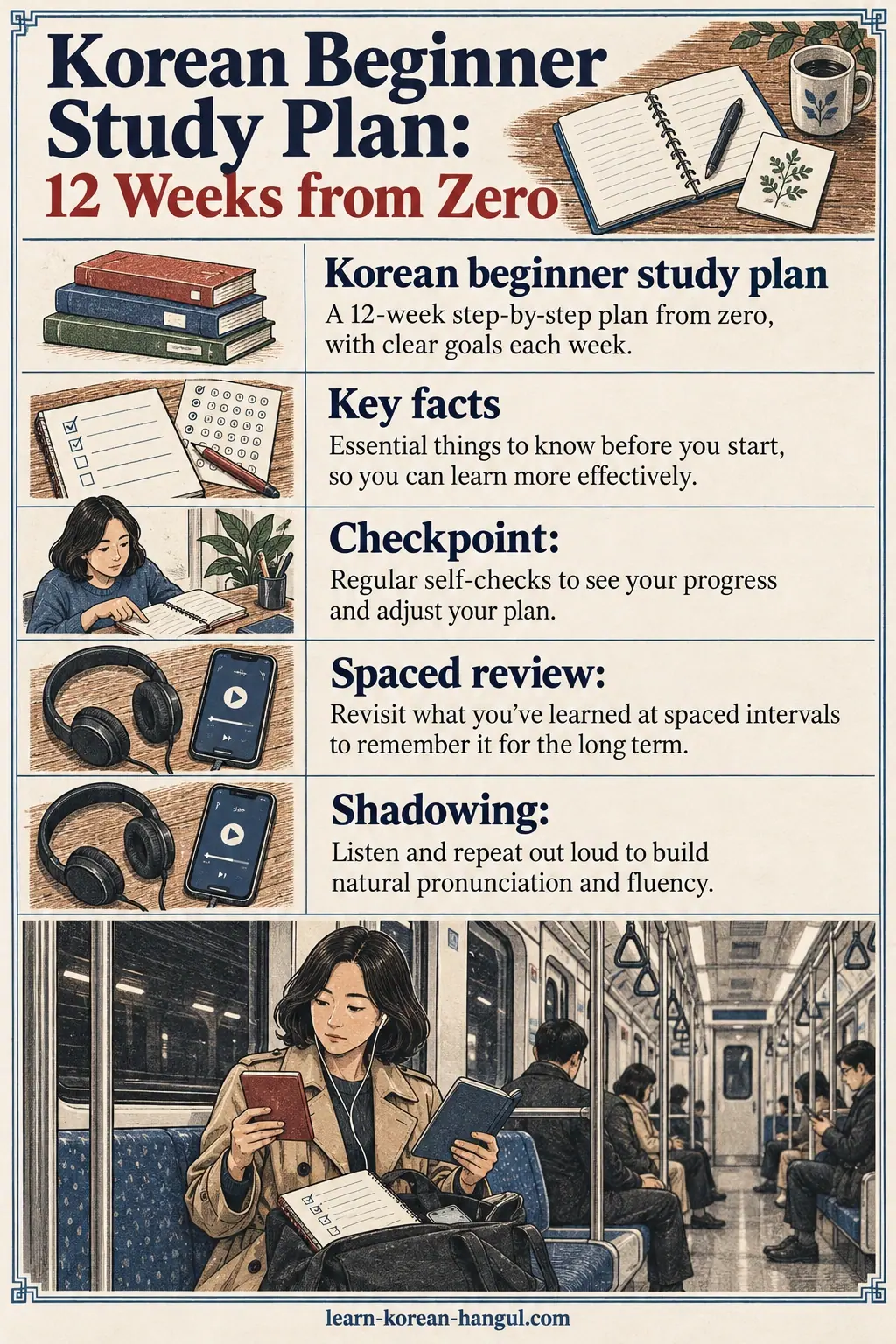
Three terms appear throughout the plan:
- Checkpoint: a short test at the end of a week. Pass it before moving on.
- Spaced review: reviewing words on a schedule that brings each word back just before you would forget it. Flashcard apps do the scheduling for you.
- Shadowing: playing a short audio line and repeating it immediately, copying the rhythm and sounds.
With those in place, the next question is how to divide each day's session.
How Much Time Does the Plan Need Each Day?

The plan needs 30-45 minutes a day, split into three blocks. The same split runs every day for 12 weeks, so you never have to decide what to do next.
| Block | Minutes | What you do |
|---|---|---|
| 1. Review | 10 | Flashcards with audio for everything learned so far |
| 2. New lesson | 15-20 | One lesson or part of one, from the week's list |
| 3. Listening or output | 5-15 | Shadow audio, read aloud, or write five sentences |
Begin every session with 10 minutes of flashcard review. Review comes first because recalling yesterday's material is what makes it stick, and it is the block most often skipped when time runs short.
Expert tip: if you have only 15 minutes on a given day, do the review block and stop. A short review keeps your memory alive; skipping the day entirely makes tomorrow's review longer. Here is what one full session looks like in practice.
What Does One Session Look Like?

One session in this plan is a fixed 40-minute sequence. Here is a typical session from week 8, when you are learning the object particle 을/를 and the polite present:
- Minutes 0-10, review. Run your flashcard deck. Cards show Hangul and play audio; you say the meaning and the word aloud before flipping. Cards you miss come back sooner.
- Minutes 10-15, warm-up. Read yesterday's five sentences aloud, for example 친구가 와요 (my friend comes).
- Minutes 15-30, new lesson. Learn three new verbs, such as 마시다 (drink), 보다 (watch) and 읽다 (read), and conjugate each in the polite present: 마셔요, 봐요, 읽어요. Write one sentence for each with 을/를: 커피를 마셔요, 영화를 봐요, 책을 읽어요.
- Minutes 30-38, listening. Shadow a 30-second dialogue three times.
- Minutes 38-40, log. Add the new words to your deck and tick the day in your checklist.
The structure matters more than the exact minutes. Because each block is fixed, you spend no time deciding what to study, and the review always happens. Now to the plan itself, phase by phase.
What Happens in Weeks 1-3?
Weeks 1-3 teach you to read Hangul, the Korean alphabet, including syllables with final consonants. By the end of week 3 you can read any common Korean word aloud, even if you do not know its meaning. Weeks 1-2 follow the 7-day Hangul course at a slower pace, two course days for every three plan days, and week 3 consolidates.
Step 1: Learn All 40 Letters
Learn all 40 Hangul letters over weeks 1 and 2, a few letters per session.
- How: Days 1-3, the six simple vowels (ㅏ ㅓ ㅗ ㅜ ㅡ ㅣ). Days 4-7, the ten basic consonants (ㄱ ㄴ ㄷ ㄹ ㅁ ㅂ ㅅ ㅇ ㅈ ㅎ). Week 2, the aspirated consonants (ㅋ ㅌ ㅍ ㅊ), the tense consonants (ㄲ ㄸ ㅃ ㅆ ㅉ), the y-vowels and the compound vowels. Play the audio for every letter and every word.
- Checkpoint: You'll know it worked when you can read 20 unseen words aloud at the end of week 2, such as 바다, 나비, 우유, 커피, 사과, and check each against audio.
- Common mistake: Learning all 40 letters in one weekend. You will recognise them on Sunday and lose half by Wednesday. Spread them out and review daily.
Step 2: Read Syllables with Batchim
Read syllables that end in a consonant, called batchim, throughout week 3.
- How: Batchim is the consonant at the bottom of a block, as in 밥 (rice) or 산 (mountain). Read 15-20 batchim words a day, grouped by final letter: 산, 한, 반 on one day; 밥, 집, 입 on another. Add 25 new words this week, choosing words you will use: 물 (water), 사람 (person), 한국 (Korea).
- Checkpoint: You'll know it worked when you read a short list of 10 batchim words in under 30 seconds without pausing inside a word.
- Common mistake: Reading the batchim as a new syllable, so 밥 becomes "ba-bu". Batchim closes the syllable; keep each block as one beat.
By the end of week 3 you can read. The next phase makes your reading sound like Korean.
What Happens in Weeks 4-6?

Weeks 4-6 teach the main pronunciation rules, greetings and both Korean number systems. Pronunciation comes before grammar on purpose: these rules change how written words sound, and learning them early stops you from practising wrong sounds for months.
Step 3: Apply Liaison and the Seven Final Sounds
Learn the seven final sounds and the liaison rule in week 4.
- How: Every batchim is pronounced as one of seven sounds: ㄱ, ㄴ, ㄷ, ㄹ, ㅁ, ㅂ or ㅇ. For example, 꽃 (flower) is pronounced [꼳]. Then learn liaison: when a block ending in a consonant is followed by a block starting with silent ㅇ, the consonant moves across. 한국어 is pronounced [한구거]. These rules come from the National Institute of Korean Language's Standard Pronunciation Rules (표준 발음법).
- Checkpoint: You'll know it worked when you read 한국어, 음악 and 먹어요 and they match the audio: [한구거], [으막], [머거요].
- Common mistake: Learning the rules as a list without audio. Rules stick when you hear them in words you know.
Step 4: Learn Greetings and Both Number Systems
Learn greetings and a self-introduction in week 5, then Korean numbers in both systems in week 6.
- How (week 5): Learn 15-20 polite phrases with audio, starting with Korean greetings. Memorise a three-line self-introduction:
- 안녕하세요. (Hello.)
- 저는 민수예요. (I am Minsu.)
- 만나서 반가워요. (Nice to meet you.)
- How (week 6): Korean has two number systems. Sino-Korean numbers (일, 이, 삼...) are used for dates, money, minutes and phone numbers. Native Korean numbers (하나, 둘, 셋...) are used for counting things, age and hours. Learn 1-10 in each, then tens, then combine.
- Checkpoint: You'll know it worked when you can count to 99 in both systems. 99 is 구십구 in Sino-Korean and 아흔아홉 in native Korean.
- Common mistake: Learning one system and postponing the other. Real Korean mixes them constantly; "3:15" is 세 시 십오 분, native for the hour and Sino-Korean for the minutes.
After week 6 you have about 150 words, correct pronunciation habits and a self-introduction. The next phase turns words into sentences.
What Happens in Weeks 7-9?

Weeks 7-9 teach your first grammar: the three core particles and the polite present tense. By the end of week 9 you can make simple statements and questions about daily life.
Step 5: Use 은/는, 이/가 and 을/를
Learn the topic and subject particles in week 7 and the object particle in week 8.
- How: A particle is a short marker attached to a noun to show its role. Use the form after a consonant or the form after a vowel:
| Particle | Role | After a consonant | After a vowel |
|---|---|---|---|
| 은/는 | Topic ("as for...") | 책은 | 저는 |
| 이/가 | Subject | 책이 | 친구가 |
| 을/를 | Object | 밥을 | 커피를 |
- Pair 은/는 with 이에요/예요 ("am, is, are") for identity sentences: 저는 학생이에요 (I am a student).
- Checkpoint: You'll know it worked when you can write five true sentences about yourself, each with the correct particle form.
- Common mistake: Trying to master the difference between 은/는 and 이/가 in one week. Learn the basic rule (은/는 for the topic you are talking about, 이/가 for new information or the subject of a question) and refine it over months.
Step 6: Conjugate Verbs in the Polite Present
Learn the polite present tense, the -아요/어요 ending, in weeks 8 and 9.
- How: Remove 다 from the dictionary form to get the stem. If the stem's last vowel is ㅏ or ㅗ, add 아요; otherwise add 어요. 하다 verbs become 해요. Vowels often merge:
| Dictionary form | Meaning | Polite present |
|---|---|---|
| 가다 | go | 가요 |
| 보다 | see, watch | 봐요 |
| 먹다 | eat | 먹어요 |
| 마시다 | drink | 마셔요 |
| 하다 | do | 해요 |
| 공부하다 | study | 공부해요 |
- Questions use the same form with rising intonation: 커피를 마셔요? (Do you drink coffee?)
- Checkpoint: You'll know it worked when you can describe your day in six present-tense sentences, such as 커피를 마셔요 (I drink coffee).
- Common mistake: Memorising each verb separately. Learn the rule, then practise it on 20 common verbs until it is automatic. The deeper reference is our lesson on the polite present conjugation.
Present-tense sentences cover today. The last phase adds yesterday and trains your ear for real conversations.
What Happens in Weeks 10-12?

Weeks 10-12 add the past tense and daily listening to slow dialogues. The final checkpoint is a six-sentence story about yesterday, told aloud in polite Korean.
Step 7: Talk about Yesterday in the past Tense
Learn the polite past tense, -았어요/었어요, in weeks 10 and 11.
- How: Use the same vowel rule as the present tense. Stems with ㅏ or ㅗ take 았어요; others take 었어요; 하다 becomes 했어요. So 가다 becomes 갔어요, 먹다 becomes 먹었어요 and 하다 becomes 했어요. Add time words: 어제 (yesterday), 오늘 (today), 주말에 (at the weekend).
- Checkpoint (week 12): You'll know it worked when you can tell a six-sentence story in past tense, like this one:
- 어제 친구를 만났어요. (Yesterday I met a friend.)
- 같이 카페에 갔어요. (We went to a café together.)
- 저는 커피를 마셨어요. (I drank coffee.)
- 친구는 케이크를 먹었어요. (My friend ate cake.)
- 그리고 영화를 봤어요. (And we watched a movie.)
- 정말 재미있었어요. (It was really fun.)
- Common mistake: Forgetting the vowel merge. 보다 becomes 봤어요, not 보았어요 in everyday speech. Both are correct in writing, but the short form is far more common in conversation.
Step 8: Listen to Slow Dialogues Daily
Listen to one slow, scripted dialogue every day in weeks 10-12, using the listening block of each session.
- How: Choose dialogues made for learners, 30-60 seconds long, with a transcript. Day 1: listen three times without the transcript, then read it. Days 2-3: shadow each line. Day 4: listen once more without the transcript and note how much you catch.
- Checkpoint: You'll know it worked when you understand the main point of a new slow dialogue on first listening, without the transcript.
- Common mistake: Using native-speed drama clips as your main listening. They are useful for motivation, but at A1 you understand too little for them to teach you much. Slow material first; dramas as a treat.
That completes the eight steps. The table below puts all 12 weeks on one screen.
The 12-Week Plan at a Glance
The 12-week plan at a glance shows each week's focus, the running word count and the checkpoint. Word counts assume about 25 new words a week and are typical, not guaranteed.
| Week | Focus | Words (cumulative) | Checkpoint |
|---|---|---|---|
| 1 | Simple vowels, basic consonants | 0-10 | Read 가, 나, 다, 고기, 바다 |
| 2 | Aspirated, tense, compound vowels | 25 | Read 20 unseen words aloud |
| 3 | Batchim | 50 | Read 10 batchim words in 30 seconds |
| 4 | Seven final sounds, liaison | 75 | 한국어 sounds like [한구거] |
| 5 | Greetings, self-introduction | 100 | Say a 3-line introduction from memory |
| 6 | Sino-Korean and native numbers | 150 | Count to 99 in both systems |
| 7 | 은/는, 이/가, 이에요/예요 | 175 | Five true sentences about yourself |
| 8 | 을/를, polite present | 200 | Ten verb-plus-object sentences |
| 9 | Polite present questions, 안 negation | 225 | Describe your day in six sentences |
| 10 | Polite past tense | 250 | Five sentences about yesterday |
| 11 | Past tense with time words | 275 | Ask and answer three past-tense questions |
| 12 | Slow dialogues, review | 300 | Six-sentence past-tense story aloud |
Lesson Review
A plan on paper always meets real life. The next section covers the ways it most often goes wrong.
Common Mistakes and How to Fix Them

Most beginner plans fail for a handful of predictable reasons. Here are the five most common, with the recovery for each:
- Skipping review to do more new material. Symptom: words from two weeks ago are gone. Fix: protect the 10-minute review block every day; cut new material first when short on time.
- Staying on romanization. Symptom: you read slowly and mispronounce ㅓ and ㅡ. Fix: delete romanization from flashcards after week 2.
- Studying grammar without examples. Symptom: you can state the 은/는 rule but not use it. Fix: write five sentences for every rule, and read them aloud.
- Silent study. Symptom: you understand written Korean but freeze when speaking. Fix: say every flashcard aloud and shadow daily from week 4.
- Mixing speech levels. Symptom: drama phrases like 뭐 해? (casual) appear next to polite 해요 forms. Fix: stay in 해요체 for the whole plan; casual speech comes later.
Most of these show up around weeks 4-6, when the novelty wears off. Recognising them early keeps the plan on track, and the plan itself can bend to fit your situation.
How Can You Adapt the Plan?
You can adapt the plan for less time, more time or a travel goal by changing the pace, not the order. The order (Hangul, sounds, words, particles, verbs, listening) suits most beginners.
15 Minutes a Day
At 15 minutes a day, stretch the plan to about 24 weeks. Do review and a half-lesson each day, and move to the next week only after passing the checkpoint. Our dedicated plan for busy learners is linked from all Korean study plans.
One Hour a Day or More
At an hour a day, you can finish in about 8 weeks by combining weeks 1 and 2, 4 and 5, and 7 and 8. Use the extra time for listening and speaking, not for more new words; 25-35 words a week is plenty to retain.
A Trip in under 12 Weeks
If you travel before week 12, move week 5 (greetings) and week 6 (numbers) to weeks 3 and 4. Hangul still comes first, because it lets you read signs and menus. Particles and verbs can wait until after the trip.
Whatever the pace, missed days are inevitable. The next section explains how to recover without starting over.
What If You Fall Behind?
If you fall behind, repeat the previous week's checkpoint rather than skipping ahead or restarting. The catch-up rule depends on how long you missed:
- 1-3 days missed: continue where you left off. Do review first; it will take a little longer than usual.
- More than 3 days missed: repeat the previous week's checkpoint. If you pass, continue. If not, redo that week at normal pace.
- More than 3 weeks missed: go back to the last checkpoint you remember passing and restart from there. Do not restart from week 1 unless you have forgotten Hangul.
The checkpoints exist for exactly this reason. They tell you where you really are, so a break costs days, not the whole plan.
Where Will You Be after 12 Weeks?
After 12 weeks at 30-45 minutes a day, you will typically be close to CEFR A1, the first level of the Council of Europe's Common European Framework of Reference. In practical terms, most learners who complete every checkpoint can:
- read any Hangul text aloud with the main pronunciation rules applied
- use about 300 words (typical range 250-350, depending on review)
- introduce themselves and talk about daily routines in polite present tense
- tell a short story about yesterday in polite past tense
- count, tell the time and handle prices with both number systems
- follow the main point of slow, scripted dialogues
Honest limits apply. You will not yet follow native-speed conversation or dramas without subtitles, and you will make particle and ending mistakes. A1 is an approximate self-assessment, not a certified level; the official Korean proficiency exam is TOPIK. After week 12, keep going with a daily Korean study routine, which keeps the same daily structure while you move into A2 material. This Korean beginner study plan is the foundation; the next three months build on exactly these habits.
Frequently Asked Questions
Can I do the plan faster?
Yes, if you have more time each day. At 60 to 90 minutes a day, you can finish the plan in about 8 weeks by combining weeks 1 and 2, 4 and 5, and 7 and 8. Do not skip the checkpoints. If you cannot pass one, the extra speed is costing you more than it saves.
Which textbook pairs well with this plan?
Any beginner textbook written in Hangul, with audio and a polite-speech focus, pairs well. Use the textbook's dialogues for listening in weeks 10 to 12 and its exercises as extra practice. Keep this plan's order. If the textbook teaches formal 합니다 endings first, learn to recognise them but keep speaking in 해요체.
Do I need a tutor during the 12 weeks?
No, but a tutor helps from week 9 onward. Before then, the work is mostly reading, listening and memorising, which you can do alone with audio. Once you form sentences, a weekly 30-minute session with a tutor or exchange partner catches mistakes you cannot hear yourself and gives you real speaking time.
Should I write by hand or type?
Write by hand in weeks 1 to 3, then type. Handwriting slows you down enough to notice each letter's shape and helps some learners remember them. From week 4, typing is faster for flashcards and messages, and it trains you to spell words letter by letter. Both are optional; reading is required.