How Do You Use the Korean Reading Practice Tool?
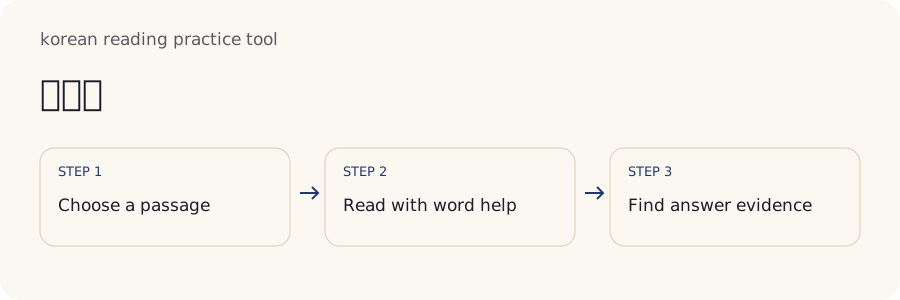
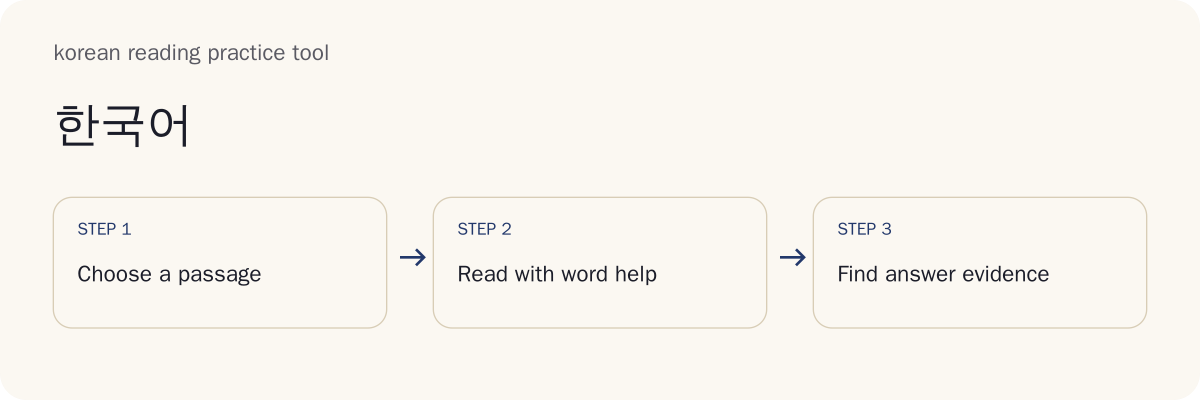
Use the reader in five steps: choose a manageable text, read for its main idea, check unfamiliar language, answer with evidence, and reread. The current sample catalog contains three stories. Starting with a short familiar topic lets you spend attention on sentence meaning rather than guessing the setting.
- Select a story. Read its topic and learning information before opening it. Choose something you can finish, rather than the highest stage you can select. The checkpoint is simple: you know what situation you are about to read.
- Read for the main idea. Keep translation hidden for your first attempt. Ask who is acting, where the action happens and what changes. Getting those details matters more than understanding every word immediately.
- Open contextual help. Check a word that blocks meaning, then reread the whole sentence. Avoid opening every label automatically; that turns reading into copying a glossary.
- Answer the questions. Find the sentence that supports your choice before checking. A correct guess is less useful than an answer you can explain from the passage.
- Save and reread. Keep useful unfamiliar vocabulary for practice. Return to the Korean sentence after checking its meaning, and try it again without the translation.
A second reading gives you a practical comparison: which parts now make sense with fewer interruptions? Use that result when choosing your next reading stage.
Which Reading Stage Should You Choose?
Choose a stage by what you can already do with a passage, rather than by how long you have studied. The six site stages describe a learning path; they do not assign an official exam grade. A stage selector also cannot create texts that are absent from the current three-story catalog.
| Reading Task | Useful Starting Skill | Check Before Moving On |
|---|---|---|
| Decode syllables | Recognise letters and block positions | Read a block without a Latin-letter prompt |
| Read words | Join blocks and recognise final consonants | Recognise a familiar word when it appears again |
| Read first sentences | Find the main action and small attached endings | Explain who does what |
| Read connected paragraphs | Follow several related statements | Keep track of the same person across lines |
| Read short stories | Follow dialogue, time and sequence | Retell events in their stated order |
| Read more demanding texts | Handle less familiar vocabulary and relationships | Separate stated facts from interpretation |
Decoding and comprehension need different practice. A learner who knows a story's English meaning but cannot read its Korean blocks needs decoding work. A learner who can pronounce every block but misses the action needs sentence and vocabulary work. Neither difficulty means starting the entire language again.
Treat topic and length as separate choices. A familiar café setting can make a passage easier to follow, while a short passage can still contain an unfamiliar form. Length expressed as eojeol counts space-separated Korean units, which can contain a word together with an attached particle or ending. It is not a count of English words or dictionary entries.
Try a single sentence when a full story feels too difficult. Once the blocks are readable, contextual word help becomes more useful than another level label.
How Are Words and Translations Matched to a Passage?
Word help explains the meaning used in that passage, while sentence translation explains the whole message. These two kinds of help answer different questions. A translation may use English wording that does not line up one-to-one with every Korean unit.
A lemma is the dictionary form used to group related forms. An inflected form is the actual form appearing in a sentence. A sense is a particular meaning. Recognising a form, finding its dictionary entry and understanding its sense are three related tasks, rather than one automatic success.
An Attached Ending Is Part of the Reading Task
The café lesson uses 카드로 in 저는 카드로 계산해요, meaning “I pay by card.” The useful reading unit includes the card word and the attached part that expresses its role. Simply translating “card” leaves out information needed to understand the payment sentence.
Read help beside the original sentence. Ask what the whole unit contributes, then return to the action at the end. Avoid treating spaces as a complete guide to dictionary words: Korean attaches grammatical information to the material it modifies.
One Word Can Have More than One Contextual Meaning
The morning routine lesson uses 아침 for both morning and breakfast. In its opening time phrase, the word places waking up in the morning. In the eating sentence, the same spelling refers to breakfast. Memorising a single English label would hide that distinction.
A saved vocabulary item should therefore retain its example context. If a label seems wrong, compare the full sentence translation before changing your understanding of the word. Imported text needs extra caution because a familiar spelling alone cannot establish its intended sense. The worked examples below show how to use this distinction without translating every component separately.
Four Worked Korean Reading Examples
Four tasks below use sentences already present in the site's café and morning routine lessons. Each task gives a reading setup, the relevant text, an answer and the evidence behind it. The fourth reuses a story deliberately: a familiar passage lets you practise a different comprehension skill without adding new vocabulary.
A Café Visit: Destination and Action
Setup: open the café story and read its first two sentences before revealing translation. Focus on where the speaker goes and where the next action happens.
오늘은 카페에 가요. 카페에서 커피를 주문해요.
The lesson translates these as “Today I go to a cafe” and “At the cafe I order coffee.” The place is the same, but its role changes: the first line describes going to it, and the second describes an action there. Compare the complete units rather than deciding that every occurrence of the café word means the same thing grammatically.
Question: what does the speaker do at the café? Answer: orders coffee. The second sentence provides the action directly. “Goes to the café” belongs to the first sentence and answers a different question. After checking, reread both lines and state their relationship in your own words.
A Café Order: Quantity, Price and Payment
Setup: stay in the café story and look for three separate details: the drink order, the price and how the customer pays.
저는 말해요. "아이스 아메리카노 한 잔 주세요." 직원이 말해요. "네, 사천 원이에요." 저는 카드로 계산해요.
The order is one iced americano, the story's price is 4,000 won, and payment is by card. These are separate pieces of evidence. The amount does not describe the quantity of drinks, and a mention of a staff member does not identify the payment method.
Question: how does the customer pay? Answer: by card, supported by the final quoted sentence. The price is a fictional story detail, not a promise about real café prices. A beginner can recognise the staff member's respectful ordering question without learning to produce that entire form during this exercise.
A Morning Routine: Time and Sequence
Setup: open the morning routine story. Keep the translation hidden initially and find the first time expression and the next action sequence.
저는 아침 일곱 시에 일어나요. 먼저 세수를 하고 아침을 먹어요.
The lesson gives “I wake up at seven in the morning” and “First I wash my face, and then I eat breakfast.” The second line contains two actions. A translation that remembers breakfast but drops washing misses part of the sequence.
Question: what happens before breakfast? Answer: the speaker washes their face. The second sentence supplies that relationship. The opening establishes the speaker; the following line continues that person's routine without repeating every English-style subject. Read across the sentence boundary rather than inventing a new person whenever a subject is unstated.
A Short Story: Stated Detail and Inference
Setup: return to the café story's closing line and distinguish a stated opinion from an explanation the text does not give.
커피가 정말 맛있어요.
The lesson translates this as “The coffee is really good.” Question: does the speaker like the coffee? Answer: yes; the evaluation in this line supports that answer. Different question: does the speaker visit this café every morning? Answer: this sentence does not establish that.
A familiar setting can tempt you to fill gaps with everyday expectations. Enjoying one coffee does not tell you a visiting schedule, a favourite shop or why the person chose the café. Practise saying “the text does not tell me” when necessary. That habit makes the evidence explanations in the reader more useful.
How Do Comprehension Answers Show Their Evidence?
Comprehension answers connect a choice to a sentence in the passage. Use the explanation to locate the relevant text, rather than treating the result as a mark to collect. The strongest check is whether you can point to the same evidence before opening the explanation.
A literal question asks for something directly stated, such as the café payment method. An inference question asks you to connect information supported by the text. Inference still needs evidence; it is not permission to add a plausible event from your own experience.
When an answer is wrong, identify the kind of error. You may have selected a detail from the wrong sentence, confused a time with a quantity, or overlooked the action. Return to that line and read it again with the translation hidden. Then check only the part that caused the mistake.
A retry is useful when it changes your reasoning. Remembering the position of the correct choice shows familiarity with the exercise, while explaining the sentence shows understanding. Question results describe performance on those questions. They do not measure your entire Korean level, prove speaking ability or replace a language examination.
Once you understand the correction, save the vocabulary that caused the problem and practise it with its original sentence.
Saved Vocabulary and Your Next Reading
Saved vocabulary gives you a way to revisit language encountered while reading. Mark items according to what you can understand in context, then use the reader's local vocabulary practice modes. A word you have seen once can stay in learning until you recognise its meaning again without help.
Keep the Original Sentence with the Word
Context prevents an English label from becoming the whole lesson. The morning example of 아침 is especially useful: seeing whether the sentence concerns a time of day or eating helps you recover the intended meaning. Remembering the Korean spelling alone does not establish both senses.
Practise in two directions. First, see the Korean item and explain its meaning in that sentence. Then see the meaning and try to recognise the Korean form when you reread. If one direction is harder, keep the item in learning. Moving it back is a useful correction, not lost progress.
Known coverage is a vocabulary aid, not a comprehension grade. A simple coverage calculation divides annotated senses marked known by all annotated senses counted in the passage, then multiplies by 100. For example, marking six of ten counted senses known gives 60 percent. This describes those annotations; it says nothing about unannotated language or whether you understood the plot.
A passage with many familiar words can still contain a difficult relationship between them. Choose your next text using both vocabulary familiarity and your ability to explain events. The current catalog is small, so rereading a story with less help is a reasonable next step. Export local progress before changing devices, and keep your export somewhere you can find it later.
Reading with Audio and Optional Pronunciation Help
Audio can support reading when you compare a sentence you can see with speech you can hear. The reader uses your device's speech system and needs an installed Korean voice. Professional narration is not available in this tool. A missing voice is an audio limitation, not evidence that the text failed to load.
Read a sentence silently first, then play it and follow the Korean blocks. Pause afterwards and read it again. Listening before every attempt can make you follow the sound without practising visual recognition, so alternate supported and unsupported attempts.
Optional romanization gives a Latin-letter aid. Revised Romanization is a writing convention, not a precise pronunciation score or a replacement for Hangul. Hide it once you can recognise the blocks, and use Korean text as your reference when comparing repeated forms.
Device voices vary, and listening does not certify your pronunciation. The reader does not provide a validated speaking assessment. If the voice is unavailable, continue with text, contextual help and questions; add listening later on a suitable device. Your own text can extend reading practice, provided you handle imported material carefully.
Can You Use Your Own Text or Create a Story?
You can paste personal text or import TXT, HTML and subtitle files locally. Importing gives you another reading source; it does not automatically turn the material into a graded lesson with dependable translations and comprehension answers. Start with a short passage you have permission to use and whose source you can identify.
Remove irrelevant material before reading. A subtitle file may include timestamps, and an HTML source may contain headings or navigation that are separate from the passage. Check that the displayed text is the material you intended to study. Keep a copy of the original if you need to compare it later.
What Happens When an Imported Word Is Ambiguous?
An imported spelling may have several meanings, and a suggested match can be wrong for its sentence. The morning lesson's two uses of “morning” and “breakfast” illustrate why context matters even when the spelling is familiar. Consult a dependable dictionary or teacher when a suggested sense does not fit the whole message.
Writing a personal story elsewhere and importing it is possible, but the import feature is not an automatic story author or accuracy guarantee. Generated text can contain language errors or misleading questions. Use text you understand and confirm uncertain language before relying on it. For classroom sharing, printing an appropriate existing passage is usually easier to manage than distributing an uncertain import.
Can You Print or Study without an Internet Connection?
You can print reading material through the browser and choose whether questions include answers. For students, choose Questions without answers, then print the separate answer key for the teacher. Check the print preview before handing anything out, especially if page breaks separate a question from its passage.
A paper copy works without a connection and supports underlining evidence, numbering events and writing a short retelling. Use A4 or Letter according to your printer, and confirm that Korean text remains readable at the selected scale. Printing to PDF is another way to retain a copy for your own study.
Browser printing and offline availability are different features. Do not assume that a page, an imported file or a device voice will remain available after closing the browser or disconnecting. Test the exact material and audio on your device beforehand. Keep a progress export separately; a printed passage does not carry your saved vocabulary statuses to another browser.
Privacy and Reading Limitations
Reading progress and saved vocabulary stay on your device in the current reader. A browser profile is the practical boundary: another person using that profile can encounter the same progress. Clearing browser storage can remove it, so export before resetting the browser or moving to a different device.
The tool organises practice; it cannot establish a learner's official level or guarantee that every imported interpretation is correct. Site stages, known-word coverage and question completion describe different things. A stage describes the intended learning task, coverage describes counted vocabulary familiarity, and completion records an activity.
Compare the reader with a lesson when you need more explanation. Sentence navigation and word help suit repeated practice; a full lesson gives the surrounding teaching and examples. Consult a teacher for uncertain language or meanings that do not fit the context. These limits also explain several common questions about shared devices, saved words and classroom use.
Frequently Asked Questions
Will Changing the Language Reset My Saved Words?
The reader saves the words you mark. Export your progress before moving to another device.
Can Two People Study on the Same Device?
Progress is shared within one browser profile. Use separate browser profiles or export each learner’s progress and import the chosen file before practising.
Why Does a Word I Marked Known Still Need an Explanation?
Knowing a spelling does not mean knowing every sense or grammatical use. The reader counts annotated senses, and you can move a word back to learning.
Does Completing a Story Mean I Have Passed TOPIK?
No. Completion records this reading activity only. Site stages, vocabulary coverage and question results are not official TOPIK grades or language certificates.
What If My Korean Keyboard Is Still Composing an Answer?
Finish the Hangul composition before checking a typed answer. The Check button waits during composition; selecting an answer choice does not require a Korean keyboard.
Can a Teacher Give Students a Pack without Showing the Answer Key?
Yes. Choose Questions without answers in the print options. Print the separate answer key afterwards, keeping it out of the student handout.
Continue with the Korean Reading Practice Tool
Use the Korean reading practice tool for one complete cycle: read, check meaning, answer from evidence and reread. Keep the passage manageable enough that you can return to it without opening every translation. Understanding the same sentence with less help gives you a concrete reason to continue.
Explore Korean reading practice for the wider learning path. Read the complete café story for the ordering sequence and its vocabulary explanations, or choose the morning routine story to practise time and event order. After the lesson, return to the reader and try the sentences again with fewer prompts.