TOPIK exam dates change every year, but the pattern is stable: 2026 has six paper-based and six internet-based sessions plus three speaking tests, and the 2027 plan reported in September 2026 keeps the same numbers. This page explains that pattern, lists the reported 2027 start dates, and shows how to confirm your country's dates and plan backwards.
When Are the TOPIK Exam Dates?
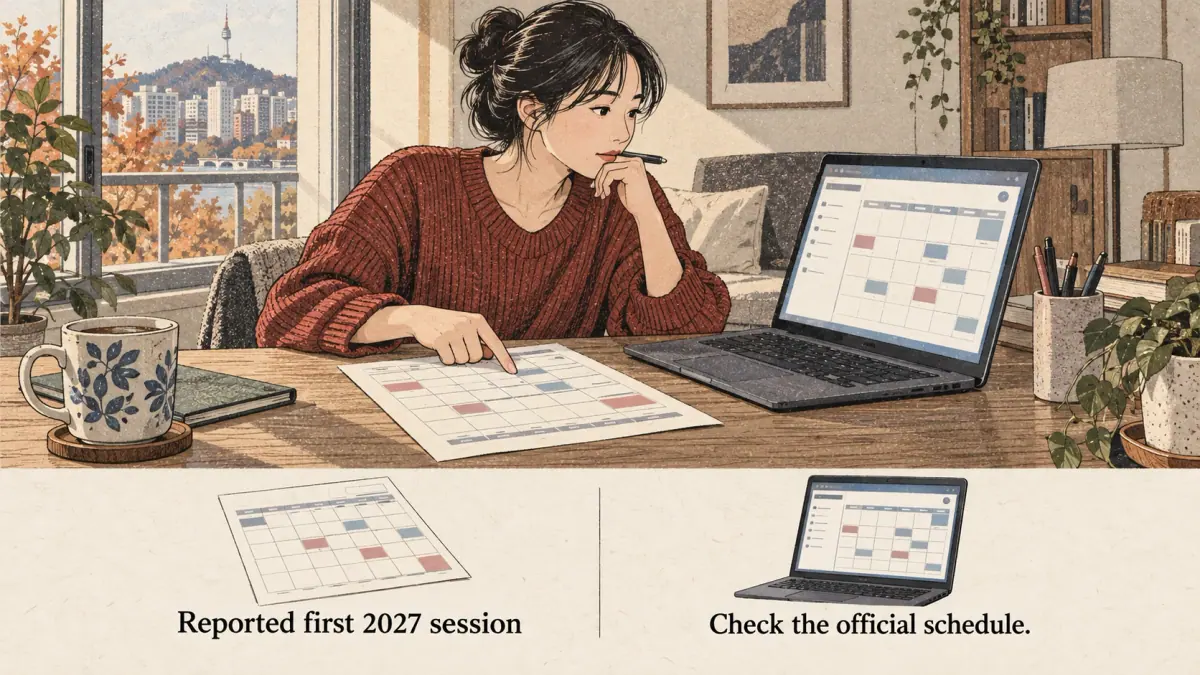
According to a press report, the TOPIK exam dates for 2027 begin with the 110th paper-based TOPIK on Sunday 10 January 2027, held in Korea only. The internet-based series starts with the 17th IBT on Saturday 20 February 2027, also Korea-only, and the first speaking test of the year is on Saturday 20 March 2027. Later sessions run through the year in Korea and, for most paper and internet sessions, overseas.
| Test series | Reported first 2027 session | Where | Other 2027 sessions |
|---|---|---|---|
| Paper-based TOPIK (PBT) | 110th, 10 January 2027 | Korea only | five more, in Korea and overseas |
| Internet-based TOPIK (IBT) | 17th, 20 February 2027 | Korea only | five more, in Korea and overseas |
| TOPIK speaking test | 20 March 2027 | Korea only | 12 June and 23 October 2027, in Korea |
These dates come from the Ministry of Education's 2027 announcement as reported by Korea JoongAng Daily on 29 September 2026. They had not been confirmed on the official site when this page was last updated on 9 October 2026, so treat them as provisional.
Check the official schedule. The calendar on topik.go.kr, run by the National Institute for International Education (NIIED), is the authority. If it differs from this table, follow the official calendar.
For the rest of 2026, the remaining paper and internet sessions fall in October and November. If you are reading this before the end of 2026, open the official calendar to see whether a session in your country still has an open registration window. The next question is how many chances a year that pattern gives you.
How Many TOPIK Sessions Are There per Year?
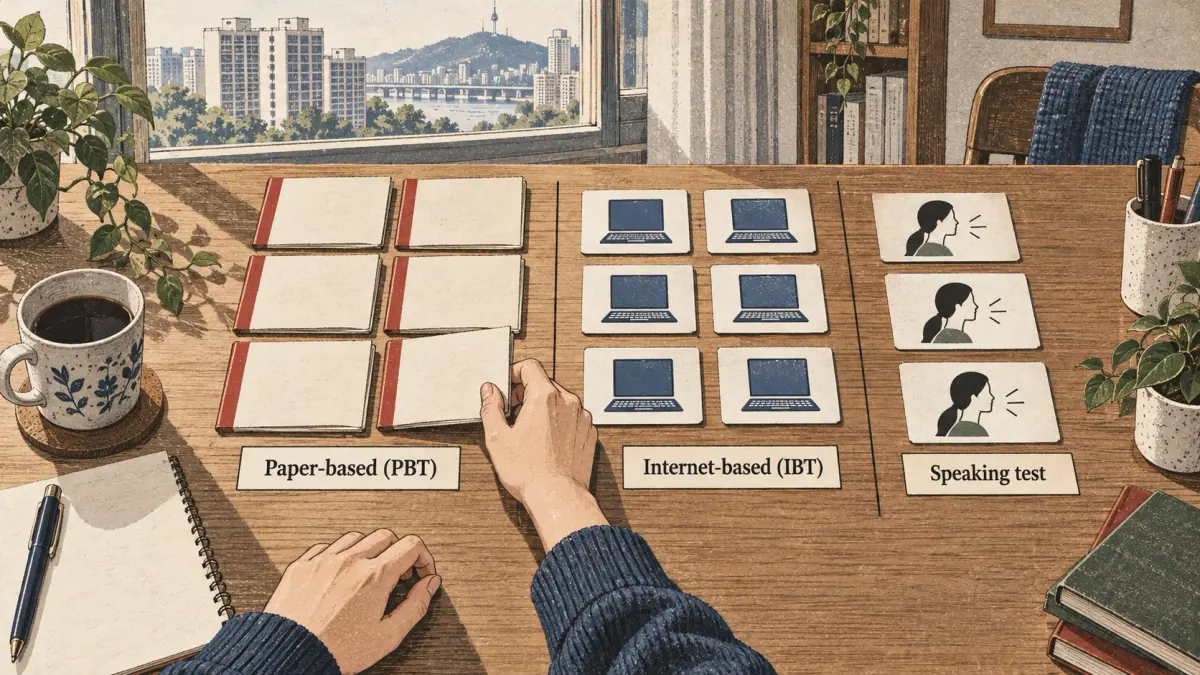
TOPIK runs fifteen sessions a year in Korea across three series: six paper-based, six internet-based and three speaking. That has been the pattern for 2026, and the 2027 plan reported in the press repeats it. The three series are separate exams with separate registration, so you choose a series and then a session.
| Series | 2026 sessions | 2026 numbering (as reported) | 2027 plan (as reported) | Held overseas? |
|---|---|---|---|---|
| Paper-based (PBT) | 6 | 104th to 109th | 6, starting with the 110th | yes, except the first session of the year |
| Internet-based (IBT) | 6 | 11th to 16th | 6, starting with the 17th | yes, except the first session of the year |
| Speaking test | 3 | 10th to 12th | 3, starting with the 13th | no, Korea only |
Three practical points follow from the table:
- Six is the Korea number. If you live in Korea, you can sit a paper test roughly every two months. Overseas, the count depends on your country.
- PBT and IBT are equal choices. Both give a TOPIK I or TOPIK II level on the same scale. The IBT is taken on a computer at a test centre, not at home; TOPIK IBT explains it.
- The speaking test is extra. TOPIK I and II contain no speaking section. The TOPIK speaking test is its own exam, held in Korea only.
In recent years the paper sessions in Korea have fallen in January, April, May, July, October and November. Treat that as a pattern, not a promise; the exact weekends move every year. Because the first sessions of the year are Korea-only, the location question comes next.
Which TOPIK Sessions Are Korea-Only?
The first paper-based session and the first internet-based session of each year have been Korea-only, and every speaking-test session is Korea-only. All other PBT and IBT sessions are held both in Korea and overseas, but no single overseas city hosts all of them.
- Korea-only in recent schedules: the January PBT (the 104th in 2026, the 110th in 2027), the first IBT of the year (late February in both 2026 and 2027) and all three speaking tests.
- Korea and overseas: the other five PBT sessions and the other five IBT sessions.
- Your city: a subset of those ten. Some countries host several sessions a year; others host one or two, and some offer only the paper or only the internet test.
The reason is practical. Overseas sessions depend on local organisers, such as Korean Education Centres, King Sejong Institutes, embassies and universities, and on time-zone arrangements. Fewer overseas sessions mean less flexibility, so overseas candidates should plan further ahead. The next step is finding exactly which sessions your country hosts.
How to Find the TOPIK Dates for Your Country
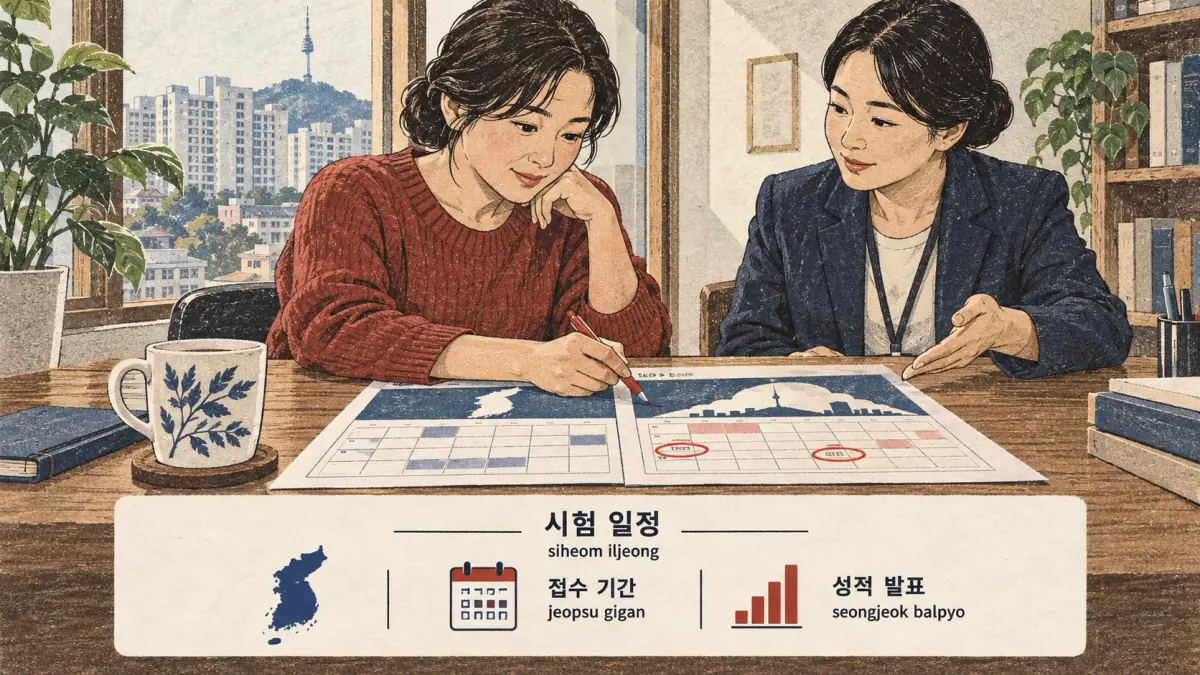
Find your country's TOPIK dates on the official site in five steps. The site has English pages, but some details appear first or only in Korean, so the key Korean words are given below.
- Open topik.go.kr and find the schedule page. Look for the annual test schedule, 시험 일정 (siheom iljeong). You will know you are in the right place when you see session numbers and three date columns: registration, test day and results.
- Choose the series. Check whether the page you are reading is the PBT, IBT or speaking schedule. The numbers differ (for example, the 110th PBT and the 17th IBT are both early-2027 sessions), so do not mix them.
- Open the overseas test-site list. Find your country and city. Note which session numbers your city hosts and whether it offers PBT, IBT or both.
- Check the local registration window. Overseas windows, 접수 기간 (jeopsu gigan), are set by the local organiser and can differ from the Korean dates. Some organisers publish them only on their own website or social media.
- Write down the results date. The results announcement, 성적 발표 (seongjeok balpyo), decides when you can use your score.
The common mistake at step 2 is reading the IBT calendar and registering for a PBT session, or the reverse. At step 4, the common mistake is assuming the window in your country matches the Korean one. With your session chosen, you can plan backwards from test day.
How Do You Read a TOPIK Session Number?
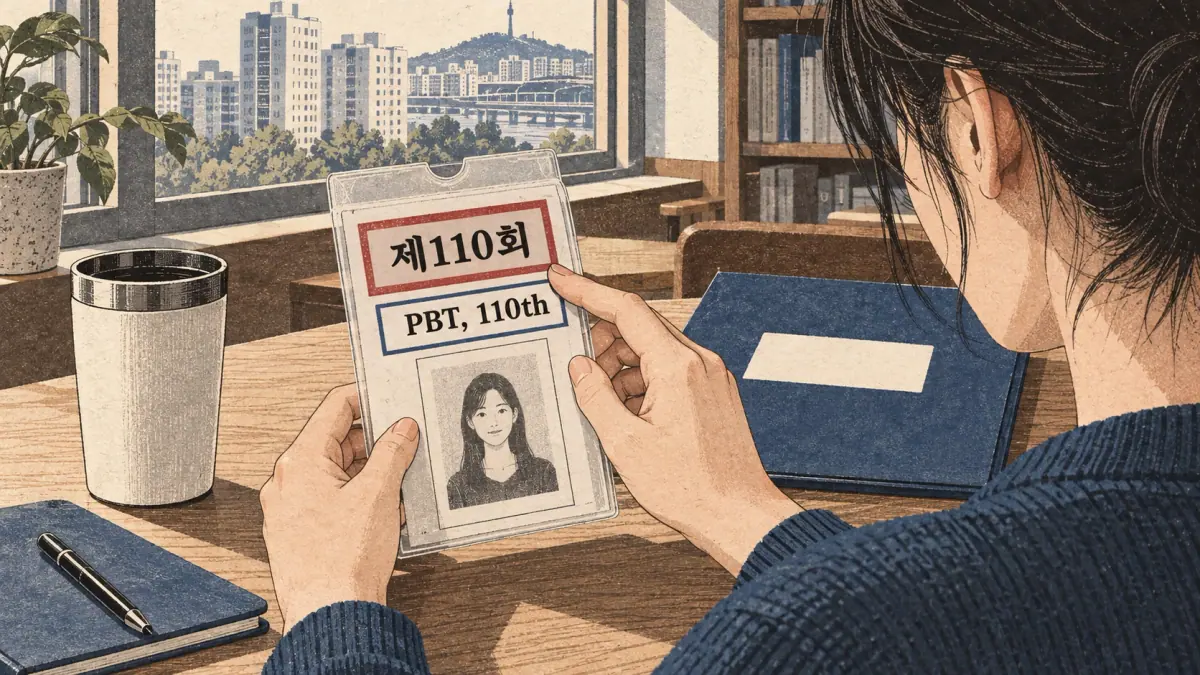
A TOPIK session number is an ordinal that counts every session of a series since it began. Paper sessions are written 제110회 (the 110th TOPIK); 제 marks an ordinal and 회 means "session" or "round". The internet-based test and the speaking test have their own, shorter counts.
The number matters in three places. Your admission ticket (수험표) shows it, your score report shows it, and many universities ask for it on application forms. If a form asks for "TOPIK session", give the series and number, for example "PBT, 110th". The number alone can be ambiguous, because an IBT session and a PBT session can share a number in different years.
How Far Ahead Should You Plan for TOPIK?
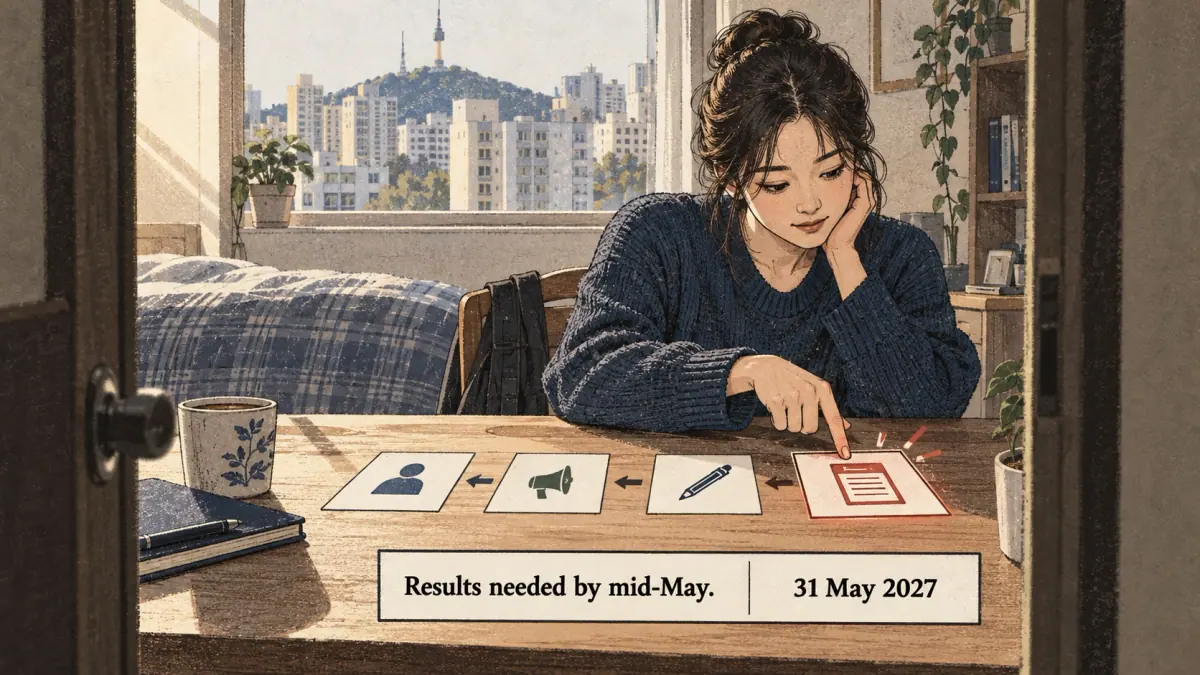
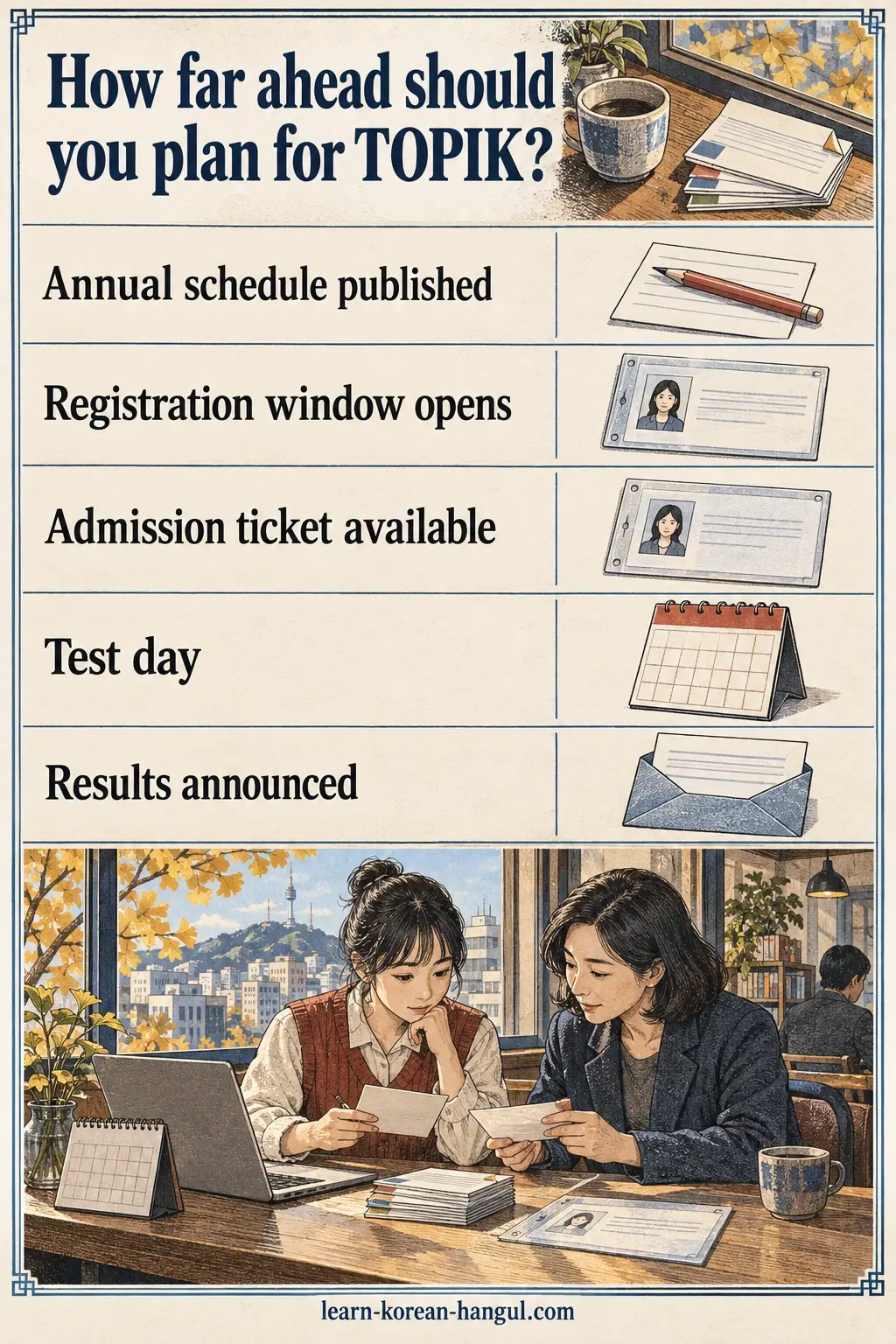
Plan backwards from the date you need a result, not from the date you want to sit the test, and allow about four months between deciding and having a usable score. The table shows typical gaps based on recent official schedules; every gap can change, so check the actual dates for your session.
| Stage | Typical timing | What to do |
|---|---|---|
| Annual schedule published | in the autumn of the year before | note the sessions and windows for your country |
| Registration window opens | about two months before test day in Korea | register on the first day if your centre is popular |
| Registration window length | often about a week | have your photo, ID and payment ready in advance |
| Admission ticket available | some weeks before test day | print it and check your name, photo and centre |
| Test day | PBT on a Sunday, IBT and speaking on a Saturday (Korea, 2026-2027 schedules) | bring the ticket and an accepted ID |
| Results announced | about three weeks after an IBT or speaking test; around a month or more after a PBT | download the score report |
| Score expires | two years after the results announcement | retake before it lapses if you still need it |
The step-by-step application is on TOPIK registration, and result timing is on TOPIK results. The two-year validity rule is explained on its own page.
Worked Example: a University Deadline
Suppose a learner outside Korea must submit a TOPIK level 3 certificate to a Korean university by 31 May 2027. Working backwards:
- Results needed by mid-May. A paper session whose results come out after the deadline is useless for this application.
- That points to a winter or early-spring session. The January PBT is Korea-only, so the learner looks at their country's first overseas session of 2027 and its results date.
- Registration for that session closes roughly two months before it. For a session in spring, registration falls in mid-winter.
- Study must therefore be well advanced by the end of 2026. If level 3 is still far off, a later application round is more realistic than a rushed test.
The same logic works for job applications and visa routes. TOPIK requirements lists the levels typically asked for, and a TOPIK study plan helps you fit preparation into the time you have. Choosing between session types is the next decision.
Which TOPIK Session Type Should You Choose?
Choose the session that gives you a usable result before your deadline in a format you have practised. The paper and internet tests give levels on the same scale, so the decision is about timing and comfort, not prestige.
| Factor | PBT (paper) | IBT (computer at a centre) | Speaking test |
|---|---|---|---|
| Sessions in Korea per year (2026-2027) | 6 | 6 | 3 |
| Overseas availability | most countries that host TOPIK | fewer centres than the paper test in many countries | none |
| Writing (TOPIK II) | by hand on grid paper | typed | not applicable |
| Results speed | slower | usually faster | about three weeks after the test in recent schedules |
| Best for | candidates who write well by hand | candidates who type Korean comfortably and need faster results | candidates who need separate proof of speaking |
If a university or employer names one format, use that one. Otherwise, IBT or the paper test compares them in detail. The schedule is not the only thing that changes from year to year.
What Changed in the 2027 TOPIK Announcement?
The 2027 announcement kept the number of sessions but tightened test security. According to the Ministry of Education's plan, as reported by Korea JoongAng Daily, candidates caught cheating will be barred from taking TOPIK for five years, and accepted ID will be limited to physical passports and foreigner registration cards. The ministry also said it will expand the use of detectors for devices such as AI glasses and earphones.
For candidates, the practical changes are simple: check that your passport or foreigner registration card is valid on test day, and leave every device outside the desk area. The ministry also described long-term plans for AI-assisted question writing and grading and for a pilot of at-home testing in 2028. None of these changes the 2027 dates; the at-home pilot in particular is a plan, not a current option.
Why Do TOPIK Dates Differ between Countries?
TOPIK dates differ between countries because each overseas session needs a local organiser, an approved test site and arrangements for time zones, while Korea hosts every session centrally. Countries with many candidates tend to host more sessions; countries with few may host one paper session a year.
Time zones add a further layer. The Ministry of Education was reported as naming time-zone differences as one route for cheating, which is one reason overseas sessions are scheduled and supervised carefully. For you, the consequence is that a session listed for "October" may fall on a different local date or time from the Korean one. Always use the date and time on your own admission ticket.
What If You Miss a TOPIK Registration Window?
If you miss a registration window, the realistic options are the next session in the same series, a session in the other series, or a nearby test site. Late registration is generally not offered for a session whose window has closed, so do not plan on it.
- Check the other series. If the paper window has closed, an internet-based session a few weeks later may still be open, and the reverse. Both give the same levels.
- Check nearby sites. In Korea, another city may have seats when yours is full. Overseas, a neighbouring country's session is sometimes an option, but weigh travel cost against waiting.
- Watch for released seats. Some candidates cancel during the refund period, and seats can reappear. Refund and cancellation rules are set in the official guide, so read them before relying on this.
- Move your deadline, not your standard. If no session gives results in time, ask the university or employer whether a pending registration or a later score is acceptable.
You will know you have a real backup when you have written down a second session number, its window and its results date.
How Should You Match Your Study to the TOPIK Dates?

Match your study to the dates by choosing a session you can reach with a margin, then counting weeks backwards from it. A useful rule of thumb is to book the test only when your timed mock-test totals sit about 15 to 20 points above the cut score you need, because test-day nerves and unfamiliar topics usually cost a few points. This margin is an editorial guideline, not an official figure.
| Weeks before test day | Focus |
|---|---|
| 12 to 8 | fill grammar and vocabulary gaps for your target level |
| 8 to 4 | section practice with timing; for TOPIK II, one writing task 53 and one task 54 each week |
| 4 to 1 | full timed mock tests, one per week, with review |
| Test week | light review, check the admission ticket, ID and route to the centre |
If your mock scores are still below the cut score eight weeks out, choosing a later session is usually better than paying for a test you expect to miss. The cut scores themselves are on the TOPIK levels page, and a full week-by-week schedule is in the TOPIK study plan.
Limits of This Page
This page gives the pattern of TOPIK exam dates and the start dates reported for 2027, but it does not list every session for every country. Those dates change, are sometimes revised after publication, and are set partly by local organisers. The 2027 dates and session numbers come from a press report, not from the official site. Some figures here, such as typical registration and results gaps, are drawn from recent schedules and labelled typical. This site is not affiliated with NIIED or the Ministry of Education. Before you register, pay or book travel, check every date on topik.go.kr and with your local organiser.
Frequently Asked Questions
When is the next TOPIK exam? As of 9 October 2026, the remaining 2026 sessions fall in October and November. For 2027, the first paper-based TOPIK (the 110th) has been reported for 10 January 2027, in Korea only; confirm it on topik.go.kr. If you are outside Korea, your first chance in 2027 is a later session, so check the dates for your country on topik.go.kr.
How many times a year is TOPIK held? In 2026 and in the 2027 plan reported in the press, TOPIK runs six paper-based sessions, six internet-based sessions and three speaking-test sessions a year. Korea hosts all of them. Outside Korea, each country hosts only some sessions, and the speaking test is held in Korea only, so your local number of chances is usually lower.
Is TOPIK held in my country? Probably, if you live in a country with a sizeable Korean-learning community, but not at every session. Overseas tests are run through local organisers such as Korean Education Centres, embassies or universities. Open the overseas test-site list on topik.go.kr, find your country and city, and note which sessions it hosts and whether it offers the paper or the internet test.
How far ahead should I register for TOPIK? Plan to register as soon as the window opens, which in Korea is typically around two months before the test. Registration windows are short, often about a week, and popular centres in Korea can fill quickly. Overseas windows are set locally and can open earlier. Mark the window date in your calendar the day the annual schedule is published.
Next Step: Register
Once you know your TOPIK exam dates, the next step is the application itself: continue with TOPIK registration for the steps, documents and fees. All exam pages are listed in the TOPIK section.