This page gives typical levels and a method to confirm the exact rule. It is general information, not legal or immigration advice. The official sources are the institution's own notice, the official TOPIK website (topik.go.kr) run by the National Institute for International Education (NIIED, 국립국제교육원), and, for visas, the Korea Immigration Service.
TOPIK Requirements: the Essentials
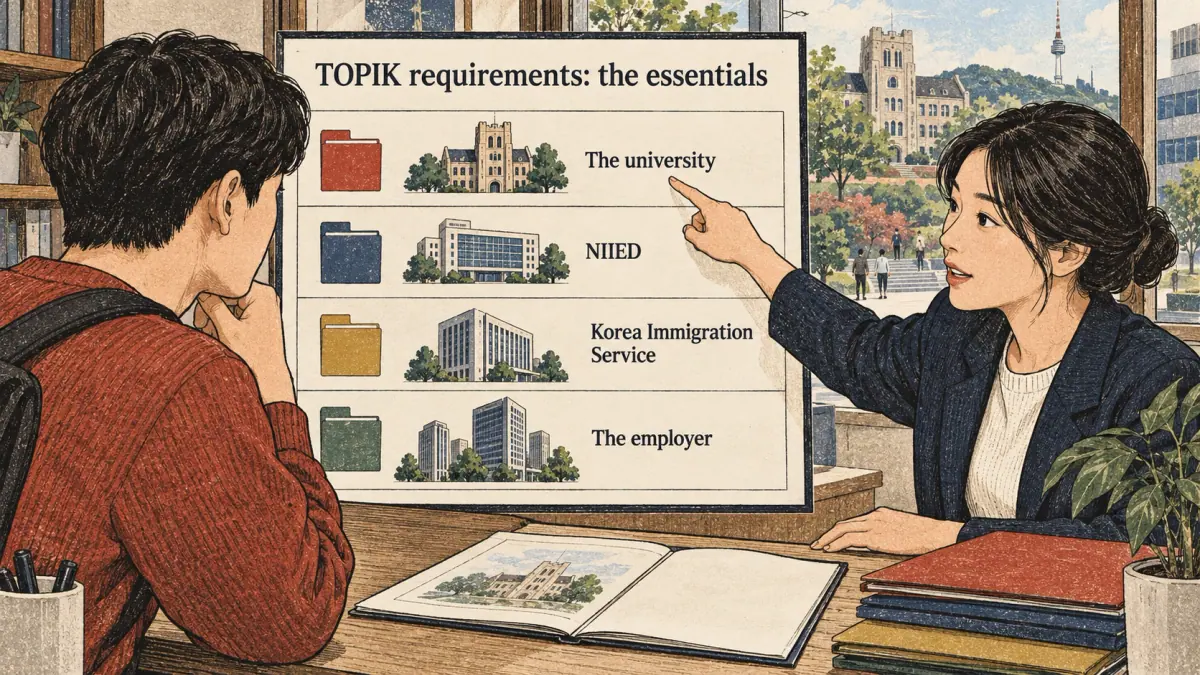
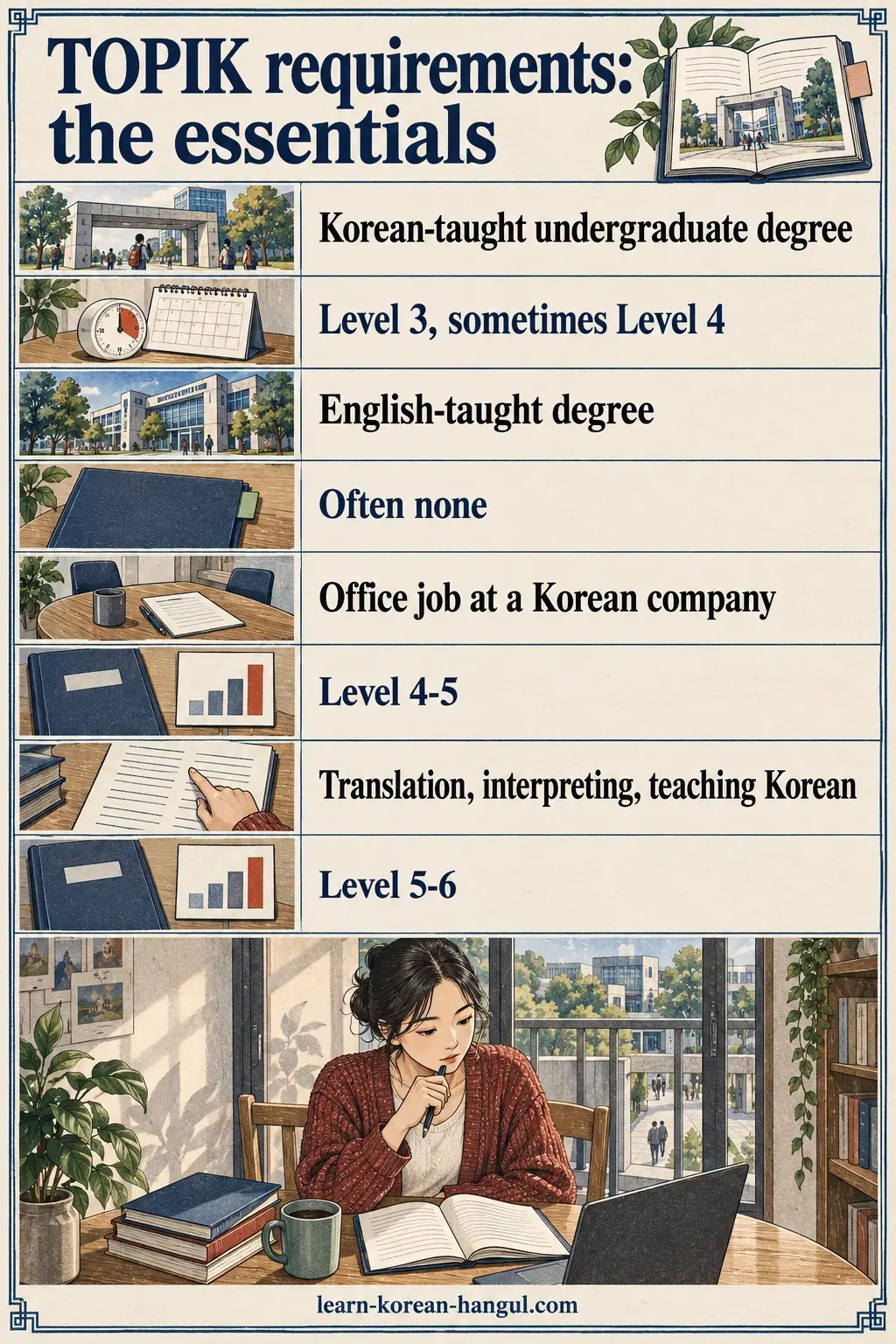
TOPIK requirements are minimum TOPIK levels that an organisation asks applicants to hold. The organisation decides whether it wants TOPIK at all, which level, and how recent the result must be. The table summarises typical asks by goal. "Typical" means common in published notices, not guaranteed for your case.
| Goal | Typical TOPIK level | Who sets the rule | Confirm with |
|---|---|---|---|
| Korean-taught undergraduate degree | Level 3, sometimes Level 4 | The university | The admissions notice (모집 요강) |
| Graduation from a Korean-taught degree | Level 4 at many universities | The university | The academic regulations |
| Korean-taught graduate degree | Level 3-4, sometimes higher | The graduate school | The graduate admissions notice |
| English-taught degree | Often none | The university | The programme page |
| Government scholarship (GKS) | Not always required; higher levels can help | NIIED | The year's GKS guidelines |
| Student or work visa that uses Korean ability | Varies by visa type | Korea Immigration Service | The immigration guidance for that visa |
| Office job at a Korean company | Level 4-5 | The employer | The job advert |
| Translation, interpreting, teaching Korean | Level 5-6 | The employer or certifying body | The advert or qualification rules |
| Factory, farm or fishing work under the Employment Permit System | EPS-TOPIK, not TOPIK | Government programme | The EPS notice in your country |
The rest of this page explains each row. Before that, one detail shapes every requirement: institutions ask for a level, not a score.
Why Do Institutions Ask for a Level, Not a Score?
Institutions ask for a TOPIK level, not a score, because the level is the official meaning of the result. A level (급, geup) is a band defined by cut scores: Level 3 starts at 120, Level 4 at 150, Level 5 at 190 and Level 6 at 230 out of 300 on TOPIK II. Asking for "Level 4" is simpler and fairer than asking for "152 points".
The typical wording in a Korean notice is "TOPIK 4급 이상" (topik sageup isang), "TOPIK Level 4 or above".
This has two practical effects. First, a candidate with 151 points and one with 189 points both meet a Level 4 requirement. Second, a candidate one point below a cut score does not meet it, so aim for a margin. The TOPIK levels page explains what each level means in plain English. The most common goal, university study, comes next.
What TOPIK Level Do Universities Ask For?

Universities that teach in Korean usually ask international applicants for TOPIK Level 3 or 4, and many ask for Level 4 to graduate. Universities that teach in English often ask for no TOPIK at all. Each university and each programme publishes its own rule.
Undergraduate Admission to Korean-Taught Programmes
Korean-taught undergraduate programmes commonly set Level 3 as the minimum for international applicants. Some majors, especially those heavy in reading and writing such as law, media or Korean literature, ask for Level 4 or higher. A few universities accept other proof instead, such as completing a set level at their own language institute.
Example: a notice may say "TOPIK 3급 이상 또는 본교 한국어교육원 4급 이상 수료", meaning "TOPIK Level 3 or above, or completion of Level 4 at our Korean language institute". The exact levels in such a sentence differ from university to university.
English-Taught Programmes
English-taught programmes usually require English proof instead, such as an IELTS or TOEFL score, and often no TOPIK. Some still give credit for TOPIK in selection, and some ask students to reach a TOPIK level before graduating, because daily life and part-time work in Korea are easier with Korean.
Graduate Programmes
Korean-taught master's and doctoral programmes commonly ask for Level 3 or 4, and some ask higher levels in humanities and social sciences. Science and engineering programmes taught partly in English may ask for less. Graduate schools may also require a TOPIK level before the thesis or graduation.
Language Courses as a Route In
Korean language courses (어학연수, eohangnyeonsu, said [어항년수]) at university language institutes do not require TOPIK, because they exist to teach Korean from the beginning. Many students take a language course first, reach Level 3 or 4, and then apply to a degree.
How Recent Must the Result Be?
The result usually must be valid on the application deadline, which in practice means announced within the last two years. Some universities check validity on the document submission date, others on the start of the semester. A result announced in June 2025, for example, is valid until June 2027, so it would not cover an application whose documents are checked in September 2027. When the wording is unclear, ask which date the office checks.
Universities also need a valid result at the right time, and that leads to scholarships, which have their own rules.
How Does TOPIK Affect Scholarships?

TOPIK affects scholarships as a selection advantage more often than as a strict requirement. A higher level shows that a scholar can study in Korean, which matters for programmes taught in Korean.
The best-known example is the Global Korea Scholarship (GKS), run by NIIED, the same institute that runs TOPIK. The GKS guidelines, published each year, explain how TOPIK is treated in selection and whether scholars with a high TOPIK level may shorten or skip the Korean language training period that usually comes before the degree. Many universities' own scholarships for international students also use TOPIK levels, for example to set tuition reductions by level.
Because these rules are written fresh each year, read the guidelines for the year you apply, not a summary from a past year. Scholarship rules are one kind of official rule; visa rules are another, and stricter.
What Do Visas and Residency Require?
Visas and residency rules require TOPIK only in specific cases, and each case has its own level. Many visa types have no Korean requirement. Where Korean ability matters, the rule is set by the Ministry of Justice and the Korea Immigration Service, and it changes over time. Treat everything in this section as a starting point for your own check, not as the rule.
Student Visas
For student visas, the university's admission decision usually carries the language requirement. Students admitted to a Korean-taught degree may need to show Korean proof such as a TOPIK level, and students on English-taught programmes may need English proof instead. Students on Korean language courses usually do not need TOPIK. The university's international office knows the current visa documents and is the first place to ask.
Points-Based and Work-Related Visas
Some residence and job-seeking visas use points systems in which Korean ability earns points, with more points for higher TOPIK levels or for stages completed in the government's integration programme. These points can make a real difference to eligibility. The exact visa codes, point tables and accepted proofs change, so read the Korea Immigration Service guidance for the specific visa.
Permanent Residence and Naturalisation
Long-term residence and naturalisation have their own routes for proving Korean ability, centred on the government's Korea Immigration and Integration Program (KIIP) and related tests. TOPIK may help in some routes, but it is not a universal substitute. Ask the local immigration office (출입국·외국인청, churipguk oegugincheong) about your case.
With study and residence covered, the third big goal is work.
What Do Employers Ask For?
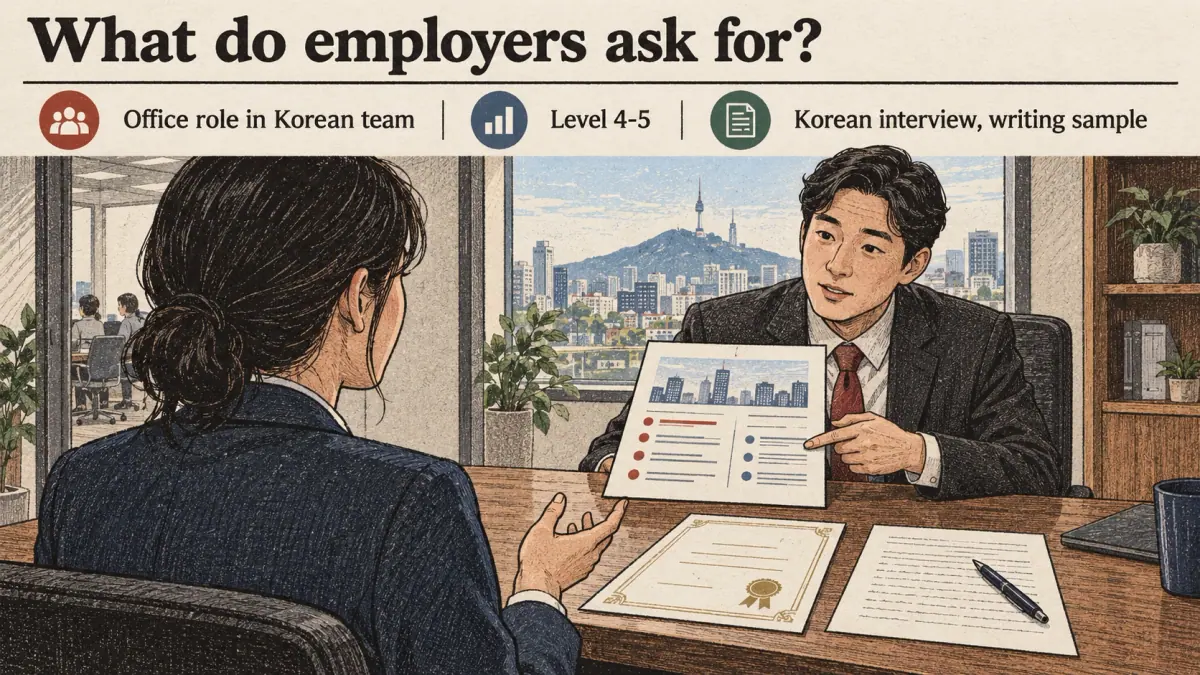
Employers ask for the TOPIK level the job needs, and there is no single standard. Most office jobs in Korean-speaking teams ask for Level 4 or 5, and language-focused jobs ask for Level 5 or 6. Job adverts often say "우대" (udae), "preferred", which means the level helps but is not strictly required.
Office Jobs at Korean Companies
Office roles where you write emails, attend meetings and read documents in Korean usually ask for Level 4 at least, and often Level 5. Global roles that use English daily may list TOPIK only as preferred. Many employers also interview in Korean, because TOPIK does not test speaking.
Translation, Interpreting and Teaching
Translation and interpreting roles typically ask for Level 5 or 6, plus a separate translation test. Teaching Korean has its own qualification rules for non-native speakers, which include a high TOPIK level; check the current rules of the certifying body before planning a teaching career.
Factory, Farm and Fishing Work
Workers coming to Korea under the Employment Permit System (EPS) take EPS-TOPIK, not TOPIK. EPS-TOPIK is a separate test with its own format, run by a different organisation, for specific countries and industries. The differences are explained on the TOPIK vs EPS-TOPIK page.
| Job type | Typical level | Extra checks employers often add |
|---|---|---|
| Customer service in Korean | Level 4-5 | Speaking interview |
| Office role in a Korean team | Level 4-5 | Korean interview, writing sample |
| Translator or interpreter | Level 5-6 | Translation test |
| Korean-language teacher | High level plus a teaching qualification | Qualification rules |
| Factory, farm or fishing worker (EPS) | EPS-TOPIK | Skills test in some sectors |
Once you know what your goal typically needs, the next question is what level to aim for yourself.
Which TOPIK Level Should You Aim For?
Aim for one level above the stated requirement if you can, or at least 10-15 points above the cut score. A margin protects you from a bad test day, and a higher level often helps in scholarships and job selection.
Use this rule of thumb:
- Find the stated minimum in the official notice.
- Add a margin. If Level 3 is the minimum, prepare as if Level 4 were the target.
- Check the time you have. Reaching each level takes months of study; see how long it takes to reach each level.
- Book a session with a results date before your deadline, then build a TOPIK study plan backwards from the test date.
If your goal includes speaking Korean at work, add speaking practice to your plan, and consider the separate TOPIK speaking test if an institution recognises it.
How to Verify a TOPIK Requirement

Verify a TOPIK requirement in three steps: read the official notice, ask the office that sets the rule, and make sure your certificate will be valid on the deadline. The whole check takes about 30 minutes and avoids the most expensive mistakes.
- Read the official notice. Find this year's admission notice, scholarship guideline, visa guidance or job advert, and copy the exact sentence about TOPIK. You'll know this step worked when you have the sentence and its source in front of you, not a forum summary. The common mistake is relying on last year's notice.
- Ask the office that sets the rule. Email the admissions office, scholarship office, immigration office or employer with one precise question, for example: "Does a TOPIK Level 3 result announced in May 2026 meet the requirement for the March 2027 intake?" You'll know it worked when you have a written answer. The common mistake is asking a vague question and getting a vague answer.
- Check validity on the deadline. A TOPIK result is valid for two years from its results announcement date. Compare that date with the application deadline and, if needed, the start date. The page does TOPIK expire explains the details. The common mistake is checking validity on the day you prepare, not on the day the institution checks.
After these steps, register for a session whose results date arrives before your deadline.
Questions to Ask, by Goal
The questions to ask depend on your goal, and a precise question gets a precise answer. Copy the ones that fit and send them to the office that sets the rule.
| Goal | Ask | Why it matters |
|---|---|---|
| Undergraduate or graduate admission | "Which TOPIK level is required for this major, and must the result be valid on the deadline or on the start date?" | Majors can differ inside one university |
| Graduation | "Which TOPIK level is needed to graduate, and by which semester?" | Some programmes block graduation until the level is reached |
| Scholarship | "Does a TOPIK level add points, and is there a minimum level to keep the scholarship?" | Some scholarships set a level to renew each year |
| Visa or residence | "Which proof of Korean ability is accepted for this visa, and which levels earn points?" | Accepted proofs and point tables change |
| Job | "Is the TOPIK level a requirement or a preference, and will there be a Korean interview?" | 우대 and 이상 mean different things |
| Exchange semester | "Do exchange students need any Korean proof for courses taught in Korean?" | Exchange rules are often lighter than degree rules |
Keep every written answer with the date you received it. If a rule changes between your question and your application, the date shows what you were told.
What If You Do Not Meet the Requirement Yet?
If you do not meet the requirement yet, you still have four common routes. Which one fits depends on how far you are from the level and how much time you have.
- Take a language course first. University language institutes teach from the beginning, and many students join a degree after reaching the required level. This route adds months, sometimes a year or more.
- Apply for a later intake. Korean universities usually admit students in spring and autumn. Moving to the next intake gives you one or two more TOPIK sessions.
- Look for conditional or English-taught options. Some programmes accept English proof now and ask for a TOPIK level before graduation. Check that the graduation rule is realistic for you.
- Retake with a focused plan. If you are within 10-20 points of the cut score, a targeted plan for your weakest section is often enough. Your score report shows which section to work on.
An expert rule of thumb: if you need to move up more than one level in less than six months, plan for route 1 or 2 rather than hoping for a big jump. Most learners move up a level over months of steady study, not weeks.
Exchange Students and Short Programmes
Exchange students and short-programme students are often treated differently from degree students. Many exchange agreements require no TOPIK for courses taught in English, and summer or winter schools are usually open to beginners. If you plan to take courses taught in Korean during an exchange, ask the host university whether it sets a level or a placement test.
A Worked Example

A worked example shows the routine in action. Mai plans to apply for a Korean-taught business degree starting in March 2028.
| Step | What Mai finds | What Mai does |
|---|---|---|
| Read the notice | "TOPIK Level 3 or above" for business; Level 4 required to graduate | Sets Level 4 as her target |
| Ask the office | Results must be valid on the application deadline in autumn 2027 | Notes that date |
| Check validity | A result announced after autumn 2025 would be valid; an older one would not | Plans a test in 2026 or early 2027 |
| Choose a session | A session whose results arrive at least a month before the deadline | Registers early to secure a seat |
Mai's choice of a Level 4 target meets the admission rule with a margin and prepares her for the graduation rule, so she studies once for two requirements.
Common Mistakes with TOPIK Requirements
The common mistakes with TOPIK requirements are about sources and dates, not about Korean. Each one below gives the assumption and the reality.
- "A forum said Level 3 is enough." The university's own notice is the only binding source, and it changes each year.
- "Level 3 on my certificate means I can apply for three years." Validity is usually two years from the results date.
- "TOPIK counts for my factory work visa." Employment Permit System workers take EPS-TOPIK, a different test.
- "Preferred means required." 우대 (preferred) helps but rarely excludes you; 이상 (or above) is a firm minimum.
- "My score is high, so the level does not matter." Institutions read the level; check that your total crosses the cut score.
What This Guide Cannot Tell You
A general guide to TOPIK requirements cannot tell you the exact rule for your university, scholarship, visa or job, because those rules are set by others and updated often. It also cannot replace legal or immigration advice. The typical levels here describe common patterns in published notices; individual programmes can be stricter or more flexible.
TOPIK Requirements: the Bottom Line
TOPIK requirements are set by the organisation you apply to: many Korean-taught degrees ask for Level 3 or 4, office jobs often ask for Level 4 or 5, and visa rules set their own levels. Find the exact sentence in the official notice, aim one level above the minimum, and make sure your result is valid on the deadline. For the full exam, return to the TOPIK exam guide.
Frequently Asked Questions
Can I Study in Korea without TOPIK?
Yes, in several ways. English-taught degree programmes often do not require TOPIK, and Korean language programmes at university language institutes are designed for beginners. Some universities also accept completion of a level at their own language institute instead of TOPIK. Each route has its own rules, so check the programme's notice.
Can I Use a TOPIK I Result for University Admission?
Rarely for a Korean-taught degree, because most of those programmes ask for Level 3 or above, which only TOPIK II awards. A TOPIK I result can still help for English-taught programmes, language courses or scholarships that give credit for any Korean ability. Read the exact wording of the admission notice.
Does an Expired TOPIK Result Still Count?
Usually not for applications. A TOPIK result is valid for two years from its results announcement date, and most institutions require a valid result on the deadline. Some may still accept an older result as background information, but you should plan to take the test again if your result will expire before you apply.
Do I Need TOPIK to Live in Korea?
Not in general. Many visa types have no TOPIK requirement at all. TOPIK matters when a visa, a points system, a university or an employer names it. For long-term residence and naturalisation, Korea uses its own routes for Korean ability, so check with the Korea Immigration Service for your case.