A TOPIK study plan works best as a 12-week schedule that rotates vocabulary, grammar, listening, reading and writing, and ends with two full timed mock tests. This plan has five steps, needs 60-90 minutes a day on six days a week, and suits any target level from 1 to 6. Its key success factor is changing each week's focus from your mock results.
Before you start
- Length: 12 weeks in three 4-week phases: foundation, skills and mocks.
- Daily time: 60-90 minutes, six days a week, about 6-9 hours a week (editorial guidance).
- Difficulty: moderate. The schedule is simple; keeping the mock days honest is the hard part.
- Typical cost: free to low. Official past papers are free on topik.go.kr; you need a course book or word deck for your level, and the test fee for your country.
- You need: five to seven official past papers for your test (a diagnostic, study papers and at least two unseen papers for the mocks), a calendar, a flashcard app, and the score tracker below or a notebook.
- Prerequisites: fluent Hangul reading and a rough idea of your level. Complete beginners should first finish a beginner course; the TOPIK 1 study plan starts lower.
TOPIK Study Plan: the Essentials

The TOPIK study plan on this page is a frame, not a fixed list of lessons. It tells you which skills to study each week and for how long, and you fill it with material for your own level. The same frame works for a Level 2 target on TOPIK I and a Level 5 target on TOPIK II, because the phases and the mock rhythm do not change; only the content does.
- 01
Weeks 1-4: Foundation
Diagnostic score, core vocabulary and grammar gaps closed
How Many Words for TOPIKVocabulary targets per level.
- 02
Weeks 5-8: Skills
Listening and reading speed, weekly writing
TOPIK past PapersOfficial papers with audio and answer keys.
- 03
Weeks 9-12: Mocks
Two full timed mocks above the target cut score
TOPIK Mock TestHow to sit, score and review a mock.
In Korean, a study plan is 공부 계획 (gongbu gyehoek), and a target is 목표 (mokpyo), as in 목표 급수 (target level).
The five steps below set the plan up and run its three phases.
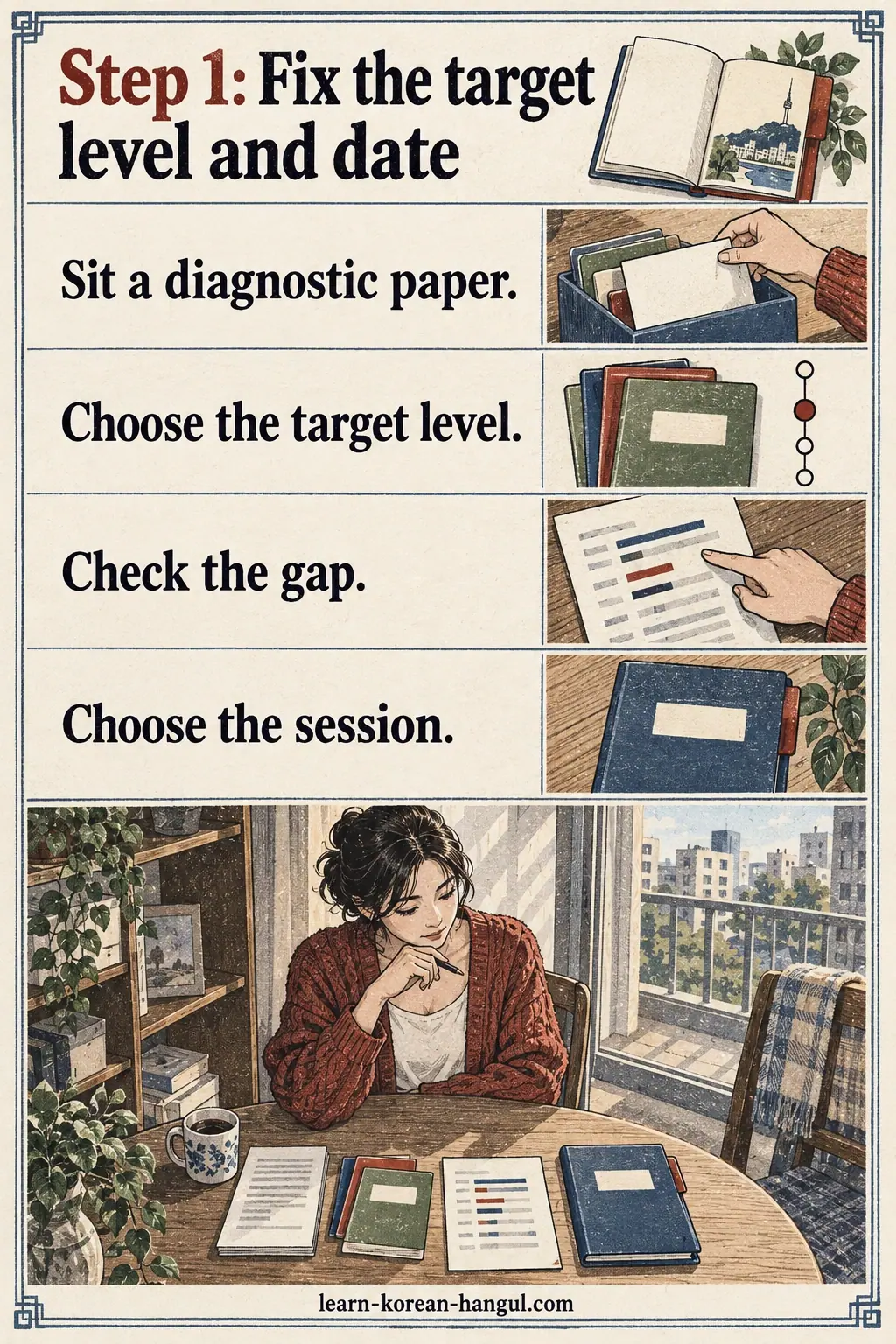
Step 1: Fix the Target Level and Date

Fix one target level and one test session before you plan anything else. The target sets the content, and the date sets the 12 weeks.
- Sit a diagnostic paper. Take one official past paper under real timing and score it. The TOPIK mock test page explains how.
- Choose the target level. Pick the level your goal needs, then add a safety margin of 10-15 points to its cut score. The cut scores are 80 and 140 on TOPIK I, and 120, 150, 190 and 230 on TOPIK II, as published on topik.go.kr.
- Check the gap. As an editorial rule of thumb, 12 weeks of 60-90 minutes a day can close a gap of about 20-40 points. A larger gap needs a later session or a lower target.
- Choose the session. Find a session about 12-13 weeks away. Dates change every year, so check the official schedule on topik.go.kr and the TOPIK exam dates overview, and note the registration deadline.
You'll know it worked when you can write one sentence: "Level 4 (target 165) on [date], current score 132."
Common mistake: choosing the target from hope rather than from the diagnostic. If the gap is 70 points, no 12-week plan will close it, and the plan fails in week 8 instead of week 1.
Step 2: Fill the Weekly Template

Fill a weekly template with five study days, one mock or long-practice day and one rest day, with minutes split by skill. The template stays the same all 12 weeks; only the content and the balance change by phase.
| Day | Type | 60-minute version | 90-minute version |
|---|---|---|---|
| Monday | study | vocabulary 15, grammar 15, listening 15, reading 15 | vocabulary 20, grammar 20, listening 25, reading 25 |
| Tuesday | study | vocabulary 15, listening 20, reading 25 | vocabulary 20, listening 30, reading 40 |
| Wednesday | study | vocabulary 15, grammar 15, writing 15, reading 15 | vocabulary 20, grammar 20, writing 30, reading 20 |
| Thursday | study | vocabulary 15, listening 25, reading 20 | vocabulary 20, listening 35, reading 35 |
| Friday | study | vocabulary 15, grammar 10, writing 20, review of the error log 15 | vocabulary 20, grammar 15, writing 35, error log 20 |
| Saturday | mock or long practice | a timed section or full mock (phase 3) | same, plus marking |
| Sunday | rest | flashcard review only, 10 minutes, optional | same |
For TOPIK I, replace the writing blocks with extra reading, because TOPIK I has no writing section. For TOPIK II, keep at least two writing blocks a week from week 1.
You'll know it worked when every study day in your calendar has a skill and a number of minutes written in it.
Common mistake: a template with no rest day. A planned rest day protects the plan; without one, tiredness creates unplanned gaps that are harder to recover from.
Step 3: Run the Foundation Phase (weeks 1-4)
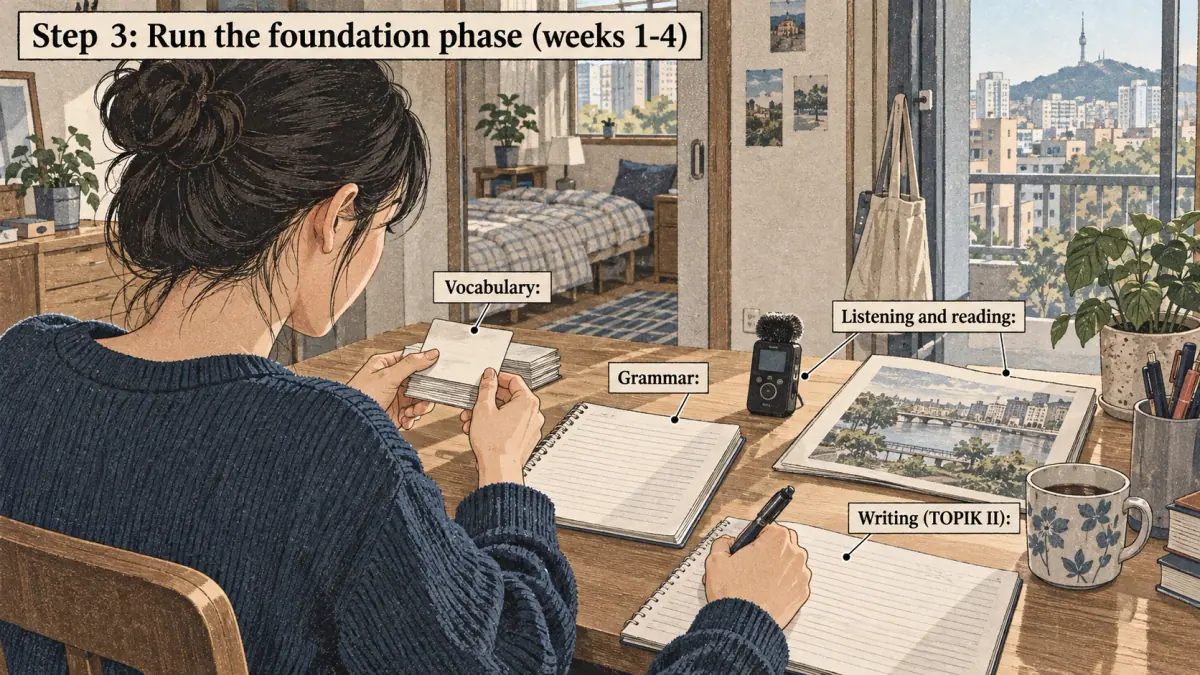
Run the foundation phase by closing the vocabulary and grammar gaps your diagnostic revealed. In these four weeks, about half of each day goes to vocabulary and grammar, and the rest to listening and reading at a comfortable pace.
- Vocabulary: 8-12 new words a day from your level's list, plus reviews. The page on how many words for TOPIK gives the targets for each level.
- Grammar: two to four patterns a week from your course book or level grammar list, each with three of your own example sentences.
- Listening and reading: untimed work with one older past paper as a study paper.
- Writing (TOPIK II): two short paragraphs a week in the written style ending in -다.
You'll know it worked when, at the end of week 4, you can read the study paper's reading passages with fewer than about one unknown word in twenty.
Common mistake: spending all four weeks on words alone. Vocabulary without listening practice does not show up as points, because TOPIK tests words in fast audio and long texts.
Step 4: Run the Skills Phase (weeks 5-8)

Run the skills phase by shifting time from learning to using: listening speed, reading speed and regular writing. Vocabulary drops to about a quarter of each day, mainly review.
- Listening: past-paper recordings and other audio at your level, with shadowing (listening and repeating each sentence aloud) for the recordings you miss.
- Reading: timed sets of five to ten questions with a checkpoint. In TOPIK II reading, 70 minutes for 50 questions is 84 seconds a question on average.
- Writing (TOPIK II): one question 53 answer and one question 54 essay a week, with a correction from a teacher, tutor or language partner when possible, and a rewrite a day later.
- Saturday: one timed section a week, rotating listening, reading and (TOPIK II) writing.
You'll know it worked when your timed section scores on Saturdays rise for at least two of the four weeks.
Common mistake: practising only the section you enjoy. The error log from Step 1 and the Saturday sections show your weakest section; give it the extra minutes, even when it is less pleasant.
Step 5: Run the Mock Phase (weeks 9-12)

Run the mock phase with two full timed mocks, in weeks 9 and 11, and targeted practice in weeks 10 and 12. This phase measures whether you are on track and fixes the last large errors.
| Week | Saturday | Weekdays |
|---|---|---|
| 9 | full timed mock 1 (unseen paper) | review every error; plan week 10 from the error types |
| 10 | timed section: your weakest | practice for the top error type |
| 11 | full timed mock 2 (unseen paper) | review; compare with mock 1 |
| 12 | no full mock; short timed drills only | light review, error log, test-day preparation |
Compare each mock total with your target plus margin. If mock 2 is at or above the target, keep the routine and rest well before the test. If it is below, use week 12 for the one or two error types that cost the most points, not for new material.
You'll know it worked when both mocks are logged in the tracker with section scores, totals and error counts.
Common mistake: a full mock in the last two or three days. It tires you and adds little; your last full mock should be about a week before the test.
The 12-Week Score Tracker
Track each week in one row. For paper practice, copy the columns into a notebook or spreadsheet.
| Week | Phase | Study days done | New words | Saturday task | Listening | Writing | Reading | Total | Top error type |
|---|---|---|---|---|---|---|---|---|---|
| 1 | foundation | diagnostic paper | |||||||
| 2-8 | foundation / skills | timed section | |||||||
| 9 | mocks | full mock 1 | |||||||
| 11 | mocks | full mock 2 |
The tracker works because it puts numbers next to each other. Three weeks of rising section scores mean the plan is working; three flat weeks mean the content or the balance needs to change.
What Mistakes Derail Plans?
Five mistakes derail most TOPIK study plans, and each has a simple fix.
- Starting without a diagnostic. Without a starting score you cannot see progress. Fix: sit one timed paper in week 1, even if the score is low.
- Using the newest papers too early. Fix: keep the two or three newest official papers unseen for weeks 9 and 11. The TOPIK past papers page explains how to divide papers between study and mocks.
- Leaving writing to the end. On TOPIK II, writing is a third of the total and the slowest skill to improve. Fix: two writing blocks a week from week 1.
- Not adjusting after a mock. A plan that ignores mock results repeats the same errors. Fix: move 15 minutes a day to the top error type after each mock.
- Treating a missed week as failure. Fix: use the adjustment rules below and continue.
What If I Miss a Week?
If you miss a week, do not try to do two weeks at once. Drop the least important week of the current phase and continue from where the calendar now is. In the foundation phase, shorten it to three weeks; in the skills phase, cut one Saturday section; in the mock phase, keep both full mocks and drop a targeted-practice week instead.
What If I Start Late?
If you have fewer than 12 weeks, shorten the plan from the front, not the back. Keep the diagnostic and both full mocks, and compress the foundation and skills phases:
| Weeks available | Foundation | Skills | Mocks |
|---|---|---|---|
| 12 | 4 weeks | 4 weeks | 4 weeks |
| 8 | 2 weeks | 3 weeks | 3 weeks (mocks in weeks 6 and 7) |
| 6 | 1 week | 2 weeks | 3 weeks (mocks in weeks 4 and 5) |
| 4 | week 1: diagnostic plus targeted review | none | 3 weeks (mocks in weeks 2 and 3) |
With four weeks or fewer, the plan can improve timing and test skill, but it cannot build much new knowledge. The page on how long to study for TOPIK explains what a realistic time frame for your gap looks like.
Which Level-Specific Plan Should You Use?
Use the level-specific plan that matches your test, and use this 12-week frame around it. The frame sets the phases and the mock rhythm; a level plan supplies the word lists, grammar and question practice for that level.
| Your target | Plan to use | What it adds |
|---|---|---|
| Level 1 or 2 (TOPIK I) | TOPIK 1 study plan | beginner vocabulary and grammar order, no writing |
| Level 3 or 4 (TOPIK II) | TOPIK 2 study plan | intermediate grammar, writing questions 51-54 |
| Level 5 or 6 (TOPIK II) | this frame plus the TOPIK 2 plan | more reading volume and essay practice |
| No exam date yet | a general Korean study plan | plans by time budget, not tied to the exam |
Should I Study Every Day or in Blocks?
Study every day in short sessions rather than in long blocks once or twice a week. Daily contact keeps vocabulary and listening fresh, because memory needs repeated exposure spread over days. Long blocks still have one use: the weekly Saturday session, where a full timed section or mock trains the stamina the test needs.
Frequently Asked Questions
Can I study for TOPIK in 30 days? You can prepare for TOPIK in 30 days only if your level is already close to your target. A month is enough to learn the format, fix timing and take two or three mocks. It is not enough to build a level from zero. Use the four-week row of the late-start table above.
How do I adjust the plan for TOPIK 1? For TOPIK I, keep the same phases and mock weeks, but replace every writing block with reading, because TOPIK I has no writing section. A full TOPIK I mock takes 100 minutes, so Saturday sessions are shorter. Use the TOPIK 1 study plan for the beginner vocabulary and grammar order.
How many hours a week does this TOPIK study plan need? This plan needs about 6-9 hours a week: 60-90 minutes on six days, with the Saturday mock sessions running longer in weeks 9 and 11. Below about 5 hours a week, stretch the plan to 16 weeks rather than cutting skills. These figures are editorial guidance, not official requirements.
Can I repeat the 12-week plan for the next level? Yes. After the exam, take a short break, sit a new diagnostic paper for the next level and start a new 12-week cycle. Keep the error log and the tracker, because they show which habits worked. Most learners need more than one cycle per TOPIK II level.
The Bottom Line on This TOPIK Study Plan
A TOPIK study plan that works fits into 12 weeks: four weeks of foundation, four of skills and four of mocks, at 60-90 minutes a day with one rest day each week. Fix the target from a diagnostic paper, keep writing in the plan from week 1 for TOPIK II, and let each mock's error types decide the next week's focus. If time runs short, shorten the front of the plan and keep both full mocks. Your next step is TOPIK mock test, which shows how to sit and score your week-1 diagnostic. All related guides are on the TOPIK preparation hub.