What Are TOPIK Levels?
TOPIK levels are the six grades of the Test of Proficiency in Korean, the main Korean language exam for people whose first language is not Korean. The test is run by the National Institute for International Education (NIIED, 국립국제교육원) under South Korea's Ministry of Education. Its Korean name is 한국어능력시험 (hangugeoneungnyeoksiheom, written as one word: 한국어 "Korean language" + 능력 "ability" + 시험 "test"), and most learners simply say 토픽 (topik).
A TOPIK level is not a pass or fail mark. It is a band. Your total score falls into a band, and the band is your level. For example, a candidate who scores 165 out of 300 on TOPIK II receives Level 4, because 165 is above the Level 4 cut score (150) and below the Level 5 cut score (190).
Koreans call a level a 급 (geup), so Level 4 is 4급 (sageup, read 사급). The general word for "grade" or "level" is 급수 (geupsu). You will see 급 on score reports, on university admission notices and in job adverts, for example "TOPIK 4급 이상" (TOPIK Level 4 or above).
If you are new to the exam itself, the page on what TOPIK is explains who takes it and why. With the idea of a level as a score band in place, the next question is how many bands exist.
How Many TOPIK Levels Are There?
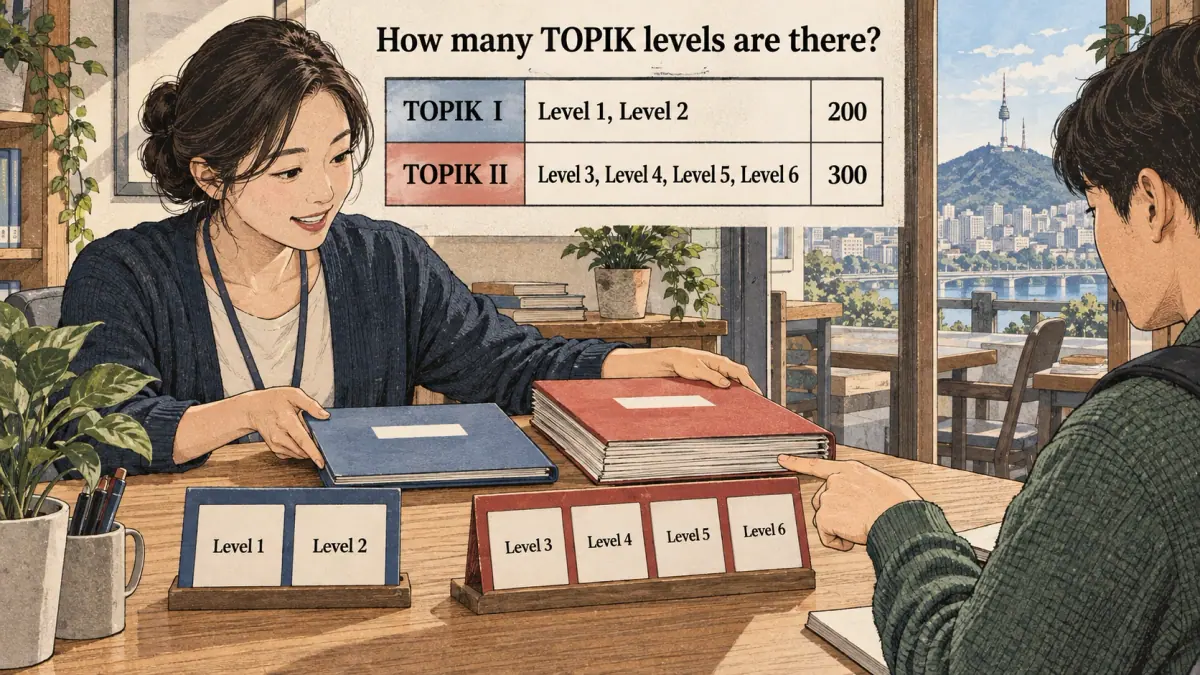
There are six TOPIK levels, numbered 1 to 6, and Level 6 is the highest. They are split across two separate tests. You do not take one exam and land anywhere from 1 to 6. You choose either TOPIK I or TOPIK II, and each test can only award its own levels.
| Test | Levels it can award | Korean band name | Total points |
|---|---|---|---|
| TOPIK I | Level 1, Level 2 | 초급 (beginner) | 200 |
| TOPIK II | Level 3, Level 4, Level 5, Level 6 | 중급 (intermediate) for 3-4, 고급 (advanced) for 5-6 | 300 |
The three Korean band names are worth knowing because Korean course books and schools use them too. A class labelled 초급 is for learners working towards Levels 1-2, 중급 for Levels 3-4 and 고급 for Levels 5-6.
What Happens If You Score below Level 1 or Level 3?
A score below the lowest cut score of your test earns no level. On TOPIK I, 79 points or fewer means no level. On TOPIK II, 119 points or fewer means no level, even though that candidate may be well above beginner. You still receive your scores, but there is no certificate level to show an admissions office or employer.
This is the most common reason to choose the test carefully. A learner who could reach Level 2 on TOPIK I may score 100 on TOPIK II and leave with nothing. The full comparison is on the difference between TOPIK 1 and 2 page. The cut scores themselves come next.
What Are the TOPIK Level Cut Scores?
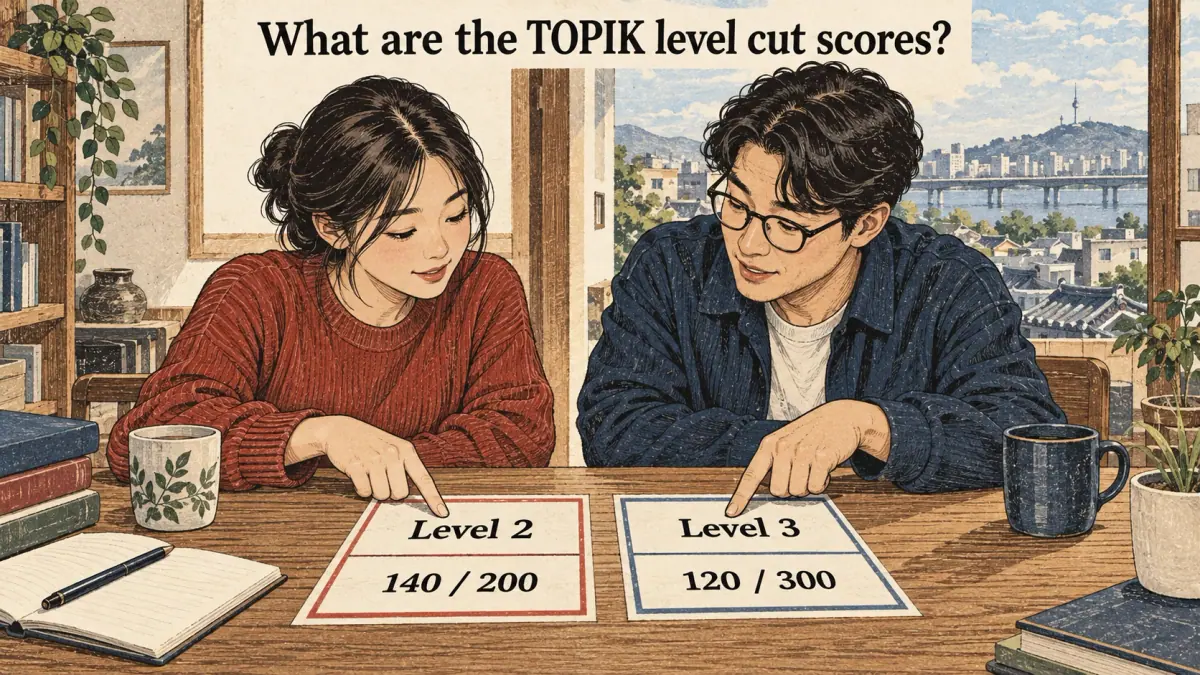
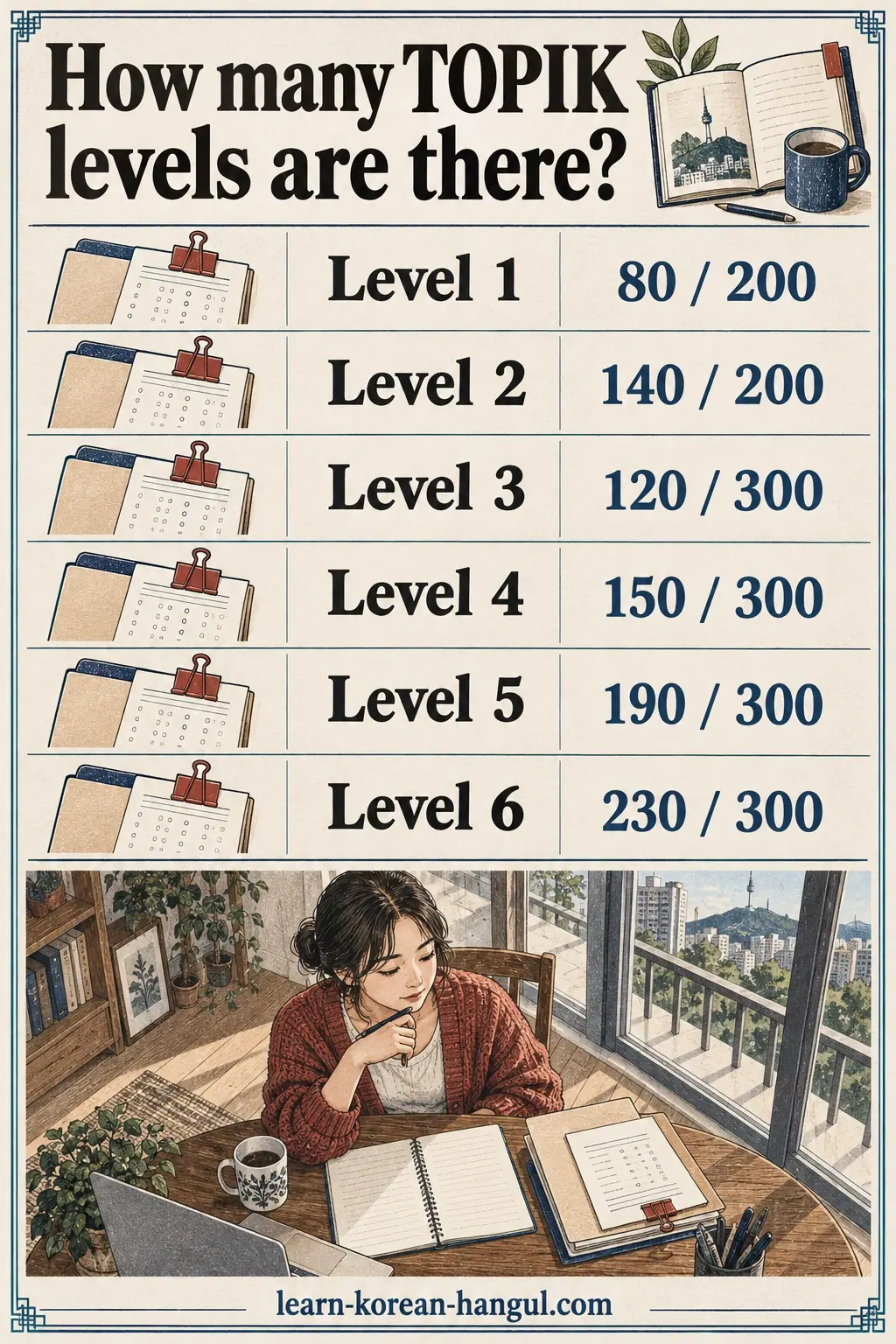
The TOPIK cut scores are 80 and 140 out of 200 for Levels 1 and 2, and 120, 150, 190 and 230 out of 300 for Levels 3 to 6. A cut score is the minimum total needed for a level. Reaching it gives you that level; missing it by one point gives you the level below, or no level.
| Level | Test | Cut score | Score range for this level | Share of the maximum |
|---|---|---|---|---|
| Level 1 | TOPIK I | 80 / 200 | 80-139 | 40% |
| Level 2 | TOPIK I | 140 / 200 | 140-200 | 70% |
| Level 3 | TOPIK II | 120 / 300 | 120-149 | 40% |
| Level 4 | TOPIK II | 150 / 300 | 150-189 | 50% |
| Level 5 | TOPIK II | 190 / 300 | 190-229 | about 63% |
| Level 6 | TOPIK II | 230 / 300 | 230-300 | about 77% |
These cut scores are published by NIIED on the official TOPIK website (topik.go.kr). They have been stable for many years, but always confirm them in the test guide for your session. The TOPIK score page explains how the points are divided between sections and how each section is marked.
Why Do Level 1 and Level 3 Use Different Scales?
Level 1 and Level 3 use different scales because they come from different tests. TOPIK I has two sections, listening and reading, worth 100 points each, so its maximum is 200. TOPIK II adds a writing section, so it has three sections worth 100 points each and a maximum of 300.
This is why the numbers look strange at first. The Level 3 cut score (120) is lower than the Level 2 cut score (140). That does not mean Level 3 is easier. 120 out of 300 on a harder, three-section test is a much bigger achievement than 140 out of 200 on the beginner test. Compare percentages within one test, never raw numbers across the two.
A Worked Example: from Section Scores to a Level
Here is how one TOPIK II result turns into a level, step by step.
- Add the three section scores. A candidate scores 62 in listening, 41 in writing and 58 in reading. The total is 62 + 41 + 58 = 161.
- Find the highest cut score at or below the total. 161 is above 150 (Level 4) and below 190 (Level 5).
- Read the level. The result is Level 4.
- Note the gap to the next level. The candidate needs 29 more points (190 − 161) for Level 5. Writing is the lowest section here, so it is usually where the next points are easiest to find.
The same method works for TOPIK I. A candidate with 55 in listening and 48 in reading has 103 points, which is Level 1. Level 2 would need 37 more points. With the cut scores clear, the next step is the two tests that produce them.
How TOPIK I and TOPIK II Award Levels
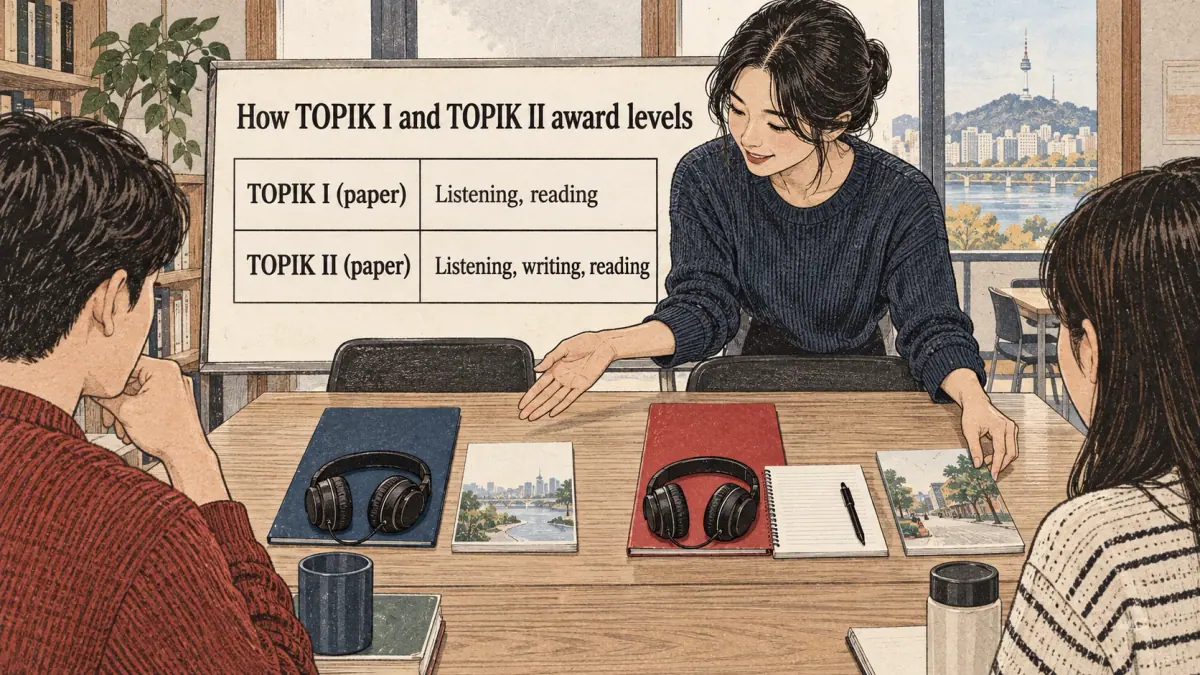
TOPIK I and TOPIK II award levels from different section mixes, and the biggest difference is writing. TOPIK I tests only listening and reading. TOPIK II tests listening, writing and reading. The table shows the paper-based (PBT) format as published by NIIED; the internet-based test (IBT) uses a different number of questions and timings.
| Feature | TOPIK I (paper) | TOPIK II (paper) |
|---|---|---|
| Sections | Listening, reading | Listening, writing, reading |
| Questions | Listening 30, reading 40 | Listening 50, writing 4, reading 50 |
| Time | Listening 40 min, reading 60 min | Listening 60 min, writing 50 min, reading 70 min |
| Points per section | 100 each | 100 each |
| Writing task | None | Two short gap-fills and two compositions |
| Levels awarded | 1-2 | 3-6 |
The writing section explains why many learners find the step from Level 2 to Level 3 hard. Writing is marked by trained raters against criteria such as task completion, structure and accuracy, and the two compositions are long: about 200-300 Korean characters for one and about 600-700 for the other. The TOPIK exam format page covers each section in detail, and the IBT version is explained on its own page.
No TOPIK level tests speaking. Speaking is assessed by a separate test, covered on the TOPIK speaking test page. Now that the mechanics are clear, the next section turns each level into plain English.
What Can You Do at Each TOPIK Level?
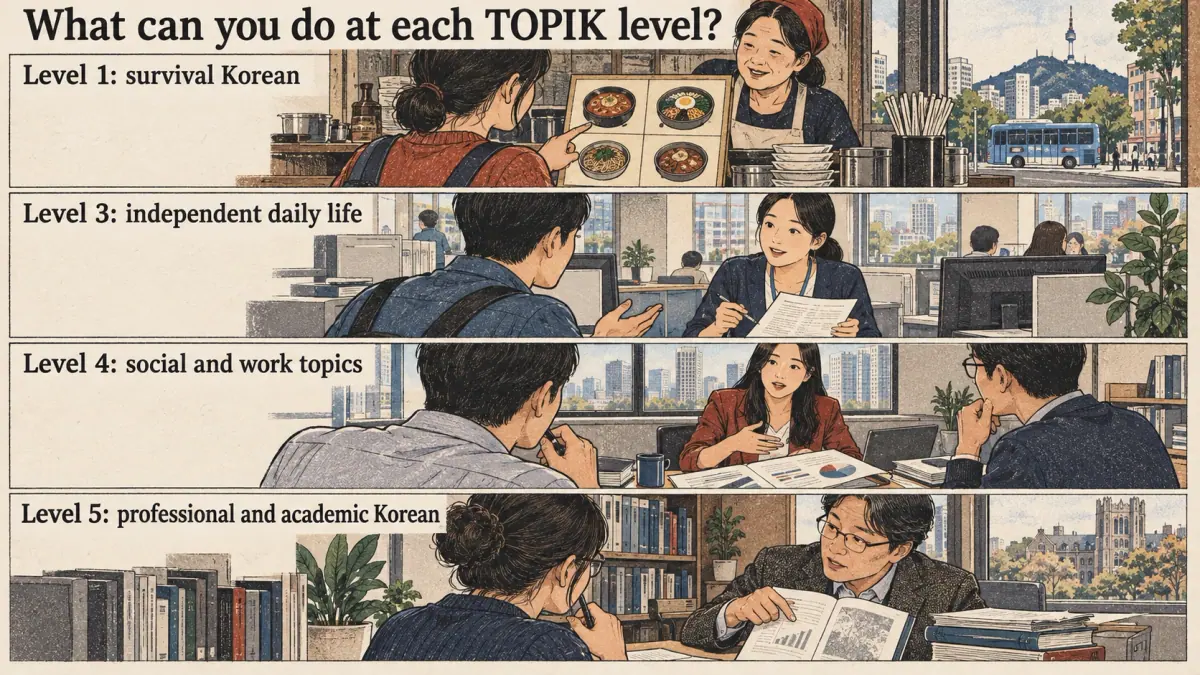
Each TOPIK level describes what you can do in Korean, from ordering food at Level 1 to working in a specialist field at Level 6. The descriptions below paraphrase NIIED's level descriptors in plain English. Each level follows the same order: the score, what you can do, what a typical learner has studied, and where to go next.
Level 1: Survival Korean
- Score: 80-139 out of 200 on TOPIK I.
- What you can do: introduce yourself, buy things, order food and talk about very familiar topics such as family, hobbies and the weather, in short simple sentences.
- Typical learner: has finished Hangul and a first course book, and knows the polite -아요/어요 present tense and basic particles.
- Next: TOPIK level 1 has the full description and a self-check.
Level 2: Everyday Korean
- Score: 140-200 out of 200 on TOPIK I.
- What you can do: make phone calls, ask for favours and handle public places such as the post office or a bank, and begin to use Korean differently in formal and informal situations.
- Typical learner: has finished a full beginner programme, uses past and future forms, and reads short notices and messages.
- Next: TOPIK level 2 shows the gap between Level 1 and Level 2.
Level 3: Independent Daily Life
- Score: 120-149 out of 300 on TOPIK II.
- What you can do: live day to day in Korea without much help, use public facilities, keep up social relationships and follow simple, familiar social topics.
- Typical learner: has finished a beginner course and started intermediate study, and can write a short paragraph with linking endings.
- Next: TOPIK level 3 covers the typical admission requirement in detail.
Level 4: Social and Work Topics
- Score: 150-189 out of 300 on TOPIK II.
- What you can do: follow news and simple newspaper articles, understand social and abstract topics, and use Korean at a basic level in work settings.
- Typical learner: has finished most of an intermediate programme and writes a structured short essay with a clear opinion.
- Next: TOPIK level 4 explains why many universities and employers set the bar here.
Level 5: Professional and Academic Korean
- Score: 190-229 out of 300 on TOPIK II.
- What you can do: use Korean for research or work in a professional field to a degree, and understand politics, economics and culture topics that are less familiar.
- Typical learner: reads authentic texts such as opinion columns, and adapts style to formal and informal contexts.
- Next: TOPIK level 5 covers the advanced band.
Level 6: near-Full Command for Specialists
- Score: 230-300 out of 300 on TOPIK II.
- What you can do: carry out research and work in specialist fields relatively accurately and fluently, and handle unfamiliar topics in politics, economics and society, though not always at native-speaker level.
- Typical learner: has studied for years, often with study or work experience in Korea.
- Next: TOPIK level 6 explains what the top level does and does not prove.
A useful rule of thumb from these descriptions: Levels 1-2 are about you and your daily needs, Levels 3-4 are about society and other people, and Levels 5-6 are about professional and academic work. The next section compares that scale with the European one many learners already know.
How Do TOPIK Levels Compare with CEFR?
TOPIK levels compare roughly with the CEFR (Common European Framework of Reference for Languages) as Level 1 ≈ A1, Level 2 ≈ A2, Level 3 ≈ B1, Level 4 ≈ B2, Level 5 ≈ C1 and Level 6 ≈ C1-C2. NIIED does not publish an official CEFR table, so this match is an approximation used by schools and learners, not a rule.
| TOPIK level | Approximate CEFR level | How sure is the match? |
|---|---|---|
| Level 1 | A1 | Widely used approximation |
| Level 2 | A2 | Widely used approximation |
| Level 3 | B1 | Widely used approximation |
| Level 4 | B2 (some sources say B1+) | Sources differ |
| Level 5 | C1 (some sources say B2+) | Sources differ |
| Level 6 | C1 or C2 | Sources differ most here |
Why sources differ: the two frameworks were built in different ways. The CEFR describes skills, including speaking, with can-do statements. TOPIK measures listening, reading and (on TOPIK II) writing with a scored test. A Level 4 candidate with weak speaking may not be a B2 speaker, even if the reading score is strong.
Which TOPIK Level Is B2?
TOPIK Level 4 is the level most often matched with CEFR B2. If an institution outside Korea asks for "B2 in Korean" and accepts TOPIK, Level 4 is the usual equivalent, and Level 5 is the safe choice if you want a margin. Ask the institution which TOPIK level it accepts as B2, because some treat Level 4 as B1+.
The CEFR match matters most when you compare Korean with another language you have studied, or when a European university uses CEFR wording. For Korean institutions, the TOPIK level itself is what counts, which leads to the practical question of which level you need.
Which TOPIK Level Do You Need?
The TOPIK level you need is set by the institution or agency you apply to, not by TOPIK. The table shows typical asks, phrased as typical because each university, scholarship and employer sets its own rule and rules change. Always check the current notice.
| Goal | Level often asked for (typical) | Where to confirm |
|---|---|---|
| Personal progress check | Any level | Your own plan |
| Korean-taught undergraduate admission | Level 3, sometimes Level 4 | The university's international admissions notice |
| Graduation from a Korean-taught programme | Level 4 at many universities | The university's academic rules |
| Graduate study taught in Korean | Level 3-4, higher in some fields | The graduate school's notice |
| Office work in a Korean-speaking team | Level 4-5 | The job advert |
| Translation, interpreting, Korean-language teaching | Level 5-6 | The employer or programme |
Visa and residency rules sometimes refer to TOPIK too, but they set their own levels and change over time. The TOPIK requirements page goes through study, visa and work goals one by one, with a routine for checking the official source. Before choosing a target, it helps to know what "fluent" means in TOPIK terms.
Which TOPIK Level Counts as Fluent?
TOPIK Level 5 or 6 is what most people mean by fluent, because those are the levels where Korean works for professional and academic tasks. Level 6 is the highest certificate and is often described as near-native for reading and listening, but it does not test speaking and does not prove native-like conversation.
Two examples show the gap between "fluent" and the levels:
- A learner with Level 6 from reading many novels may still hesitate in fast casual speech, because TOPIK does not test it.
- A heritage speaker who talks with family every day may score Level 3 or 4, because the test rewards formal reading and written Korean.
So treat Level 4 as "comfortable in daily and social life", Level 5 as "able to work or study in Korean" and Level 6 as "advanced in written and formal Korean". The next section collects the misunderstandings that most often lead learners to the wrong target.
Common Misunderstandings about TOPIK Levels

Learners often misread the TOPIK level system in four predictable ways. Each one below gives the assumption, the reality and the reason.
- "Level 3 is lower than Level 2 because 120 is less than 140." Actually Level 3 is higher, because 120 out of 300 on TOPIK II is a harder result than 140 out of 200 on TOPIK I. The scales are different.
- "Taking TOPIK II is a safe way to get any level." Actually TOPIK II gives no level below 120 points, so a beginner who takes it may receive nothing. Choose TOPIK I if your practice scores on TOPIK II are under about 120.
- "My level lasts forever." Actually a result is valid for two years from the announcement date for most purposes, as explained on the page about how long a TOPIK result stays valid.
- "A higher level means I can speak well." Actually no TOPIK level includes speaking. A separate speaking test exists, and many institutions do not ask for it.
An expert rule of thumb follows from points 1 and 2: decide between TOPIK I and TOPIK II with a timed mock test, not with your course book level. If a full TOPIK II mock gives you around 120 or more, take TOPIK II. With the misunderstandings cleared, it is fair to look at what the levels cannot tell anyone.
What TOPIK Levels Do Not Show
TOPIK levels have honest limits, and knowing them helps you use a result well. A level is a snapshot of one test day, measured with one format, for three skills at most.
- No speaking. No level says anything about pronunciation, fluency in conversation or listening in noisy, real-life situations.
- No writing on TOPIK I. Levels 1 and 2 say nothing about writing ability at all.
- Bands are wide. Level 4 covers 150 to 189 points. A candidate with 151 and one with 188 receive the same level, although their ability can differ a lot.
- One day's result. Illness, nerves or an unfamiliar format can move a score by a band. A second attempt is the normal fix.
- Limited life. Most institutions accept a result for two years only.
Because of these limits, many universities add an interview, and many employers test spoken Korean themselves. If you want a realistic estimate of how long each level takes to reach, read how long to study for TOPIK. The last section pulls the whole system together.
TOPIK Levels: the Bottom Line
TOPIK levels give six bands from two tests: Levels 1-2 from TOPIK I (cut scores 80 and 140 of 200) and Levels 3-6 from TOPIK II (cut scores 120, 150, 190 and 230 of 300). The two most decision-relevant points are these. First, choose the test that matches your ability, because a score below the bottom cut score gives no level. Second, the level you need is set by your university, employer or visa rule, so confirm it before you set a study target.
For the wider exam, return to the TOPIK exam guide. To understand exactly how the points behind your TOPIK level are earned, continue with the TOPIK score page.
When people ask about levels in Korean, they usually say:
토픽 몇 급이에요? (topik myeot geubieyo?, said [토픽 멷 끄비에요]) means "What TOPIK level are you?" The answer is a number plus 급, for example 4급이에요 (sageubieyo), "I'm Level 4."
Frequently Asked Questions
Can I Get Level 3 on the TOPIK I?
No. TOPIK I can only award Level 1 or Level 2, even with a perfect 200 out of 200. Level 3 and above come only from TOPIK II, which is a separate test with a writing section and a 300-point scale. If you are already above Level 2, register for TOPIK II.
What Is a Good TOPIK Level?
A good TOPIK level is the one your goal asks for. Level 3 is a common minimum for Korean-taught university admission, Level 4 is often asked for graduation or office work, and Levels 5 and 6 suit professional and academic use. For personal study, any level that shows progress is a good result.
Is There a Minimum Score for Each Section?
Under the current system, the level is decided by your total score, so a weak section can be balanced by a strong one. The test guide on the official TOPIK website (topik.go.kr) states the rule for each session, so check it before you plan around a weak section.
Can I Take TOPIK II without Passing TOPIK I First?
Yes. There is no requirement to pass TOPIK I before TOPIK II. You choose the test that matches your current ability. A learner at Level 2 ability who takes TOPIK II will usually score below 120 and receive no level, so most learners take TOPIK I until they are close to intermediate.
Do TOPIK Levels Expire?
A TOPIK result is valid for two years from the date the results are announced, according to the official TOPIK website. After that, institutions that ask for TOPIK usually want a new result. The level itself does not change; only its validity for applications ends.