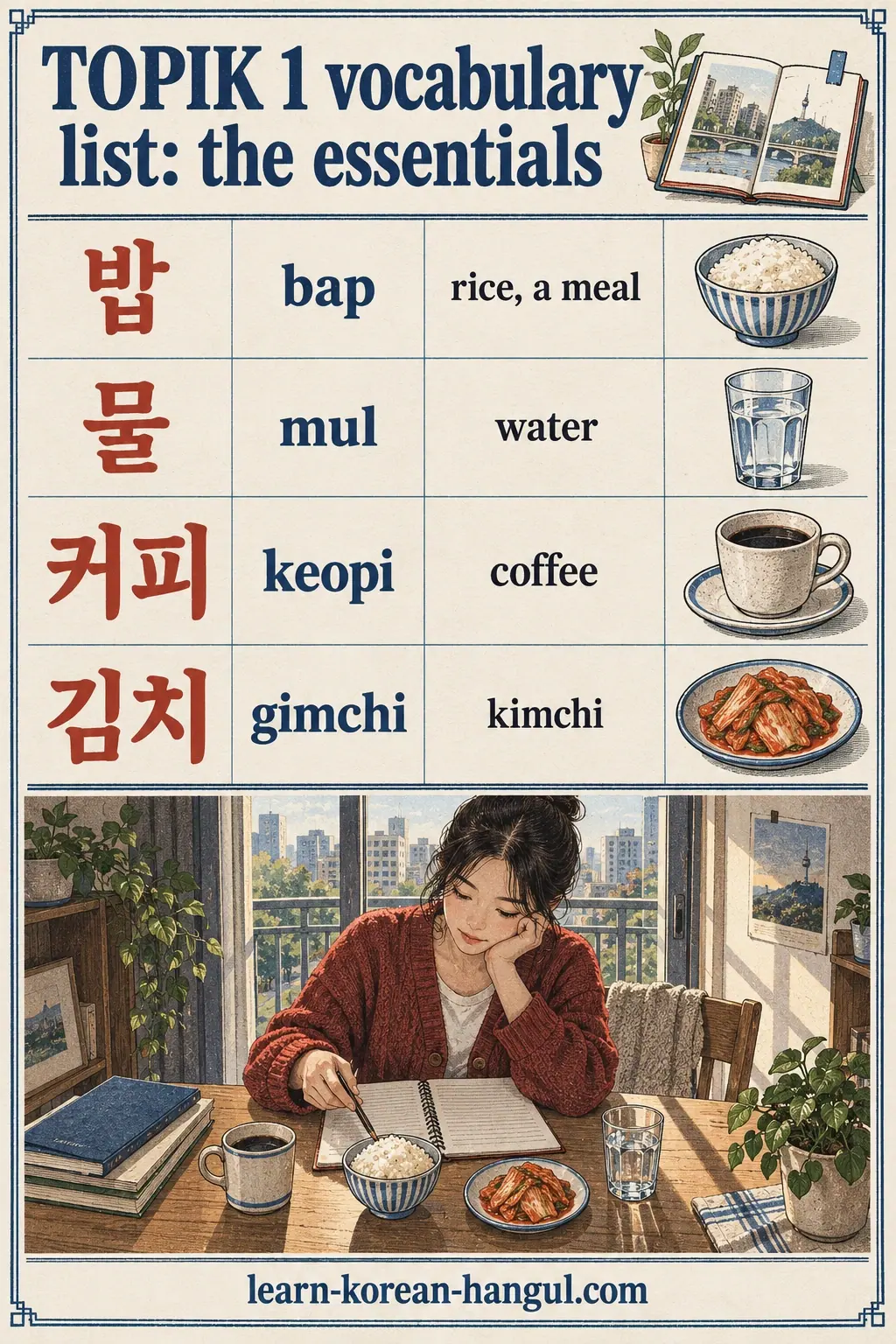
Key facts
- TOPIK I has no official word list; this list is editorial, built from beginner courses and past-paper topics.
TOPIK 1 Vocabulary List: the Essentials
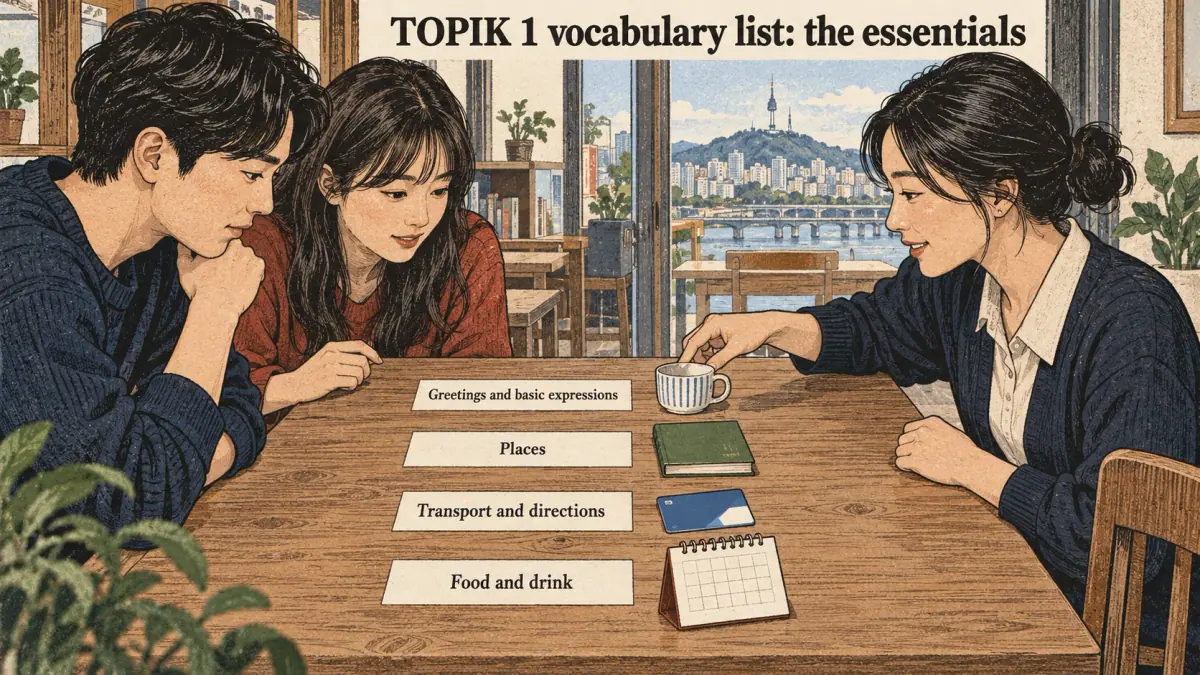
The TOPIK 1 vocabulary list on this page covers the topics that TOPIK I listening and reading draw on: personal life, everyday places and simple transactions. The 12 groups below run from everyday life and people to the most transactional topics (shopping, money).
| Group | Topic | Typical TOPIK I situation |
|---|---|---|
| 1 | Greetings and basic expressions | Choosing the natural reply in a short exchange |
| 2 | Daily routine | Matching a schedule to a description |
| 3 | Hobbies and free time | Understanding weekend plans |
| 4 | Weather and seasons | Reading a short forecast or a postcard |
| 5 | Body and health | Understanding a visit to a doctor or pharmacy |
| 6 | Family and people | Reading a self-introduction |
| 7 | Places | Saying where a conversation happens |
| 8 | Transport and directions | Following a route or a station announcement |
| 9 | Numbers and counting | Catching prices, quantities and phone numbers |
| 10 | Time and dates | Catching days, times and schedules |
| 11 | Food and drink | Ordering, menus and recipes |
| 12 | Shopping and money | Prices, sizes and paying |
Romanization in the tables follows Revised Romanization and is only a learning aid. Where a word is said differently from its spelling, the pronunciation appears in [brackets], following the 국립국어원 standard pronunciation rules.
Which Topic Groups Are Covered?
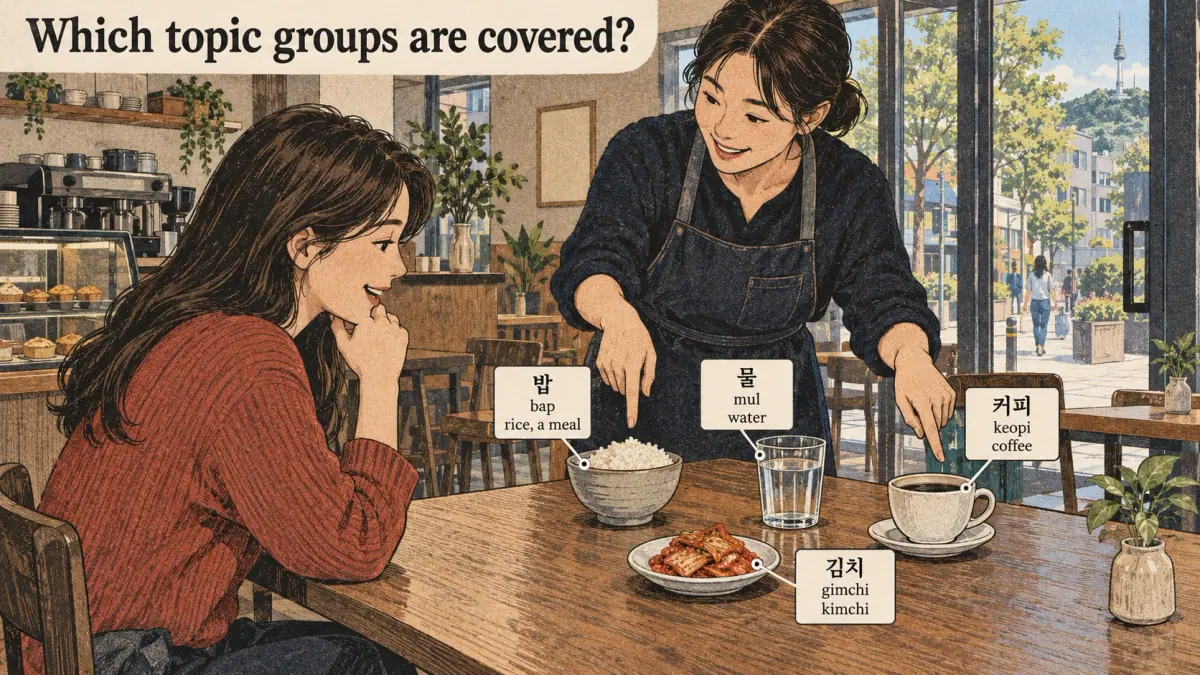
The 12 topic groups fall into four clusters: everyday life, people and places, getting around, and time, numbers, food and money. Each group below has the same structure: a table of eight anchor words, then one example sentence that uses at least two of them.
Everyday Life
Group 1: greetings and basic expressions. These words open almost every TOPIK I dialogue.
| Korean | Romanization | Meaning |
|---|---|---|
| 안녕하세요 | annyeonghaseyo | hello |
| 감사합니다 [감사함니다] | gamsahamnida | thank you |
| 죄송합니다 [죄송함니다] | joesonghamnida | I'm sorry |
| 네 | ne | yes |
| 아니요 | aniyo | no |
| 이름 | ireum | name |
| 나라 | nara | country |
| 사람 | saram | person |
안녕하세요? 제 이름은 민수예요.
annyeonghaseyo? je ireumeun minsuyeyo.
Hello. My name is Minsu.
Group 2: daily routine. Routine verbs carry the schedule questions in both sections.
| Korean | Romanization | Meaning |
|---|---|---|
| 일어나다 [이러나다] | ireonada | to get up |
| 자다 | jada | to sleep |
| 씻다 [씯따] | ssitda | to wash |
| 일하다 | ilhada | to work |
| 공부하다 | gongbuhada | to study |
| 운동하다 | undonghada | to exercise |
| 청소하다 | cheongsohada | to clean |
| 쉬다 | swida | to rest |
저는 아침 일곱 시에 일어나요.
jeoneun achim ilgop sie ireonayo.
I get up at seven in the morning.
Group 3: hobbies and free time. Hobby words appear in weekend-plan dialogues and short personal texts.
| Korean | Romanization | Meaning |
|---|---|---|
| 취미 | chwimi | hobby |
| 영화 | yeonghwa | film |
| 음악 [으막] | eumak | music |
| 노래 | norae | song |
| 여행 | yeohaeng | travel, trip |
| 사진 | sajin | photo |
| 책 | chaek | book |
| 축구 [축꾸] | chukgu | football |
주말에 친구하고 영화를 봐요.
jumare chinguhago yeonghwareul bwayo.
I watch films with a friend at the weekend.
Group 4: weather and seasons. Weather adjectives are a common source of picture-matching items.
| Korean | Romanization | Meaning |
|---|---|---|
| 날씨 | nalssi | weather |
| 봄 | bom | spring |
| 여름 | yeoreum | summer |
| 가을 | gaeul | autumn |
| 겨울 | gyeoul | winter |
| 비 | bi | rain |
| 눈 | nun | snow (also "eye") |
| 덥다 [덥따] | deopda | to be hot |
오늘은 날씨가 좋아요.
oneureun nalssiga joayo.
The weather is nice today.
Group 5: body and health. 눈 appears again here as "eye", a useful reminder that context decides meaning.
| Korean | Romanization | Meaning |
|---|---|---|
| 머리 | meori | head |
| 눈 | nun | eye |
| 배 | bae | stomach |
| 다리 | dari | leg |
| 아프다 | apeuda | to hurt, to be ill |
| 감기 | gamgi | a cold |
| 약 | yak | medicine |
| 약국 [약꾹] | yakguk | pharmacy |
머리가 아파요.
meoriga apayo.
I have a headache. (literally: my head hurts)
People and Places
Group 6: family and people. Family words matter for self-introduction texts.
| Korean | Romanization | Meaning |
|---|---|---|
| 가족 | gajok | family |
| 아버지 | abeoji | father |
| 어머니 | eomeoni | mother |
| 형 | hyeong | older brother (said by a male) |
| 언니 | eonni | older sister (said by a female) |
| 동생 | dongsaeng | younger sibling |
| 친구 | chingu | friend |
| 선생님 | seonsaengnim | teacher |
우리 가족은 네 명이에요.
uri gajogeun ne myeongieyo.
There are four people in my family.
Group 7: places. The early listening questions often ask where a conversation happens, so place nouns are high value.
| Korean | Romanization | Meaning |
|---|---|---|
| 학교 [학꾜] | hakgyo | school |
| 회사 | hoesa | company, office |
| 집 | jip | home, house |
| 병원 | byeongwon | hospital, clinic |
| 은행 | eunhaeng | bank |
| 우체국 | ucheguk | post office |
| 도서관 | doseogwan | library |
| 식당 [식땅] | sikdang | restaurant |
은행이 우체국 옆에 있어요.
eunhaengi ucheguk yeope isseoyo.
The bank is next to the post office.
Getting Around
Group 8: transport and directions. These words carry the route and announcement items.
| Korean | Romanization | Meaning |
|---|---|---|
| 버스 | beoseu | bus |
| 지하철 | jihacheol | subway |
| 택시 | taeksi | taxi |
| 역 | yeok | station |
| 표 | pyo | ticket |
| 왼쪽 | oenjjok | left |
| 오른쪽 | oreunjjok | right |
| 타다 | tada | to ride, to take (transport) |
지하철을 타고 학교에 가요.
jihacheoreul tago hakgyoe gayo.
I take the subway to school.
Time, Numbers, Food and Money
Group 9: numbers and counting. Korean has two number systems: native Korean numbers (하나, 둘, 셋) for counting things and hours, and Sino-Korean numbers (일, 이, 삼) for prices, dates and minutes. A counter is a word placed after a number to show what is counted, such as 개 for things and 명 for people.
| Korean | Romanization | Meaning |
|---|---|---|
| 하나 | hana | one (native) |
| 둘 | dul | two (native) |
| 셋 [섿] | set | three (native) |
| 일 | il | one (Sino-Korean) |
| 십 | sip | ten (Sino-Korean) |
| 백 | baek | hundred |
| 개 | gae | counter for things |
| 명 | myeong | counter for people |
사과 세 개 주세요.
sagwa se gae juseyo.
Three apples, please. (셋 shortens to 세 before a counter)
Group 10: time and dates.
| Korean | Romanization | Meaning |
|---|---|---|
| 시간 | sigan | time, hour |
| 오늘 | oneul | today |
| 어제 | eoje | yesterday |
| 내일 | naeil | tomorrow |
| 아침 | achim | morning, breakfast |
| 주말 | jumal | weekend |
| 월요일 [워료일] | woryoil | Monday |
| 생일 | saengil | birthday |
내일은 토요일이에요.
naeireun toyoirieyo.
Tomorrow is Saturday.
Group 11: food and drink.
| Korean | Romanization | Meaning |
|---|---|---|
| 밥 | bap | rice, a meal |
| 물 | mul | water |
| 커피 | keopi | coffee |
| 김치 | gimchi | kimchi |
| 고기 | gogi | meat |
| 과일 | gwail | fruit |
| 먹다 [먹따] | meokda | to eat |
| 맛있다 [마싣따] | masitda | to be tasty |
김치찌개가 맛있어요.
gimchijjigaega masisseoyo.
The kimchi stew is tasty.
Group 12: shopping and money.
| Korean | Romanization | Meaning |
|---|---|---|
| 돈 | don | money |
| 가게 | gage | shop |
| 시장 | sijang | market |
| 옷 [옫] | ot | clothes |
| 얼마 | eolma | how much |
| 사다 | sada | to buy |
| 비싸다 | bissada | to be expensive |
| 싸다 | ssada | to be cheap |
이 옷은 얼마예요?
i oseun eolmayeyo?
How much are these clothes?
The 96 anchor words above are the starting core of each topic, not the whole of TOPIK I. Review them with the TOPIK 1 vocabulary flashcards, which use spaced repetition.
Practice · 12
- 01안녕하세요? 제 이름은 민수예요.
Show answer
annyeonghaseyo? je ireumeun minsuyeyo.
Hello. My name is Minsu.
- 02저는 아침 일곱 시에 일어나요.
Show answer
jeoneun achim ilgop sie ireonayo.
I get up at seven in the morning.
- 03주말에 친구하고 영화를 봐요.
Show answer
jumare chinguhago yeonghwareul bwayo.
I watch films with a friend at the weekend.
- 04오늘은 날씨가 좋아요.
Show answer
oneureun nalssiga joayo.
The weather is nice today.
- 05머리가 아파요.
Show answer
meoriga apayo.
I have a headache. (literally: my head hurts)
- 06우리 가족은 네 명이에요.
Show answer
uri gajogeun ne myeongieyo.
There are four people in my family.
- 07은행이 우체국 옆에 있어요.
Show answer
eunhaengi ucheguk yeope isseoyo.
The bank is next to the post office.
- 08지하철을 타고 학교에 가요.
Show answer
jihacheoreul tago hakgyoe gayo.
I take the subway to school.
- 09사과 세 개 주세요.
Show answer
sagwa se gae juseyo.
Three apples, please. (셋 shortens to 세 before a counter)
- 10내일은 토요일이에요.
Show answer
naeireun toyoirieyo.
Tomorrow is Saturday.
- 11김치찌개가 맛있어요.
Show answer
gimchijjigaega masisseoyo.
The kimchi stew is tasty.
- 12이 옷은 얼마예요?
Show answer
i oseun eolmayeyo?
How much are these clothes?
Knowing which groups exist is the first half; the order you study them in decides how much you remember.
How Should You Study the TOPIK 1 Word List?

Study the TOPIK 1 word list one topic at a time, with audio first and spelling second, and review earlier groups every few days. A five-step routine works for most learners:
- Listen before you read. Play the example sentence and try to catch the anchor words by ear. TOPIK I listening is half the score, so the sound of a word matters as much as its spelling.
- Learn one group per session. Eight words with one sentence is a realistic target for a 20-minute session.
- Say the words in a sentence. Make one new sentence for three of the words, such as 도서관에서 공부해요 (I study at the library).
- Review with spaced repetition. Return to the group after one day, three days and one week, using the deck.
- Check with real questions. After four groups, read a past-paper text and mark every word you know.
The common mistake is to learn only nouns. TOPIK I questions turn on verbs and adjectives such as 아프다, 비싸다 and 타다, so give them equal time. The TOPIK 1 grammar list shows the endings these verbs need.
How Many Words Do You Need for TOPIK 1?

You need roughly 800 words for TOPIK level 1 and about 1,500-2,000 words for TOPIK level 2. These are estimates commonly cited by teachers and textbooks; topik.go.kr publishes the level descriptions but no list that defines which words count. The numbers describe recognition in context, not a vocabulary test.
| Target | Words often cited | What it means in practice |
|---|---|---|
| This page | 96 anchor words in 12 groups | The core of each everyday topic |
| TOPIK level 1 | about 800 | Short exchanges about yourself and daily life |
| TOPIK level 2 | about 1,500-2,000 | Public places, plans and short paragraphs |
The honest limitation: a word count cannot predict a score. A learner who knows 1,500 words but has never practised listening may still score below 140. The page on how many words for TOPIK compares the counts for all six levels and explains where they come from.
Where to Go Next
For a wider set beyond the exam topics, the TOPIK vocabulary hub routes to word lists for every level, and the 500 Korean words list gives a frequency-based core. All TOPIK decks are collected under TOPIK flashcards, and the TOPIK I guide links every page for the beginner test. Once this TOPIK 1 vocabulary list feels familiar, continue with the grammar that holds the words together.
Frequently Asked Questions

Is There an Official TOPIK Vocabulary List?
No official TOPIK word list is published for candidates. Lists online, including this one, are editorial: they are built from beginner course books and the topics that appear in past papers. Use any list as a study tool, and use past papers from the official TOPIK website to check what real questions look like.
Should I Memorise the List in Order?
No. Learn one topic group at a time and mix in review of earlier groups. Words learned together with a situation, such as a post office or a bus stop, are easier to recall in a listening item. Learning a long list from top to bottom tends to leave the end of the list weak.
Which Words Are Most Common?
The most useful words for TOPIK I are everyday verbs and adjectives such as 가다, 오다, 먹다, 좋다 and 많다, time words such as 오늘 and 내일, and place nouns such as 학교 and 병원. They appear in almost every listening dialogue and reading text, so learn them before less frequent nouns.
Do I Need to Know How to Spell Every Word?
For TOPIK I you mainly need to recognise words in listening and reading, because the test has no writing section. Spelling still helps, because it fixes the word in memory and prepares you for TOPIK II writing. A quick self-check is to write each new word once from its audio.
Can I Print the TOPIK 1 Vocabulary List?
Yes. This page prints from your browser with every table and example sentence, and the TOPIK 1 vocabulary flashcards page has a print view of its cards. Print one topic group at a time and test yourself by covering the meaning column, then check the audio online for anything you cannot pronounce.