Key facts
- This list has 32 core patterns in 5 groups: particles, endings and tenses, negation and questions, wanting and ability, and connectors.
TOPIK 1 Grammar List: the Essentials

The TOPIK 1 grammar list is built around one idea: TOPIK I tests grammar through comprehension. You never name a grammar rule on the test. Instead, a gap-fill reading item or a listening reply only makes sense if you know what a particle or ending does.
| Group | Patterns | What the group lets you do | Main lesson hub |
|---|---|---|---|
| 1. Particles | 10 | Mark who does what, where and when | Korean particles |
| 2. Endings and tenses | 6 | Speak politely about past, present and future | Korean tenses |
| 3. Negation and questions | 5 | Say no, cannot, don't, and suggest | Korean negation |
| 4. Wanting, ability and requests | 5 | Ask for things, say what you want or can do | want to grammar |
| 5. Basic connectors | 6 | Join two clauses with and, but, so, if, when | Korean connectors |
Particles come first because every Korean sentence in listening and reading depends on them. A particle is a short word attached to the end of a noun that shows the noun's role, such as subject, object or place.
How Are the TOPIK 1 Grammar Patterns Grouped?
The patterns are grouped by function, not by alphabet, so each group answers one kind of communication need. Each group below uses the same table: the pattern, its job in plain English, one example, and the lesson link.
Particles: 이/가, 은/는, 을/를, 에, 에서 and More
| Pattern | Job | Example | Lesson |
|---|---|---|---|
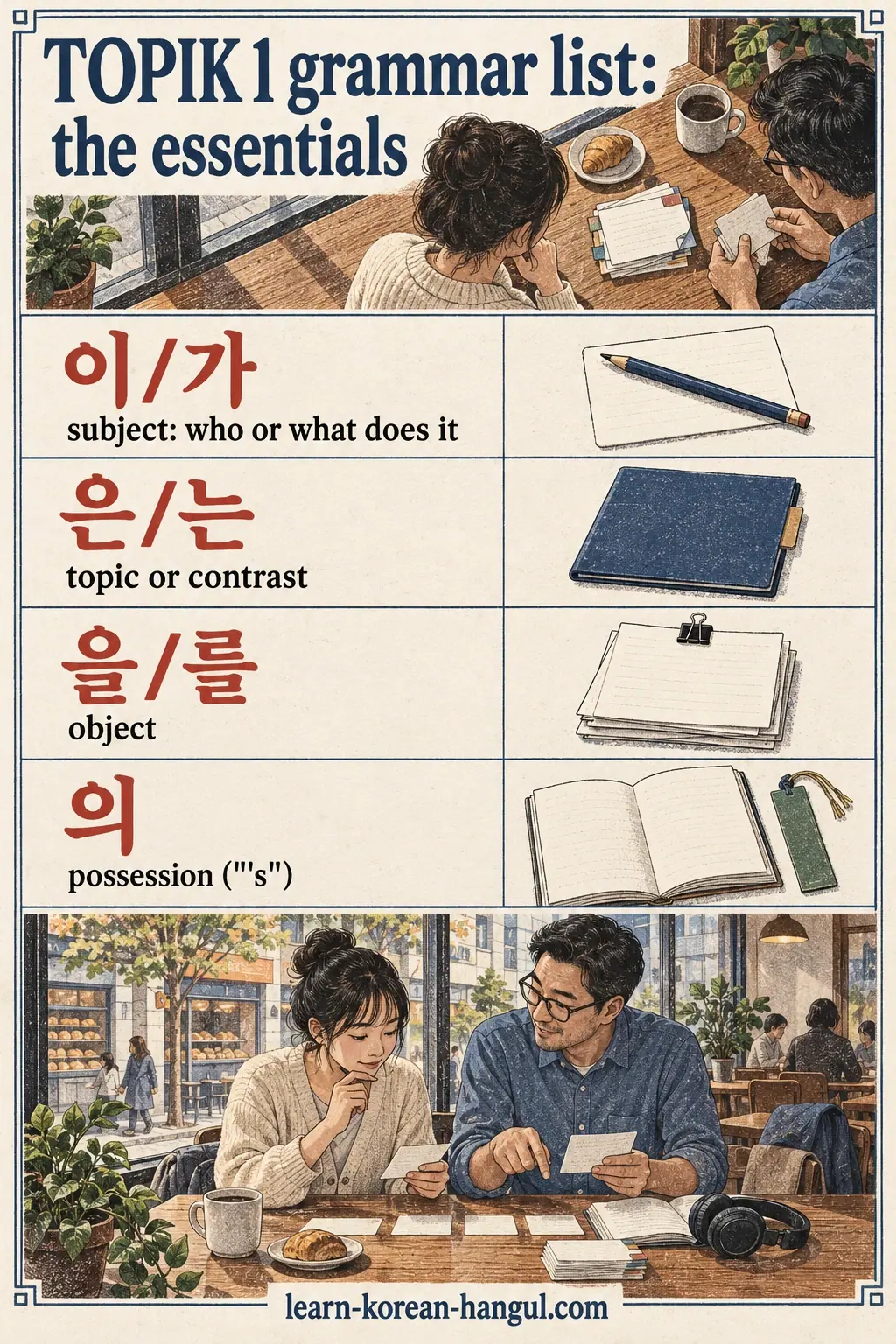
| 이/가 | subject: who or what does it | 비가 와요. (It is raining.) | 이/가 |
| 은/는 | topic or contrast | 저는 학생이에요. (I am a student.) | 은/는 |
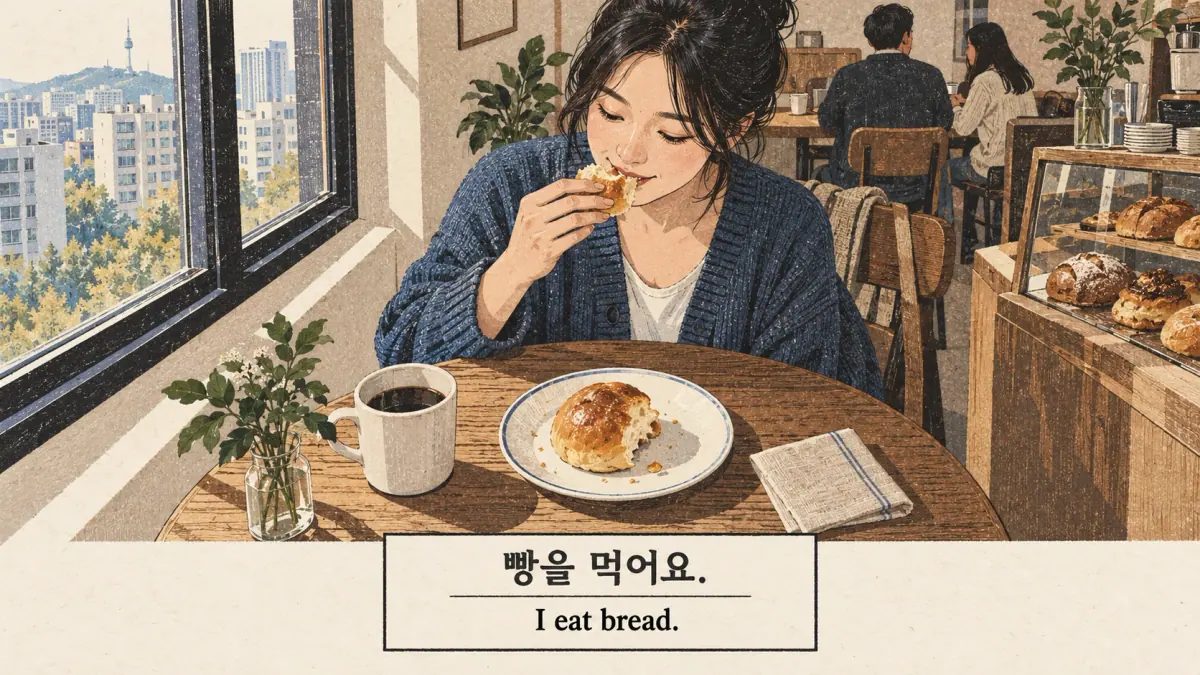
| 을/를 | object | 빵을 먹어요. (I eat bread.) | 을/를 |
| 에 | destination, location of existence, time | 세 시에 학교에 가요. (I go to school at three.) | location particles |
| 에서 | place where an action happens; "from" | 식당에서 일해요. (I work at a restaurant.) | 에서 |
| 의 | possession ("'s") | 친구의 가방 (a friend's bag) | 의 |
| 도 | also, too | 동생도 학생이에요. (My sibling is a student too.) | 도 |
| 와/과, 하고 | and, with | 친구하고 영화를 봐요. (I watch a film with a friend.) | 와/과 |
| 에게, 한테 | to a person | 엄마한테 전화해요. (I call Mum.) | 에게/한테 |
| 부터, 까지 | from, until | 아홉 시부터 다섯 시까지 (from nine to five) | 부터/까지 |
저는 학생이에요. 동생도 학생이에요.
jeoneun haksaengieyo. dongsaengdo haksaengieyo.
I am a student. My younger sibling is a student too.
The two particle pairs beginners confuse most are 은/는 vs 이/가 and 에 vs 에서. A quick test for the first pair: in answer to "Who is Minsu?", Korean uses 가 for the new information.
제가 민수예요.
jega minsuyeyo.
I am Minsu. (answering "Which one of you is Minsu?")
저는 민수예요.
jeoneun minsuyeyo.
I am Minsu. (introducing yourself)
The full explanation is in 은/는 vs 이/가. Particles mark the nouns; endings then finish the sentence.
Endings and Tenses: -아/어요, -(스)ㅂ니다, -았/었-, -(으)ㄹ 거예요
| Pattern | Job | Example | Lesson |
|---|---|---|---|
| -아/어요 | polite present (everyday speech) | 학교에 가요. (I go to school.) | polite style |
| -(스)ㅂ니다 | formal present (announcements, news, instructions) | 감사합니다. (Thank you.) | formal style |
| -았/었- | past | 어제 영화를 봤어요. (I saw a film yesterday.) | past tense |
| -(으)ㄹ 거예요 | future, plan, guess | 내일 갈 거예요. (I will go tomorrow.) | future tense |
| -고 있다 | action in progress | 지금 공부하고 있어요. (I am studying now.) | -고 있다 |
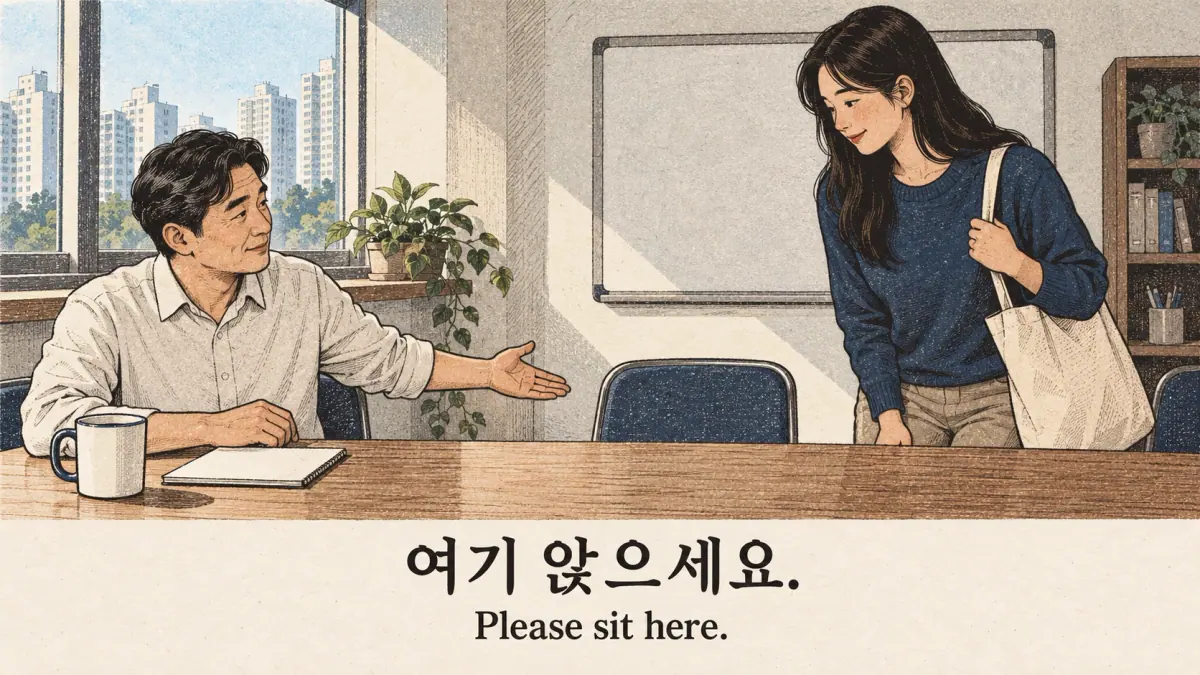
| -(으)세요 | polite request; honorific | 여기 앉으세요. (Please sit here.) | -(으)세요 |
어제 도서관에서 책을 읽었어요.
eoje doseogwaneseo chaegeul ilgeosseoyo.
I read a book at the library yesterday.
-(스)ㅂ니다 matters for recognition: every TOPIK I instruction is formal, for example 알맞은 것을 고르십시오 (choose the right answer). With tense in place, the next group turns sentences negative or into questions.
Negation and Questions: 안, -지 않다, 못, -(으)ㄹ까요?
| Pattern | Job | Example | Lesson |
|---|---|---|---|
| 안 + verb | do not (short form) | 커피를 안 마셔요. (I don't drink coffee.) | 안 |
| -지 않다 | do not (long form, more formal) | 춥지 않아요. (It is not cold.) | -지 않다 |
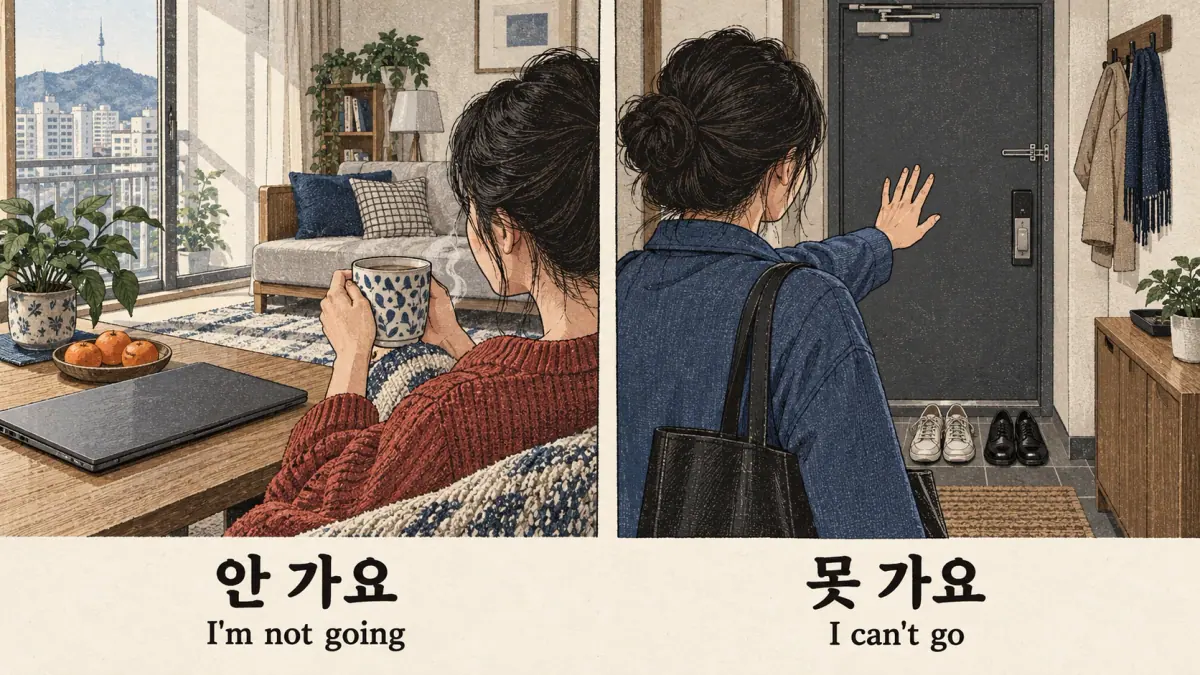
| 못 + verb | cannot | 오늘은 못 가요. (I can't go today.) | 못 |
| -지 마세요 | please don't | 여기에서 사진을 찍지 마세요. (Please don't take photos here.) | -지 마세요 |
| -(으)ㄹ까요? | shall we? / do you think? | 같이 갈까요? (Shall we go together?) | -(으)ㄹ까요? |
오늘은 학교에 안 가요.
oneureun hakgyoe an gayo.
I'm not going to school today.
안 and 못 are a classic listening trap: 안 가요 means "I'm not going" by choice, while 못 가요 means "I can't go". One syllable changes the answer.
Wanting, Ability and Requests: -고 싶다, -(으)ㄹ 수 있다, -아/어 주세요
| Pattern | Job | Example | Lesson |
|---|---|---|---|
| -고 싶다 | want to | 한국에 가고 싶어요. (I want to go to Korea.) | -고 싶다 |
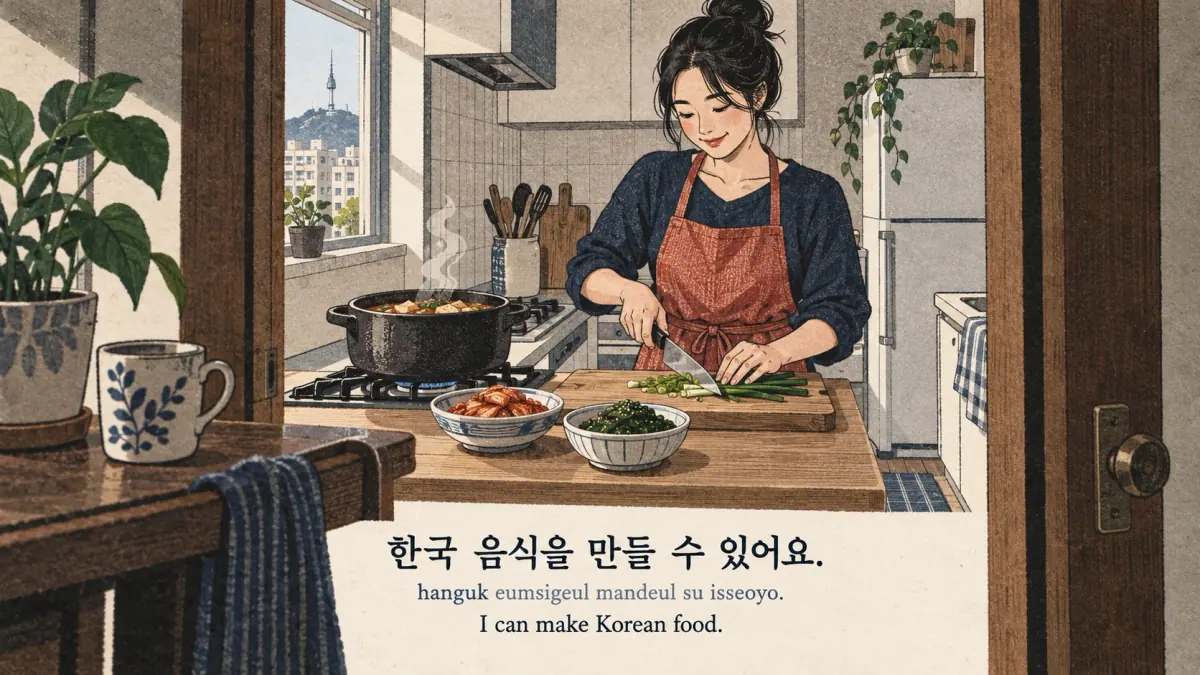
| -(으)ㄹ 수 있다/없다 | can / cannot | 한국 음식을 만들 수 있어요. (I can make Korean food.) | -(으)ㄹ 수 있다 |
| -아/어 주세요 | please do (for me) | 천천히 말해 주세요. (Please speak slowly.) | -아/어 주세요 |
| -아/어야 하다 | have to | 일찍 일어나야 해요. (I have to get up early.) | -아/어야 하다 |
| -(으)러 가다/오다 | go/come in order to | 밥을 먹으러 가요. (I'm going to eat.) | -(으)러 |
한국 음식을 만들 수 있어요.
hanguk eumsigeul mandeul su isseoyo.
I can make Korean food.
Basic Connectors: -고, -지만, -아/어서, -(으)니까, -(으)면
| Pattern | Job | Example | Lesson |
|---|---|---|---|
| -고 | and (listing, sequence) | 밥을 먹고 공부해요. (I eat and then study.) | -고 |
| -지만 | but | 비싸지만 맛있어요. (It's expensive but tasty.) | -지만 |
| -아/어서 | because; and then | 비가 와서 집에 있었어요. (It rained, so I stayed home.) | -아/어서 |
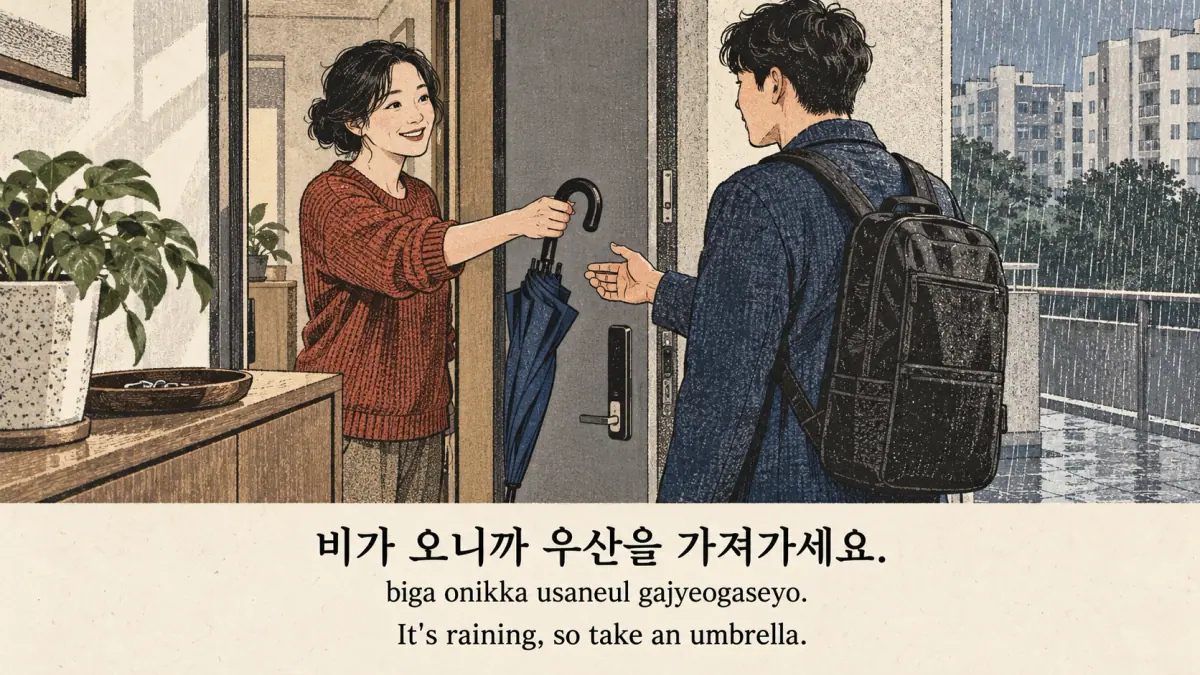
| -(으)니까 | because (also before commands) | 비가 오니까 우산을 가져가세요. (It's raining, so take an umbrella.) | -(으)니까 |
| -(으)면 | if, when | 시간이 있으면 같이 가요. (If you have time, let's go.) | -(으)면 |
| -(으)ㄹ 때 | when, at the time of | 어릴 때 부산에 살았어요. (I lived in Busan as a child.) | -(으)ㄹ 때 |
The key contrast here is -아/어서 vs -(으)니까. Both give a reason, but only -(으)니까 can come before a suggestion or command.
비가 와서 집에 있었어요.
biga waseo jibe isseosseoyo.
It rained, so I stayed at home.
비가 오니까 우산을 가져가세요.
biga onikka usaneul gajyeogaseyo.
It's raining, so take an umbrella.
The full comparison is on -아/어서 vs -(으)니까. With all five groups mapped, the remaining question is the order to learn them in.
In What Order Should You Study the TOPIK 1 Grammar?
Study the patterns in the order of the groups, but start using connectors before you finish every ending. A practical order for most beginners is:
- Particles 이/가, 은/는, 을/를, 에, 에서 with the polite present -아/어요. These let you read most early TOPIK I items.
- Past tense -았/었- and negation 안/못. Listening dialogues often turn on what happened or did not happen.
- -고 싶다, -(으)ㄹ 수 있다, -아/어 주세요. These cover shop, restaurant and request dialogues.
- Connectors -고 and -지만, then -아/어서 and -(으)면.
- Future -(으)ㄹ 거예요, -고 있다, -(으)ㄹ까요? and the remaining particles.
- -(으)니까, -(으)ㄹ 때, -아/어야 하다, -(으)러 and recognition of -(스)ㅂ니다.
Steps 1-3 roughly match Level 1, and steps 4-6 complete Level 2. Pair each step with the matching topic in the TOPIK 1 vocabulary list, so the new pattern has words to work with.
What This List Does Not Cover
This TOPIK 1 grammar list is deliberately short. It leaves out patterns that beginner courses teach but that rarely decide a TOPIK I answer, such as some honorific verb forms and the plain written style. For the complete set, with a lesson for each pattern, see beginner Korean grammar. The intermediate patterns for TOPIK II are collected under TOPIK grammar.
Frequently Asked Questions
How Many Grammar Points Are on TOPIK 1?
No official number exists, because TOPIK publishes no grammar syllabus for candidates. Beginner course books differ widely in how many patterns they count, partly because they split forms differently. This list picks 32 core patterns that carry most TOPIK I sentences; learn them first, then add the extra patterns your course book teaches.
Do I Need to Know -(으)니까 for Level 1?
Not for Level 1, but you will meet it on the same test. -(으)니까 usually appears in late beginner courses, so it matters for Level 2. Learn to recognise it first: it gives a reason and, unlike -아/어서, it can come before a suggestion or a command, as in 비가 오니까 우산을 가져가세요.
Which Particles Are Most Tested?
The particles most worth mastering are 은/는 versus 이/가, 을/를, and 에 versus 에서, because they appear in nearly every sentence and are easy to swap by mistake. Gap-fill reading items often hinge on one of them. 도, 의 and 하고 or 와/과 are simpler and usually cause fewer errors.
Is Formal Speech Tested on TOPIK 1?
Yes, for recognition. TOPIK I instructions use the formal style, as in 고르십시오 (choose), and notices and announcements in the reading and listening sections often use -(스)ㅂ니다. You do not have to produce formal speech, because TOPIK I has no writing or speaking, but you must understand it.
Is This the Same as a Beginner Grammar Course?
Close, but narrower. A beginner course teaches every pattern you need to speak and write. This list keeps the patterns that matter most for reading and listening on TOPIK I. For the full beginner set with a lesson for each pattern, use the beginner Korean grammar page alongside this list.