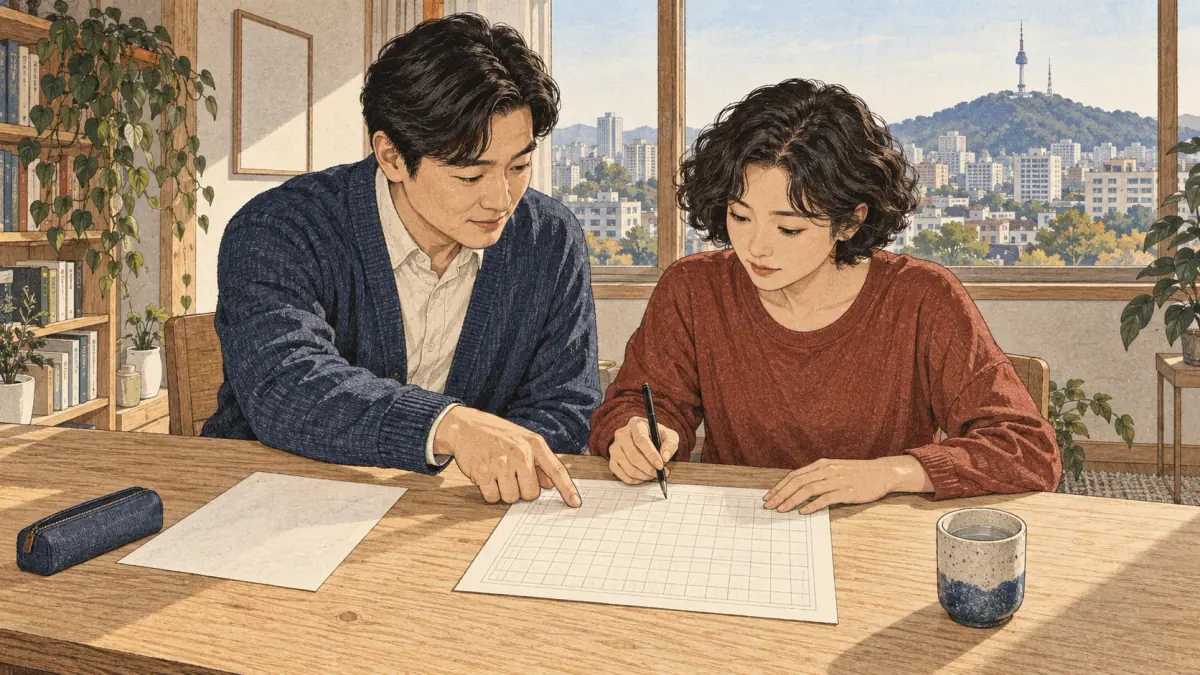
What you'll learn
- Place syllables, spaces and paragraph indents correctly on a manuscript grid.
- Write numbers, English letters and punctuation in the right squares.
- Count the length of a question 53 or 54 answer the way the grid shows it.
- Know what changes when you type your answers on the computer-based TOPIK IBT.
Before you start: you should read Hangul fluently and know basic word spacing. Time: about 20 minutes, plus 10 minutes for the practice set. The level is B1, an editorial estimate for learners preparing for TOPIK II.
What Are the TOPIK Writing Rules?
The TOPIK writing rules are the conventions of Korean manuscript paper plus the length and content instructions printed with each question. The manuscript conventions are the ones Korean schools teach as 원고지 사용법 (wongoji sayongbeop, "how to use manuscript paper"); TOPIK does not invent its own. The test adds three instructions of its own:
- Length. Question 53 asks for 200 to 300 characters and question 54 for 600 to 700.
- No title in question 53. The instruction for the data-description task tells you not to write a title.
- No copying in question 54. The essay instruction tells you not to copy the prompt text as it is.
Questions 51 and 52 are different: you write one sentence for each blank, ㉠ and ㉡, on answer lines, not on the grid, so the square rules do not apply to them. The current answer-sheet layout and instructions are published on topik.go.kr, the official TOPIK site; check a recent sample sheet before you practise. The square rules start with the simplest case, a single sentence.
How Do Squares and Spacing Work?
Squares and spacing work on a simple principle: every syllable block takes one square, and every space between words takes one empty square. A syllable block is one Hangul character such as 한 or 국, however many letters it contains.
The grid below shows a ten-square practice strip. Real answer sheets have longer rows, but the rules are the same. An empty cell is an empty square.
Sentence: 나는 2026년 3월에 처음 한국에 왔다. 모든 것이 낯설었다. ("I came to Korea for the first time in March 2026. Everything was unfamiliar.")
| 1 | 2 | 3 | 4 | 5 | 6 | 7 | 8 | 9 | 10 |
|---|---|---|---|---|---|---|---|---|---|
| 나 | 는 | 20 | 26 | 년 | 3 | 월 | |||
| 에 | 처 | 음 | 한 | 국 | 에 | 왔 | |||
| 다 | . | 모 | 든 | 것 | 이 | 낯 | 설 | ||
| 었 | 다 | . |
Read the grid row by row and five rules appear:
- Paragraph indent. The first square of a paragraph stays empty (row 1, square 1). This is called 들여쓰기 (deullyeosseugi, "indenting").
- One syllable per square. 나, 는, 처 and 음 each fill one square.
- One square per space. The space between 나는 and 2026년 is an empty square (row 1, square 4).
- No extra space after a period. The period after 왔다 takes its own square, and the next sentence, 모든, starts in the very next square.
- Two digits per square. 2026 fills two squares, 20 and 26, while the single digit 3 takes one.
What Happens at the End of a Line?
At the end of a line, a word space that would fall in the first square of the next line is dropped: the next line starts with a syllable in its first square, not with an empty square. Some teachers add a small ∨ mark at the end of the full line to show the space; the rater still reads the words as separate. The only empty first square on a line should be a paragraph indent.
Word Spaces and Particles
Word spaces go where Korean spacing rules (띄어쓰기, ttuieosseugi) put them: after each word together with its particles, so 한국에 is one unit and 한국 에 is wrong. Bound nouns such as 것 and 수 are spaced from the word before them: 할 수 있다, not 할수있다. A missing space is visible on the grid as two syllables in neighbouring squares, so spacing errors are easy for a rater to see. The full rules are on Korean spacing rules, and the most common trap is covered on particle spacing. Spacing settled, the next squares to master are numbers and punctuation.
How Do You Write Numbers and Punctuation?
Numbers and punctuation each have a fixed place on the grid: Arabic digits go two to a square, punctuation marks take a square of their own, and question and exclamation marks are followed by an empty square. The table summarises the conventions taught in Korean schools.
| Item | Rule | Grid example |
|---|---|---|
| Arabic digits | two digits per square | 2026 → [20][26]; 10 → [10]; 3 → [3] |
| Capital letters | one letter per square | TOPIK → [T][O][P][I][K] |
| Lower-case letters | two letters per square | app → [ap][p] |
| Period . and comma , | one square, written low in the left of it; no empty square after | 왔다. → [왔][다][.] |
| Question mark ? and exclamation mark ! | one square, centred; leave the next square empty | 그럴까? 이유는 → [그][럴][까][?][ ][이][유][는] |
| Opening quotation mark " | one square of its own | "좋다" → ["][좋][다]["] |
| Closing quotation mark after a period | the period and the closing mark may share a square | 했다." → [했][다][."] |
| Punctuation that would start a new line | write it in the last square with the final syllable, or just outside the grid | [다.] in the last square |
| Percent sign % | one square | 10% → [10][%] |
Two TOPIK habits save squares and mistakes. First, write numbers in figures with Korean units, as in 12만 명 ("120,000 people"), rather than spelling them out as 십이만 명 or writing 120,000 with a comma. Second, avoid English words in the essay unless the prompt uses them; a Korean word is almost always available and is easier to place on the grid.
Numbers and Punctuation in a Question 53 Answer
In a question 53 answer, punctuation is mostly periods and commas, plus a few % signs and numbers from the chart. A sentence such as 2016년 3만 명에서 2026년 12만 명으로 늘었다 ("rose from 30,000 in 2016 to 120,000 in 2026") uses digit pairs for the years and the counts: [20][16][년], [3][만] and [12][만]. Data answers are dense with numbers, so they use fewer squares than their typed length suggests. That difference matters as soon as you start counting length.
How Is Length Counted?
Length is counted in squares: on the paper test, the length of your answer is the number of squares it fills, including empty squares for spaces and squares used by punctuation. Recent answer sheets print running counts along the edge of the grid, so you can see when you pass the 200 or 600 mark without counting by hand.
Worked Example: Counting a Sentence
Take the sentence from the grid above and count it two ways.
| Count | Result | Why |
|---|---|---|
| Typed characters, with spaces | 35 | every character and every space counts once |
| Squares on the grid | 33 | the indent adds 1; 2026 saves 2; the space after the period is not written |
The two numbers are close but not identical. Over a 650-character essay, the difference is usually small, a few squares for numbers and the indent of each paragraph. Practise on a real grid at least a few times, so you learn how full the sheet looks at 600 and at 700.
Answers outside the Length Range
An answer outside the range is not marked as invalid, but it usually scores lower. An essay well below 600 characters cannot complete the task, which reduces the content mark, and a much shorter one is weak on every criterion. The question 54 grid ends at about 700 squares, so going far over is physically limited. The exact deductions are not published for candidates; aim for the middle of each range, about 250 for question 53 and about 650 for question 54. Those habits belong to the paper grid. The computer test changes some of them.
What Changes in the IBT?
On the computer-based TOPIK IBT, you type your answers in Korean, so the grid rules for squares, digits and punctuation positions no longer apply. Spacing, punctuation choice, style and length still do.
| Rule | Paper test (PBT) | Computer test (IBT) |
|---|---|---|
| Where you write | manuscript grid, by hand | text box on screen, typed |
| Paragraph indent | leave the first square empty | start a new line; follow the on-screen guidance |
| Word spacing | one empty square | one space with the space bar |
| Digits and letters | two digits or lower-case letters per square | typed normally |
| Punctuation position | fixed place in the square | typed normally, no space before . or ? |
| Length check | count marks along the grid | a character counter if the screen shows one, otherwise your own sense of length |
| Corrections | follow the correction method in the test-day instructions | delete and retype |
Typing removes the slow corrections of paper, but it also removes the visual length guide. If you choose the IBT, practise typing a 650-character answer on the standard 2-beolsik keyboard layout until you can do it with time left. The full comparison of the two formats is on TOPIK IBT vs PBT. Whichever format you take, the same errors keep costing marks.
Mistakes That Lose Marks
These five errors are the ones raters see most on manuscript paper, and each is easy to fix in a five-minute check.
- No paragraph indent. Without an empty first square, a new paragraph looks like a continued line. Fix: indent every paragraph, including the first.
- Particles spaced from their word. 한국 에 or 학생 이다. Fix: keep particles and 이다 attached to the word before them.
- Bound nouns joined. 할수있다 or 먹을것. Fix: space 수 and 것 from the word before.
- A space square after every period. Leaving an empty square after . or , wastes space and looks careless. Fix: empty squares follow only ? and !.
- A title in question 53. The instruction says not to write one. Fix: start the answer with the content, in an indented first line.
Corrections on paper should follow the method announced in the test-day instructions, so check the current candidate guidance on topik.go.kr rather than relying on habits from school. The safest correction is the one you never need, which is why a three-minute outline before writing pays off.
Common Misconceptions about the Manuscript Grid
Learners often assume the grid count ignores spaces; actually spaces fill squares, because each empty square between words is part of the written text. Learners also assume that more punctuation makes an answer look more advanced; actually extra commas and exclamation marks only use squares, and essays rarely need ! at all. Finally, many think a perfect grid layout raises the score on its own; the layout only removes reasons to lose marks, while content, structure and language earn them, as the TOPIK 54 essay page explains.
Practice: Grid Rules
Try the four exercises, then check the answers below.
- How many squares does 나는 2026년에 한국에 왔다. take, without a paragraph indent?
- Correct the spacing and punctuation of this line: 정말 좋았다 ! 다음에도 가고 싶다.
- How many squares do TOPIK and app take?
- Your question 54 answer ends at the 580 mark. What should you do?
Answers. (1) 15 squares: 나, 는, a space, 20, 26, 년, 에, a space, 한, 국, 에, a space, 왔, 다, and the period. (2) 정말 좋았다! 다음에도 가고 싶다. The exclamation mark follows 다 directly and is then followed by one empty square. (3) TOPIK takes 5 squares, one per capital; app takes 2, [ap][p]. (4) Add one more sentence of 30 to 60 characters to the conclusion, such as a prediction with -(으)ㄹ 것이다, so the answer passes 600.
Practice · 5
How many squares does the number 2026 take on the grid?
Show answer
2
Arabic digits go two to a square: [20][26].
What follows a question mark on the grid?
Show answer
one empty square
Leave one empty square after ? and !, but not after . or ,.
Which spacing is correct?
Show answer
한국에 갔다
Particles attach to their word; bound nouns such as 수 are spaced: 할 수 있다.
Where do you write the answers to questions 51 and 52?
Show answer
on answer lines for each blank
Questions 51 and 52 use answer lines for blanks ㉠ and ㉡; the grid is for 53 and 54.
Which instruction belongs to question 53?
Show answer
do not write a title
Question 53 asks you not to write a title; 600 characters is the question 54 minimum.
What to Learn Next
This lesson covered the grid, not the language you write in it. The written plain style that every grid answer needs is explained on TOPIK writing style. Apply both on TOPIK question 53, the 200-300 character data description, and then on the TOPIK 54 essay. For the whole section, return to the TOPIK writing hub. This page does not cover handwriting style or the rules of Korean punctuation outside the exam; for general punctuation, see Korean punctuation.
About this page. Last updated 2026-10-09. The grid conventions on this page are the manuscript-paper rules taught in Korean schools; TOPIK's own instructions and answer-sheet layout are published on topik.go.kr and can change between years. The Korean was drafted with AI assistance; a Korean reviewer checks every lesson before it is marked as reviewed.
Frequently Asked Questions
Do Spaces Count in the TOPIK Writing Length?
On the paper test they do in practice, because every space between words fills an empty square on the grid and the length is read from the squares used. Punctuation squares count too. When you practise on a computer, use a counter that includes spaces, so your sense of length matches the sheet.
Can I Write Numbers as Korean Words Instead of Digits?
You can, but digits are usually better on the grid. Two digits share one square, so 2026년 takes three squares while 이천이십육 년 takes six plus a space. Mixed forms with Korean units, such as 12만 명, are the most compact and the most natural in data descriptions for question 53.
Should I Use Exclamation Marks in a TOPIK Essay?
Rarely, if ever. An essay argues calmly, so periods and the occasional question mark are enough, and each exclamation mark also uses two squares: its own and the empty square after it. A rhetorical question with ? can open a body paragraph; one per essay is plenty.
Do I Need to Practise on Manuscript Paper If I Take the IBT?
No. On the TOPIK IBT you type your answers, so squares, digit pairs and punctuation positions do not apply. Spend the time on typing speed and on judging length without a grid instead: practise typing 650-character answers and use any counter the test screen shows. Spacing, style and length rules still apply.
Can I Write a Title in Question 53?
No. The question 53 instruction tells you not to write a title, so start straight away with the content of your answer, indenting the first line. A title would also use squares that add nothing to the content. Question 54 does not ask for a title either, so begin the essay with your introduction.